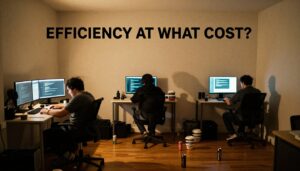
The job posting promised cutting-edge AI work and a chance to shape the future. The reality was 60-hour weeks, a product that existed only in pitch decks, and KPIs that required bending the laws of physics. Three months later, the termination email arrived with all the ceremony of a spam filter catching a newsletter. No exit interview. No final paycheck for some ex-colleagues. Just a Slack deactivation and a non-disclosure agreement attached like a digital tombstone.
This isn’t a cautionary tale from the dot-com bubble. This is what happens when you join an AI startup in 2025.
The Gold Rush Mentality Meets Human Capital
The research paints a stark picture. A first-hand account from an early-stage AI startup employee describes joining “HydroX AI” with genuine enthusiasm, only to discover a company operating with no real onboarding, no clear product vision, and expectations that would make a management consultant blush. The assignment? Drive thousands of signups for a product that wasn’t fully defined or built. The work week? Regularly stretching 55-60 hours. The support? “Verbal encouragement” that never materialized into structure or sustainable expectations.
What’s particularly revealing is how unexceptional this story has become. The employee’s experience mirrors patterns identified across the AI startup ecosystem, where the race to capture market share has turned human beings into disposable compute resources.

The data backs this up. According to a recent survey of 500 hiring managers, 22% of business leaders reported that AI adoption directly contributed to employee burnout. Yet here’s the paradox: 26% of those same leaders believed AI reduced their own burnout. That disconnect, leaders feeling relief while their teams drown, reveals the fundamental misalignment at the heart of many AI startups.
When Founders Break, Everyone Gets the Shrapnel
The cascade effect of founder stress might be the most underreported crisis in tech. Research from Startup Snapshot shows that while only 10% of founders openly share emotional challenges with their teams, 57% of employees regularly notice signs of founder stress through tone, energy, and facial expressions. It’s the startup equivalent of radioactive fallout, invisible but pervasive.
The numbers are damning. Teams led by highly stressed founders report:
– 16% lower work wellbeing
– 14% higher burnout rates
– 16% lower psychological safety
This creates a toxic feedback loop. Founders, under pressure from VCs to demonstrate “hockey stick growth”, offload that stress onto teams. Teams, operating in environments where they can’t admit struggle, burn out quietly. The product suffers. The metrics slip. The founders get more stressed. Rinse and repeat until the Series B funding runs out or the FTC starts asking questions.
What’s worse is the transparency gap. Only 18% of employees say their founders are fully transparent about company challenges, yet transparency directly correlates with a 19% increase in work wellbeing and 26% lower turnover intention. In other words, the secrecy that feels like survival to founders is actually hemorrhaging talent.
The Cognitive Debt Trap
Here’s where AI itself becomes part of the problem. Tools like Copilot and OpenAI’s APIs promise to supercharge productivity, but they also supercharge expectations. Junior developers now feel pressure to ship at senior velocity because autocomplete has gotten smarter. The result? A phenomenon researchers call “cognitive debt”, the slow erosion of actual skill while confidence paradoxically increases.
A report from the Work AI Institute warns that generative AI creates an “illusion of expertise” where workers mistake easy access to solutions for genuine understanding. When you can generate a functional microservice in minutes, you skip the messy, inefficient process of wrestling with the problem. That wrestling? That’s where real learning happens. As one expert put it: “You don’t become experienced by generating code, you become experienced by understanding why the generated code is wrong.”
The math is brutal. AI adoption contributes to burnout for nearly a quarter of workers, yet companies increasingly measure success by AI usage metrics. Some organizations even stack-rank employees based on how many times they click an AI tool, tying performance reviews to shallow engagement rather than deep understanding. It’s like judging a pilot by how many times they press the autopilot button.
The Human Cost Behind the Hype
Let’s talk numbers that don’t make it into pitch decks. 80% of startup employees say the work has harmed their mental health, despite only 10% anticipating that outcome when they joined. Burnout affects 50% of employees directly, with 52% reporting anxiety, rates that exceed even those reported by founders themselves.
The HydroX AI story gets darker. After the abrupt termination, the employee discovered that previous ex-colleagues hadn’t been paid at all. This isn’t just unethical, it’s part of a pattern. The rush to build AI companies has resurrected the “fake it ’til you make it” mentality, but with a twist: some of these companies aren’t trying to make it at all. They’re building thin wrappers around existing APIs, pumping up user numbers, and hoping for a quick acquisition before anyone notices there’s no there there.
Industry veterans see the parallels. The current AI boom echoes the dot-com era’s worst excesses, where companies with no business model beyond “get acquired” burned through human capital like kindling. The difference is the scale, AI startups are raising billions, not millions, and the tools they build can amplify both productivity and pathology.
Red Flags That Actually Matter
If you’re considering joining an AI startup, the usual advice about “cultural fit” is worthless. Here’s what to actually ask:
- 1. “What, specifically, have you built?”
Not “what’s your vision” or “what’s your roadmap.” What exists right now that you can touch and test? If the answer is a slick demo and a waitlist, you’re looking at vaporware with a burn rate. - 2. “How do you measure success for this role?”
The HydroX AI employee was given KPIs that were “disconnected from reality.” If the metrics sound like they were generated by a random KPI generator, they probably were. Sustainable goals have context, history, and contingency plans. - 3. “Can I talk to former employees?”
If a company balks at this, they’re hiding something. Period. The best companies maintain alumni networks, the worst have a trail of NDAs and unpaid invoices. - 4. “How does leadership handle bad news?”
Ask for a specific example. The research is clear: transparent leadership predicts team wellbeing. If they can’t describe a time they shared difficult information, they’re either lying or delusional. - 5. “What’s your AI policy for internal work?”
Companies measuring success by AI tool clicks are building cognitive debt, not real expertise. Look for organizations that focus on outcomes, quality, innovation, customer satisfaction, not usage metrics.
The Uncomfortable Truth
The AI startup ecosystem is producing a new kind of burnout. It’s not just about long hours, it’s about moral injury, watching yourself become a cog in a machine that treats human creativity as a commodity to be extracted and discarded. The passion that draws people to AI work becomes the very thing that accelerates their exploitation.

The paradox is that AI itself could help solve this. The same tools creating pressure could be used to automate drudgery, clarify requirements, and reduce cognitive load. But that requires intentional adoption, not the reflexive implementation driving today’s burnout crisis. Companies need to ask not just “Can we build this?” but “Should we?” and “At what human cost?”
For now, the warning stands: the AI gold rush is minting fortunes for some and burnout for most. The employees at HydroX AI learned this the hard way. You don’t have to.
Before you join that AI startup with the billion-dollar valuation and the kombucha on tap, remember: the best engineering challenge is building a sustainable career, not debugging someone else’s get-rich-quick scheme. Your mental health isn’t a bug to be fixed in the next sprint, it’s the operating system everything else runs on.
Treat it accordingly.