
The 75% Solution: Anthropic’s Data Reveals the White-Collar Bloodletting Already in Progress
Anthropic just published the most uncomfortable chart in modern economic history. It shows that computer programmers currently have 75% of their tasks covered by AI, not theoretically, not in some distant future, but right now, measured by actual Claude usage data. Customer service representatives sit at 70%. Data entry keyers at 67%. These aren’t predictions, they’re receipts.
The AI company, ironically founded by safety-obsessed researchers who left OpenAI, has essentially built a real-time job destruction detector. Their report, “Labor Market Impacts of AI”, introduces what they call “observed exposure”: a metric comparing what AI could theoretically do versus what it’s actually being used to do in professional settings. The gap between those two numbers tells us exactly how much blood is still left to spill.
The Blue-Red Chasm
The researchers visualize this as a radar chart where the blue area represents theoretical AI capability and the red area shows observed usage. For computer and math occupations, the blue extends to 94%, meaning AI could theoretically handle nearly every task, but the red only reaches 33%. Office and administrative roles show 90% theoretical capability against 25% actual coverage. Business and finance sits at 85% theoretical, 20% observed.
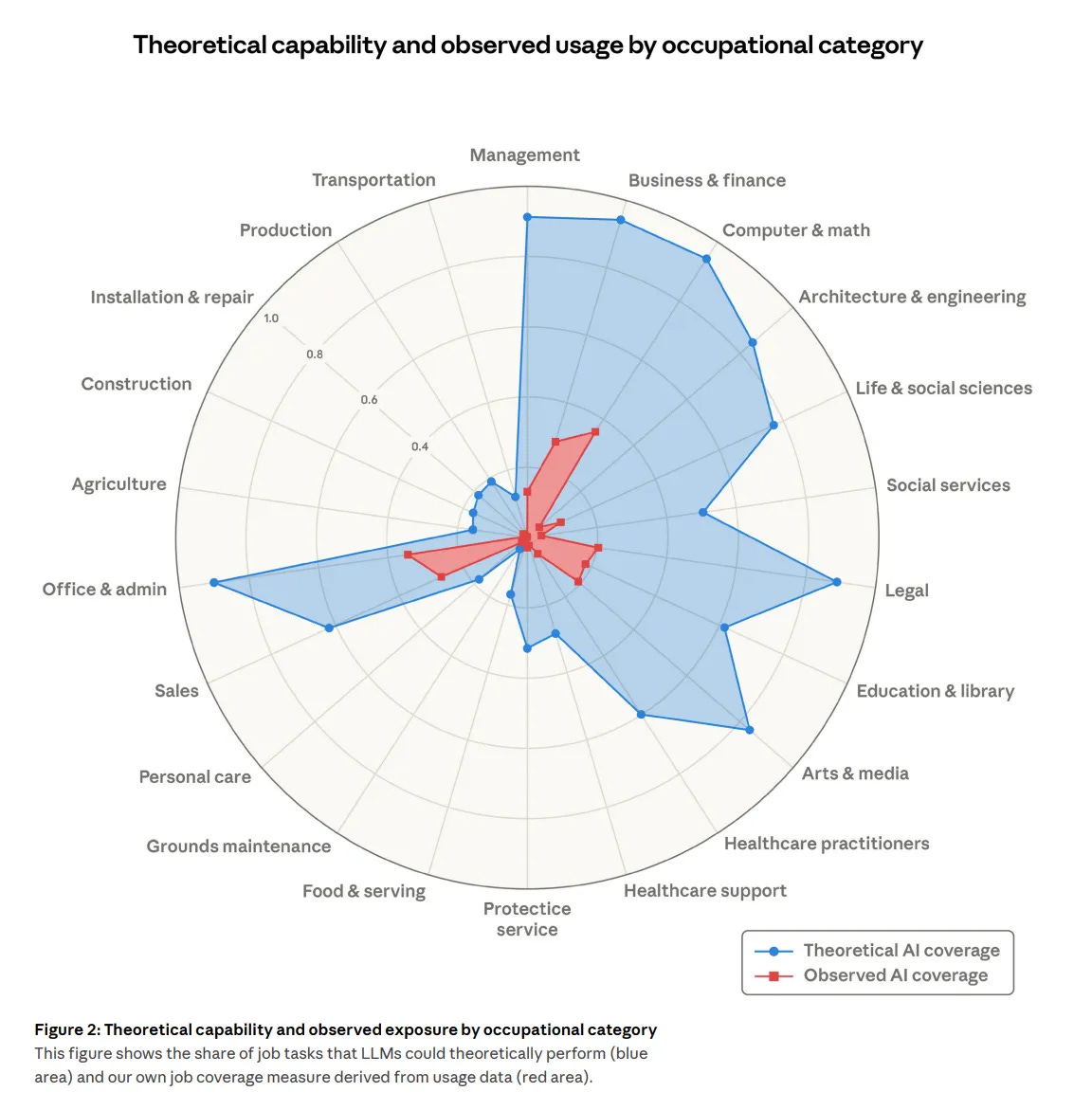
That gap isn’t a safety buffer. It’s a countdown. As Anthropic CEO Dario Amodei has warned, generative AI replacing rather than just assisting roles isn’t a distant possibility, it’s the baseline scenario. The only question is how fast the red swallows the blue.
The Demographic Inversion
Here’s where it gets spicy. The workers most exposed to AI disruption aren’t the stereotypical blue-collar factory workers usually targeted by automation. They’re the elite knowledge workers. Anthropic’s data shows the most exposed group is 16 percentage points more likely to be female, earns 47% more on average, and is nearly four times as likely to hold a graduate degree compared to the least exposed group.
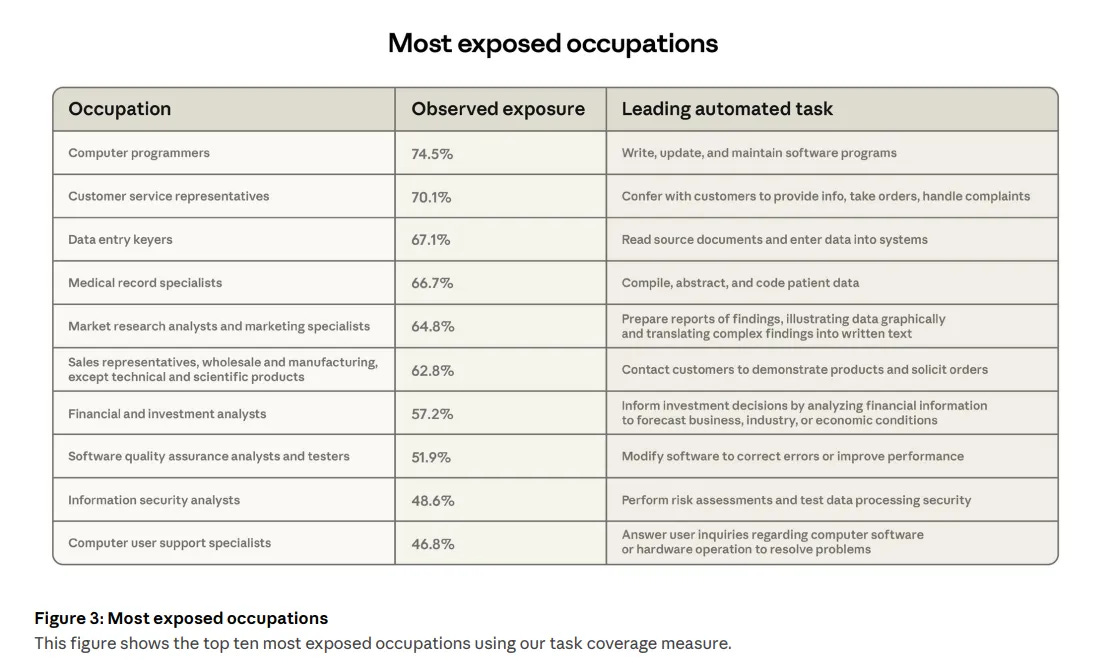
The top ten most exposed occupations read like a who’s-who of respectable professional careers: computer programmers (75%), customer service reps (70%), data entry keyers (67%), financial analysts (60%), technical writers (55%), market research analysts (50%), paralegals (45%), accountants (40%), administrative assistants (38%), and editors (35%). Meanwhile, 30% of the workforce, including cooks, mechanics, bartenders, and dishwashers, have zero AI exposure. The robot uprising is skipping the manual labor and going straight for the college graduates.
The Silent Hiring Freeze
Age Group: 22-25 years old
14%
Drop in job-finding rate since ChatGPT’s release
Demo: Same age group
16%
Fall in employment according to cited study
Trend: Entry-level jobs
Evaporating
Before they can even be posted
If you’re waiting for mass unemployment headlines to validate your anxiety, you’re looking at the wrong metric. Anthropic’s researchers found limited evidence that AI has affected employment to date, but they did find something more insidious: a 14% drop in the job-finding rate for young workers (ages 22-25) in AI-exposed occupations since ChatGPT’s release. Another study cited in the report found a 16% fall in employment among the same demographic.
This aligns with internal reports on AI’s transformative impact on developer work. Companies aren’t necessarily firing their existing staff, they’re simply not hiring new ones. Entry-level white-collar jobs are evaporating before they can even be posted. The “Great Recession for white-collar workers” that the researchers warn about won’t necessarily look like 2008’s mass layoffs, it’ll look like a generation of graduates sending resumes into a void.
The Education Paradox
Narrow Technical Certifications Camp
One camp argues that narrow technical certifications, exactly the kind that feed into those 75% exposed programming roles, are becoming death traps. Better to have a broad liberal arts foundation that teaches you how to think, adapt, and learn new domains quickly. History, literature, philosophy, and writing courses develop the kind of critical thinking that remains valuable when technical stacks evolve faster than semester schedules.
The Counter-Argument
The counter-argument is equally brutal: if you’re paying six figures for a philosophy degree when AI can now pass the bar exam and write legal briefs (even if some lawyers argue the results are “complete jokes”), you’re paying for intellectual luxury while the world burns. The data suggests that corporate assertions minimizing mass unemployment fears are increasingly detached from the reality that AI-native companies like Block have already used AI as justification to cut nearly half their workforce.
The uncomfortable truth might be that neither pure technical specialization nor pure liberal arts generalism offers shelter. The winners might be those who combine technical fluency with the kind of cross-domain thinking that lets them direct AI tools rather than compete with them.
The Ecosystem Collapse
The second-order effects could dwarf the direct job losses. If finance, management, and legal jobs evaporate, the secondary economy that services those workers collapses too. No white-collar workers means no need for downtown office space, commuter trains, business lunch restaurants, or dry cleaners. The long-term economic irrelevance of the average worker isn’t just about individual careers, it’s about the entire consumer economy that depends on their salaries.
Federal Reserve Governor Michael S. Barr has laid out scenarios where AI adoption could trigger exactly this kind of systemic shock. The Anthropic researchers note that a doubling of unemployment in the top quartile of AI-exposed occupations, from 3% to 6%, would be “clearly detectable” and absolutely possible. During the 2007-2009 financial crisis, unemployment doubled from 5% to 10%. We’re talking about a similar magnitude, but concentrated among the highest-paid, most-educated workers in the economy.

The 33% Problem
The most terrifying number in the report isn’t the 75%, it’s the 33%. That’s the current observed coverage for computer and math workers against a 94% theoretical capability. It means two-thirds of the automation potential for white-collar work hasn’t even been deployed yet. We’re seeing the early tremors, not the earthquake.
As one economist noted, the “China shock” of the early 2000s took years to fully manifest in employment data. AI’s impact could follow a similar trajectory, slow at first, then sudden. The difference is that manufacturing offshoring primarily hit specific geographic regions, AI hits every knowledge worker with an internet connection simultaneously.
The researchers are clear: paradoxical work culture shifts despite AI efficiency mean that even those who keep their jobs may find themselves in an increasingly precarious position, working harder to manage AI systems that do the work of their former colleagues.
The Coverage Gap
What to Watch
Watch This Metric
Hiring rate for 22-year-olds
Don’t Watch
Unemployment rate
Monitor Closely
“Observed coverage” metric
Avoid
AI capability announcements
If you’re trying to time your career pivot, don’t watch the unemployment rate, watch the hiring rate for 22-year-olds. Don’t watch the AI capability announcements, watch the “observed coverage” metric. The gap between blue and red is closing every month, and right now, the red is growing fastest in exactly the places that pay the best.
The 75% solution is already here. The question is whether you’re in the 25% that remains, or whether you’ll notice the red area has swallowed your job before it’s too late.