The narrative from Silicon Valley has been consistent and loud: generative AI is the ultimate productivity multiplier, a force that will reshape work, collapse development timelines, and unlock economic growth previously thought impossible.
But the Bank of Korea just threw a bucket of cold data on that bonfire.
In a freshly published report, the central bank of one of the world’s most technologically advanced, and AI-exposed, economies found that for all the hype, AI adoption yields a measly 3.8% reduction in work time. That’s roughly 1.5 hours saved per week per worker. And here’s the killer: the correlation between those saved hours and any actual increase in output is exactly zero.
This isn’t an anecdote from a skeptical blogger. This is a rigorous, data-driven analysis from a national bank in a country that is literally printing money from the AI boom by selling memory chips to NVIDIA and OpenAI. If the productivity payoff is missing in South Korea, where 51.8% of workers already use generative AI for their jobs, what does that say about the rest of the world?
The Adoption Speed of a Rocket, The Productivity of a Rocking Chair
Let’s start with the most visually arresting data point from the report. Generative AI is spreading faster than any technology in history, including the internet.
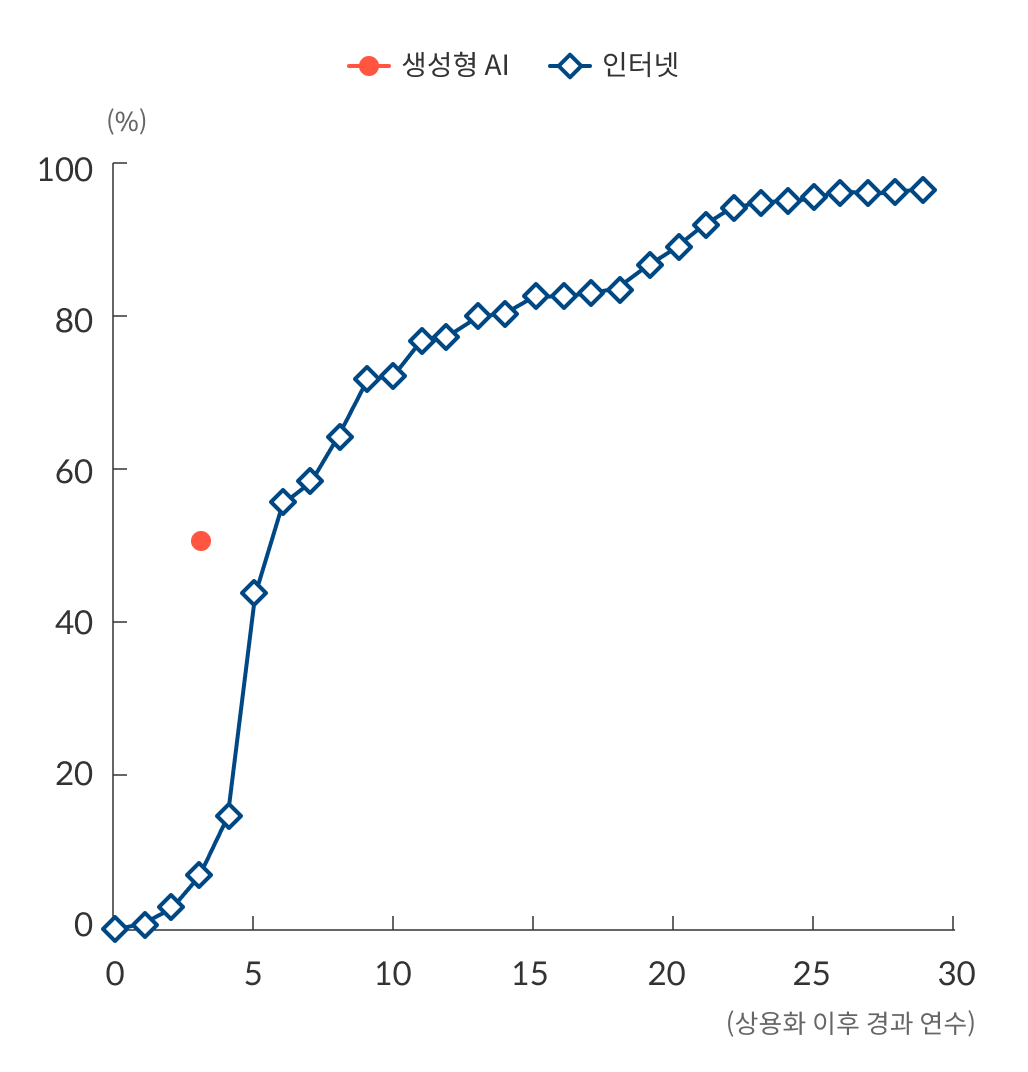
According to the BOK’s official blog post, the adoption rate of generative AI in South Korea is eight times faster than the adoption of the internet in the 1990s. By 2025, more than half of all employed South Koreans were using tools like ChatGPT for work. If speed of adoption were the sole predictor of economic impact, we should be swimming in productivity gains by now.
We are not.
The second chart tells the real story. When you plot the country’s labor productivity (real GDP per hour worked) from 2010 to the end of 2025, the line follows a steady, predictable trend. The introduction of ChatGPT in late 2022? The massive investments in 2023 and 2024? The proliferation of agents and coding assistants in 2025?
The productivity trendline doesn’t care.
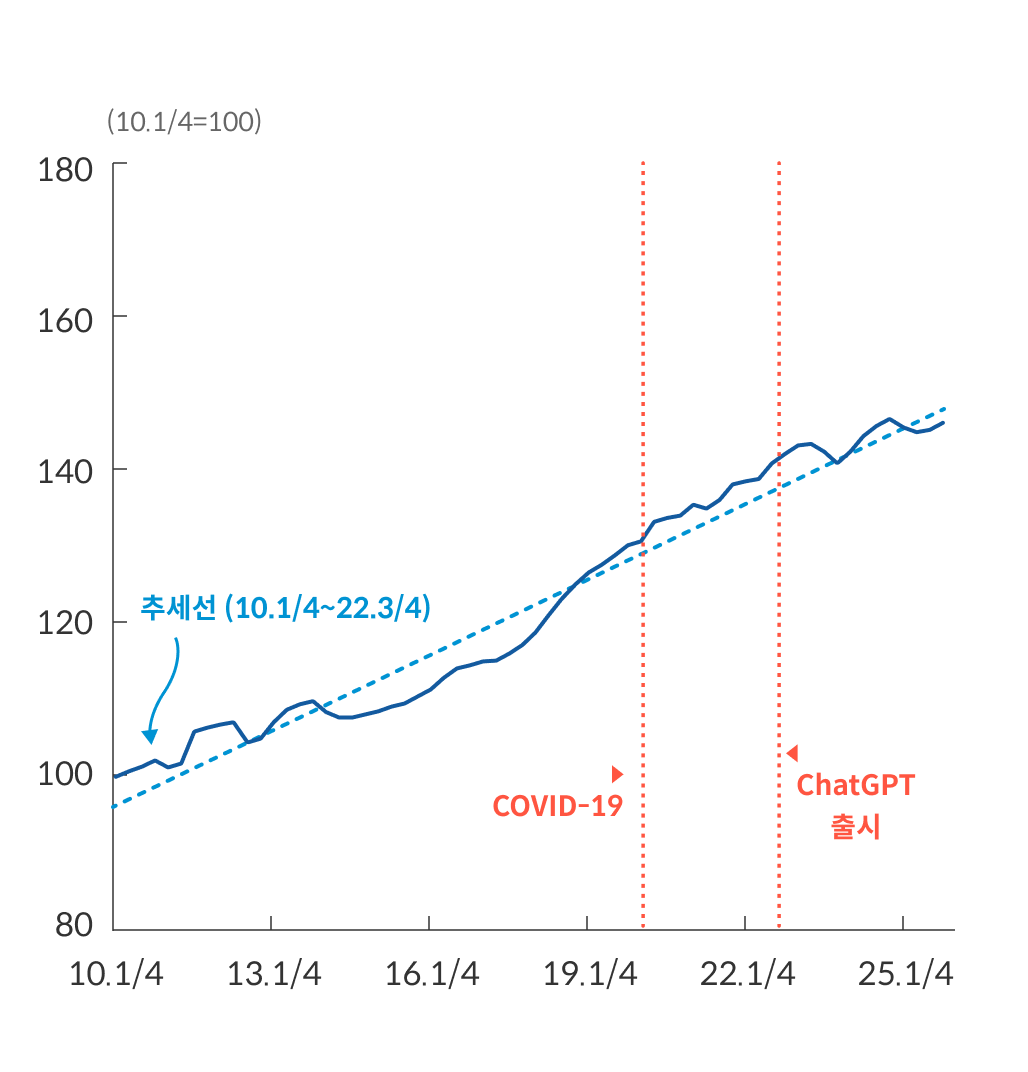
It continues its slow, steady climb at exactly the same slope it had for the previous decade. The deviation from the long-term trend is statistically non-existent. This is the definition of the “productivity paradox” that Nobel laureate Robert Solow famously articulated in 1987: “You can see the computer age everywhere but in the productivity statistics.”
History, it seems, is rhyming.
The “Disconnect”: How Saving Time Fails to Create Output
The BOK’s investigation didn’t stop at macro-level disappointment. They dug into the micro-level mechanics of how individuals use AI. The results, visualized in a dense but incredibly telling distribution chart, show why the macro numbers are so stubborn.
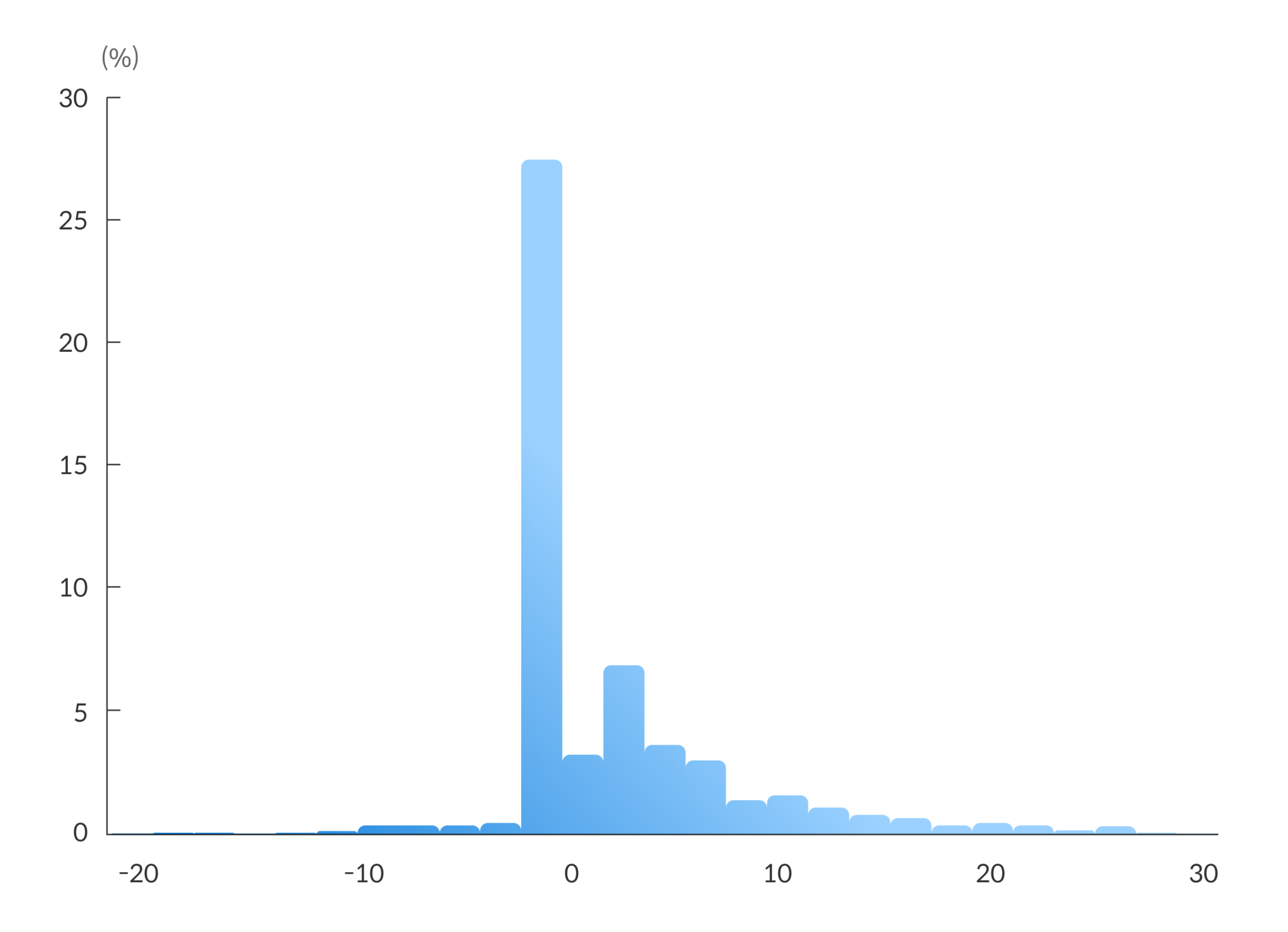
The average worker saves 3.8% of their time. But look at the distribution: a massive cluster of workers hover around 0% savings, meaning AI is a net neutral for a huge portion of the workforce. There’s a positive skew, but the tail is long and thin. The report explicitly notes that only 4.4% of tasks saw time savings exceeding 20%.
Then comes the true “disconnect.”
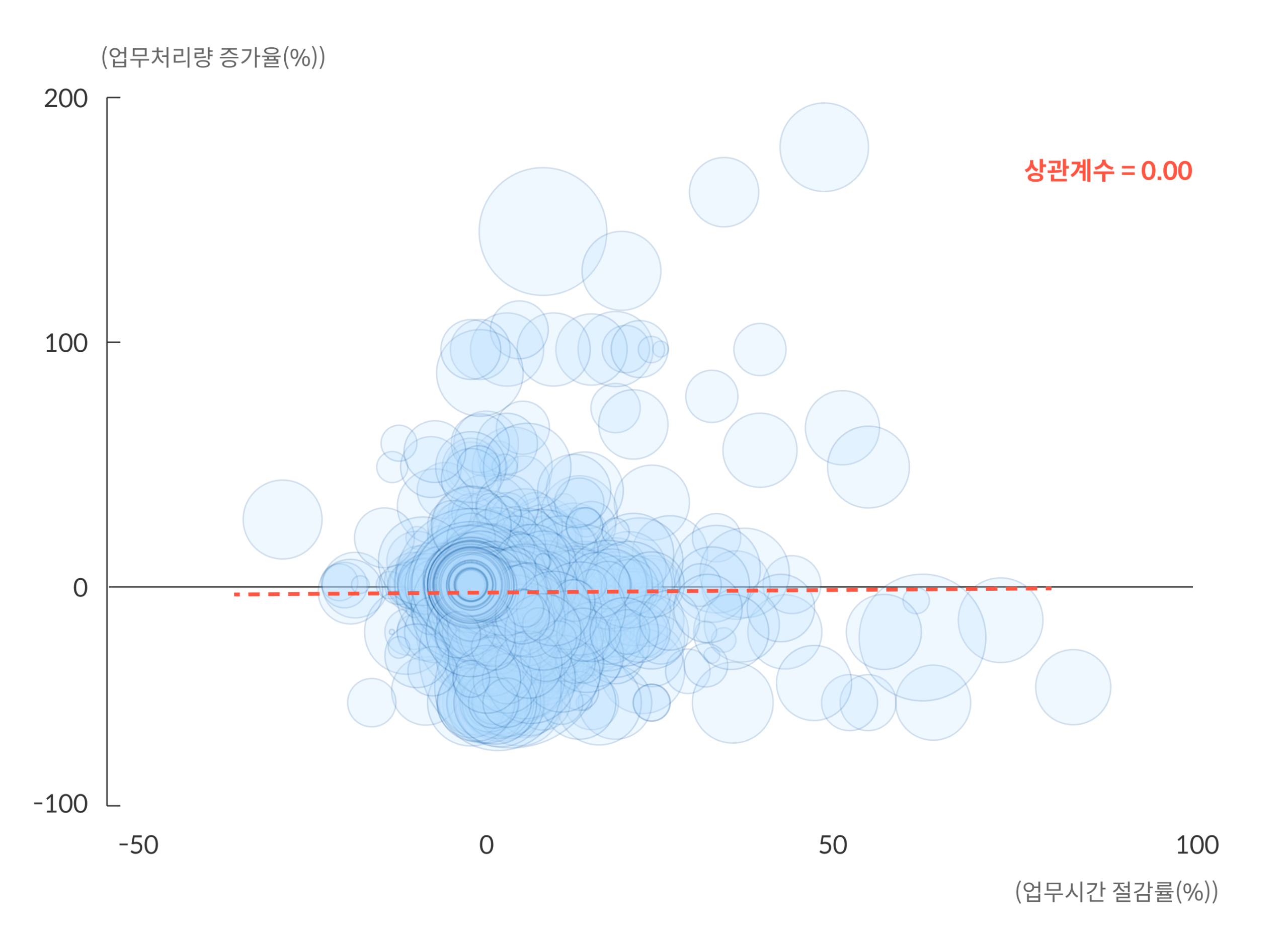
The BOK plotted time savings against increases in work throughput. The resulting scatterplot is the report’s most damning visual. The regression line is perfectly flat. The correlation coefficient is 0.00.
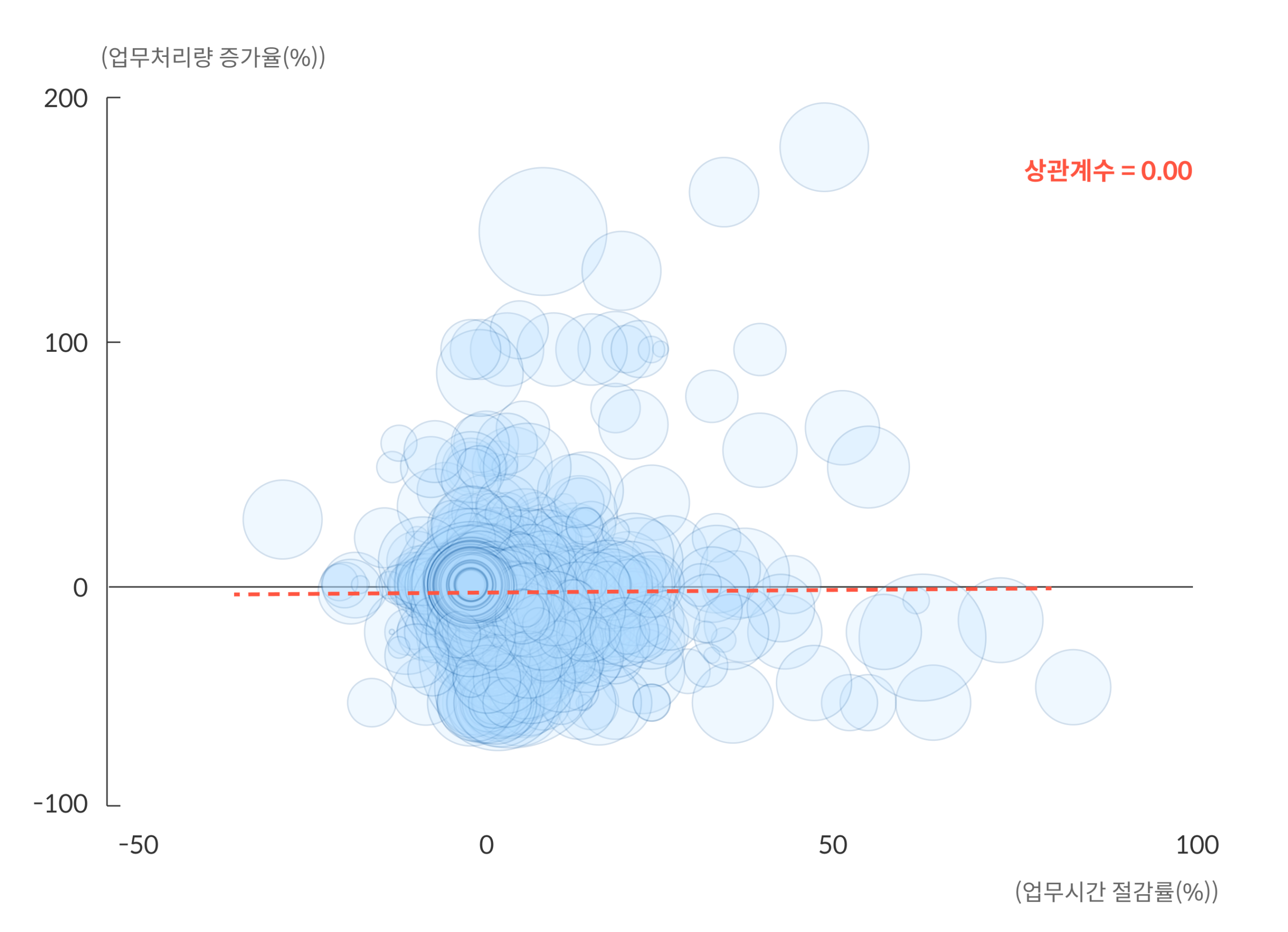
This is the economic equivalent of an EKG flatline. The report’s authors call it the “AI productivity disconnect.” Workers who save two hours a week are not producing more output than workers who save nothing. The time saved appears to vanish into a black hole of organizational friction, busywork expansion, or simply a more relaxed pace.
Why? The BOK’s Four Explanatory Factors
The report provides a sharp, four-factor diagnosis for this disconnect, and it should make every engineering manager and product lead uncomfortable:
- Task-Level Confinement: AI is currently good at specific tasks, not entire workflows. You can summarize a meeting in 10 seconds, but you still have to attend the meeting to get the context. You can generate boilerplate code, but you still need to architect the system. The AI impact is siloed.
- Workflow Rigidity: The report is brutally specific here. Corporate culture, employee behavior, and rigid processes don’t adapt just because you bought a Copilot license. The regression analysis makes this explicit: self-employed workers and professionals (those with high autonomy) show measurable productivity gains. Regular employees in structured hierarchies do not. The saved time is reabsorbed by the organizational molasses.
- Process Bottlenecks: This is the theory of constraints applied to software. Even if you use AI to write code 10x faster, if the code review process takes a week, the bottleneck hasn’t moved. The report explicitly identifies “approval processes” as a common chokepoint that nullifies individual efficiency gains.
- Misaligned Incentives: This is the most uncomfortable one for white-collar knowledge workers. Why would you do more work with your saved hour if you don’t get paid more? The regression analysis shows that workers with high “labor supply elasticity”, those willing to work more for more pay, actually showed negative throughput gains. They took the time back. The only groups that turned time savings into output were those with a direct financial stake in the outcome: self-employed workers and professionals.
Who Actually Wins with AI? The Demographic Breakdown
The BOK ran regression analyses to isolate which groups actually managed to turn AI into measurable output gains. The coefficients tell a story of privilege and incentive.
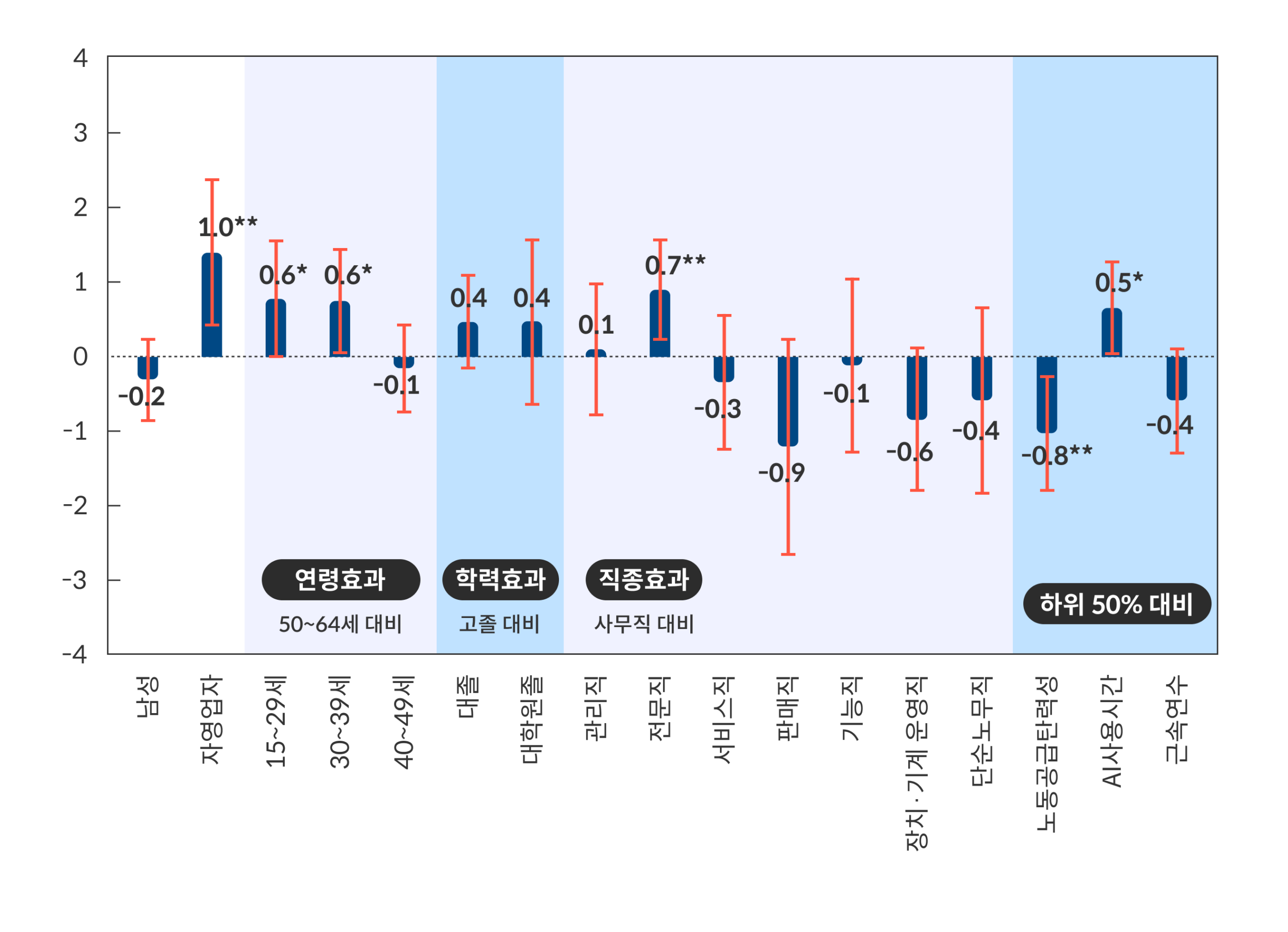
For throughput increases (actual productivity), the statistically significant winners were:
– Self-employed (+1.0 coefficient): Direct profit motive.
– Ages 15-29 (+0.6): Digital natives who integrate tools more fluidly.
– Ages 30-39 (+0.6): Likely mid-career professionals with some autonomy.
– Professionals (+0.7): Doctors, lawyers, consultants, high autonomy, high stakes.
– High AI usage (+0.5): The more you use it, the better you get. Shocking.
– Low labor supply elasticity (-0.8): Workers unwilling to do more work actually showed less throughput.
The losers? Sales workers, service workers, and manual laborers showed statistically significant negative impacts on both time savings and throughput. For these roles, AI appears to be an extra layer of friction, not a tool for liberation.
The J-Curve and the Solow Paradox: A Glimmer of Hope?
Before you cancel your OpenAI subscription, the report offers a crucial historical perspective. The current “disconnect” might be a temporary J-Curve effect. When a general-purpose technology (like electricity, the internet, or AI) is first introduced, productivity often dips as organizations restructure and workers learn. The payoff comes later, often in ways that are hard to measure with traditional metrics.
The report explicitly invokes the Solow Paradox as precedent. IT spending exploded in the 1970s and 80s, but productivity statistics didn’t budge until the mid-1990s when companies finally restructured their workflows around the new capabilities.
Critics on Reddit have been quick to point out that the survey data likely predates the explosion of agentic tools like Claude Code and Codex. As one commenter noted, “1 year is like 3 years of advancements in AI. I am most definitely getting at least 8 hours of work done more each week.”
The BOK acknowledges this limitation. The data is a snapshot from early 2025, before the current wave of “agentic” AI. But the report’s core findings about organizational friction and misaligned incentives remain deeply relevant. Better tools don’t help if the organizational structure is designed to waste their output.
What This Means for Enterprise Adoption
For organizations spending millions on AI licenses, the BOK report is a mandatory reading. It suggests a radical rethinking of how AI is deployed:
- Don’t just buy the tool, redesign the process. The BOK’s finding that only 4.4% of tasks see significant savings implies that blanket adoption is wasteful. Target high-leverage, high-friction tasks first.
- Fix the bottlenecks before you speed up the input. If code generation is fast but code review is glacial, you’ve bought a faster pump for a clogged pipe. The bottleneck must be addressed first.
- Align incentives. If the only reward for being more efficient is having to do more work for the same pay, workers will rationally choose not to be more efficient. The report’s data on self-employed workers is the clearest signal here.
- Invest in training for junior staff. The report found that higher tenure correlates with lower time savings. AI seems to be an equalizer that benefits younger workers more than veterans. This is a cultural challenge for organizations that reward seniority over adaptability.
This finding aligns with recent controversies in South Korea’s AI ecosystem, such as the dispute over the independence of Solar-100B Open, which highlighted the gap between claiming AI leadership and executing on it.
The Bottom Line
The Bank of Korea has done the global tech industry a significant service. They have provided hard, macro-level evidence for what many individual developers and managers have suspected: Individual efficiency does not automatically translate to organizational productivity.
The AI hype train runs on narratives of magical growth. The Bank of Korea runs on data. Right now, the data says that the most AI-adopted country in the world is spending hundreds of billions on silicon and seeing a net productivity gain of approximately zero.
The potential is real. The path to realizing it, however, involves not just better AI, but better organizations, better processes, and better incentives. That’s a much harder problem to solve than simply deploying a model.
As South Korea’s tech sector continues its ambitious push to build sovereign AI capabilities, the BOK’s findings serve as a crucial reality check: building the technology is only half the battle. The other half is building the systems that let it work.