“16 million pixels. 10-20 seconds. Open weights.” That’s the entire pitch MiniMax posted on X when they dropped H3-Image on November 10, 2026. Three clauses, each one doing a lot of heavy lifting.
Let’s dig into whether the reality matches the marketing, why the architecture matters more than the megapixel count, and the licensing asterisk that makes “open weights” feel more like “open weights, with restrictions, for some of you.”
The 4K Question Nobody Asked For, Now Answered in 10 Seconds
Here’s the thing about image generation models: most of them produce 1K or 2K outputs that get upscaled to look bigger. It’s a bit like stretching a JPEG and hoping nobody zooms in. MiniMax is claiming something different, native 16-megapixel output at 4096×4096, generated directly without an upscaler.
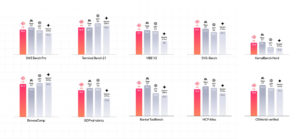
The latency comparison chart they published tells the story:
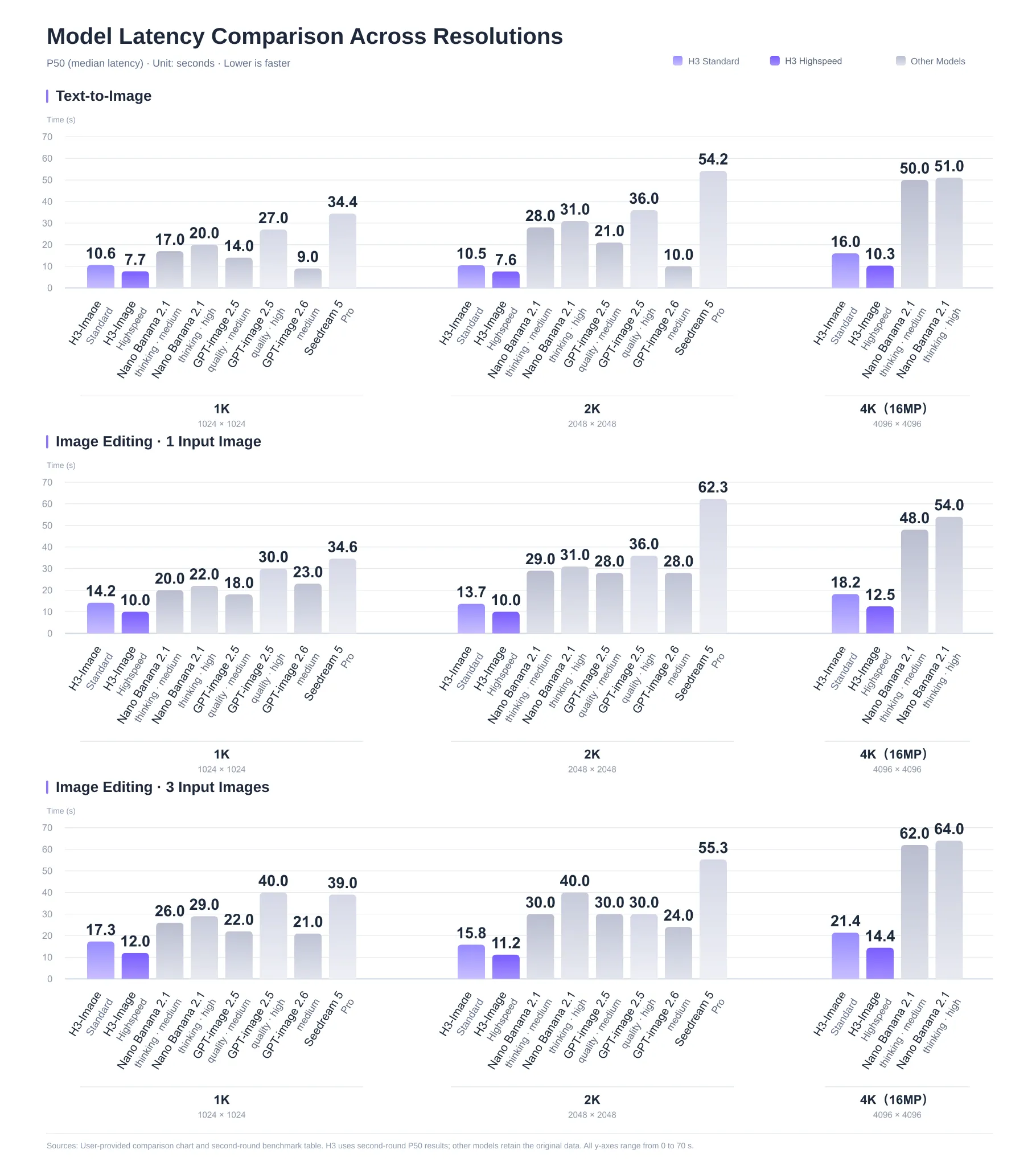
The headline claim: up to 5× faster than mainstream alternatives at full 4K resolution. The model is distilled to just 6 sampling steps with no classifier-free guidance, which is the technical secret sauce behind the speed. No CFG means no negative prompts, no guidance scale tuning, no second pass through the model. You write your prompt, the model does its thing in one shot.
The 33.1B-parameter diffusion transformer runs on the H3 architecture with the audio layers stripped out. It reuses the Qwen3-VL text encoder from the original H3 model unchanged, a 66.7 GB download that’s required for full functionality. So the “download” is really two large models. The image model itself weighs in at 68.65 GB in BF16, plus a 2.34 GB VAE.
Run this locally and you’re looking at roughly 135 GB of weights, minimum. The ComfyUI repack trims that down with an INT8 pruned DiT at 21 GB and a 25.28 GB text encoder, but the full-fat version is a serious storage commitment.
One Checkpoint to Rule Them All: Generation and Editing in a Single Model
Most image tools split the work. One model generates from text, a separate model handles editing. H3-Image does both with a single checkpoint, text-to-image, reference-based generation, and image editing all live in the same 33.1B parameter transformer.
The editing workflow is where things get interesting. The model accepts up to 16 reference images, addressed as <Picture 1>, <Picture 2>, and so on in the prompt. The first image is the edit target, the rest supply identity, props, materials, or composition. Want to replace the car in Picture 1 with the one from Picture 2? Just say so.
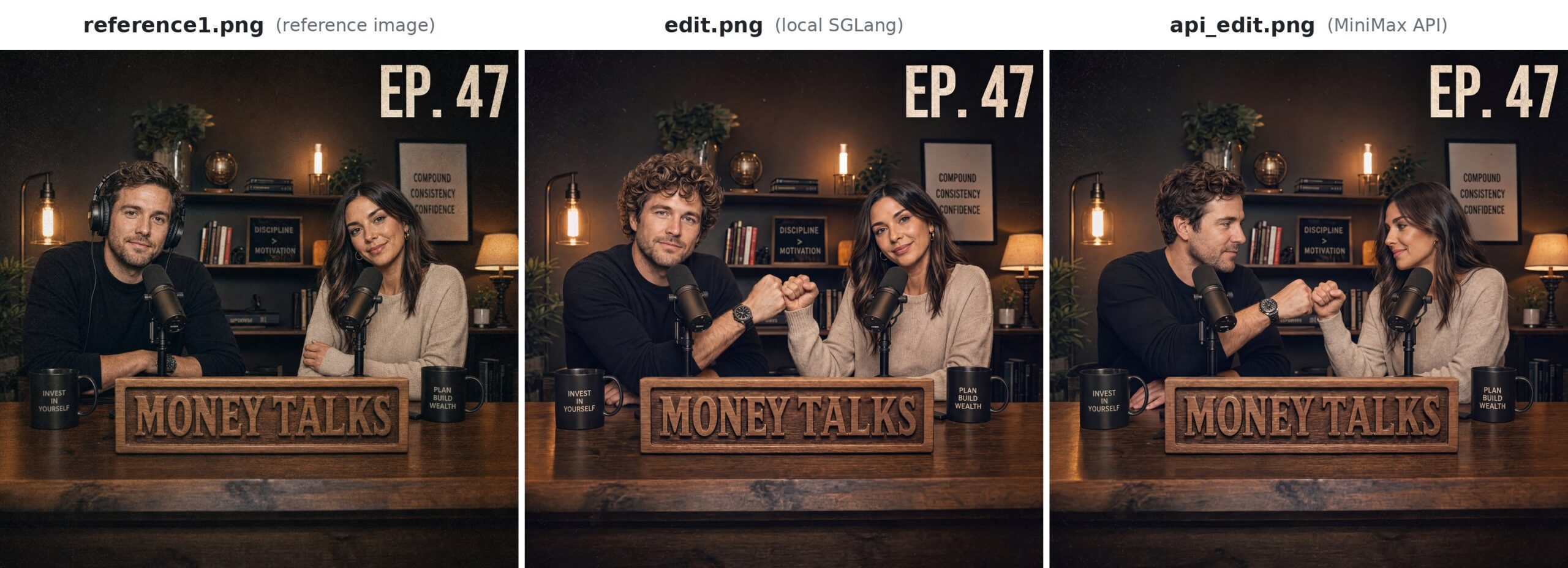
The multi-reference capability scales impressively. The showcase includes a room furnished from nine separate furniture reference images, composed into a single coherent living space. For product visualization, character consistency, or scene compositing workflows, this is genuinely useful, not just a benchmark novelty.
There are limits though. The API doesn’t support masked edits, transparent backgrounds, or preview images. Image edits always go through prompt rewriting, which the docs describe as “prompt enhancement.” You can’t turn it off for edits, and if a request times out, you still get charged, the server finishes generation even if your client disconnects.
The Architecture: H3 Without the Audio, Packed for Pixels
MiniMax has been building toward this. The H3 architecture unified text, image, video, and audio generation in a single omni-modal model. H3-Image takes that design and strips out the audio branch, creating a dedicated image model that inherits the pre-training intelligence.
The specs are worth reading closely:
- Text encoder: Full Qwen3-VL text encoder from H3, unchanged. The DiT reads hidden states from its 50th layer.
- Image VAE: CNN encoder with 2D ViT decoder (24 layers), 16× spatial downsampling, 24 latent channels. The DiT patchifies with a 2×2 patch, so each transformer token covers a 32×32 pixel area.
- Diffusion transformer: 33.1B parameters, dense single-stream, 50 layers, hidden size 5376, 56 attention heads, FFN size 14336, with 3D multimodal RoPE.
One thing worth noting from the Hugging Face model card: the checkpoint is distilled to 6 sampling steps with no classifier-free guidance. The output layers are replaced by per-step fused heads stored in a separate file. This is a deployment optimization that reduces inference cost substantially, but it also means you can’t adjust guidance or steps, the API rejects any value other than 6 steps or guidance of 1.
What the Benchmarks Don’t Say
Here’s where the skepticism kicks in. MiniMax claims “state-of-the-art prompt adherence among open-weight models” and “rich, natural details without the overly smooth, artificial look.” They published no benchmark numbers, no leaderboard entries, no independent evaluation.
The CellCog analysis flags this directly: neither the announcement nor the model card gives a test score or leaderboard rank. The speed claim of 10-20 seconds for a 4K image doesn’t specify the hardware it was measured on. The model card names no GPU model.
Early community sentiment is cautiously optimistic but not universally convinced. On developer forums, the consensus is that the model is “way smarter than all the other available local image models” but comes with real tradeoffs, the 32B text encoder makes it heavy, and some users report losing face identity in editing workflows compared to Qwen Image 2.1. The fine detail quality has been questioned too.
For a model making this many claims, the absence of transparent benchmarks is notable. Maybe the numbers are good. Maybe they’re not. Right now, we’re working on trust and curated showcases.
The Pricing: Cheaper, Until You Do the Math
MiniMax’s API pricing undercuts mainstream alternatives by 50-70%, which sounds great. The example costs per image:
| Output size | Pixels | Standard | Highspeed | Standard until Nov 17 |
|---|---|---|---|---|
| 1K (1024×1024) | 1,048,576 | $0.02179 | $0.03529 | $0.02179 |
| 2K (2048×2048) | 4,194,304 | $0.02333 | $0.03622 | $0.02333 |
| 4K (4096×4096) | 16,777,216 | $0.06879 | $0.13001 | $0.03439 |
But the fine print matters. Billing is per token, not per image. The price list notes that “example amounts have been adjusted for presentation.” A 4K image is 16× the pixels of a 1K image but only costs about 3.2× as much. The launch discount gives 50% off 4K generations until November 17 at 16:00 UTC.
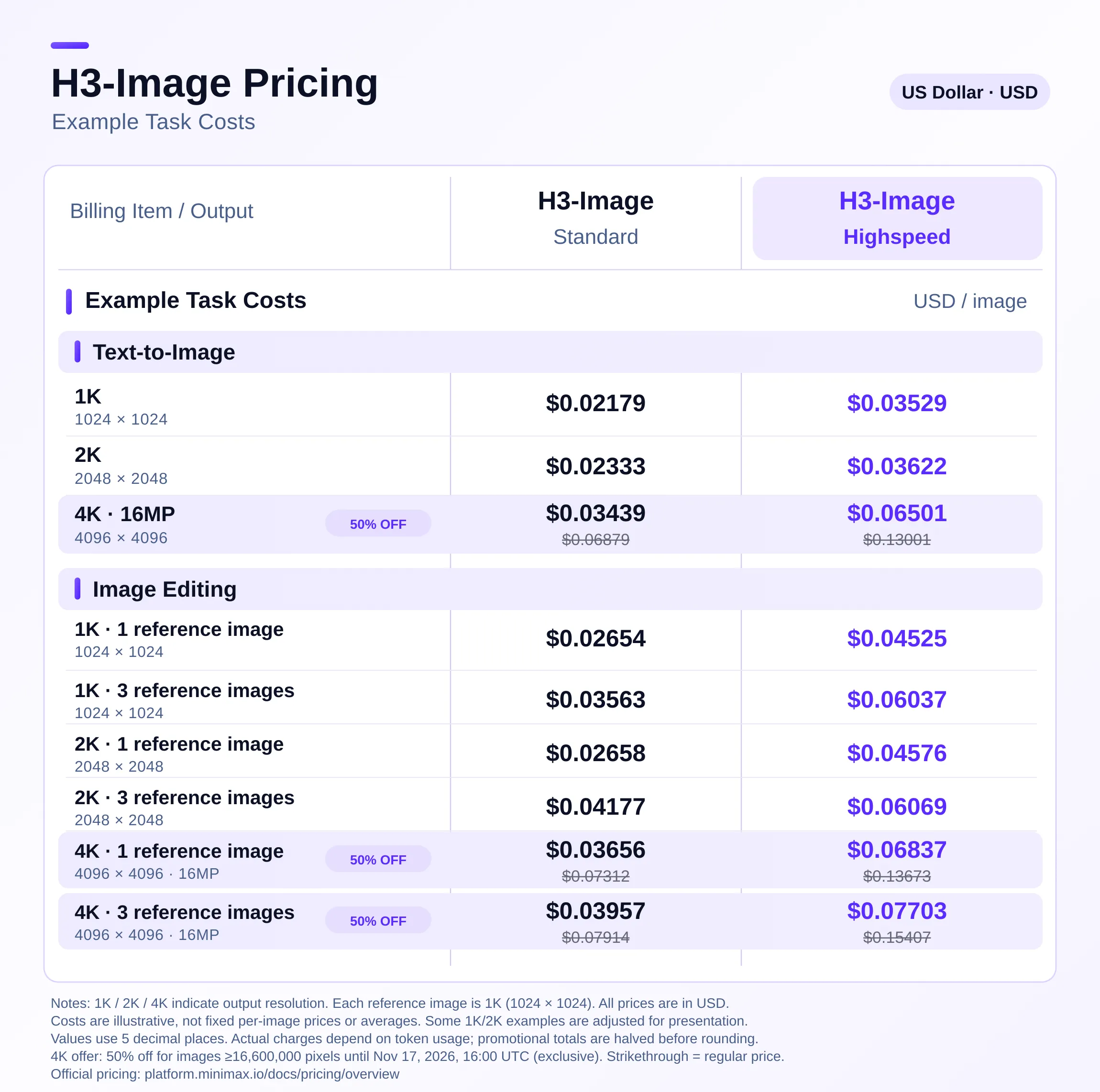
Editing costs more. A 4K edit from one 1K reference runs $0.07312. From three references, $0.07914.
The API docs contain a warning that should make any developer pause: “Neither endpoint is idempotent.” If your client gives up early, the server finishes generation and charges for successful images. MiniMax explicitly tells developers to turn off automatic retries. The server waits up to 600 seconds, which is a long time to hold a connection open.
The License: “Open Weights” Meets Geopolitics
Now the elephant in the room. H3-Image is released under the MiniMax-H3-Image Community License Agreement. It’s not an OSI-approved open-source license. It’s MiniMax’s own terms, and they’re restrictive in ways that matter.
The license excludes use in the United States, the European Union, the United Kingdom, and South Korea. If you’re in any of those jurisdictions, you’re supposed to contact MiniMax for a separate license. The weights are public, but the welcome mat has a few countries crossed off.
Beyond the geographic restrictions:
- Companies with annualized revenue exceeding $1 million USD need written authorization
- Offering the model as a hosted service requires written authorization
- Commercial products must display the name “MiniMax-H3-Image” in the interface
- You can’t use the model or its outputs to train other AI models
- Your generated outputs belong to you, MiniMax claims no rights over them
Earlier the open-weight release of MiniMax M3 set a precedent for their community-focused approach. And the M3.1 Flash showed they could deliver serious performance at scale. But the H3-Image license is a different beast.
The revenue threshold is the insidious one. A startup pulling in $1.1 million in annual revenue needs written authorization to legally use the model. A solo developer with $900,000 in revenue doesn’t. The line between “community” and “enterprise” is drawn at a number that excludes a significant chunk of legitimate small businesses.
The Ecosystem Is Already Moving
Despite the licensing headwinds, integration came fast. ComfyUI supported H3-Image on day one with templates for both text-to-image and image editing workflows. The Comfy-Org mirror repackaged the weights into a more practical footprint: a 21 GB INT8 pruned DiT, a 25.28 GB text encoder, and a 1.17 GB VAE.
SGLang and vLLM-Omni both have deployment guides. The vLLM recipe includes NVIDIA H200, RTX PRO 6000 Blackwell, and AMD Instinct MI350X configurations. Sequence parallelism with Ulysses lets you split requests across multiple GPUs for lower latency.
A derivative model called P-H3-Image was announced days before the official release, claiming faster inference on consumer hardware. The ecosystem around this architecture is already self-organizing.

If you’re outside the excluded jurisdictions and have the hardware to run it, the local workflow is straightforward. The recommended SGLang deployment starts with:
sglang serve --model-path MiniMaxAI/MiniMax-H3-Image --host 0.0.0.0 --port 30000 --warmup-mode off
With a text encoder path specified for local copies:
sglang serve --model-path MiniMaxAI/MiniMax-H3-Image --host 0.0.0.0 --port 30000 --warmup-mode off --text-encoder-path /path/to/text_encoder
The four-GPU setup for lower latency:
sglang serve --model-path MiniMaxAI/MiniMax-H3-Image --host 0.0.0.0 --port 30000 --warmup-mode off --num-gpus 4 --ulysses-degree 4
The Verdict
H3-Image pushes the open-weight image generation bar in meaningful ways. Native 4K output without upscaling, unified generation and editing in one checkpoint, 16 reference images, 6-step distillation with no CFG, these are real technical achievements.
The speed claims need independent verification. The absence of benchmarks is suspicious for a model making “state-of-the-art” claims. But even conservative estimates put this ahead of most local image generation options.
The license is the dealbreaker for many potential users. “Open weights” without access for the US, EU, UK, and South Korea is a significant portion of the global developer community being told to wait or ask permission. The $1 million revenue threshold adds another layer of friction.
This fits a pattern. MiniMax’s open-weight strategy has been aggressive across their model line, but each release carries terms that reflect the geopolitical reality they operate in. H3-Image is technically open. Practically, it’s a gate.
If you’re eligible to use it, H3-Image is worth the bandwidth. If you’re not, the API is still available, provided you accept the token-based pricing and the non-idempotent endpoints that charge you even when your connection drops.
The 10-second 4K era is here. It just has a few countries crossed off the guest list.