For a company that treats product announcements like theater productions, this is… weird. But it’s also exactly the kind of move that signals something bigger brewing beneath the surface.
The Sharpness-Jitter Tradeoff That’s Been Haunting Depth Estimation
Here’s the fundamental problem that’s plagued monocular depth estimation since the field got serious: single-frame models give you razor-sharp edges but their predictions flicker like a broken fluorescent light when applied to video. Multi-frame models fix the flicker but smear boundaries like a toddler got hold of the blur tool.
It’s a tradeoff that’s been baked into the architecture. Single-frame models can afford to look hard at every pixel. Multi-frame models have to balance what they see now against what they saw before, and something’s got to give.
Depth Pro 2’s pitch is that it doesn’t choose. The architecture uses a multi-view transformer that processes frames jointly, after the first third of its blocks, attention alternates between within-frame and across-frame processing. A DPT decoder then assembles tokens into feature maps at resolutions from 1/32 to 1/4 of the input. The result, per Apple’s claims, is depth that’s sharp at object boundaries and stable from frame to frame.
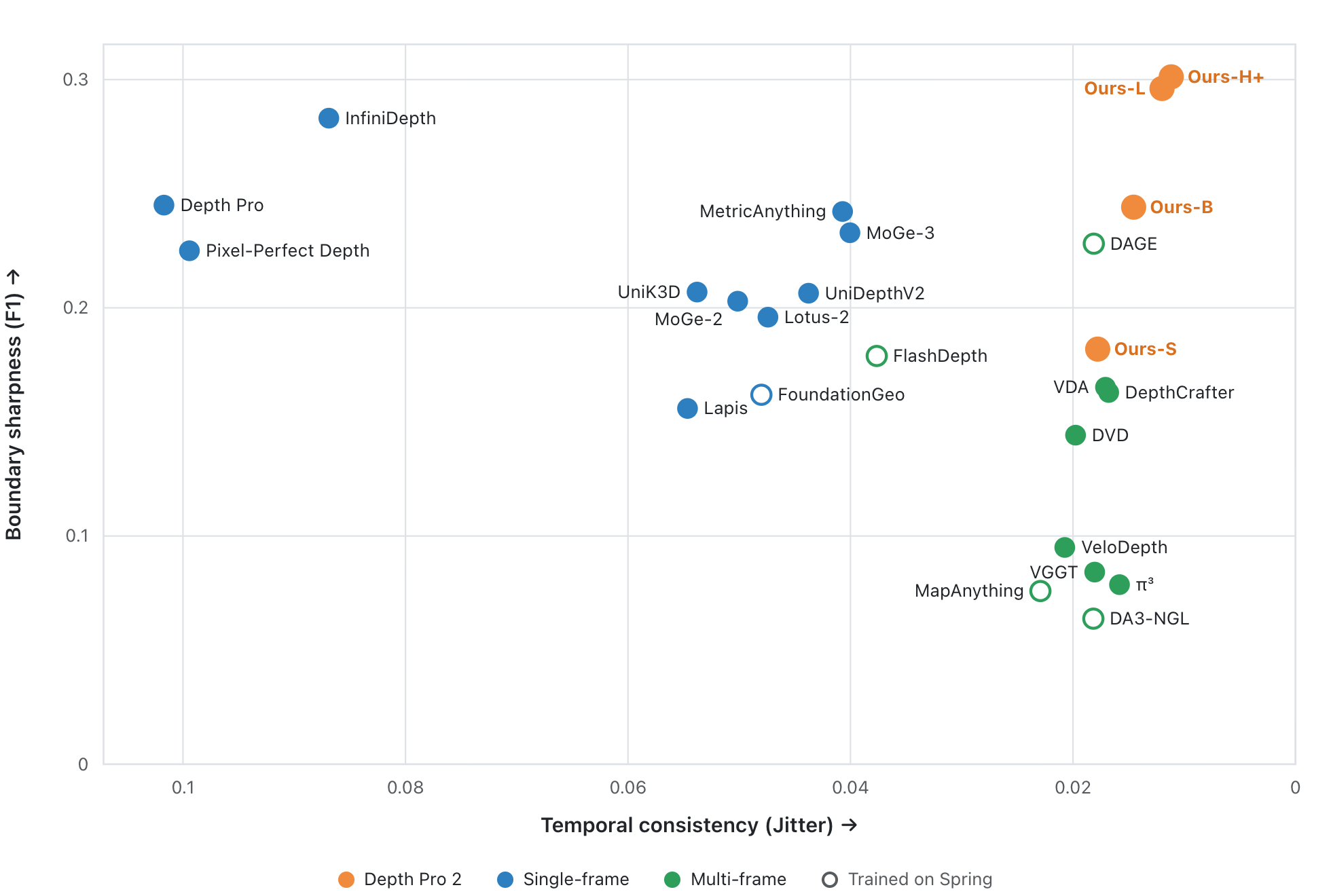
The scatter plot above shows where Depth Pro 2 lands on the Boundary F1 (sharpness) versus Jitter (temporal consistency) axes, averaged over the Sintel and Spring datasets. The claim is a new Pareto frontier, top right, where you want to be. Reading positions off the chart, the H+ model sits near a Boundary F1 of 0.29 with jitter around 0.017, versus roughly 0.235 and 0.095 for the original Depth Pro. That’s a meaningful jump, if the numbers hold up.
Here’s the catch: those numbers are Apple’s claims. The arXiv link is a placeholder. The company’s own research page 404’d for days after release. There’s no table, no per-dataset breakdown, no speed or memory measurements. Everything quantitative about this model’s performance is vendor-said, until the paper actually lands.
Four Sizes, One Focal Length Problem to Rule Them All
Depth Pro 2 ships in four flavors, from a laptop-friendly 24M parameters to a serious 872M H+ model:
| Model | Parameters | Download Size |
|---|---|---|
| S | 24M | 97 MB |
| B | 97M | 386 MB |
| L | 334M | 1.3 GB |
| H+ | 872M | 3.5 GB |
That range matters. The S model at 97MB is genuinely phone or laptop territory, the kind of thing that could run in real-time on the evolution of Apple’s on-device AI architecture and Neural Engine limitations we’ve covered before. The H+ at 3.5GB requires serious hardware.
All four share a focal length estimator: a compact 23.5M parameter network (94 MB) that predicts focal length in pixels when a photo or video lacks camera metadata. This is the unglamorous but critical detail. Metric depth means output in meters, but pixel measurements only convert to meters if you know the camera’s focal length. Get that wrong by 10% and everything is 10% too far away. The estimator is what makes arbitrary footage usable at all.
For video, Depth Pro 2 offers two modes:
– Buffered: processes 16-frame clips with 4-frame overlap, default for video files
– Unbuffered: predicts each frame as it arrives from that frame plus the 15 before it, designed for live streams
The documentation is refreshingly honest about the warm-up penalty: the first frames of a stream have fewer predecessors to attend to, so their depth is less steady. The camera doesn’t pause politely while the model catches up.
What Can You Actually Do With It?
The model outputs depth in meters at full input resolution. Try it on a photo:
image, f_px = load_rgb("photo.jpg")
depth = model.infer(transform(image), f_px=f_px)["depth"]  # meters, (H, W)
Or video:
video = av.open("video.mp4")
frames = (transform(upright(f)) for f in video.decode(video=0))
for prediction in model.infer_video(frames):
    depth = prediction["depth"]  # meters, (H, W)
Depth is infinite where the scene is infinitely far, the sky, mostly. The inference code runs in bfloat16 on NVIDIA and Apple GPUs, float32 on CPU, and there are Core ML exports for Apple silicon plus a minimal Mac camera demo requiring macOS 15 and Xcode 16.
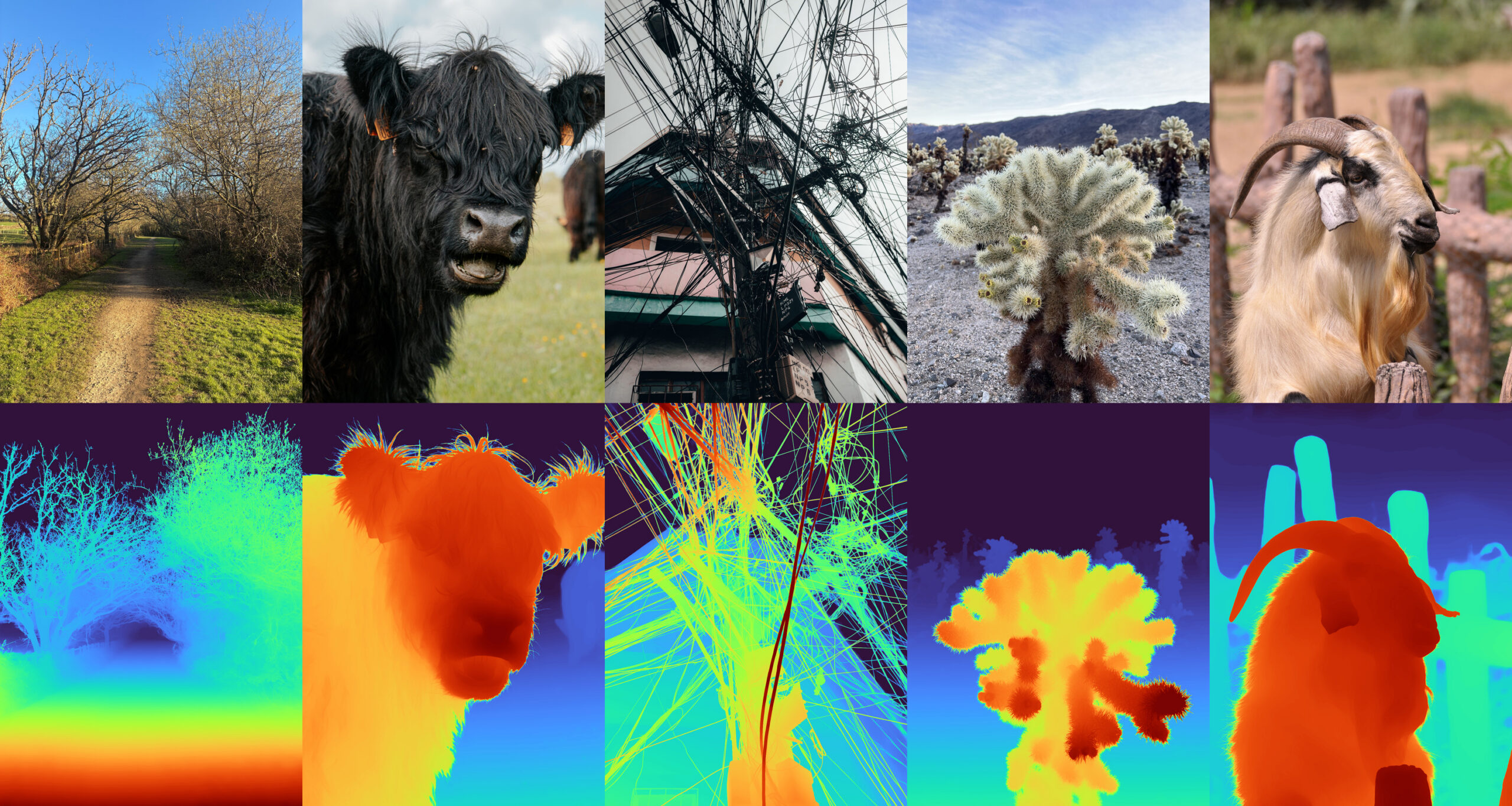
The demo above shows Apple’s own examples: inputs on top, predicted depth below, red near and blue far.
Now, what would you do with this? The use cases range from the obvious to the genuinely exciting:
AR/VR
This is the big one. Depth is the gateway from 2D to 3D. Reliable metric depth that’s temporally consistent across video frames unlocks 2D-to-3D conversion for Vision Pro, scene understanding for AR overlays, and spatial computing features we haven’t even seen yet.
Robotics
SLAM/SfM pipelines that accept external depth data get dramatically better inputs. Walk around a room with a camera for five minutes, get RGB+D frames, feed them into a structure-from-motion system and you get a consistent reconstruction. Load that into a simulator and you can train a robot to navigate your actual room.
Better inputs for vision-language models
Depth maps give VLMs spatial awareness they desperately lack. Background removal, replacement, and blur also become dramatically cleaner with proper metric depth, no more hair-flying-off-foreheads artifacts.
Photogrammetry and game development
Scan real environments, load them into game engines, create experiences set in real locations.
The developer who’d been using Marigold V2 for stereo 3D conversion noted that for characters, Marigold still captures finer detail. Apple’s model tends to flatten facial geometry, treating a face as roughly one depth plane. But the temporal stability across frames is where Depth Pro 2 appears to pull ahead.
The License Problem: Open Weights, Closed Intentions
Now for the uncomfortable part. The weights ship under the Apple Machine Learning Research Model license. That’s a researched-approved way of saying: “look, don’t touch.”
This is consistent with Apple’s pattern, the same research-only approach they’ve used for FastFrames-L and other releases. Publish weights so researchers can inspect and build on them. Keep commercial applications for the products Apple plans to ship itself. Given Apple’s investments in Vision Pro, spatial computing, and techniques for running large AI models entirely on-device, you can bet Depth Pro 2 or something like it is destined for a shipping product.
The “launch” itself reveals a staged engineering rollout rather than a coordinated announcement. Hugging Face timestamps show the model card created November 3, weights repositories two days later, Core ML exports on November 9, and the focal estimator plus GitHub repo on November 19. Sixteen days of artifacts clearing internal review one at a time. It reads less like a deliberate release strategy and more like someone flipping switches as approvals land.
The reception so far has been modest. A few hundred likes on Hugging Face, some scattered forum discussion. The H+ weights repository had 40 downloads when the Emergent analysis was written. For a model from the lab that produced the original Depth Pro replacement, it’s a quiet debut.
The Paper Problem
Here’s what bugs me, and should bug anyone planning to build on this: there’s no paper. Not “the paper is in review.” Not “preprint coming soon.” The arXiv ID in every model card and BibTeX block is a literal placeholder. The Apple ML research page for depth-pro-2 returned a 404 when the Emergent team checked. The sitemap lists depth-pro but not depth-pro-2.
This matters because the technical report is where the evaluation protocol lives. Without it, we can’t verify the Boundary F1 and jitter claims against named baselines. We can’t assess what’s in the training data. We can’t reproduce the results. Everything quantitative is Apple’s undocumented claim.
It’s worth noting the paper does now appear on Apple’s ML research site as “published November 2026” with the arXiv link referenced. The placeholder ID and missing details at launch may have been a timing issue, artifacts ready before the writeup cleared review. But the community has been burned before by benchmark claims that evaporate under scrutiny.
What This Means for On-Device AI
Depth estimation is a foundational capability, not a flashy demo. It’s the kind of thing that makes other things possible. The fact that Apple is investing in making it work at full resolution, with temporal consistency, across model sizes from phone-scale to datacenter-scale, tells you where their spatial computing roadmap is heading.
The S model at 97MB is particularly interesting in the context of Apple’s hardware trajectory. Combined with the next-generation iPhone AI capabilities and Neural Engine advancements, a 24M parameter depth model could plausibly run at interactive rates on-device. That’s the kind of capability that enables features like the lock screen clock that sits behind foreground elements, or portrait mode blur that actually understands scene geometry.
There’s also the M5 Ultra’s memory bandwidth enabling powerful on-device inference angle. The H+ model at 3.5GB, running at full 4K resolution with a 16-frame temporal window, is the kind of workload that wants unified memory bandwidth measured in terabytes per second. Apple’s silicon advantage here isn’t just about raw compute, it’s about not shuffling data between separate GPU and CPU memory pools.
And if you want to cluster multiple Mac Studios for bigger depth pipelines, the on-device AI clustering and high-bandwidth interconnects for local models we’ve covered before become relevant. Depth estimation at scale, fed by multiple camera streams, processed across interconnected hardware, that’s a plausible architecture for Apple’s spatial computing ambitions.
The Verdict
Depth Pro 2 is technically impressive and strategically revealing. The multi-view transformer architecture with alternating attention patterns is a genuinely interesting approach to the sharpness-consistency tradeoff. The model family spans a useful range of hardware targets. The focal length estimator solves a real practical problem.
But the release is also a masterclass in Apple’s approach to AI openness: give researchers enough to validate the approach, hold back everything that would enable commercial competition, and ship without a paper so there’s nothing to independently verify. It’s not a betrayal of open source, Apple never claimed it was open source. It’s a product teaser dressed in research clothing.
If you’re a researcher, dive in. The weight download is trivial, the code runs, and the architecture is worth studying. If you’re building a commercial product on top of this, read the license first and then check Apple’s strategic move into AI servers with custom silicon, because that’s where this technology is actually heading.
The real question isn’t whether Depth Pro 2 works. It’s whether you’ll ever get to use it in something you ship. And the answer, pending a paper that actually exists and a license that allows commercial use, is the same one Apple always gives: eventually, on their terms.