The prevailing narrative about US-China AI competition reads like a Cold War thriller: two superpowers locked in a zero-sum race, each trying to outmaneuver the other with export controls, espionage accusations, and trillion-dollar compute investments. The House Select Committee on the CCP just released a 40-page report warning that China is trying to get American companies “addicted” to their AI models. The Pentagon is reportedly drafting contingency plans for a future where the PLA runs its cyber operations on DeepSeek-powered “intelligent attack” systems.
But here’s what that narrative misses: the two countries are building each other’s best models.
Not in some abstract, mutually-assured-destruction sense. Literally. There’s a direct line from RoFormer’s rotary position embeddings to LLaMA’s architecture, and from DeepSeek’s multi-head latent attention to Kimi K2’s KV-cache compression. The innovation flow is so bidirectional that untangling who “owns” which idea has become nearly impossible. And the result is that both sides are advancing faster than either could alone.
The Untold Story: Ideas Don’t Respect Export Controls
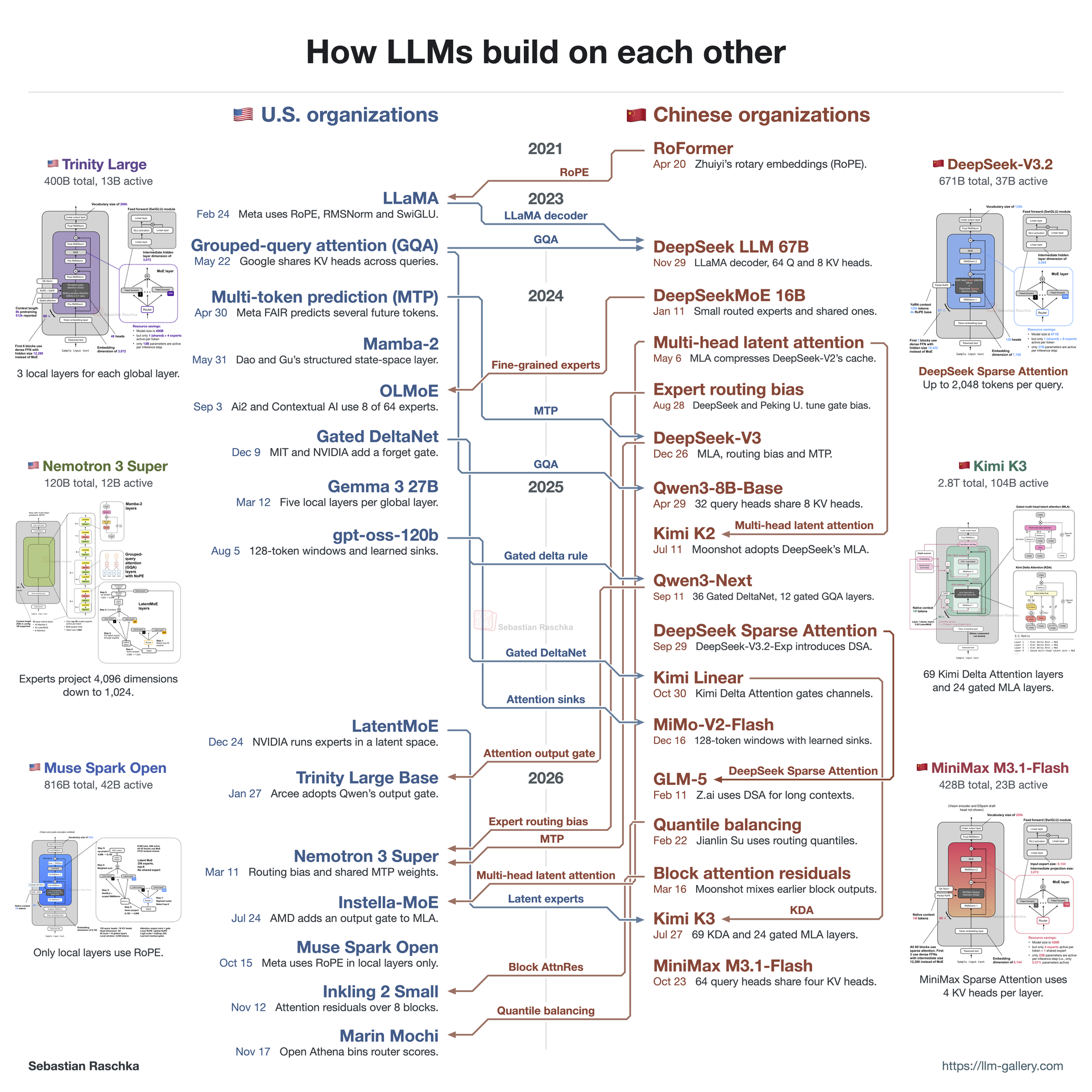
Sebastian Raschka, who’s been tracking LLM architectures since before “attention is all you need” became a personality trait, published a striking timeline of this feedback loop showing how specific technical ideas hop between US and Chinese models. It’s not a one-way street. It’s not even a two-lane highway. It’s more like a trans-Pacific container shipping network where the containers are attention mechanisms and the ports are Hugging Face repositories.
The figure below (click to enlarge) traces this cross-pollination from 2021 through 2026:
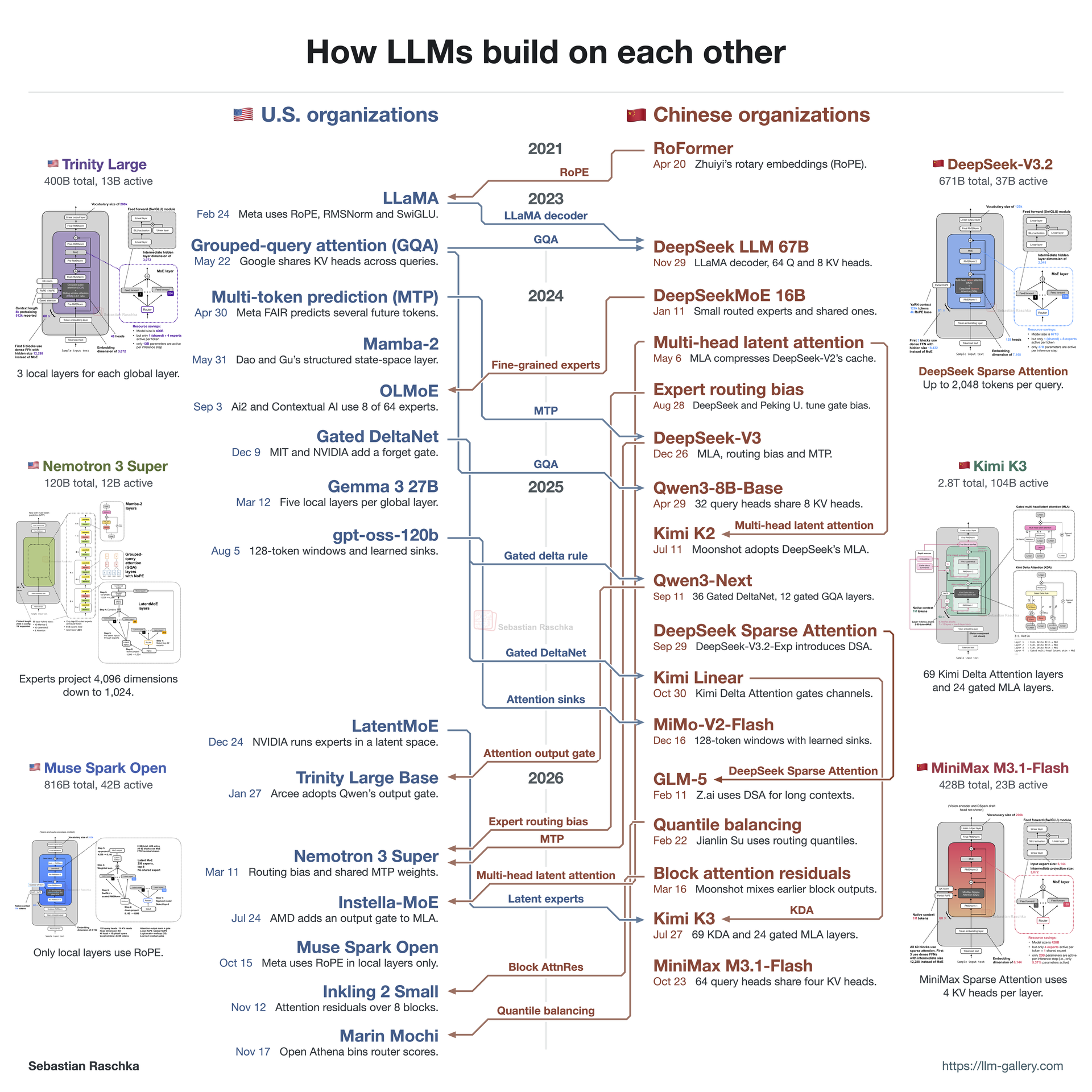
Consider just a few of the documented connections:
| Model | Borrowed Idea | Original Source |
|---|---|---|
| LLaMA (2023) | Rotary position embeddings (RoPE) | RoFormer (Chinese lab) |
| DeepSeek LLM 67B | Grouped-query attention | |
| OLMoE (2024) | Fine-grained expert design | DeepSeekMoE |
| DeepSeek-V3 | Multi-token prediction | Meta |
| Kimi K2 (2025) | Multi-head latent attention | DeepSeek-V2 |
| Qwen3-Next | Gated delta rule | Gated DeltaNet |
| Trinity Large (2026) | Learned sigmoid gate | Qwen’s gated attention |
| Instella-MoE | MLA + attention output gating | DeepSeek + Qwen |
| Marin Mochi | Quantile balancing | Jianlin Su |
The pattern is unmistakable. When DeepSeek-V2’s multi-head latent attention proved that you could cut KV-cache memory dramatically without sacrificing quality, Kimi K2 adopted it within months. When Meta’s multi-token prediction showed that predicting multiple future tokens during training improves performance, DeepSeek-V3 incorporated it into its training objective. LLaMA’s use of RoFormer’s rotary embeddings set the standard for positional encoding that virtually every major model now uses.
This is not espionage. This is how open research is supposed to work.
Why Open Weights Beat Closed APIs at Innovation
The feedback loop operates on a simple principle: model weights reveal implementation details that papers omit. You can read a paper about multi-head latent attention and understand the theory. But download the actual weights and you can see exactly how Moonshot quantized those compressed keys, how DeepSeek handled the sliding window boundary conditions, how they tuned the compression ratio against benchmark performance.
A research paper is a destination. Weights are a starting point.
There’s a reason this matters for the pace of innovation. As one analysis from Emergent put it, “Model weights reveal implementation details that papers omit, allowing engineers to reverse-engineer successful approaches within weeks rather than months.” The result has been a compression of release cycles from quarterly to monthly for major open-weight models, with some labs pushing incremental updates on weekly timeframes.
The open-weight feedback loop isn’t just about copying, though. It’s about adapting. Chinese labs take US innovations and optimize them for different hardware constraints, often NVIDIA chips they can’t easily export, so they have to squeeze more efficiency from fewer resources. US labs take those optimizations and push them in different directions, often prioritizing scale over efficiency.
This creates a natural division of labor. Chinese labs have become masters of parameter efficiency and inference cost reduction. US labs lead on raw capability and frontier exploration. Each side’s constraints become the other side’s blueprint.
The Distillation Elephant in the Room
Now, before anyone accuses me of painting a picture of harmonious international cooperation, let’s address the uncomfortable part: distillation.
The Select Committee report alleges that “major PRC developers used proxy networks and fraudulent accounts to harvest outputs from American frontier models and replicate their capabilities.” The September 2026 joint advisory from NSA, CISA, and the FBI warned that “China utilizes advanced AI models to increase the scale, scope, and speed of its intrusions into U.S. systems.”
There’s real substance here. The DeepSeek V4.1 Flash’s performance on cybersecurity benchmarks is genuinely impressive for an MIT-licensed model. The PLA’s procurement records show DeepSeek, Qwen, and Moonshot models integrated into military cyber operations. These are legitimate national security concerns.
But here’s the uncomfortable counterargument, one that Daniel Saedi from Minerva articulated on the Odd Lots podcast: distillation alone doesn’t explain Chinese labs’ competitiveness. If you look at Reflection AI, a US open-weight lab with Nvidia backing and roughly 12,000-14,000 Blackwell GPUs, their flagship model landed about 6-9 months behind the frontier. Chinese open-weight models are only about 3 months behind the frontier. If distillation were the sole explanation, Reflection would be doing better.
Saedi credits Chinese labs with “the absolute prolific, publishing nature of researchers there… These guys are doing a public service on the other side.” The Chinese labs aren’t just copying, they’re contributing novel techniques that US labs then adopt. The gated delta rule from Gated DeltaNet, which Qwen3-Next was among the first to adopt, is a genuinely innovative approach to hybrid attention that emerged from Chinese research.
What This Means for the Application Layer
The conventional wisdom says that if you want to build an AI-powered product, you should pick the smartest model you can afford. But Saedi’s argument, based on Minerva’s experience running models in production, is more nuanced: the right model depends on the phase of your product lifecycle.
| Phase | Model Choice | Reasoning |
|---|---|---|
| Building the product | Frontier (Claude, Astra, GPT-6.x) | Save developer time, avoid debugging loops |
| Repeatable, customer-acceptable tasks | Fine-tuned open-weight | Optimize cost per completed task, protect margin |
The economics here are brutal. A company with fixed per-seat revenue and variable model costs has an incentive to cut the variable side. That’s why Harvey, the legal AI company, reportedly spent about $6 million in compute to reach the frontier of legal tasks on its own model, two to three orders of magnitude above a small fine-tune. It’s not about whether they serve their fine-tuned model to users, it’s about having leverage in pricing negotiations with the labs.
The critical caveat: fine-tuned weights don’t transfer to a new base model. When Kimi K3.1 weights arrive, you can’t move your Kimi K3 fine-tune over. The training dataset is transferable, but you don’t know how the new base weights were produced, so you can’t predict whether retraining will converge. That uncertainty is a real cost, one that founders have to price into their decisions.
The Open-Weight Pushback: Licenses Get Complicated
Here’s where the “open” in open-weight gets messy. Not all open-weight models are created equal, and the autumn 2026 release crop proves it.
Mistral Large 4 (“Le Chonk”) ships under a modified MIT license that requires commercial agreements for Model-as-a-Service businesses. Kimi K3.1 Pro’s custom license has a $20 million revenue threshold for hosted services and a branding requirement at 100M+ monthly users. Only DeepSeek V4.1 Flash 1017 (MIT) and Qwen3.8 (Apache 2.0) offer what a lawyer would consider genuinely permissive terms.
This is the “open-weight vs open source” distinction that matters. Open weights mean you can download the parameters. Open source, in the OSI’s definition, means you can study, modify, and share both the code and meaningful information about training data. Almost no frontier model clears that bar. As developer Simon Willison noted about Moonshot’s licensing: “To their credit, they make no attempt to describe this as an ‘open source’ license in their own materials, consistently using the term ‘open weight’ in its place.”
The trend line is concerning for anyone who values openness: Mistral moved from Apache 2.0 on Large 3 to a modified MIT on Large 4. Alibaba’s Qwen4-Max, the newest flagship, shipped without downloadable weights entirely. The Qwen series remains the most downloaded open-weight model family in the world, but the latest generation is behind an API.
The Compliance Asymmetry
There’s a structural advantage Chinese labs have that has nothing to do with technical genius: a willingness to ignore terms of service.
Joe Weisenthal pressed this point on Odd Lots: the ability to fine-tune a lagging-edge open model is partly subsidized by Chinese labs allegedly violating Western terms of service. Llama didn’t go anywhere partly because Meta wouldn’t do that. US open-weight efforts may be structurally disadvantaged because American companies won’t violate frontier labs’ terms of service to train, while Chinese labs face no such constraint.
This creates a weird sort of subsidy: Chinese open-weight models benefit from the distillation of American frontier models, and American companies benefit from the resulting cheap open weights. The question is whether this asymmetry is sustainable. If Western regulators crack down, and the Select Committee is clearly pushing in that direction, the cost advantage of Chinese models could evaporate.
What the Abliteration Problem Tells Us
Here’s the scenario that keeps security researchers up at night: take an open-weight model, remove the safety fine-tuning, deploy it in swarm mode, and you have a PhD-level assistant that will do anything you tell it.
Saedi’s account of experimenting with an “abliterated” DeepSeek model is revealing. The uncensored version costs about $0.30 per million blended tokens, roughly a tenth of Sonnet’s price and about a hundredth of the frontier’s. It’s probably not as capable as the frontier model from February 2025, but that’s still PhD-level capability for pocket change.
His assessment of the current threat landscape: “People are running swarms of these abliterated DeepSeek models… The real risk is that a few parameter changes turn a PhD-level model into a thousand Mr. Robot-style agents in the cloud that can be told to hack anything.”
This is the dark side of the open-weight feedback loop. The same weights that let Minerva fine-tune a marketing automation model also let anyone with $0.30/million tokens run an uncensored cyber agent. KYC before weight downloads is one proposed solution, but it would crush the startup dynamism that makes the ecosystem valuable in the first place.
The Compute Reality Check
The feedback loop is accelerating, but it’s hitting a wall.
Saedi’s heuristic: a fully AI-native employee should consume about one GPU’s worth of tokens per year. Against that, the US has somewhere between 5 and 10 million leading-edge Blackwell GPUs deployed and roughly 100 million knowledge workers. The shortfall is enormous, roughly an order of magnitude.
This explains the current tension between “AI overbuild” talk and “compute shortage” talk. The loudest voices are the most compute-short, so the overbuild narrative gets amplified. But the actual economics suggest we’re heading toward roughly one GPU per knowledge-working employee within four years. That’s not an overbuild. That’s the real demand curve.
Even at the frontier labs, compute is tight. At a White House medal ceremony, Greg Brockman reportedly asked Elon Musk for compute. When the president of OpenAI is begging NVIDIA’s CEO for GPUs at a state function, you know the supply constraints are real.
The Open-Weight Option
The US-China exclusionary dynamic has pushed more AI infrastructure toward open-source models. Nvidia’s $60 million bet on AI factories running open-source models suggests the hardware giant sees an opportunity to diversify beyond closed-source dependencies. If the open-source AI bet hits 86% adoption as some projections suggest, the market for fine-tuned open-weight models will explode.
Meanwhile, the Chinese open-weight ecosystem continues to expand. Tencent’s Hy4 architecture with its Apache 2.0 license and Alibaba’s open-source medical AI that beats most radiologists are pushing real-world applications far beyond the chatbot use cases.
The 4.4-month gap between Chinese open-weight models and US frontier models that Mozilla’s State of Open Source report documented is closing fast. Distillation is part of the story, but it’s not the whole story, US export controls may have actually accelerated China’s open-source AI push by forcing Chinese labs to optimize for efficiency with scarce compute resources.
Where This Leaves Us
The uncomfortable reality is that the US-China AI competition isn’t zero-sum. It’s a feedback loop. American open-weight models are better because Chinese open-weight models exist, and vice versa. Proprietary models are better (and cheaper) because open-weight models exist. The Select Committee’s report is right that there are genuine national security concerns, the PLA’s integration of Qwen and DeepSeek into military cyber operations is not something to dismiss lightly. But the solution isn’t to sever the feedback loop. It’s to make it more transparent and more equitable.
For practitioners, the takeaway is more practical. The open-weight ecosystem offers a real competitive advantage if you understand its economics. Fine-tuning is the primary benefit to the application layer right now. The models are good enough, the licenses are manageable (with the right legal review), and the cost advantages over frontier APIs are substantial. Just remember: read the license file, not the press release. And don’t expect your fine-tune to survive the next base-model upgrade.
The feedback loop is a reality. The question is whether policymakers, and practitioners, will treat it as a threat to be contained or a network effect to be leveraged. Right now, the evidence suggests the latter is more powerful than the former. And that’s true whether you’re in Beijing, Washington, or a startup in San Francisco fine-tuning Qwen on your proprietary data while waiting for Kimi’s next open-weight release.
Competition is a good thing. So is cooperation. The US-China open-weight feedback loop is both at the same time, which makes it one of the most interesting dynamics in technology, and one of the hardest to regulate. Just ask anyone trying to serve a 2.8-trillion-parameter model for under $52,500 a month in GPU rental costs.