For two years now, we’ve watched the AI industry pour billions into chatbots that write poetry, generate anime girls, and occasionally hallucinate legal precedents with total confidence. Meanwhile, the actual life-or-death applications, the ones that could genuinely save millions of lives, have been quietly gathering dust in research papers nobody reads.
Then, on September 18, Alibaba’s Damo Academy flipped the script.
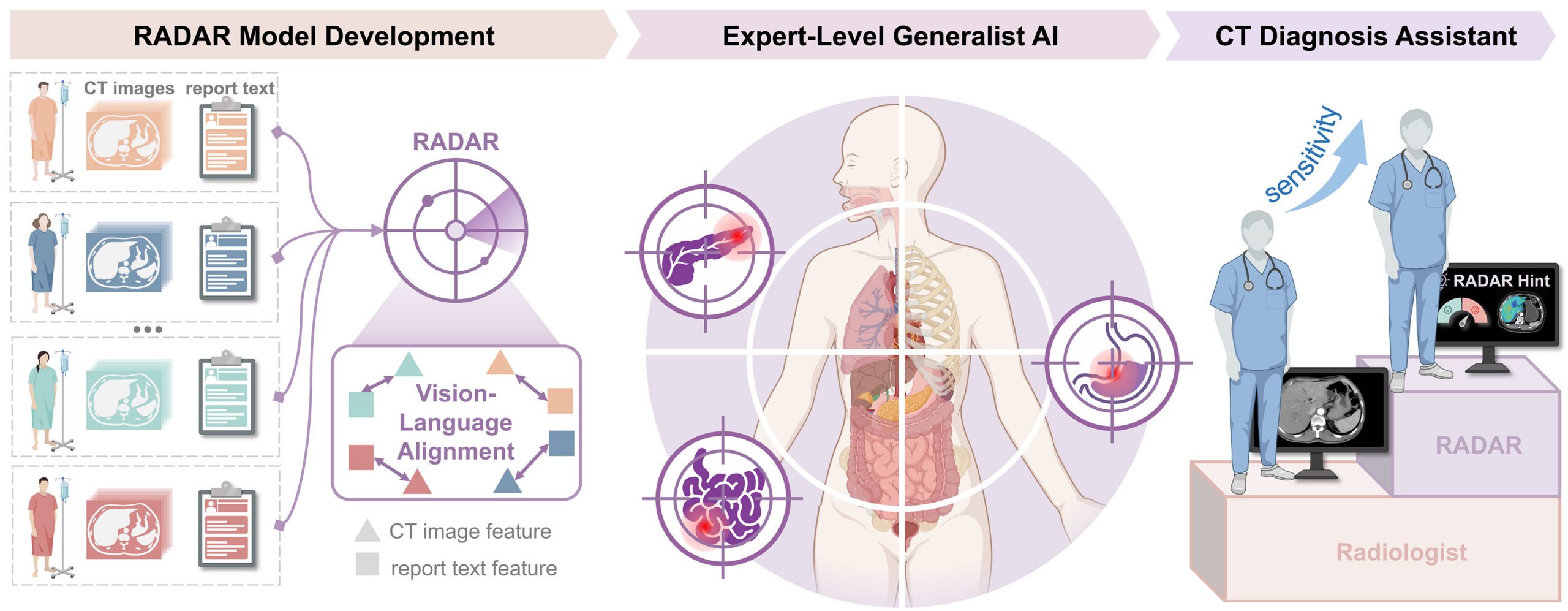
They open-sourced Damo Radar, a vision-language model that reads contrast-enhanced abdominal CT scans and identifies 146 clinical findings across 18 abdominal organs, including malignant tumors, aortic dissections, and all manner of silent killers that radiologists spend decades learning to spot. The weights, training code, and inference framework are all public. Apache 2.0 license. No paywall, no API subscription, no “contact sales for pricing.”
If you’re wondering whether this is actually as significant as it sounds, yes, it is. And the implications ripple far beyond radiology.
The Numbers That Should Make Every Radiology Department Nervous
Let’s get straight to the data, because this isn’t another “our model is great, trust us” press release.
According to the study published in Science, Damo Radar was evaluated on nearly 40,000 real-world CT examinations and achieved a mean area under the curve (AUC) of 0.913 across 146 clinical findings. For context, an AUC of 1.0 is perfect diagnostic accuracy. The best competing vision-language model in the researchers’ comparison? A mean AUC of 0.776. That’s not a marginal improvement, that’s a generational leap.
The model held up outside its comfort zone too: 0.895 AUC in cohorts from eight external medical centers and 0.904 across more than 27,000 emergency CT cases. Generalization isn’t just a buzzword here, it’s the difference between a lab demo and something that works when a trauma patient rolls in at 2 AM.
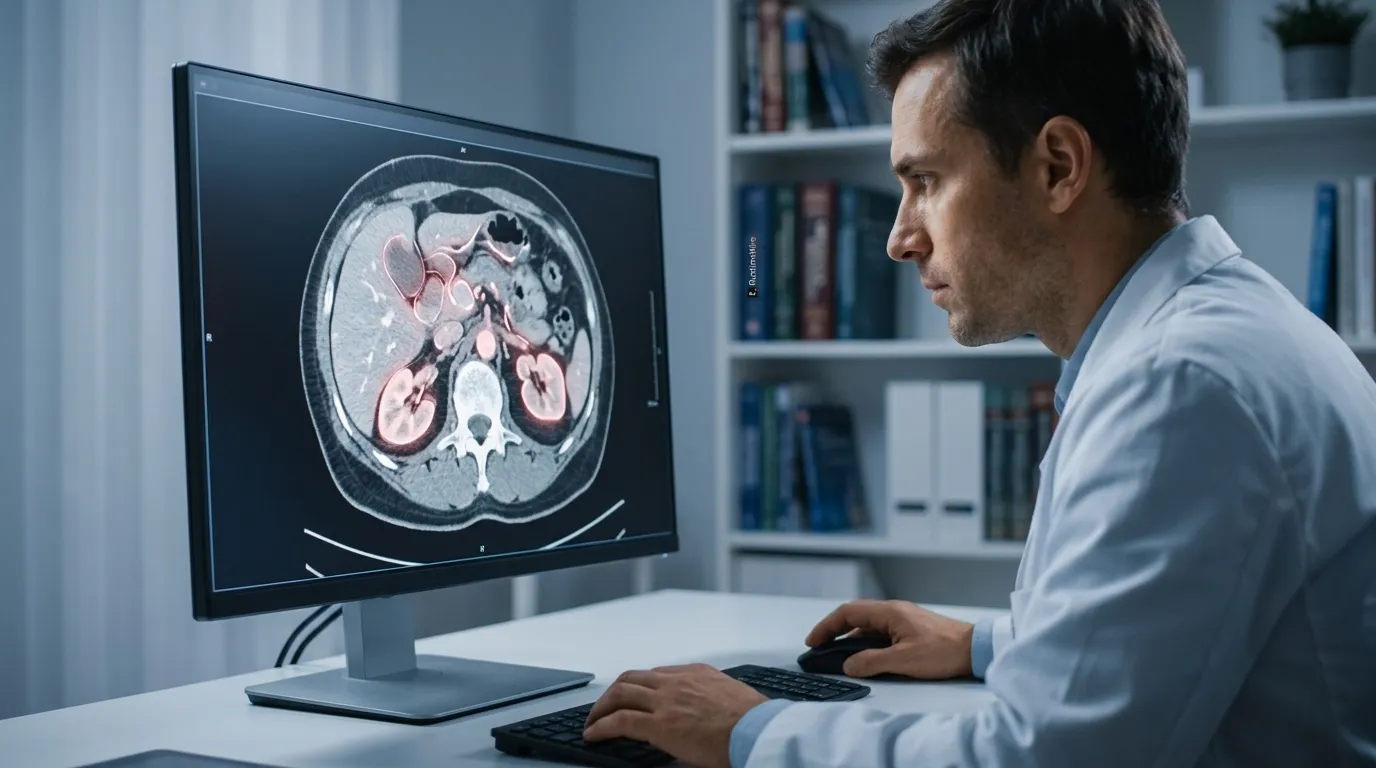
Then comes the comparison that will make certain clinicians reach for the antacids. In a head-to-head study with 26 radiologists from multiple hospitals, Damo Radar’s average accuracy exceeded that of 23 participants. Twenty-three out of twenty-six. The model isn’t just hanging with the experts, it’s outperforming most of them on its home turf.
And here’s the part that should terrify and excite you in equal measure: when radiologists used Damo Radar as an assistive tool, they reduced missed diagnoses by 10% while cutting reading time by more than 30%. That’s not AI replacing doctors. That’s AI turning good doctors into exceptional ones.
Training on Reports, Not Just Labels
What makes Damo Radar technically interesting, beyond the headline-grabbing benchmarks, is how it was trained.
Most medical imaging models are still built the old-fashioned way: clinicians painstakingly annotate thousands of images, drawing bounding boxes and labeling every abnormality by hand. It’s slow, expensive, and scales about as well as a fax machine in a messaging app.
Damo Radar took a fundamentally different approach. The research team trained it on 424,911 contrast-enhanced abdominal CT examinations paired with more than 15 million anatomy-aware image-text pairs. Instead of relying on manual annotations, the model learns by matching three-dimensional anatomical structures directly with the language used in clinical radiology reports.
In practical terms: the model learns what “hepatic lesion, suspicious for metastasis” looks like by reading millions of real reports that describe such findings, then associating that language with the visual patterns on the scans. It’s the same paradigm shift that made large language models work, unsupervised and weakly supervised learning at massive scale, applied to the medical domain.
This training strategy carries enormous implications. It means the methodology could theoretically extend to other imaging modalities. The researchers explicitly state that the approach can be adapted to lung imaging, brain imaging, and beyond. Radiographs, MRIs, ultrasound, any imaging domain with radiology reports attached could potentially benefit from the same recipe.
Remember Alibaba’s strategic commitment to open-source AI through the Qwen ecosystem? This isn’t an isolated move. It’s part of a broader pattern where Alibaba treats open-source distribution as a strategic weapon rather than a charitable donation.
The Open-Source Play: Smarter Than It Looks
Here’s what makes this release genuinely different from anything OpenAI or Anthropic have shipped. When asked to produce an open vision model that can detect cancers from CT scans, those companies’ answer has been… well, no answer at all. Their financial backers want chatbots that can replace knowledge workers with subscription fees, not models that might actually save lives without generating recurring revenue.
The contrast is stark. As one developer pointed out, “Cancer screening does more for AI’s public reputation than any chatbot demo. Open weights mean the hospital that can’t afford an API gets to run it anyway.”
That’s the key insight, Damo Radar isn’t just open-sourced for philosophical reasons. It’s a strategic move that positions Alibaba as the infrastructure provider for medical AI development worldwide. Instead of trying to own every vertical like some American AI labs attempt, they’re telling potential customers: “We’re not here to compete with you. We’re here to help you build.”
The GitHub repository includes training and inference code, preprocessing tools, and pretrained checkpoints, with instructions for evaluating the model against external datasets like MERLIN. The Hugging Face checkpoint is openly downloadable. Any research group, hospital, or startup can pick this up and start building immediately.
This aligns perfectly with the trajectory we’ve been tracking: China’s rapid progress in open-weight AI models, led by Alibaba’s Qwen, has compressed what used to be a multi-year gap between frontier research and public availability to just months.
The Honest Caveats Nobody Wants to Talk About
Now, before we all start planning the AI-powered radiology revolution, let’s pump the brakes on one critical distinction that’s getting lost in the headlines.
Damo Radar detects 146 radiological findings, a category that includes cancers but also encompasses countless other abnormalities, diseases, and anatomical variations. The breathless coverage calling it a model that “diagnoses 150 diseases” is technically accurate but misleading. This is a broad abdominal imaging model, not a cancer-specific detector. Its value lies in covering the enormous range of findings a radiologist must consider during routine work, not in being the ultimate cancer oracle.
More importantly, open weights are not the same as clinical authorization. The FDA maintains a list of AI-enabled medical devices that have received regulatory clearance. Damo Radar is not on it. Nor should it be, yet. Independent prospective clinical studies haven’t established how the model performs when inserted into routine hospital workflows, where patient populations, scanner protocols, reporting standards, and disease prevalence can all shift the delicate balance between missed findings and false alarms.
The researchers’ description of Damo Radar as “the world’s first expert-level generalist medical imaging model” is, charitably, a bold claim. It’s the team’s own characterization, not a regulatory designation. The model has shown remarkable research performance. Whether that translates into clinical infrastructure, that question remains wide open.
There’s also the inevitable comparison to existing commercial products. In the United States, companies like Aidoc and a2z Radiology AI have FDA-cleared abdominal CT triage products that are already deployed in hospitals. Damo Radar covers a much broader set of findings, but those products have something Damo Radar doesn’t: regulatory clearance and years of clinical integration experience.
What This Actually Means for Healthcare AI
Strip away the hype, and here’s what the release of Damo Radar genuinely changes:
Barrier to entry collapsed
The barrier to entry just collapsed. Researchers at universities, hospitals, and startups in developing countries, places that could never afford to license a commercial medical AI system, now have access to a state-of-the-art foundation model they can run, evaluate, and fine-tune for their own patient populations. The democratization angle isn’t rhetorical, it’s structural.
Training methodology is the real win
The training methodology is arguably more valuable than the model itself. The idea that clinical reports can provide sufficient supervision to train a generalist medical imaging model represents a paradigm shift. If validated across other imaging modalities, it could fundamentally change how medical AI gets built. No more hand-labeling millions of images. The data that hospitals already generate through routine clinical care becomes the training signal.
Radiologist augmentation
The radiologist augmentation effect is the killer feature. A 10% reduction in missed diagnoses combined with a 30% reduction in reading time isn’t about replacing radiologists, it’s about addressing a global shortage of them. In regions where one radiologist covers a population that would require five, tools like Damo Radar could meaningfully improve diagnostic quality without requiring five times the specialists.
The public reaction has been notably positive, with many expressing that “hopefully things like this let people understand there is good that can come out of AI.” It’s a rare moment where AI’s reputation gets a boost from something other than a viral demo or a clever hack. This is the kind of application that makes the technology feel like it’s working for humanity rather than against it.
The Long Game
Alibaba’s Damo Academy was established in 2017 and has spent years developing AI screening tools for pancreatic, stomach, and colorectal cancers, as well as aortic dissections. The April release of the Coca AI model, built for early colorectal cancer detection and co-developed with Guangdong General Hospital, demonstrated higher sensitivity than radiologists in identifying early-stage disease. Damo Radar represents the consolidation of that work into a single generalist architecture.
This also continues the pattern we’ve seen in Alibaba’s Qwen-driven AI advancements in specialized domains like autonomous driving, a company that’s increasingly willing to give away its research to establish ecosystem dominance.
The question now is what the broader AI industry does in response. Will OpenAI and Anthropic feel pressure to open-source their medical AI work? Will Western regulators view open-weight medical models as an opportunity or a liability? And most critically, will the validation studies that genuinely establish clinical safety keep pace with the research momentum?
For now, the open-source community has a new toy to play with, and it’s one that might actually save lives. The hospital that can’t afford an API subscription just got access to a radiology assistant that outperforms most human experts. That’s not a headline, that’s a revolution, delivered under the Apache 2.0 license.
The ball is now in the court of researchers, clinicians, and regulators to determine whether Damo Radar remains a remarkable research achievement or becomes the foundation of genuinely accessible medical AI infrastructure. Given how fast China’s open-weight AI ecosystem has been moving, I wouldn’t bet against the former.