Alibaba’s Qwen team just dropped an open-weight model for autonomous driving, and honestly, it’s a bigger deal than the headline suggests. Qwen-Drive-1.0 packs 3D perception, driving-scene question answering, and motion planning into a single architecture built on the Qwen3.5-4B vision-language backbone. The full BF16 checkpoint runs about 9GB.
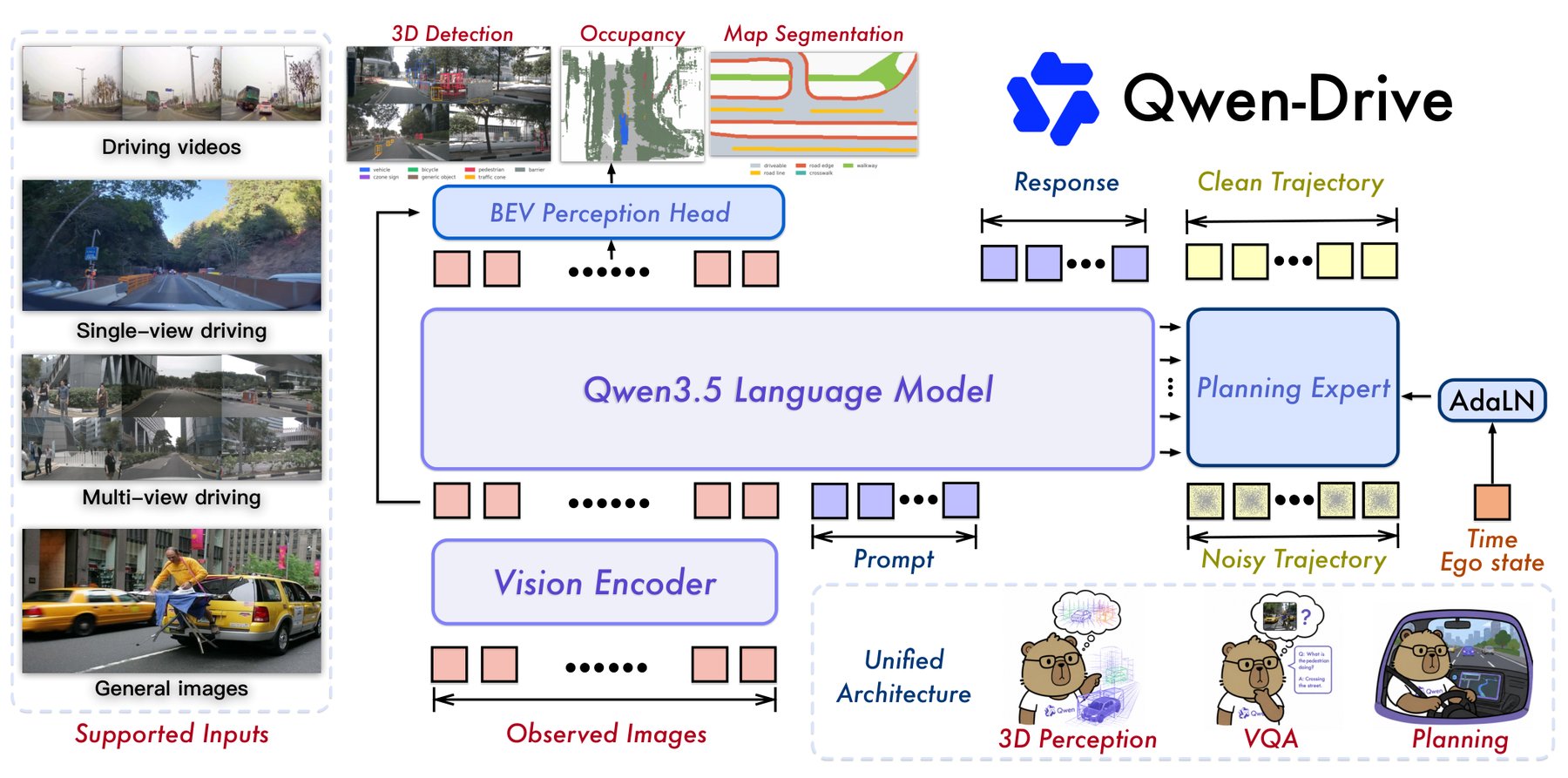
This isn’t just another fine-tuned chatbot that can describe a traffic scene. It’s a model that detects objects in 3D space, predicts occupancy, segments the road map, answers questions about what it sees, and plans a trajectory for the next five seconds, all from shared representations. Under Apache 2.0.
The Reddit crowd immediately did what Reddit does: someone claimed they’d install it on their actual car. The replies were equal parts “comma.ai runs open pilot, so it’s not impossible” and “o7 brave soldier.” For the record, nobody should be slapping this on their daily driver. But the enthusiasm hints at something real: open-weight driving models just became a thing you can actually tinker with.
The Architecture: One VLM, Three Jobs
The design philosophy here is refreshingly modular. Qwen-Drive-1.0 keeps the pretrained Qwen3.5-4B VLM completely untouched, then bolts on specialized components where the language decoder isn’t the right tool for the job.
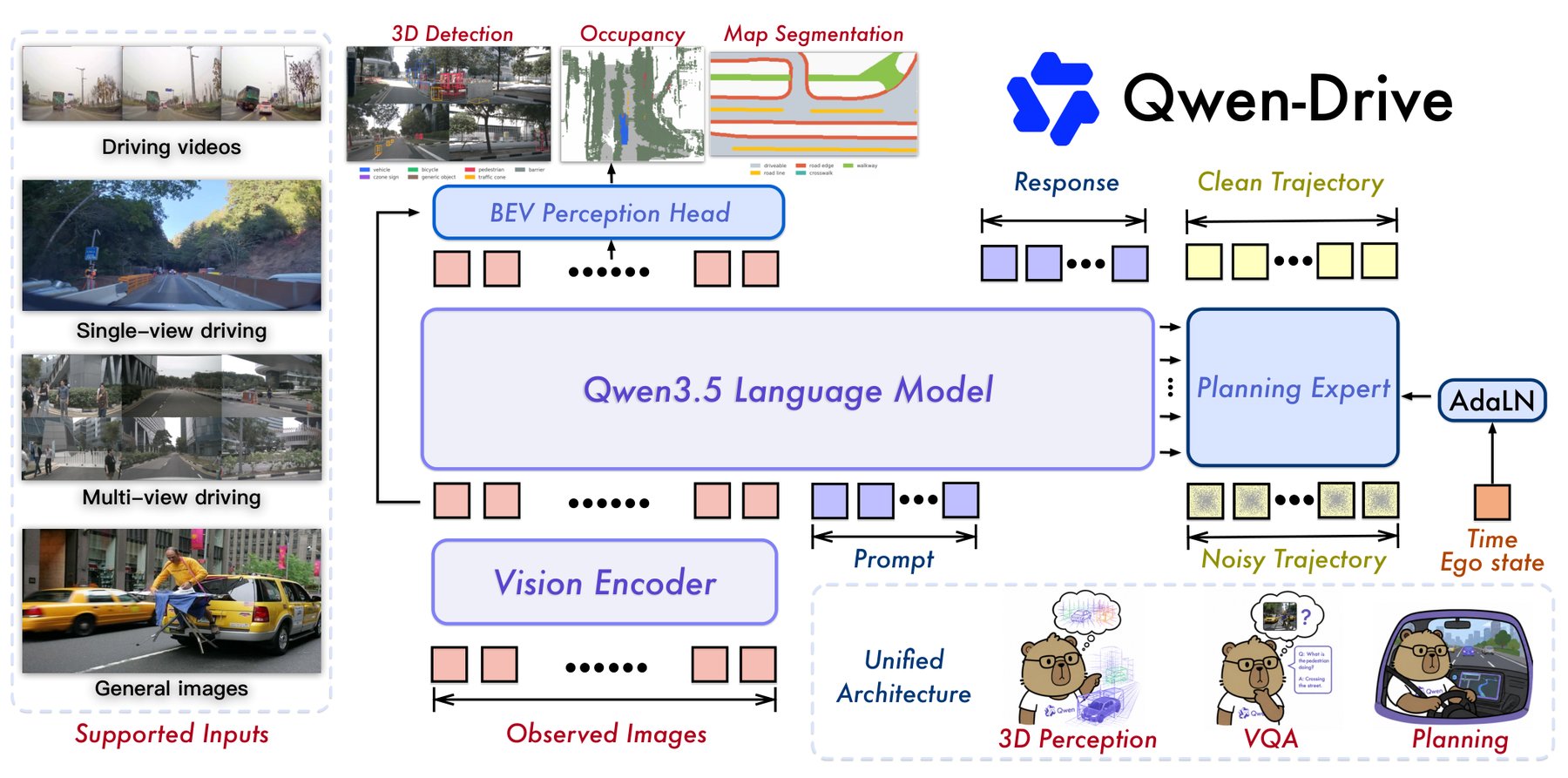
Here’s the breakdown:
| Component | Technical Role | What It Outputs | Key Constraint |
|---|---|---|---|
| Qwen3.5-4B VLM | Shared multimodal backbone | Vision-language features, general and driving VQA | The “4B” label describes the shared VLM only |
| BEV Perception Head | Reads shared features for explicit 3D structure | 3D object detection, semantic occupancy, BEV map segmentation | External module, not a full sensor stack replacement |
| Planning Expert | Cross-attends to VLM key/value caches | Future ego trajectories | ~1B additional parameters beyond the 4B backbone |
| LLM Decoder | Original Qwen3.5 decoder, unchanged | Natural-language answers | Language output is separate from trajectory output |
The Planning Expert is the interesting piece. It doesn’t need its own image encoder, it reads the internal caches from the Qwen3.5 attention layers via cross-attention. Scene information flows directly into trajectory generation without being funneled through a hand-designed intermediate representation.
The BEV perception head serves a different, almost scientific purpose. It’s deliberately simple, acting as an “inspectable 3D probe” that reveals how much spatial information the shared representations actually contain. The researchers needed to know: can a text-image model that describes pictures well actually understand three-dimensional space?
Spoiler: not automatically.
Text-Image Models Don’t Understand Space (Yet)
The team’s experiments confirmed something subtly important. When they trained only the added components and left the vision-language model frozen, spatial accuracy stayed low. A model that can describe a traffic scene in vivid detail still doesn’t inherently grasp distance, position, or open space. That understanding has to be built in deliberately during training.
Only when they trained the VLM itself on spatial tasks did perception performance improve significantly. This matches what the Qwen team found with their HopChain benchmark, vision-language models misclassify objects and confuse spatial relationships even while scoring well on standard image-text benchmarks.
This echoes broader concerns about whether popular benchmarks actually measure what they claim to measure. The Qwen team has been vocal about benchmark flaws, and their driving work reinforces the point: generic visual understanding doesn’t automatically translate to spatial competence.
The Staged Training Recipe
The training approach is worth understanding because it tackles two problems simultaneously: acquiring driving-specific competence while avoiding catastrophic forgetting.
The recipe runs in stages, perception first, then perception combined with question answering, then route planning. The final step applies reinforcement learning to refine driving behavior. For the vision-language component specifically, the team combined 24 public driving datasets with different structures and, inevitably, inconsistent labels. An AI model standardized the questions and answers while aligning them with the original data. They also built custom examples explaining why the car should make a specific decision, like which object triggers braking.
This focus on preserving general capability matters for a practical reason. In modern vehicles, infotainment and driving systems are converging on a single computing unit. A model that trades general abilities for pure driving performance would force automakers to run a separate cockpit model anyway. Qwen-Drive-1.0 aims to be the one model that does both.
Benchmarks: Where It Wins and Where It’s Honest
The results table deserves a close read because it reveals both genuine strengths and carefully communicated limitations.
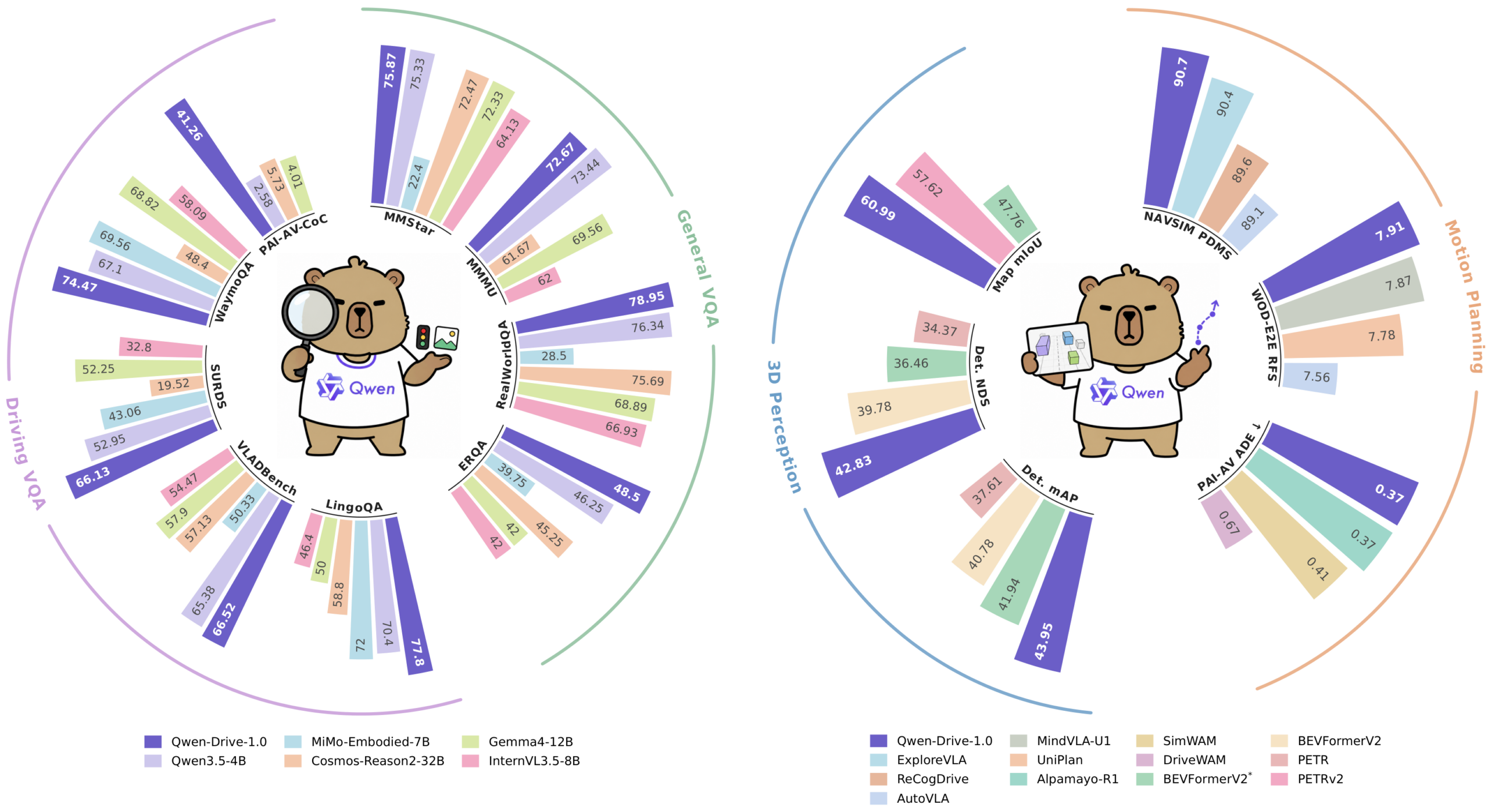
Motion planning:
| Benchmark | Qwen-Drive-1.0-SFT | Qwen-Drive-1.0-RL | Best Competitor |
|---|---|---|---|
| WOD-E2E RFS val/test | 7.95/7.78 | 8.45/7.91 | MindVLA-U1: 8.20/7.87 |
| WOD-E2E ADE 5s val/test | 2.31/2.65 | 1.27/2.67 | MindVLA-U1: 2.28/2.66 |
| NAVSIM PDMS | 88.2 | 90.7 | SpanVLA: 90.3 |
| AlpaSim at-fault score | 0.27 | 0.37 | Alpamayo-1.5: 0.45 |
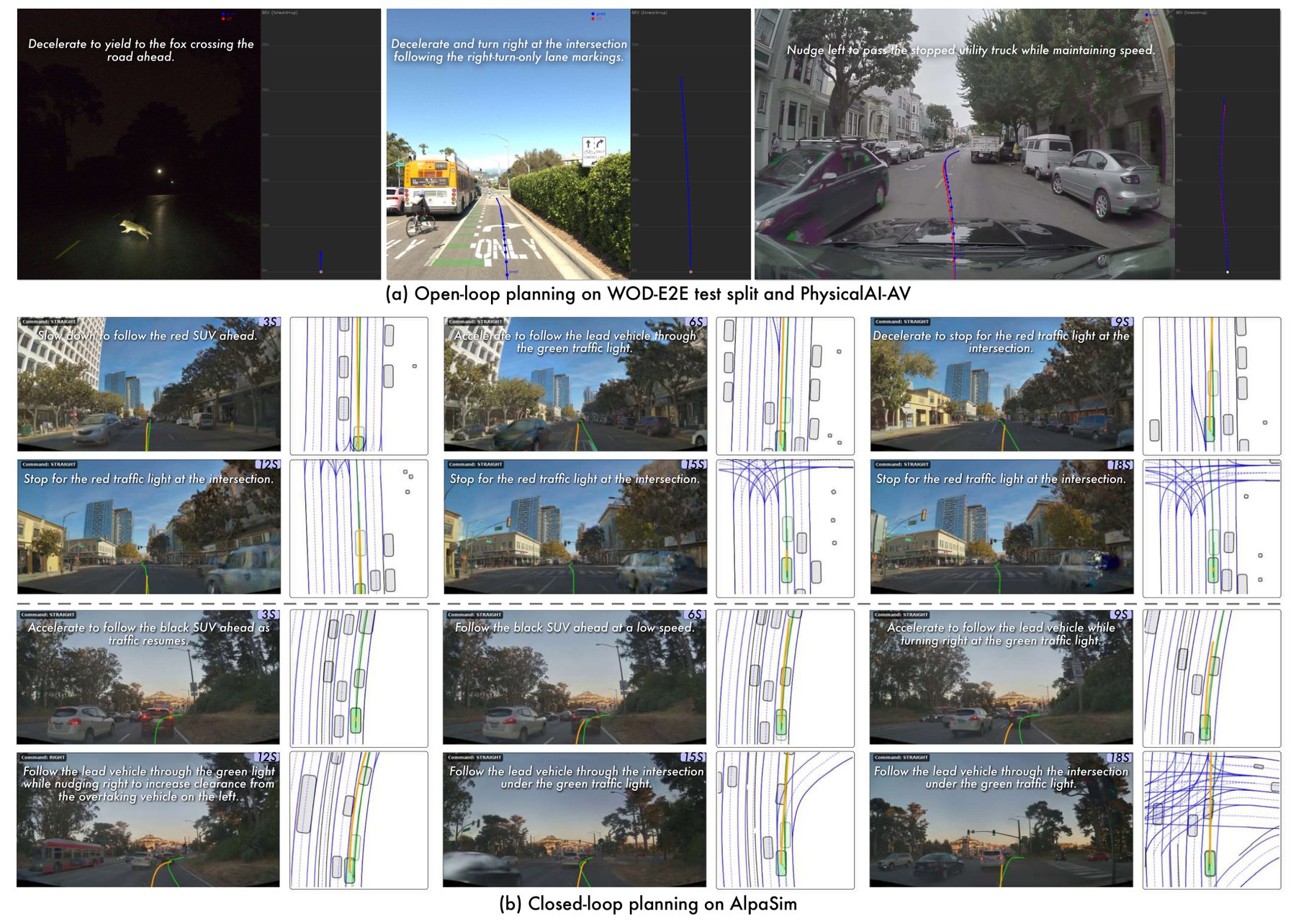
The RL-tuned version leads on most metrics. But the closed-loop AlpaSim result tells a more nuanced story, Qwen-Drive’s RL planner improves over its SFT counterpart but still trails Alpamayo-1.5.
Driving VQA:
The gap between Qwen-Drive and general-purpose models is dramatic here. LingoQA jumps from 46.4 (InternVL3.5-8B) or 70.4 (base Qwen3.5-4B) to 77.8. Ego3D RMSE drops from 9.85 (MiMo-Embodied-7B) to 7.78. On CoC, a causality benchmark, Qwen-Drive scores 41.3 while every other model sits between 0.6 and 3.4. That’s not incremental, that’s a different class of behavior.
General capability preservation:
The catastrophic forgetting concern appears largely addressed. Qwen-Drive-1.0-SFT scores on par with the base Qwen3.5-4B across knowledge, reasoning, and recognition benchmarks. On some spatial understanding tests, it actually improves: RealWorldQA jumps from 76.3 to 79.0, EmbSpatial from 76.0 to 78.9, ODinW13 from 40.8 to 45.9.
Oh, and the LingoQA scoring note is worth flagging. The team used Qwen-Plus as the judge instead of the official LingoJudge, which they found “score(s) leniently and inconsistently.” Under the official protocol, Qwen-Drive obtains 79.4. That kind of methodological transparency is refreshing, and consistent with Qwen’s broader critiques of benchmark practices.
What the Model Can’t Do (and Won’t Admit)
Here’s where the marketing noise needs filtering. Qwen-Drive generates trajectories inside a research framework. It does not provide the surrounding engineering stack that makes real vehicles safe: synchronized sensors, calibration, localization, deterministic control, real-time scheduling, fault detection, degraded-mode behavior, redundancy, cybersecurity, and validation across rare edge cases.
The perception results come with notable caveats too. When the model encounters footage from unfamiliar camera configurations, different placements, different calibrations, detection performance drops significantly. The team acknowledges suitable training data for those configurations simply doesn’t exist yet.
And then there’s the reasoning-reliability gap. The model’s explanations don’t always match its actual driving decisions. A red light in the distance and a child stepping into the road demand very different reaction times, and the model can conflate them. The planned maneuver doesn’t always correspond to the reasoning provided beforehand.
The team is admirably direct about this. But it’s worth emphasizing for anyone tempted to treat “explainable AI” as a solved problem just because a model can narrate its decisions.
The Real Contribution: Modularity as Architecture
Strip away the driving hype and the strongest technical contribution becomes clear: the clean separation between a reusable multimodal representation and specialized, inspectable driving heads.
The repository structure makes this operational, not just conceptual:
Qwen-Drive-1.0-4B/          9.1 GB  the VLM, which on its own serves the VQA mode
├── planner-sft/            2.1 GB  Planning Expert, imitation-trained
├── planner-rl/             2.1 GB  Planning Expert after reward optimization
└── perception/             0.5 GB  BEV perception head
Load the VLM alone for question answering. Attach the SFT or RL planner when you need trajectories. Use the perception class for BEV outputs. Each component loads independently based on the task.
The quickstart is refreshingly straightforward:
import torch
from qwen_drive import InferenceMode, QwenDriveForPlanning

model = QwenDriveForPlanning.from_pretrained(
    "Qwen-Drive-1.0-4B",
    planner="Qwen-Drive-1.0-4B/planner-rl",
    dtype=torch.bfloat16,
    attn_implementation="flash_attention_2",
).to("cuda").eval()

result = model.run(InferenceMode.REASONING_PLANNING, scene=scene, num_samples=6)
print(result.reasoning)
print(result.trajectories.shape)   # (6, 50, 3) -> (x, y, heading), 5 s at 10 Hz
The trajectory output is six samples by 50 future steps by three values, x, y, heading, covering five seconds at 10 Hz. That’s a motion-planning proposal, not low-level steering commands. The RL planner was reward-optimized on reasoning-conditioned rollouts, so it runs best with an explicit reasoning step before trajectory sampling.
The hardware requirements keep this firmly in research territory: recommended 24GB+ VRAM, Python 3.10+, PyTorch 2.8+, Transformers 5.14.x, and FlashAttention. This isn’t an embedded ECU model.
What This Means for the Industry
The release lands in the middle of a steady run of Qwen open-source releases across vision and language. This driving model is the first to extend that lineage directly into the autonomous-driving domain.
The strategic implications are significant. A permissively licensed 4B driving VLM from a top Chinese lab gives independent research labs and lower-tier automakers a fine-tunable base. It also applies pricing pressure to closed AV stacks that charge for equivalent capability. When the Qwen team lost key leadership earlier this year, the concern was that model development would stall. Releases like this suggest the pipeline is still producing.
For the broader autonomous-driving research community, this is a shift from narrowly specialized perception networks toward multimodal foundation models that combine visual understanding, language reasoning, explicit spatial representations, and planning. The architectural bet is that one backbone can learn richer scene semantics than a pipeline where every task is optimized independently and information is discarded at each interface.
The Bottom Line
Qwen-Drive-1.0 is a research model with research limitations. It’s not road-certified, it struggles with unfamiliar camera rigs, and its explanations occasionally diverge from its actions. Anyone treating it as production-ready autonomous driving software is reading the release wrong.
But as a test of whether one multimodal representation can support scene understanding, explicit 3D structure, reasoning, and trajectory generation simultaneously? The results are genuinely impressive. The RL planner cuts off-road driving incidents from 24% to 12% in simulation. The VQA gains over specialized driving models are substantial. And the general capability preservation means this could plausibly serve as a unified cockpit-and-driving model.
For developers, the immediate value is reproducibility: open weights, inference code, demo scenes, evaluation scripts, and modular components make the architecture inspectable in ways closed automotive foundation models rarely are. You can run the demo scenes end-to-end with scripts/demo.py from the GitHub repo without any additional data.
The bigger question isn’t whether this model can drive. It’s whether VLM-based planners can maintain this apparent flexibility once the benchmark environment is replaced by the latency, reliability, and long-tail safety requirements of real traffic. That question remains open. But for the first time, it’s a question researchers outside the major labs can actually investigate, with a downloadable model, under a permissive license, on hardware that costs less than the car itself.
Just don’t install it in your actual car. The Reddit commenter who tried did not survive to report back.