
This isn’t hypothetical. It’s a real scenario playing out in university halls right now, and it’s exposing a brutal disconnect between what we’re teaching and what’s actually happening in the trenches. The research is stark: AI isn’t coming for data science jobs, it’s already surgically removing specific roles while simultaneously creating a hunger for skills most programs don’t teach.
The Displacement Is Happening Now, Not Later
Let’s cut through the speculative hand-wringing. According to a recent Nature investigation, the obsolescence of basic data roles “is not even in the future. It’s happening now.” Xuanhe Zhao, a mechanical engineer at MIT, puts it bluntly: “AI is doing this much better than entry-level scientists.” The evidence isn’t just anecdotal, it’s measurable. The American Translators Association’s Science & Technology Division has watched membership crater by 26% in less than two and a half years as AI-powered translation vaporized that career path. Former translators are now driving for DoorDash.
The academic labs tell the same story. Brian Hie, a computational biologist at Stanford, declares that research programmer positions “are now obsolete” because AI code generation outperforms human juniors. Hannah Wayment-Steele at the University of Wisconsin, Madison admits that if she were starting her lab five years ago, she’d have hired a research programmer. Today? “I really don’t see a need for that.” Even hiring for graduate research assistants is getting conservative, with Nanshu Lu at UT Austin citing “AI, for sure” as a factor.
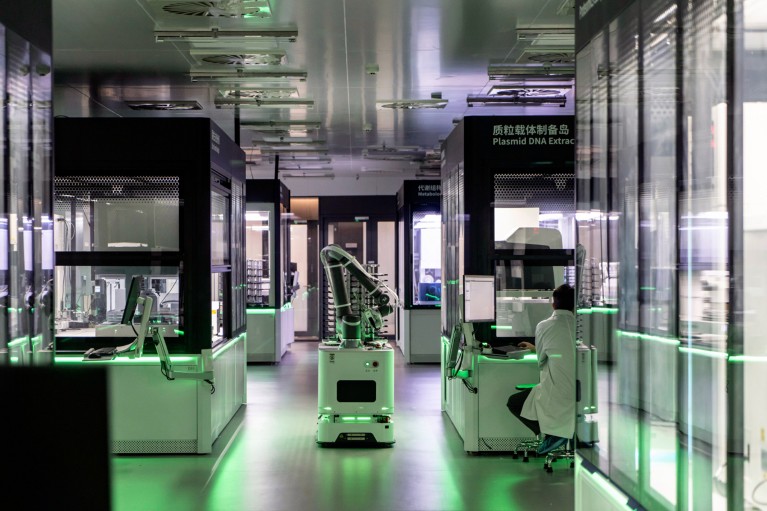
This is the uncomfortable truth that guest lecturer is terrified to voice: the entry-level pipeline is collapsing. The traditional stepping stones, data cleaning, basic modeling, dashboard building, are being automated at a speed that makes last year’s skills look like a punch card. Anton Korinek, an economist at UVA, frames it coldly: Jobs involving “purely cognitive tasks will be first” to go. “Traditionally, these are the jobs that were most closely associated with scientific research. They will shortly be taken over by AI.”
But The Job Market Data Tells a Different Story
Here’s where the narrative gets spicy. While academic labs are freezing entry-level hires, the broader market is exploding. AI, machine learning, and data science roles totaled 49,200 job postings in 2025, up 163% from the previous year. That’s not a typo, one hundred sixty-three percent growth while traditional roles evaporate.
The disconnect? Role evolution, not replacement. The market isn’t rejecting data scientists, it’s rejecting data scientists who only know how to work in notebooks. The podcast Super Data Science cuts through the panic by pointing out that even OpenAI and Anthropic are aggressively hiring developers despite having AI that can write code. Why? Because how AI engineering roles are evolving from core data engineering skills reveals a truth: someone needs to build, validate, and monitor the systems that AI plugs into.
The jobs growing fastest aren’t “data scientist” in the traditional sense, they’re AI/ML engineers who understand production pipelines, MLOps architects who can orchestrate automated retraining, and research scientists who can design studies that AI can’t. The title changed, but the core need intensified.
The Causal Inference Moat
So what exactly can AI not do? The answer lies in a skill most master’s programs barely touch: causal inference. As one experienced practitioner noted in online discussions, “Causal inference models can’t be automated very well by AI since they require hands-on experience to build and knowledge of how cause & effect works. Job security!”
The distinction is critical. Predictive models, the bread and butter of traditional data science, are optimized on loss functions. AI can brute-force those. But estimating a causal effect requires understanding confounders, designing interventions, and knowing how close you are to the true population parameter. Unlike prediction, there’s no easy validation metric. This is why why data alone doesn’t guarantee AI success, relevant to data science career value beyond data access matters, having petabytes of data doesn’t help if you can’t frame the right causal question.
The problem? Causal inference is “hard to sell” to stakeholders who want quick predictions. It’s academically dense and doesn’t demo well. But that’s precisely why it’s defensible. While AutoML hoovers up predictive work, the ability to answer “what happens if we change X?” becomes the premium skill.
From Code Writer to AI Orchestrator
The real transformation isn’t in what gets done, it’s in who does what. The Towards Data Science article on “Code Smells” reveals the new reality: everyone has effectively become a senior developer guiding a junior (the coding assistant). Your value isn’t writing code, it’s reviewing, architecting, and steering AI agents away from disastrous decisions.
Consider this classic “do-it-all” ML pipeline class that AI coding assistants love to generate:
class ModelPipeline:
    def __init__(self, data_path):
        self.data_path = data_path

    def load_from_s3(self):
        print(f"Connecting to S3 to get {self.data_path}")
        return "raw_data"

    def clean_txn_data(self, data):
        print("Cleaning specific transaction JSON format")
        return "cleaned_data"

    def train_xgboost(self, data):
        print("Running XGBoost trainer")
        return "model"
This is a textbook code smell called “Divergent Change”, one class handling infrastructure, data engineering, and ML concerns. When requirements shift, this becomes a brittle nightmare. An AI agent will happily churn out this pattern because it’s syntactically correct and looks structured. But it’s technical debt waiting to happen.
The fix requires architectural intuition:
class S3DataLoader:
    """Handles only Infrastructure concerns."""
    def load(self):
        print(f"Connecting to S3 to get {self.data_path}")
        return "raw_data"

class TransactionsCleaner:
    """Handles only Data Domain/Schema concerns."""
    def clean(self, data):
        print("Cleaning specific transaction JSON format")
        return "cleaned_data"

class XGBoostTrainer:
    """Handles only ML/Research concerns."""
    def train(self, data):
        print("Running XGBoost trainer")
        return "model"

class ModelPipeline:
    """The Orchestrator: It knows 'what' to do, but not 'how' to do it."""
    def __init__(self, loader, cleaner, trainer):
        self.loader = loader
        self.cleaner = cleaner
        self.trainer = trainer

    def run(self):
        data = self.loader.load()
        cleaned = self.cleaner.clean(data)
        return self.trainer.train(cleaned)
This separation minimizes operational risk, makes testing trivial, and lets you swap components like Lego bricks. But here’s the kicker: AI can’t decide which architecture fits your context. The first approach might be fine for a one-off notebook. The second is essential for production. Knowing the difference, and guiding your AI assistant accordingly, is now the core skill.
The Missing Curriculum
This is where academia is catastrophically failing. The Miller School of Medicine is a rare exception with their MIL Agentic Data Scientist platform, which embeds AI into research training. But most programs still teach students to write code in isolation, not orchestrate AI agents.
The essential curriculum isn’t more algorithms, it’s software engineering hygiene. As the Towards Data Science piece argues, you need to understand code smells, abstraction, and design patterns to review AI output effectively. Yet most data science graduates have never done a proper code review in their lives.
This gap explains why the shift from traditional data governance to AI readiness in modern data careers is so painful. Governance was about controlling human access, AI readiness is about controlling agent behavior. The rules are different, and most curricula haven’t caught up.
The Jobs That Are Safe (For Now)
Let’s get specific about where the growth actually is. The 163% spike in job postings isn’t for dashboard builders. It’s for:
- AI/ML Engineers who can productionize models and handle open-source AI ecosystems reducing dependency on proprietary tools and shifting skill demands
- MLOps Architects who understand how cost and performance disruption in AI models, affecting job market dynamics impacts infrastructure decisions
- Research Scientists with deep domain expertise who can frame questions AI can’t articulate
- Data Product Managers who translate between business needs and AI capabilities
The common thread? Human-in-the-loop judgment at critical decision points. AI can generate 100 candidate models, but someone needs to know which ones make business sense. AI can write data pipelines, but someone needs to architect the system so it doesn’t collapse under its own complexity.
What You Actually Tell Students
So back to our terrified guest lecturer. Here’s the honest script they need:
- 1. “Yes, the entry-level job you imagined is probably dead.” The days of getting paid $80K to clean CSVs and run
.fit()are over. AI does that better, faster, cheaper. Don’t sugarcoat it. - 2. “Your skills are valuable, but only if you level up.” Learning production ML pipelines isn’t optional, it’s survival. The career transition challenges in the face of technological disruption, similar to today’s AI shift show that those who adapt early define the new normal.
- 3. “Focus on what AI can’t automate: context and causality.” Master causal inference. Understand the business domain deeply. Develop communication skills to sell complex ideas. These are the moats.
- 4. “Treat AI as your junior developer, not your replacement.” Your job is now code review, architecture, and orchestration. The manual labor of writing code has been offloaded. The fun part, solving problems, remains yours, but only if you know how to direct the AI.
- 5. “The job market is growing, but the titles are changing.” Look for AI/ML Engineer, MLOps, and Research Scientist roles. The “data scientist” title is morphing into something that requires end-to-end ownership. Open-source AI advancements changing accessibility and skill requirements mean you’ll need to evaluate tools, not just use them.
- 6. “Build projects that show judgment, not just accuracy.” Anyone can get 95% accuracy on Kaggle with AutoML. Show me you chose the right problem, designed a solution that scales, and validated it in a way that matters to stakeholders. That’s the portfolio that gets hired.
The Bottom Line
The AI disruption in data science isn’t a future event, it’s a current restructuring. The pipeline is collapsing at the entry level while the top end balloons. This isn’t fair to new graduates, but it’s reality.
The educators who serve their students are the ones who stop teaching syntax and start teaching steering. Who replace notebook assignments with production system design. Who grade on architectural decisions, not just model performance.
As for that guest lecturer? They should walk into the room and say: “The job you thought you were training for is gone. But the job you can have instead is more impactful, better paid, and honestly more interesting. It just requires accepting that you’re not here to write code. You’re here to think, and to make AI think with you.”
That’s not scary. That’s liberating. And it’s the only honest thing to say.