The Slack message hits at 4:47 PM on a Friday: “Stripe SDK v15 released. Breaking changes in payment intent handling. Migration guide attached.” Your stomach drops. You know what this means. It isn’t just updating a dependency version in requirements.txt. It’s three weeks of refactoring business logic, rewriting unit tests, and praying that the checkout flow doesn’t implode during Black Friday.
This is the hidden tax of SDK entities leaking into your business layers. It starts innocently enough, a quick import stripe in your order service, a direct reference to StripePaymentIntent in your domain models. “It’s just faster this way”, you tell yourself. Until it isn’t.
The Trap of Convenience
Most teams don’t set out to violate layered architecture principles. They follow the path of least resistance: presentation layer calls business layer, business layer calls data layer, and somewhere in the middle, someone drops a from paypal_sdk import PaymentRequest because they need to process a refund right now.
The immediate result works. The long-term result is architectural quicksand. When the payment gateway updates their API, which they will, because external vendors have this annoying habit of “innovating”, that change propagates upward like a crack in a foundation. Your business logic, which should be sacred and stable, suddenly depends on the versioning whims of a third-party JavaScript wrapper.
The prevailing sentiment on developer forums is that this is among the most disruptive patterns in modern application development. Yet it remains ubiquitous because it feels efficient in the moment.
Why the Gateway Pattern Falls Short
Some teams recognize the danger and attempt isolation through the Gateway Pattern. They create an IntegrationLayer that sits between the business logic and the external SDK. The business layer talks to the gateway, the gateway talks to Stripe. Problem solved?
Not quite.
Even with a gateway, the dependency direction remains wrong. The business layer still references the integration assembly. When the SDK changes, the integration layer changes, and that change ripples upward because the business layer depends on that assembly. You’ve moved the problem one folder to the left, but you haven’t solved it.
The interface lives in the integration layer beside the payment service, meaning your core domain remains coupled to infrastructure concerns. This creates what architecture forums describe as a “leaky abstraction”, you’ve injected an API formulated in the terms and workflow of an external service directly into your business layer. You do an OOP trick with abstract class or interface inheritance to emulate dependency inversion, without actually protecting your business logic from implementation details.
Inverting the Dependency with Separated Interface
The fix requires flipping the relationship entirely. Instead of the business layer depending on the integration layer, the integration layer must depend on the business layer. This is the Separated Interface Pattern from Martin Fowler’s Patterns of Enterprise Application Architecture (2003), and it’s the conceptual predecessor to modern hexagonal architecture.
Here’s how it works in practice:
- Define a
PaymentGatewayinterface in your business layer (or application layer, depending on your granularity). This interface speaks your domain language:charge(order_id, amount),refund(transaction_id). - Your business logic depends only on this interface.
- Create an adapter in the infrastructure layer that implements this interface using the actual Stripe SDK.
- Use dependency injection to wire the concrete adapter to your domain service at runtime.
Now when Stripe releases v15 with breaking changes, you modify only the adapter. The business layer doesn’t know Stripe exists. It knows only the contract it defined for itself.
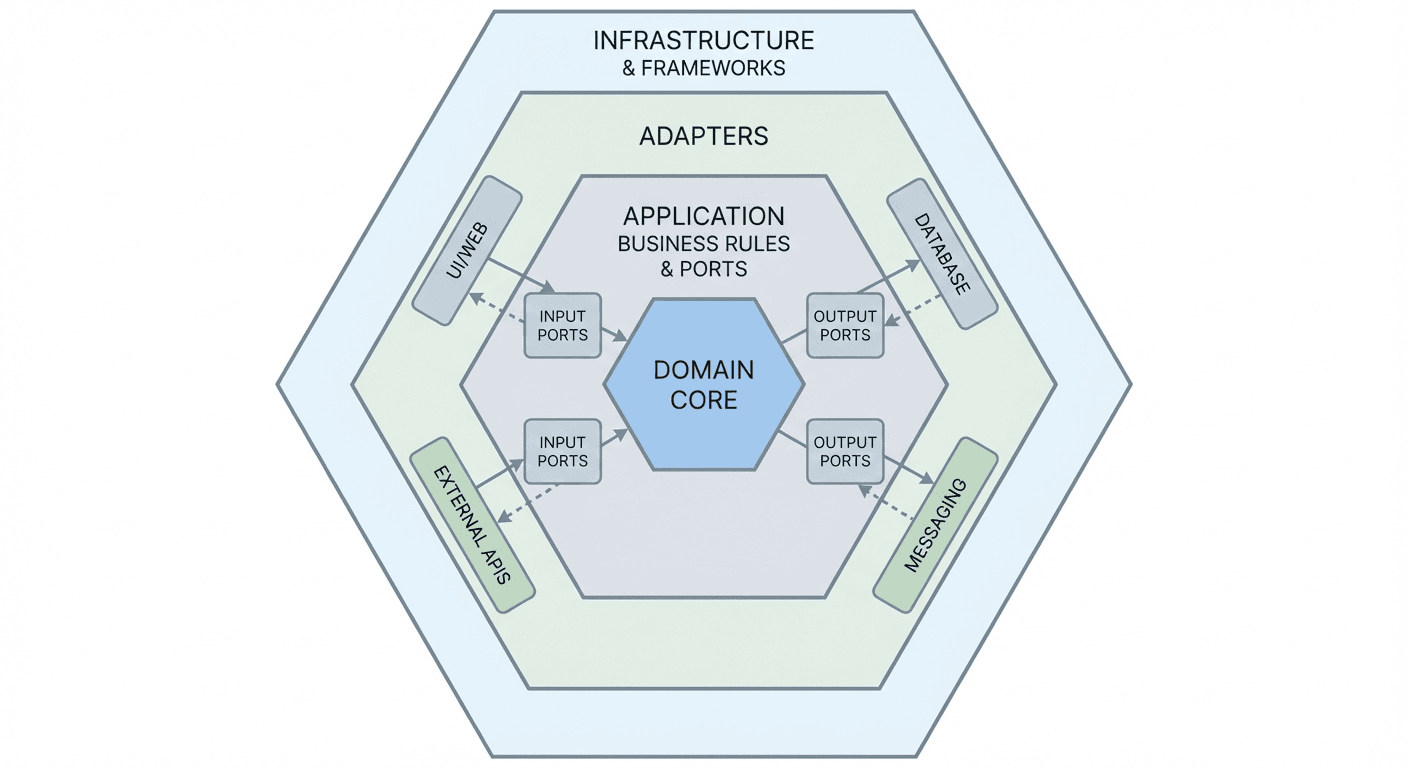
This approach aligns with Direct architectural pattern (Anti-Corruption Layer) to solve SDK leakage issues, which prevents external models from corrupting your domain’s ubiquitous language.
Hexagonal Architecture in Practice
The Separated Interface Pattern evolves into what Alistair Cockburn called Hexagonal Architecture (or Ports & Adapters). The domain sits at the center, completely isolated. It defines “ports”, interfaces through which it communicates with the outside world. Adapters plug into these ports.
Consider this Python implementation structure:
# domain/models/order.py
@dataclass
class Order:
    id: UUID = field(default_factory=uuid4)
    customer_id: str = ""
    items: List[OrderItem] = field(default_factory=list)
    status: OrderStatus = OrderStatus.PENDING

    def confirm(self) -> None:
        if not self.items:
            raise ValueError("Cannot confirm an order with no items")
        self.status = OrderStatus.CONFIRMED

# ports/output/payment_gateway.py
class PaymentGateway(ABC):
    @abstractmethod
    def charge(self, order_id: UUID, amount: float, customer_id: str) -> bool:
        pass

# domain/services/order_service.py
class OrderService:
    def __init__(self, order_repo: OrderRepository, payment_gateway: PaymentGateway):
        self._order_repo = order_repo
        self._payment_gateway = payment_gateway

    def confirm_order(self, order_id: UUID) -> Order:
        order = self._order_repo.find_by_id(order_id)

        # Process payment through the port
        success = self._payment_gateway.charge(
            order_id=order.id,
            amount=order.total_amount,
            customer_id=order.customer_id
        )
        if not success:
            raise ValueError("Payment failed")

        order.confirm()
        self._order_repo.save(order)
        return order
The OrderService knows nothing about Stripe, PayPal, or cryptocurrency. It knows only that it has a PaymentGateway port. The concrete implementation lives in the adapters:
# adapters/output/stripe_payment.py
class StripePaymentGateway(PaymentGateway):
    def __init__(self, api_key: str):
        self._client = stripe.Client(api_key)

    def charge(self, order_id: UUID, amount: float, customer_id: str) -> bool:
        # Translate domain request to Stripe-specific API call
        try:
            self._client.payment_intents.create(
                amount=int(amount * 100),  # Stripe uses cents
                currency='usd',
                metadata={'order_id': str(order_id)}
            )
            return True
        except stripe.error.CardError:
            return False
When Stripe changes their API, you modify only StripePaymentGateway. When you want to switch to PayPal, you write a PayPalPaymentGateway adapter implementing the same interface. The domain remains untouched.
This modularity is crucial for Discussing how integration layers accumulate technical debt similar to SDK misuse, where tight coupling creates invisible drag on system evolution.
The Testing Dividend
This architecture doesn’t just save you during vendor migrations, it transforms your testing strategy. Domain unit tests require zero mocks because domain models have no external dependencies. You’re testing pure business logic:
def test_cannot_confirm_empty_order():
    order = Order(customer_id="C001")
    with pytest.raises(ValueError, match="no items"):
        order.confirm()
For service-level tests, you mock only the ports (interfaces), not concrete implementations:
def test_confirm_order_with_payment():
    mock_repo = MagicMock()
    mock_payment = MagicMock()
    service = OrderService(mock_repo, mock_payment)

    order = Order(customer_id="C001")
    order.add_item(OrderItem("P001", "Laptop", 1, 1500.00))
    mock_repo.find_by_id.return_value = order
    mock_payment.charge.return_value = True

    result = service.confirm_order(order.id)
    assert result.status.value == "confirmed"
No database spin-up. No Stripe test API keys. No network calls. Just fast, deterministic tests that validate your business rules.
The Real Cost of Leakage
When SDK entities leak into business layers, you don’t just get brittle code, you get operational stagnation. Teams avoid upgrading dependencies because the blast radius is too large. They postpone switching vendors even when the current one is bleeding them dry on transaction fees, because the migration would require touching every service that handles money.
This creates Broadening the scope of debt to include organizational factors affecting modernization. The technical constraint becomes a business constraint. You’re stuck with 2023 pricing and 2024 security vulnerabilities because your architecture made change prohibitively expensive.
The architecture also helps manage Contrasting tight SDK coupling with the costs of loose coupling architectures, providing explicit boundaries rather than implicit dependencies that masquerade as decoupling.
Implementation Without the Rewrite
You don’t need to refactor your entire monolith tomorrow. Start with the Separated Interface Pattern on your next external integration:
- Define the interface in your domain/application layer based on what your business needs, not what the SDK provides.
- Implement the adapter in infrastructure.
- Inject it.
Over time, these adapters form an Illustrating how architectural coupling leads to systemic silent failures prevention layer, isolating your core logic from the chaos of external change.
The goal isn’t architectural purity, it’s operational sanity. When that Friday afternoon Slack message arrives, you should be able to update a single adapter file, run your tests, and go home. Not rebuild your entire payment flow.
Your business logic deserves better than to be a hostage to someone else’s SDK changelog.