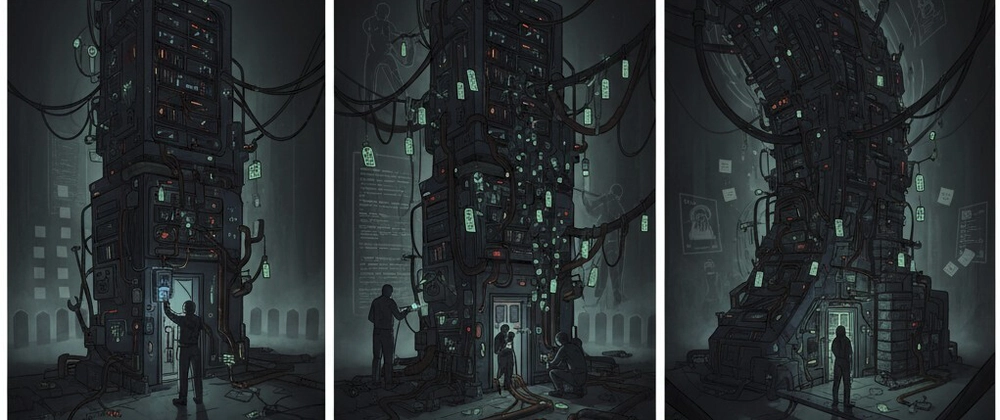
Your monitoring dashboard is green. Error rates are flatlined at zero. The on-call rotation is so quiet you could hear a mouse click. And yet, your biggest customer just discovered they’ve been underbilled by $400,000 over eighteen months. No one pushed buggy code. No alerts fired. The system worked exactly as designed. The problem is that five different teams designed five different systems, and they all happen to share the same database.
This is the architecture of team edge cases: failures that don’t live in your code, but in the negative space between organizational boundaries.
The Five Realities Problem
In a typical SaaS company, the same “user” concept exists simultaneously in five parallel universes:
Product defines a user as an entity with a subscription tier, feature entitlements, and usage limits. Their reality is a clean hierarchy of plans and permissions.
Engineering implements a user as a database record with nullable fields, boolean flags, and a status column that made sense three years ago. Their reality is a normalized schema that balances performance with flexibility.
Billing understands a user as an invoice recipient with payment terms, tax jurisdiction, and revenue recognition rules. Their reality is a ledger that must balance to the penny.
Support sees a user as a ticket history, a collection of past issues, and a “please make this work” exception policy. Their reality is the emotional weight of customer satisfaction.
Finance views a user as a line item in a cohort analysis, a churn risk, and a margin calculation. Their reality is spreadsheets that must reconcile with the bank account.
Each interpretation is “correct” in isolation. Each team builds features that make perfect sense within their reality. But when these interpretations stack over quarters and years, you get what one developer described as “organizational gravity”, a force so subtle you don’t notice it until you’re crushed by it.

The Status Field That Ate a Company
A manufacturing firm ran their operations on a legacy mainframe with a two-character “status” field. Users had spent decades learning its quirks. Every team invented their own two-character codes. By the time modernization came around, every possible combination was spoken for, each with tribal meaning known only to specific departments.
Engineering dutifully replicated this field in the new web interface. One day, a director requested that the combination ?. trigger a backend workflow. Soon, other directors wanted their own magic codes. The switch statement metastasized. Teams started triggering each other’s workflows accidentally. Was this a bug? The code performed exactly as specified. The specification, however, had become a shared hallucination.
This is how team edge cases evolve: not through malice or incompetence, but through the accumulation of locally rational decisions. The horror isn’t in the code, it’s in the fact that no single team owns the semantic integrity of the system. The “status” field didn’t mean anything anymore, and it also meant everything.
Why Your Monitoring Is Blind
Traditional observability looks for crashes, latency spikes, and error logs. Team edge cases manifest differently:
- Financial drift: Customers get grandfathered into pricing that no longer exists, creating a growing margin hole that only appears in quarterly reviews.
- Entitlement confusion: A user’s “pro” features work on web but not mobile because two teams interpreted the entitlement matrix differently.
- Policy decay: Support grants manual exceptions that become permanent, while billing continues charging the old rate, and product’s analytics count them as churned.
These issues survive because nothing crashes. The system is working. A 2012 leap second incident taught us that when time itself behaves unexpectedly, systems don’t fail, they just enter live-lock, spinning in circles, unable to make progress. The same happens with semantic drift: every component waits for another to be the source of truth, and the whole system becomes a distributed denial-of-service attack against itself.
As one analysis of distributed systems noted: “A clock drifting slightly, a disk failing occasionally, or a message arriving late does not feel like a problem on its own. But when these small deviations happen across many machines and services, they stop being edge cases and start becoming normal behavior.”
The Gravitational Field of Operational Debt
Operational debt is technical debt’s sociopathic cousin. While technical debt lives in your codebase, operational debt lives in your org chart. A legacy ERP study found that distributors using outdated systems experience error rates 3-5 times higher than modern platforms, not because the code is buggy, but because manual workarounds become standard practice.
Consider the anatomy of a single order in such a system:
– Web orders arrive via email because there’s no native integration
– Someone manually enters them, checking inventory across three screens
– They email the warehouse for back-order timelines
– Finance runs batch invoices overnight
– Customer service can’t track status because sync happens once daily
Each step is “correct” within departmental constraints. The cost? For a 50-person operation, 15-20 hours of daily productivity loss, equivalent to burning $150,000-$225,000 annually on work that adds zero value.
The truly insidious part? Leadership often can’t see it. The system works “good enough.” Employees adapt rather than escalate. As the ERP analysis notes: “The gradual nature of operational debt makes it particularly dangerous. By the time the pain becomes undeniable, competitors have already gained significant advantages.”
Operational debt compounds silently until it becomes a strategic constraint, not just a technical one.
When Edge Cases Become Identity
There’s a moment in every system’s life when debt stops being a backlog item and becomes a gravitational field. Every shortcut adds mass. Every workaround deepens the well. You don’t pay down this debt, you atone for it.
The DEV Community’s “Tech Horror Codex” frames this perfectly: “You’re not maintaining a system. You’re maintaining a haunting.” The patch is a prayer. The backlog is a tomb. Every sprint becomes a séance to summon stability from beneath layers of unresolved decisions.
This is why these issues are politically impossible to fix:
- No clear owner: The bug lives in the space between teams. Each team can prove their component works correctly.
- Legitimate users depend on the bug: That workflow trigger based on
?.status? Finance uses it for quarterly close. Breaking it means breaking the business. - Support has already built a cathedral of workarounds: Their manual process is documented, trained, and measured. Automating it would disrupt their metrics.
- The cost appears slowly: It’s not a $400K mistake. It’s $22,000/month for 18 months, each month looking like normal variance.
- From the outside, it’s a weird edge case: From inside, it’s just how things are done.
The UI as Organizational Scar Tissue
Here’s the diagnostic trick: The frontend reveals what the backend tolerates. If the UI has a “Fix This” button that manually recalculates billing, that’s not a feature, it’s an organizational scar. If there’s a dropdown with 47 status options, that’s not flexibility, it’s a timeline of every departmental power struggle since 2019.
The interface reflects what the company allows culturally and operationally, not what the architecture properly enforces. Every manual override field, every “admin only” checkbox, every “recalculate” button is a testament to a decision that was too hard to make correctly the first time.
Detecting the Undetectable
You can’t fix what you can’t see. Traditional error tracking won’t help, but semantic drift detection can:
Cross-team invariant monitoring: Don’t just check that user.is_pro is true. Check that billing.recognizes_pro(), support.can_grant_pro_features(), and analytics.counts_pro_correctly() all agree on what “pro” means.
Financial reconciliation as a service: Run continuous double-entry bookkeeping between teams. Does the sum of all “active” users in product equal the sum of “billable” users in finance? If not, you’ve found a semantic leak.
Workaround heatmaps: Instrument your UI to see which manual processes are used most. If 80% of support tickets involve the “override” button, you don’t have a support problem, you have a design problem.
Policy entropy metrics: Measure how many exceptions exist per rule. A growing exception-to-rule ratio means your policy is decaying into a collection of edge cases.
The Path Forward: Semantic Synchronization
Fixing this requires more than code, it requires cross-functional data contracts. Not the legal kind, but the computational kind: explicit, versioned, enforced agreements about what shared concepts mean.
-
Event sourcing with team-level schemas: Each team publishes their interpretation of state changes. A user upgrade isn’t a database update, it’s a
UserEntitlementChangedevent with schemas that product, billing, and support all validate against. -
Continuous reconciliation pipelines: Run daily jobs that check for semantic divergence. When billing’s “active user” count drifts from product’s, alert before it becomes a $400K surprise.
-
Kill the shared database: The monolithic database is the original sin of team edge cases. Move to bounded contexts with explicit APIs. If support needs to override billing, that should be a deliberate API call with audit logs, not a SQL update.
-
Semantic versioning for business rules: When product changes what “enterprise” means, version it. Keep the old definition running for existing users. Migrate explicitly rather than letting definitions change underneath people.
The Cost of Invisible Architecture
The most expensive bugs are the ones that don’t exist. They hide in the space between Jira tickets, in the assumptions of standup meetings, in the “that’s how we’ve always done it” that no one questions.
Team edge cases are a reminder that software is a sociotechnical system. The architecture isn’t just in your repos, it’s in your org chart, your meeting rhythms, your budget allocations. The code is the easy part. The hard part is maintaining a shared reality when every team naturally builds their own.
The leap second incident taught us that time isn’t absolute. Neither is “user”, “active”, or “paid.” Until we monitor for semantic drift with the same rigor we monitor for latency, we’ll keep building systems that are technically perfect and operationally haunted.
The next time your dashboard is green but the business is on fire, don’t look for a bug. Look for a boundary. The edge case isn’t in your code, it’s in the space between teams who stopped speaking the same language years ago.