The Rust Supply Chain Attack That Weaponized Cargo’s Own Safety Feature
How the arrayref compromise turned a routine cargo update into silent RCE, weaponizing yanked versions as bait
On August 20, 2026, someone typed cargo update and got owned. Not through a zero-day exploit or a sophisticated kernel vulnerability, through a build script. The Rust ecosystem just witnessed what happens when a package manager’s safety features become attack vectors.
The arrayref crate, a deceptively simple utility with 245 million downloads, became the delivery vehicle for what the Rust Security Response Team now calls one of the most sophisticated supply chain attacks the ecosystem has seen. The malicious version 0.3.10 lived on crates.io for just 86 minutes. But in that window, compiling any project that resolved the dependency was enough to silently execute a second-stage payload on the developer’s machine.
Here’s what happened, why it worked, and why your existing security tooling probably missed it.
The Anatomy of a Silent Compromise
The attack chain is elegant in its simplicity. arrayref 0.3.10 added exactly one line to its manifest, a dependency on proc-macro1, a typosquat of the legitimate proc-macro2 crate. The malicious package’s library source was a genuine copy of proc-macro2, so builds succeeded and tests passed. Nothing looked wrong.
The weapon lived entirely in build.rs, which Cargo compiles and executes automatically during any build. The script reassembled its command-and-control infrastructure from base64 fragments to evade string detection:
// proc-macro1-1.0.107/build.rs
const SRC_URL_PARTS: &[&str] = &["aHR0cHM6Ly8=", "MjMuMjU0Lg==", "MTY1Lg==", "MTEyOg==", "OTA4OS8="];
const END_URL_PARTS: &[&str] = &["MjMuMjU0Lg==", "MTY1Lg==", "MTEyOg==", "NDQz"];
Decoded, those fragments produce the payload host at 23.254.165.112:9089 and a C2 address at 23.254.165.112:443. The script then fetches an architecture-specific binary over TLS, with certificate validation completely disabled, and executes it detached from the build process.
On Unix, the payload lands at /tmp/rust-setup. On Windows, a PowerShell script and VBScript launcher appear in %TEMP%. The Windows path includes a particularly devious touch: the source comment explains that routing through WScript escapes Cargo’s job object, so the malware keeps running after the build finishes and the compiler exits cleanly.
Cargo’s Safety Feature Was the Delivery Mechanism
Here’s where this attack diverges from everything before it. The attacker didn’t just publish a malicious crate and hope developers found it. They weaponized Cargo’s “yanked version” warning as a lure.
Twenty-four seconds after publishing 0.3.10, the compromised droundy account began yanking every other modern release of arrayref, 0.3.9 through 0.3.5, done in a scripted burst by 07:15:40. The crates.io audit log shows the cadence of automation, not human action.
The psychology is brutal in its effectiveness. Developers and CI maintainers see warning: packagearrayref v0.3.9in Cargo.lock is yanked, consider updating to a version that is not yanked on every build. The “responsible” fix, cargo update -p arrayref, resolves to the only non-yanked modern release: 0.3.10. The original reporter to the RustSec advisory database confirmed this is exactly how they got hit.
The Rust Security Response Team has since unyanked the clean versions, and the malicious releases are gone. But the pattern should terrify you: the attacker turned the registry’s own trust signal into a delivery channel.
One-Line Injection, Multi-Crate Fallout
The compromise extended beyond arrayref. The same account published poisoned releases of internment 0.8.7 and append-only-vec 0.1.9 within 23 minutes. Each followed the same pattern: untouched library source, one injected dependency on a dropper crate.
| Crate | Version | Exposure Window | Status |
|---|---|---|---|
arrayref |
0.3.10 | 86 minutes | Removed |
internment |
0.8.7 | 90 minutes | Removed |
append-only-vec |
0.1.9 | 107 minutes | Removed |
proc-macro1 |
All versions | ~6 hours | Removed |
proc-macro-en |
All versions | Same day | Removed |
Six additional attacker-owned crates, proc-macro-en, aovine, arone, aronenao, and tinymember, were deleted in the same sweep. Notably, arone and aronenao were staged two days before the arrayref push, suggesting premeditation and infrastructure readiness that goes far beyond opportunistic compromise.
Why Static Analysis Missed It
The attack exploited a fundamental blind spot in how we secure package ecosystems. arrayref 0.3.10’s library source was clean. The single malicious line was in the manifest. And the actual payload was fetched at runtime from a bare IP address.
Most security scanners and static analysis tools would have flagged nothing. The malicious crate shipped genuine proc-macro2 source, so even code review would have been inconclusive. The build dependencies, base64, rustls, and ureq, are individually legitimate and could plausibly appear in any network-capable utility.
Even today, cargo audit shows clean for projects that resolved the poisoned version, because the malicious releases were deleted rather than yanked. The tooling gap is real, and it extends to local caches: a warm ~/.cargo/registry directory keeps building the payload offline even though the version no longer exists in the registry.
The Blast Radius: GUI, Crypto, and Everything Between
What makes this attack particularly dangerous is where arrayref sits in the dependency ecosystem. The crate’s 406 dependent versions include:
tiny-skia→sctk-adwaita(26M downloads) →winit(49.8M downloads) →egui/eframe/iced: most of the Rust GUI ecosystemblake3and related hashing librariesrevm-precompile: Ethereum infrastructurespl-token/solana-runtime: Solana tooling
Every caret range on 0.3.x accepted 0.3.10. And there’s a second-order effect worth noting: internment itself depends on append-only-vec, meaning a single resolve could pull two poisoned crates into one dependency tree.
Runtime Detection Works When Static Tools Don’t
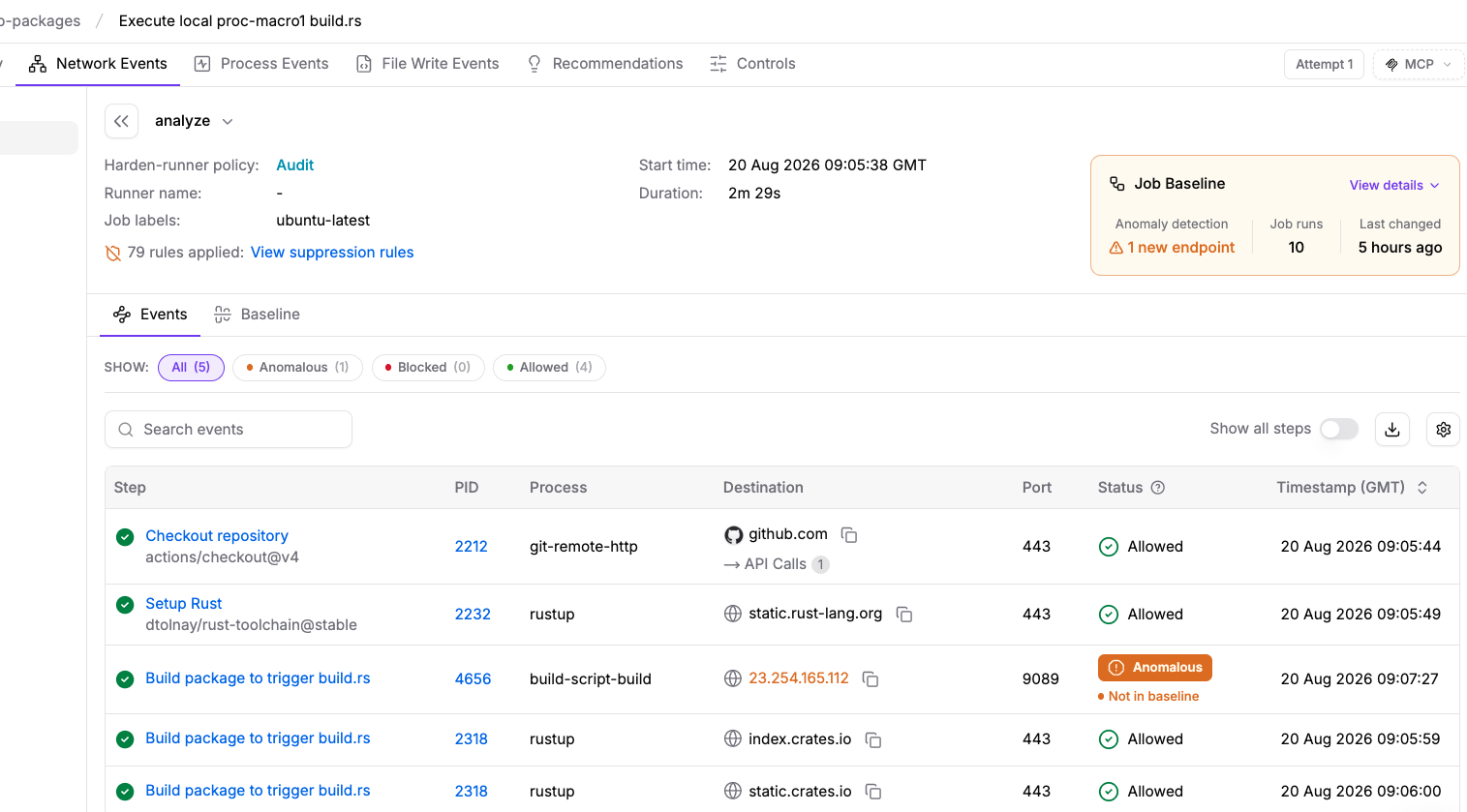
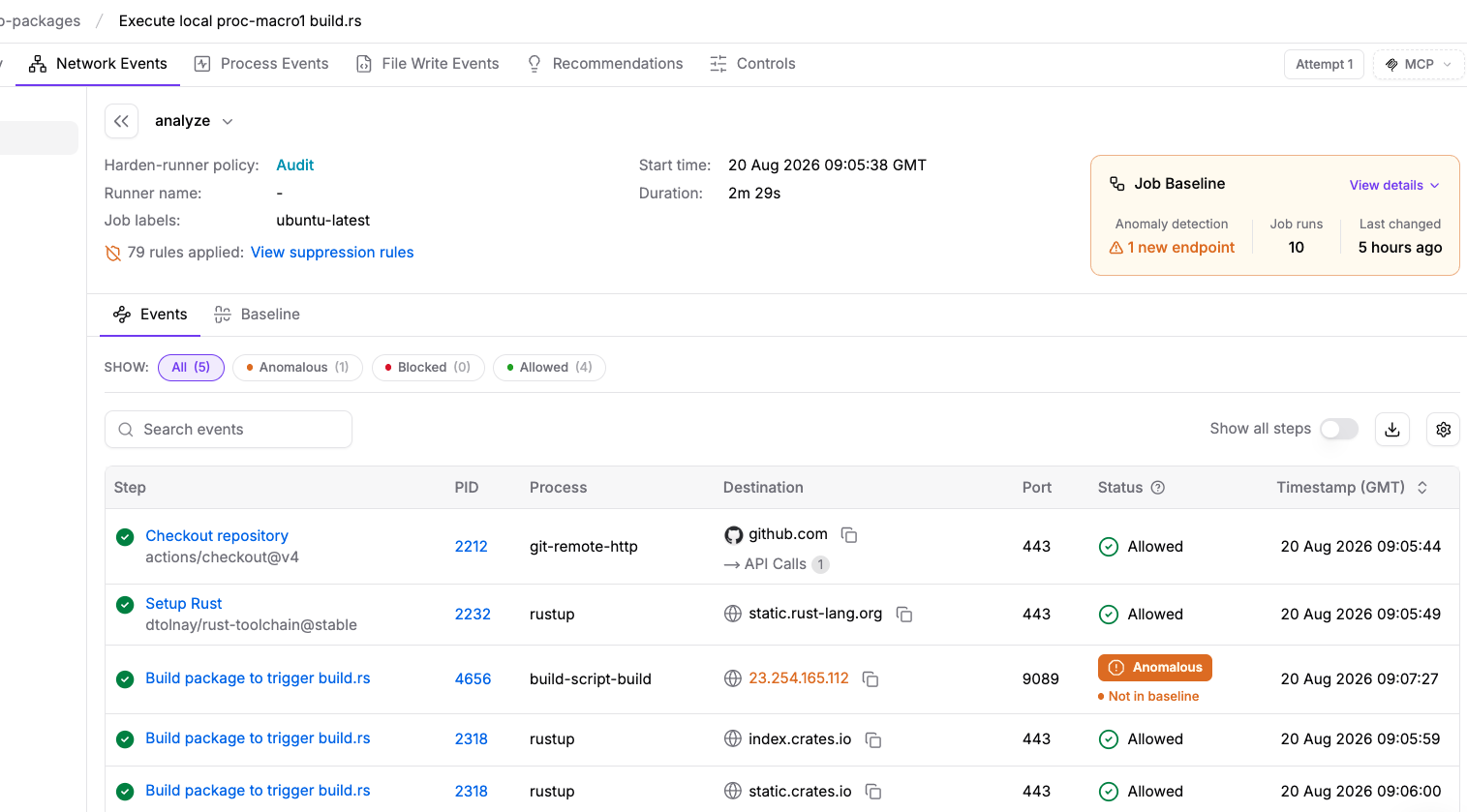
StepSecurity’s Harden-Runner demo showed what runtime visibility gets you. In an audit run, the tool flagged the build step’s outbound connection to 23.254.165.112:9089 as anomalous, the endpoint had never appeared in any previous workflow run. The step still concluded “success” and the job went green, because the payload fetch doesn’t fail the build.
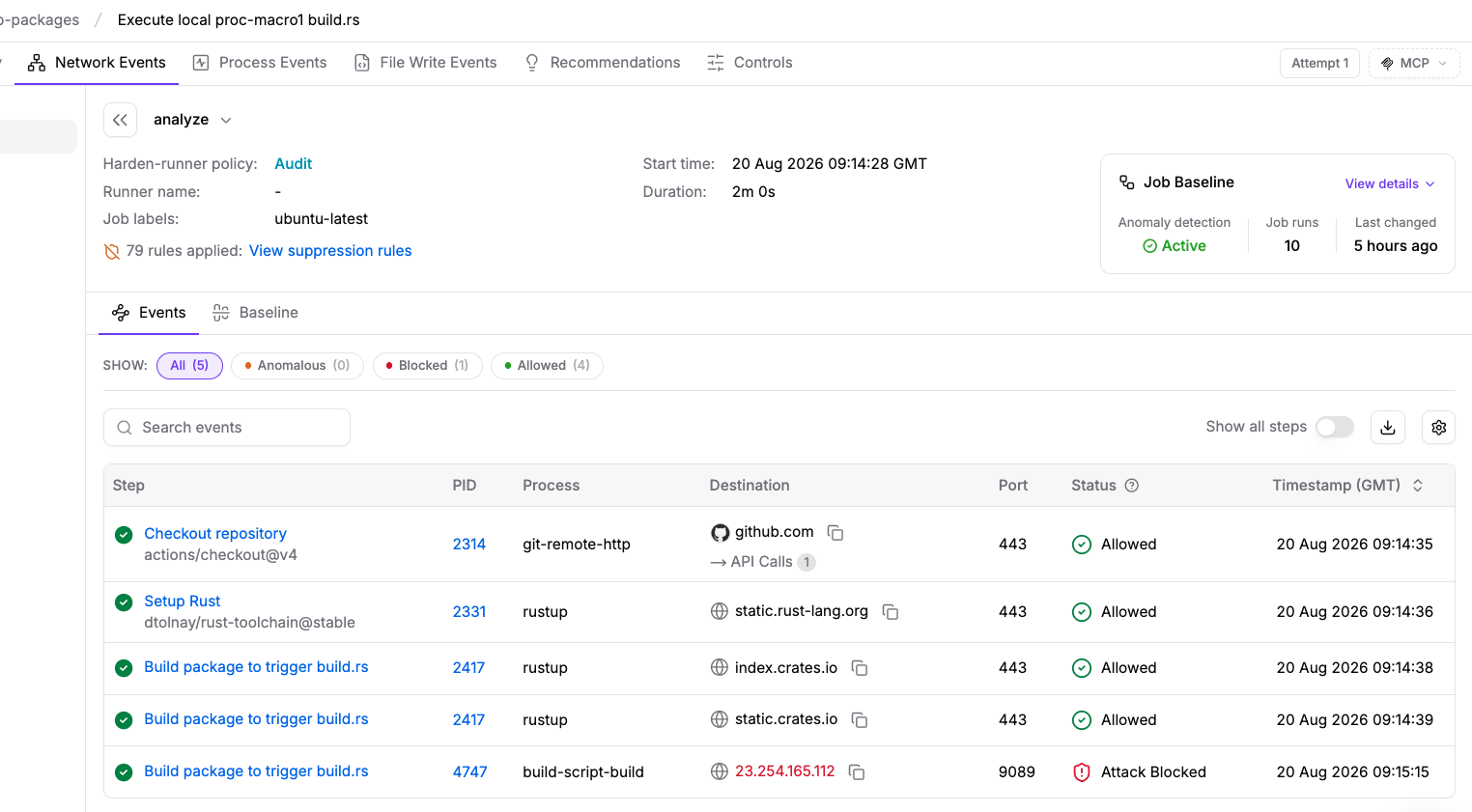
Once the IOC was added to the global block list, the same connection was denied automatically. The malware’s design, fetching from a bare IP over TLS with no certificate validation, created a network signature that destination-based egress control catches, even when package-level detection misses it.
What the Payload Actually Does
Aikido’s technical analysis recovered two of the four platform builds. Both are Rust executables, and both are the same malware family compiled for different targets. The payload is an infostealer targeting Chromium-based browsers, Chrome, Brave, and Edge, by querying SQLite login databases for saved credentials.
The malware also references browser extension storage, which is where many cryptocurrency wallets keep their data. And it contains a lightweight C2 dispatcher supporting commands named runscript, Shell, and ShellX, a compact remote command runner that polls the server on an interval.
For persistence, the macOS build embeds a LaunchAgent plist template with RunAtLoad set to true. Windows uses a Registry Run key. Linux reportedly uses a systemd user service, based on reports from infected developers.
The Infrastructure Fingerprint
Wiz’s analysis notes significant overlap with recent North Korean campaigns, specifically the Mastra npm compromise attributed to Sapphire Sleet and the axios compromise attributed to MIDNIGHT NEPTUNE. No vendor has formally attributed this crates.io incident, but the infrastructure patterns are consistent with state-sponsored activity.
The entire operation, persona creation to registry takedown, fit within a single working morning. The typosquat persona dtolney was created at 01:17 UTC, published a clean decoy release at 01:55, and weaponized at 07:11. The decoy’s purpose was pure credibility: any scanner checking the crate hours later would find publishing history, not a zero-day-old package.
What You Need to Do Right Now
The official advisory includes the exact commands to check your local caches:
find ~/.cargo/registry/cache -type f \( \
  -name 'append-only-vec-0.1.9.crate' -o \
  -name 'arrayref-0.3.10.crate' -o \
  -name 'internment-0.8.7.crate' -o \
  -name 'proc-macro1-*.crate' -o \
  -name 'proc-macro-en-*.crate' -o \
  -name 'aovine-*.crate' -o \
  -name 'arone-*.crate' -o \
  -name 'aronenao-*.crate' -o \
  -name 'tinymember-*.crate' \
\) -print
If you built anything between 07:11 and 09:25 UTC on August 20, treat affected machines as compromised. The payload ran with the building user’s privileges, meaning access to SSH keys, cloud credentials, CI secrets, and signing keys. Rotate everything reachable from those machines.
Pin clean versions: arrayref = "=0.3.9", internment = "=0.8.6", append-only-vec = "=0.1.8". The yanks have been reversed, but verify the resolved version in your lockfile rather than trusting the absence of a warning.
The Deeper Architectural Problem
This attack exposes a structural weakness in how package managers handle trust. Cargo builds and executes build scripts from every dependency in the resolution graph, with full privileges of the building user, and there’s no runtime sandboxing. The global-min-publish-age setting that would hold back dependencies younger than a configured age was still open and unmerged as of August 21, two days after the attack.
The pattern here isn’t new. We’ve seen sophisticated CI/CD-based supply chain attacks with trusted attestations, compromised maintainer pipelines on npm, and PyPI attacks hitting AI development infrastructure. Each incident follows the same arc: a trusted distribution channel becomes the attack vector, and the ecosystem’s safety mechanisms become part of the exploit chain.
The uncomfortable truth is that most organizations are one compromised credential away from this becoming a full-scale incident. The broader open source supply chain crisis isn’t hypothetical, it’s happening in waves. The question isn’t whether you’ll face something like this. It’s whether your detection and response capabilities are ready when you do.
Where Do We Go From Here?
The realistic options for improving the ecosystem are sobering. A publish-age cooldown would have made this attack a non-event. Better credential hygiene, scoped, short-lived tokens instead of long-lived API keys, would have raised the bar for the initial compromise. Runtime egress controls would catch the payload fetch even when static analysis misses it.
What didn’t work, and won’t work, is relying on community auditing and post-hoc analysis. The payload was live for a maximum of 107 minutes across three crates. If you weren’t running runtime detection monitoring network egress from your build systems, you didn’t have a chance.
The arrayref incident is a reminder that package managers are not security boundaries. They’re dependency resolution tools. The trust they encode is inherited from a social contract between maintainers and users, and that contract breaks the moment a credential is stolen.
Build systems need to treat dependency resolution as an attack surface. That means cooldown periods for new releases, runtime monitoring of build-time network activity, and, critically, assuming that any package in your dependency tree is potentially malicious and designing your tooling accordingly.
The 86-minute window is closed. The malicious crates are deleted. But the lessons from this attack will shape crate ecosystem security for years to come. The question is whether your organization is learning them now, or waiting for the next incident to remind you.