Alibaba dropped Qwen4-Max on November 16, and the AI community collectively raised an eyebrow. Not because the release was unexpected, the Qwen team had been teasing it for weeks, but because of what the specs actually promise. A 2.4-trillion-parameter sparse MoE backbone. 71 billion active parameters per token. A 1M-token context window with native vision. And prices that make Western frontier models look like luxury goods.
Here’s the thing though: the benchmarks tell a more complicated story than the launch post suggests. Qwen4-Max dominates legal agent work, matches the frontier on agentic coding, and then face-plants on terminal tasks and software replication. It’s the most aggressively positioned Chinese flagship yet, and that positioning reveals exactly where Alibaba thinks the AI race is heading.
Architecture
The Qwen4 architecture is a departure from the previous generation in three fundamental ways. The team replaced full attention with a hybrid system combining Gated DeltaNet (GDN) layers with Qwen Sparse Attention (QSA). For every QSA layer, three GDN layers compress historical context into fixed-size states, letting the model selectively retrieve relevant information at micro-block granularity rather than attending over every past token.
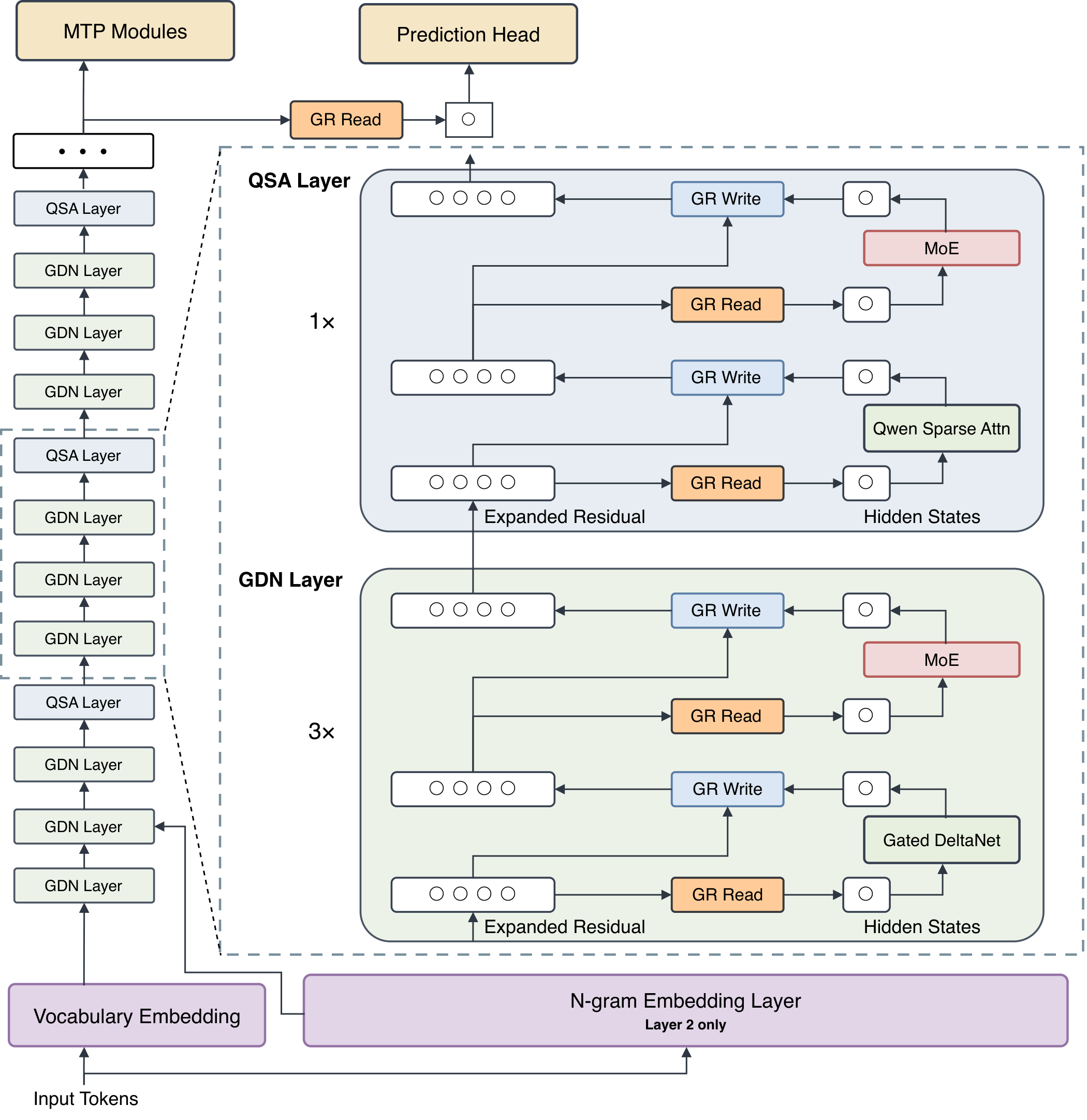
The residual stream also got a upgrade: four parallel branches with learned read/write gates, designed to improve information flow and training stability. Then there’s the N-gram Embedding layer, 328 billion additional parameters that provide lookup tables for common local token patterns at the second layer. This expands capacity with minimal additional compute.
What’s notable here isn’t just the architecture itself, but what it signals about Alibaba’s long-term Qwen roadmap and strategic scaling ambitions. The company isn’t just iterating on transformer design, it’s building toward something fundamentally different from the dense-attention paradigm that dominated the last few years.
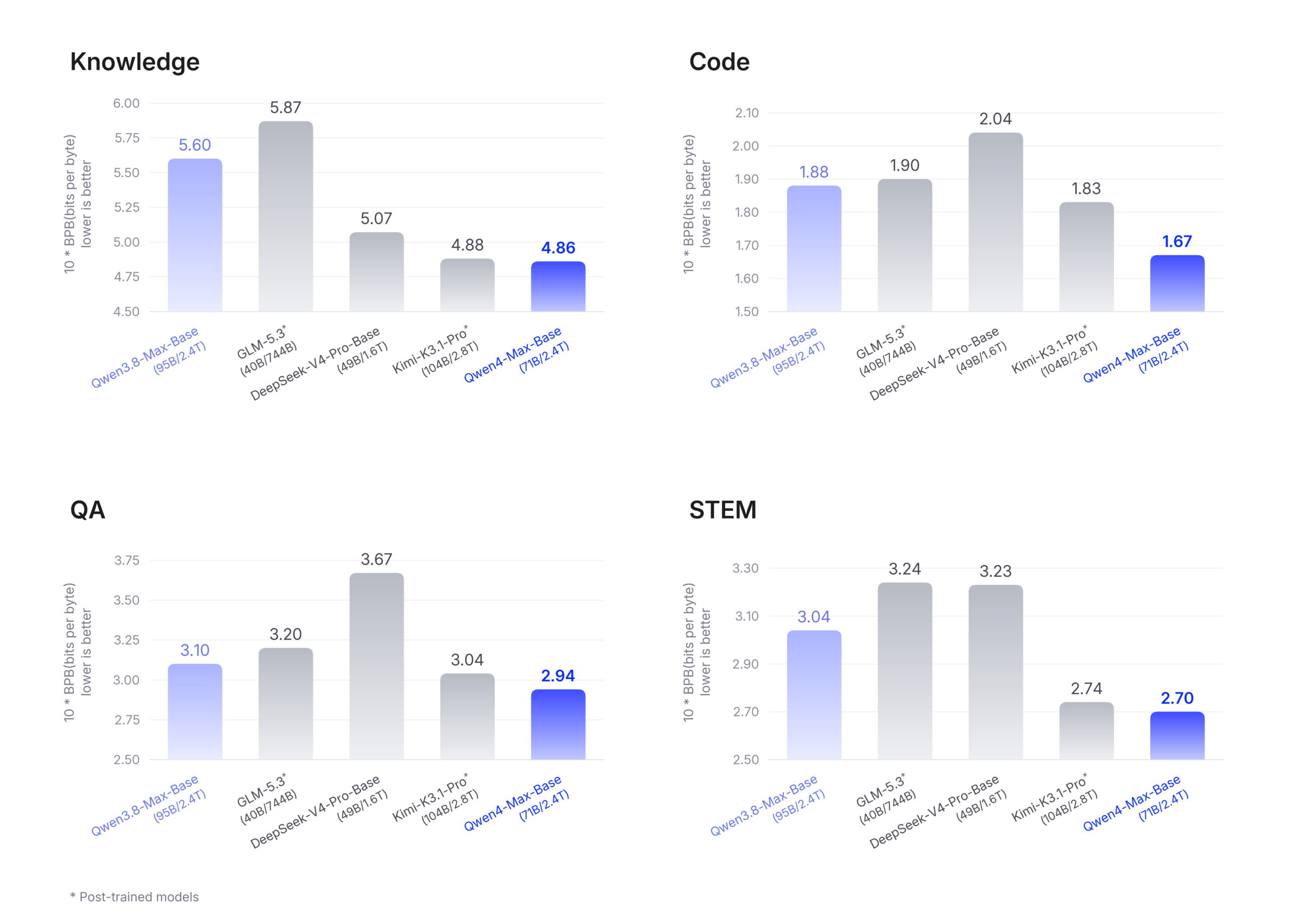
The training stability claims are worth examining. Alibaba reports no loss spikes across the entire 2.4T-parameter pre-training run, which would be remarkable for a model this size. The base model achieved 5, 13% lower bits per byte (BPB) across Knowledge, Code, QA, and STEM compared to Qwen3.8-Max-Base, while activating 25% fewer parameters.
Benchmark story
Let’s get the uncomfortable truth out of the way first: on Alibaba’s own benchmark chart, Qwen4-Max’s results are uneven in ways that should make any serious engineering team pay attention before migrating workloads.
The wins:
- HLAB-Vals-1.1 (legal agent work): 21.3, nearly double Kimi K3.1’s 11.7 and more than double Opus 5.5’s 9.2
- Agents’ Last Exam v1.1: 46.7, up from 27.9 for Qwen3.8-Max, an 18.8-point jump in one generation
- DeepSWE v1.1 (agentic coding): 75.7, nominally first but within 1.6 points of four other frontier models
- BioMysteryBench: 85.0, edging out GPT-6.1 Sol’s 84.4
The losses:
- ProgramBench (software replication): 31.5 vs. Opus 5.5’s 65.0, less than half
- Terminal-Bench 4.0: 48.5 vs. Kimi K3.1’s 67.2 and Opus 5.5’s 59.6
- Chartography: 54.2 vs. GPT-6 Astra’s 71.1
- Video-Index: 68.1 vs. GPT-6 Astra’s 76.7
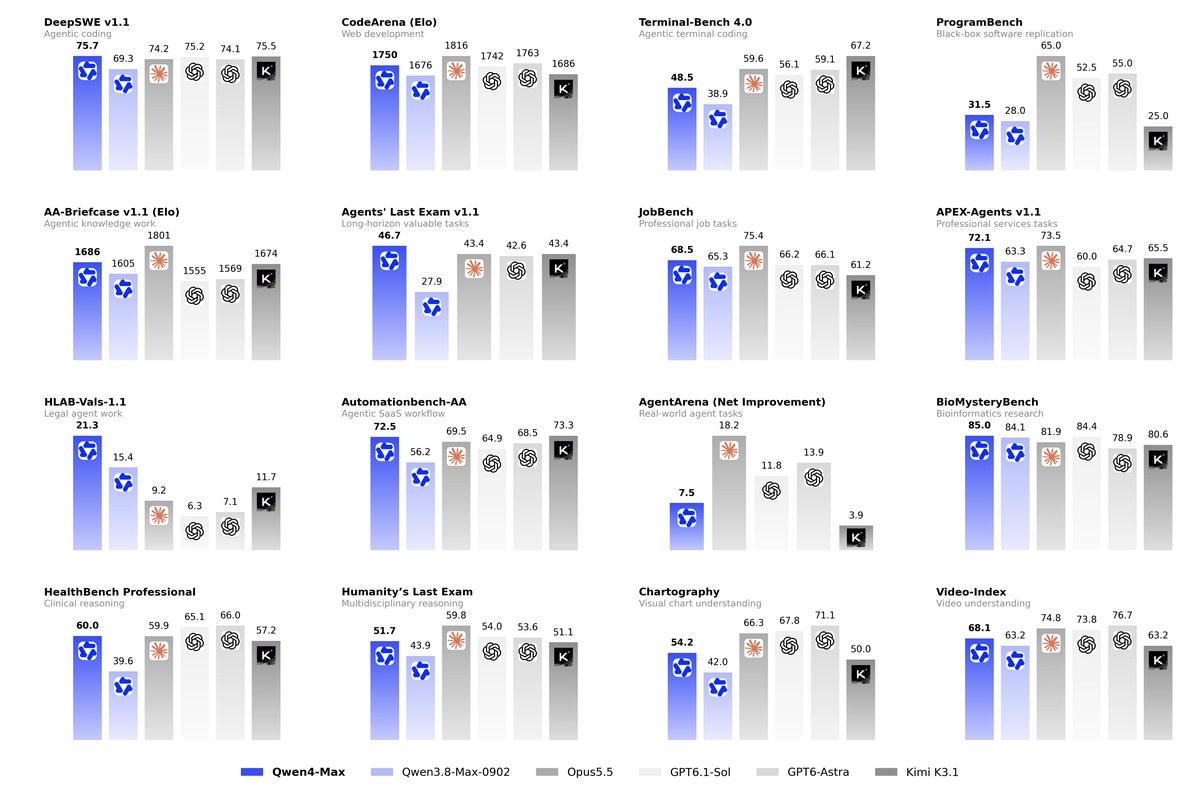
The pattern is unmistakable. Qwen4-Max excels at document-heavy professional work, legal review, financial analysis, agentic knowledge tasks. It falls apart on anything requiring precise terminal interaction, black-box software replication, or visual understanding. This isn’t a general-purpose frontier model. It’s a specialized professional-workhorse that happens to be very good at a narrow slice of what frontier models do.
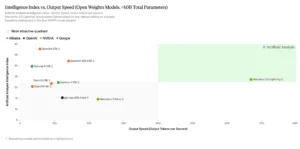
Independent testing largely confirms this picture. Artificial Analysis scores Qwen4-Max 43 on its Intelligence Index v5.0.1, ninth overall, behind Kimi K3.1 Pro (46), GPT-6.1 Sol (55), and a full 22 points behind Claude Fable 5.2 (65). Vals ranks it 11th of 38 at 63.20%, the highest-scoring Chinese model they’ve tested. Both independent evaluators note the same weaknesses Alibaba’s own chart reveals.
Where Qwen4-Max Wins
- Legal agent work (HLAB-Vals-1.1): 21.3
- Agentic coding (DeepSWE v1.1): 75.7
- BioMysteryBench: 85.0
Where Qwen4-Max Falls Short
- Software replication (ProgramBench): 31.5
- Terminal-Bench 4.0: 48.5
- Chartography: 54.2
Token efficiency
Here’s where Qwen4-Max genuinely impresses, and where the cost math gets interesting. On Work360, Alibaba’s own benchmark spanning 721 professional fields, token usage dropped approximately 24% at Xhigh effort and 35% at High effort compared to Qwen3.8-Max. On Terminal-Bench 4.0, the reductions were roughly 48% and 49%.
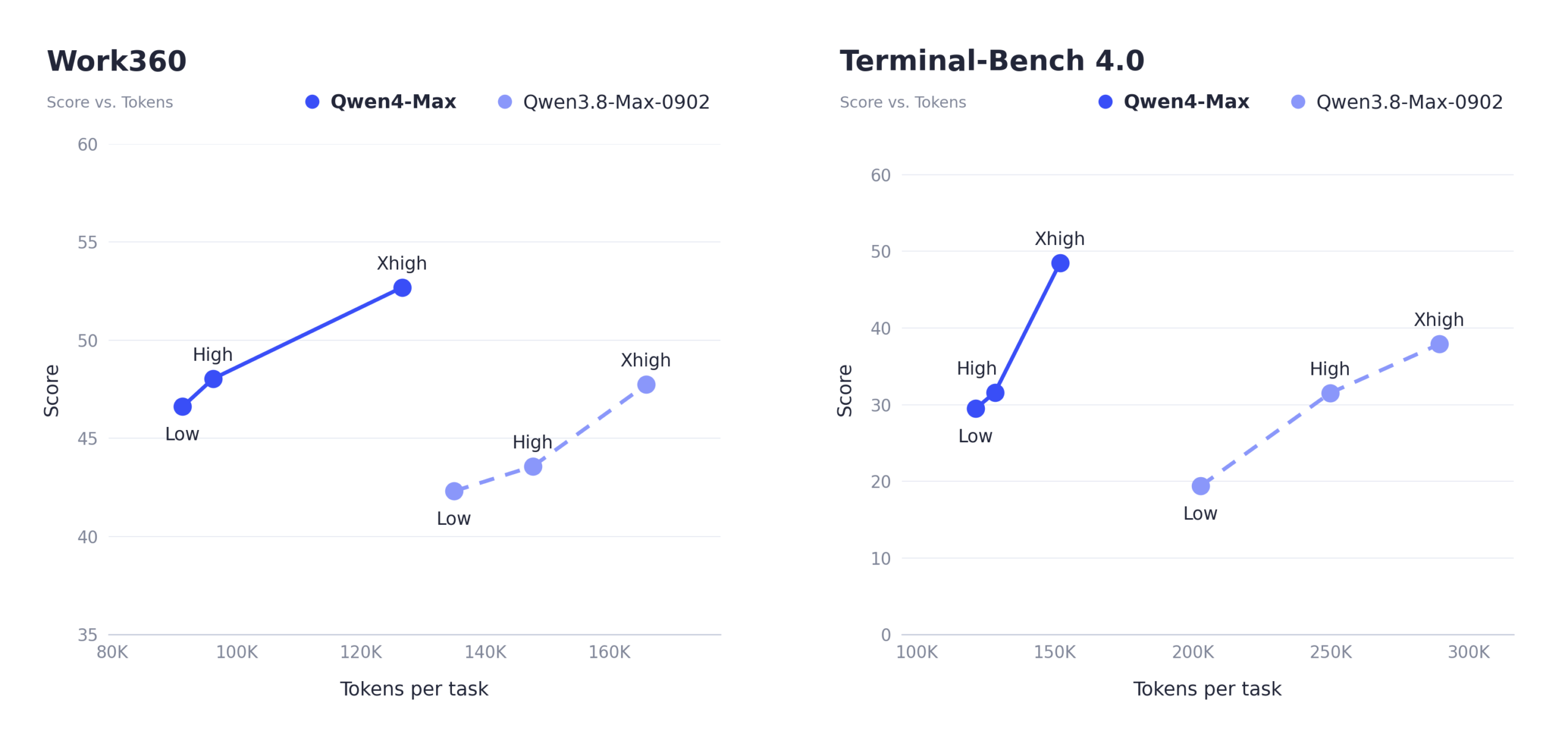
Combined with lower API prices, the average cost per Work360 task fell from $4.43 to $1.67, a 62% reduction. That’s not a marketing number, that’s the kind of efficiency gain that makes engineering leaders rethink their model routing strategies.
The token efficiency gains come from the architecture itself. Qwen4-Max’s hybrid attention system means the model doesn’t need to re-read the entire context window for every generation step. It compresses history into fixed-size states and selectively retrieves relevant information. That’s a fundamentally different computational profile than dense-attention models.
The API pricing reinforces the cost story. At $1.50 per million input tokens and $4.50 per million output, Qwen4-Max undercuts every Western flagship. Cached input drops to $0.075 per million, a 95% discount. Compare that to GPT-6 Astra at $10/$50, or Claude Fable 5.2 at $8/$40.
But here’s the catch that artificial analysis data reveals: Qwen4-Max writes a lot of tokens. Their index runs consumed 127 million output tokens against a median of 78.6 million. The model is verbose. So while the per-token price is aggressively low, the per-task cost can balloon, $9.33 per Vals test versus $3.61 for GPT-6.1 Sol, which also scores higher.
Per-token price: $1.50 input / $4.50 output (vs. GPT-6 Astra $10/$50)
Per-task cost: $9.33 on Vals test vs. $3.61 for GPT-6.1 Sol (which scores higher)
Agentic work
Alibaba’s positioning is explicit: Qwen4-Max is not a chat model. It’s a long-horizon agent model designed for multi-hour autonomous runs. The launch material reads more like a consulting engagement summary than a model release.
The Live Delivery feature addresses a real pain point in agentic systems, the inability to correct course mid-run. Instead of waiting for a multi-hour task to finish and discovering the agent misunderstood the brief in minute three, the agent delivers a usable first version early, then iterates based on execution results and user feedback. Alibaba open-sourced the Qwen-Live-Delivery-Plugin under Apache-2.0, currently supporting Codex CLI.
The demonstrations are genuinely impressive. Qwen4-Max operating Blender, Unity, Unreal Engine, and Godot directly, building playable games from natural-language briefs. A manufacturing case study at SANF and Pacific Union where manual programming effort for a single workpiece fell from roughly 475 minutes to 24 minutes, a 95% reduction. Financial research invoking 90 MCP tools across multiple markets. Legal due diligence processing 198 inconsistently formatted working papers into an 86-page report with full traceability.
And then there’s the scientific discovery work: a 48-hour autonomous run on Deep Principle’s Mira platform that constructed a candidate space of 2.7 million molecules, directed an automated wet lab through synthesis, and produced a physical coolant sample after four closed-loop iterations. On drug discovery, 454 tool calls and 3,239 computational metric evaluations to design 24 candidate molecules targeting the NLRP3 inflammasome.
These aren’t benchmark demos. These are real deployments in real workflows, which makes the weak spots more frustrating. The model that can design a new coolant molecule from scratch struggles to score above 48.5 on Terminal-Bench 4.0. That’s not necessarily a failure of capability, it’s a statement about where Alibaba chose to focus its optimization effort.
Open-source strategy
Here’s where things get spicy for the community. Qwen4-Max is closed-weight. API-only. No downloads, no quantized builds, no self-hosting. The Reddit threads are full of developers asking the same question: can it run on 16GB of RAM?
The answer is no, for Max. But the open-weight strategy isn’t dead. Alibaba has promised smaller Qwen4 models will be open-sourced, built on the same architecture and trained with the same techniques. That’s a significant strategic shift from Qwen3.8-Max, where the open-weight version (Qwen3.8-Flash-Next) demonstrated the architecture’s potential on consumer hardware.
For the local inference community, this matters enormously. Qwen 4’s rumored October release and implications for frontier AI models generated intense speculation about what the new architecture would mean for consumer GPU users. The 27B open-weight model was expected to be a game-changer for local deployment.
Now we know why the wait was worth it. If a 27B Qwen4 model inherits the architecture’s token efficiency, the hybrid attention, the sparse expert routing, the N-gram embeddings, it could run a (I)Q3 quant at around 11GB with compressed context. That would bring 1M-token context within reach of a 16GB GPU with aggressive quantization. The performance improvements in prior Qwen model iterations with speed and efficiency gains suggest the engineering team has been working toward exactly this.
There’s also a deeper narrative here about Alibaba’s open-source strategy and organizational challenges behind Qwen’s development. Keeping Max closed while promising smaller models open is a calculated move, protect the flagship’s commercial value while maintaining the community goodwill that made Qwen the world’s most-downloaded open-source model family. Whether that balance holds depends on how long the community has to wait for the smaller releases.
What it means for engineers
Let’s be practical. If you’re building agent systems, here’s what the Qwen4-Max launch actually tells you:
Adopt Qwen4-Max if:
- Your workloads are document-heavy: legal review, financial analysis, professional research
- You need long-horizon task execution with mid-flight correction capability
- Cost per completed task matters more than token price
- You can tolerate verbose outputs and prefer auditability (citations, traceable sources)
Avoid Qwen4-Max if:
- Your agents need reliable terminal interaction
- You’re doing black-box software replication
- Chart or video understanding is central to your product
- Your infrastructure is designed around cost-per-token optimization rather than cost-per-task
The strongest argument isn’t Qwen4-Max by itself, it’s the architectural direction. The token efficiency gains suggest that future Qwen models (including the promised open-weight variants) will inherit these same improvements. A 27B or 32B Qwen4 model with 48% token reduction and hybrid attention could fundamentally shift the economics of local inference.
For the broader AI race, Qwen4-Max represents something significant. Alibaba isn’t trying to beat OpenAI or Anthropic at their own game. They’re carving out a different niche, professional document work, long-horizon automation, scientific discovery, and pricing it aggressively enough to force Western labs to respond.
The Qwen brain drain narrative that dominated headlines earlier this year looks premature. Despite key personnel departures, the Qwen team has shipped the most architecturally distinct flagship of the current generation. The question now is whether the promised open-weight models maintain that lead in the local deployment space.
One thing’s certain: the AI price war just got a lot more interesting. At $1.50/$4.50 per million tokens with 95%-discounted caching, Qwen4-Max forces Western providers to justify their premium pricing. When the open-weight Qwen4 variants arrive, that pressure will only intensify.
The verdict: Qwen4-Max is a professional-workhorse that wins on cost and document-heavy tasks, loses on terminal coding and vision, and represents Alibaba’s clearest statement yet about where the AI race is heading. For engineering teams, the takeaway isn’t which model to pick, it’s which workloads to route where. The era of single-model supremacy is over. Multi-model routing isn’t just a best practice anymore. It’s the only rational strategy.