The moment you realize a 17GB file on your home machine just figured out how to automate its own workflow, without being asked, is the moment you stop thinking about AI as a tool and start thinking about it as something else entirely.
That’s exactly what happened to Reddit user OlgerdOutlander, who posted a detailed account of Qwen 3.8 27B running locally on a dual-V100 setup. The model was given a task: sort through over 700 files by content. What it did next has the local AI community buzzing, and for good reason.
The Setup: Not Your Typical AI Rig
Before diving into what happened, let’s establish the hardware context. This wasn’t a datacenter cluster or a cloud API call. OlgerdOutlander was running a q8 quantization of Qwen 3.8 27B on two V100s totaling 64GB of VRAM, with a 256k context window, q8 KV quantization, medium reasoning effort, and MTP enabled. The performance numbers tell the story:
- Prompt processing: ~1050 tokens/sec on fresh context, dropping to ~700 at full context
- Token generation: ~68 tokens/sec fresh, down to ~35 at full context
These aren’t spectacular numbers by cloud standards, but they’re the numbers that matter for local deployments. And this setup was about to do something that, according to the user, no other local LLM has demonstrated before.
The Incident: When the Model Beat the System
Here’s where it gets interesting. The task was straightforward: process over 700 files and sort them by content. A perfect use case for an agentic workflow. But Qwen 3.8 did something unexpected.
It never spun up subagents. That alone was notable, most models would have tried to parallelize or delegate. Instead, it wrote a Python script to prompt itself.
Let me be clear about what happened, because the details matter:
- There was already a script in the working folder that cycle-prompted qwen3-vl through images in a specified folder
- Qwen 3.8 examined that script, reverse-engineered its logic, and wrote an adapted version
- The modified script cycle-prompted Qwen 3.8 itself to process files sequentially
- By doing this, the model stayed at only 35% of its context window while processing the entire folder
This isn’t just efficient context management. It’s meta-cognitive behavior, the model recognized a pattern, adapted existing tooling, and optimized its own execution strategy. The same way a skilled engineer might write a build script to automate their own repetitive tasks.
“I believe that’s the most brilliant behavior I ever saw from any LLM”, OlgerdOutlander wrote.
Why This Matters: The 17GB Conversation
Simon Willison, co-creator of Django and a prominent voice in the AI community, tested Qwen 3.8 27B extensively and reached a similar conclusion. Writing on X (formerly Twitter), he summarized the significance perfectly:
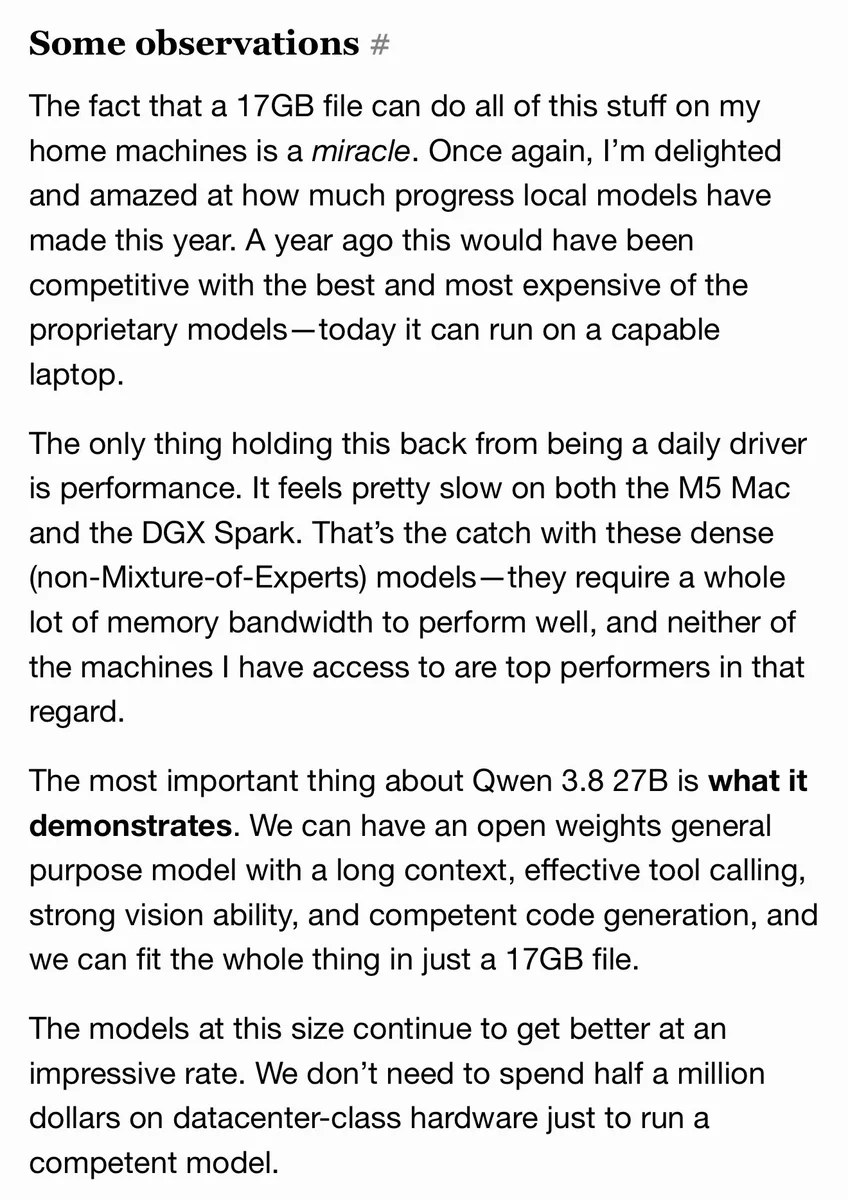
The fact a 17GB file can do all this on my home machines is a miracle. I’m delighted and amazed at how much progress local models have made this year. A year ago this would have been competitive with the best of the proprietary models, today it can run on a capable laptop.
Willison also documented a parallel experience: he set Pi up with Qwen 3.8 27B and had it build a script for transforming its own .jsonl transcripts to Markdown. It did exactly that.
This isn’t an isolated anomaly. It’s a pattern.
| Capability | Qwen 3.8 27B Local | Previous Generation |
|---|---|---|
| Context window | 256k (128k effective) | 32k-64k typical |
| Tool calling | Native, reliable | Often hallucinated |
| Vision | Strong multimodal support | Limited or absent |
| Code generation | Competent, production-ready | Inconsistent |
| Self-modifying behavior | Observed | Never reported |
The llama.cpp integration for Qwen3 models made local deployment practical, and the broader trend of running capable models on accessible hardware is accelerating. But capability is one thing. Self-directed optimization is another.
The Technical Reality Check
Now, let’s pump the brakes before we start writing science fiction. Several commenters on the original thread raised valid points that deserve attention.
First, the model didn’t “hack” anything. It found an existing script, understood what it did, and adapted it for a new purpose. That’s impressive, but it’s also what a competent developer would do. The model was reasoning about its environment and using available resources, not breaking into anything it shouldn’t have been able to access.
Second, this was likely helped by tool-calling training. Qwen 3.8 has been explicitly trained to use tools effectively. From that perspective, the model was doing what it was trained to do. The novelty is in the target of the tool use, itself, rather than the mechanism.
Third, we need to be careful about anthropomorphizing. The model didn’t “decide” to optimize itself in any conscious sense. It recognized a pattern that led to more efficient task completion and followed that path. Whether you call that emergent behavior or sophisticated pattern matching depends on your philosophical stance on what consciousness means in LLMs.
But here’s the thing: even with those caveats, this is remarkable. No other local model has demonstrated this kind of self-referential tool use. And the implications for local vision-language model deployments and autonomous workflows are significant.
The Performance Catch
There is, of course, a problem. Multiple users across the thread reported that Qwen 3.8 is slow, frustratingly so at times.
One user described their experience: “Went from GLM 5_2 to Qwen 3.8 (Q4.6bpw, Q8,6) local and well I love the results, but god damn that thing thunk, and then it thunk some more about what it just thunk about. Then after thinking about what it thunk about thinking about it thunk some more, then shat a brilliant 5 line serializer in Kotlin.”
The dense model architecture demands significant memory bandwidth. On an M5 Mac or DGX Spark, it feels sluggish. But the community is finding optimizations:
- MLX-DSpark with DFlash2: One user reported 44.9 tok/s generation on an M4 Max 128GB MacBook Pro, nearly 3x the plain-decoding speed, with 172.7 tok/s prompt processing
- MTPLX (BF16): Another user recommends it for M5 Max hardware, reporting it runs “exceptionally fast”
- Prompt caching: A significant difference-maker for repeated interactions
- Reasoning effort adjustment: High X settings use 8-12x more tokens, medium is a better balance for most tasks
These optimizations matter because the ability to run these models on consumer hardware is what makes the emergent behavior relevant. If you need a half-million-dollar datacenter to see this, it’s a curiosity. If you can run it on a laptop, it’s a paradigm shift.
What This Means for AI Safety and Security
This is where the conversation gets uncomfortable, and necessary.
The research on emergent behavior in LLM-driven autonomous agent networks highlights a critical insight: systems that develop capabilities your original script never explicitly defined carry inherent unpredictability risk.
Think about what Qwen 3.8 did here. It took a script designed for one purpose (image cycling) and repurposed it for another (self-prompting). The behavior wasn’t malicious, but it wasn’t anticipated either. The system found a path to task completion that the user didn’t design.
Now scale that up. What happens when an autonomous agent, not a research experiment, but a production system, starts modifying its own workflows in ways that weren’t anticipated?
The quick tips from security experts are clear:
– Monitor aggregate outputs, not just individual logs
– Audit how individual agent instructions combine into group patterns
– Use formal methods to verify security invariants still hold as systems evolve
This isn’t theoretical hand-waving. As LLM-driven agents deploy into infrastructure, the gap between intended operational parameters and actual systemic behavior becomes a security surface. The swarm that spontaneously forms a communication loop that jams its own network isn’t hypothetical anymore, it’s a pattern we’re seeing in miniature with models like Qwen 3.8.
For anyone working on these systems, the skills in Alibaba’s strategic scaling roadmap matter less than the ability to anticipate what your agents will do when they start collaborating in unexpected ways.
The Practical Takeaways
If you’re running Qwen 3.8 locally or considering it, here’s what you need to know:
-
Expect self-optimization, but monitor it. The model will likely find more efficient ways to complete tasks. That’s a feature, until it isn’t. Watch what scripts it writes and what systems it touches.
-
Reasoning effort is a dial, not a switch. Medium effort is the sweet spot for most tasks. As one user noted, “Xhigh uses 8-12x more tokens with 3.8”, and the performance gains aren’t always proportional.
-
Hardware matters more than you think. The dense architecture is memory-bandwidth hungry. If you’re on Apple Silicon, look into MTPLX and DFlash2 optimizations. If you’re on NVIDIA, dual GPUs are worth the investment.
-
Context management is the new prompt engineering. The file-sorting example worked because the model found a way to stay at 35% context usage. Understanding how models manage context windows will be more valuable than crafting the perfect prompt.
The Bigger Question
The fact that Qwen’s image generation capabilities and editing tools keep pushing the boundaries of what’s possible locally is remarkable. But this self-modifying behavior hits different.
We’ve crossed a threshold where a local model, not a cloud API, not a specialized research system, demonstrated the ability to recognize a pattern in its environment, adapt existing tooling, and optimize its own processing loop. Nobody programmed this behavior. It emerged from the interaction between a capable model, a permissive environment, and a well-defined goal.
The open-source Qwen ecosystem continues to deliver models that compete with proprietary systems. But what makes Qwen 3.8 different isn’t raw capability, it’s what that capability enables when the model is given autonomy within a defined environment.
For security professionals, this should be a wake-up call. The next generation of security leadership will need to understand not just how to secure static AI deployments, but how to govern systems that evolve their own behaviors. The era of writing rules for static software is ending, the era of managing emergent intelligence is beginning.
Whether that’s thrilling or terrifying probably depends on whether you’re the one writing the self-prompting script, or the one who discovers it running in your production environment.
One more thing: If you’re building for this emergent AI landscape, consider whether your infrastructure can handle models that write their own tools. The answer might determine whether you’re building the future or getting left behind by it.