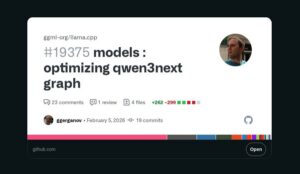
The Reddit post announcing the breakup has 252 upvotes and 46 comments worth of technical grievances. But beneath the surface lies a more troubling pattern: Ollama is becoming the thing it was designed to replace.
The Cloud Update That Broke Trust
As one developer put it: “I saw Ollama as a great model runner, you just download a model and boom. Nope! They decided to combine proprietary models with the models uploaded on their Library.” The privacy implications weren’t just theoretical, users started asking hard questions about what data was leaving their machines and why.
The timing made it worse. Update frequency had already slowed, creating the impression of a project losing momentum. Then came what many saw as feature bloat: “It just felt like they were adding more and more bloatware into their already massive binaries.” For a tool that built its reputation on being lean and local, every megabyte of cloud integration felt like a betrayal.
When “Local” Becomes a Marketing Term
WWW-Authenticate realm from a registry without validating origin, allowing signed authentication material to be sent to an attacker-controlled endpoint during a normal model pull.
A security researcher reproduced the issue and confirmed the proposed fix remains unmerged. The attack requires no exploit chain or malware, the client generates and forwards the token itself based on untrusted input. In a cloud-integrated world, this isn’t just a bug, it’s a design philosophy problem.
The original disclosure credits FuzzingLabs, but the real story is how Ollama’s architecture is evolving to prioritize convenience over the zero-trust principles that define truly local AI.
The Great Migration: Building Your Own Stack
The migration path is technical but telling:
# Build llama.cpp with CUDA support
 cmake -B build -DGGML_CUDA=ON -DCMAKE_CUDA_ARCHITECTURES=89
 cmake --build build --config Release -j $(nproc)

 # Run models directly
 llama-cli --model ~/.cache/llama.cpp/Qwen3-30B-A3B-Thinking-2507-IQ4_XS.gguf \
   --n-gpu-layers 20 --ctx-size 4096 --color --interactive-first
The key difference? Control. Ollama decides for you how to run a model. Llama.cpp lets you decide everything, from GPU layer offloading to context size to quantization levels. For developers who built workflows around Ollama’s simplicity, this feels like a return to first principles.
The Alternatives Are Eating Ollama’s Lunch
- LM Studio: GUI-first with MLX optimization for Apple Silicon, running 1,000+ models without touching the command line
- GPT4All: CPU-only operation with LocalDocs RAG, no GPU required
- Jan.ai: Hybrid local/cloud with built-in web search and Metal acceleration
- AnythingLLM: Enterprise-grade RAG with no-code agent builders
Each alternative attacks a specific Ollama weakness. LM Studio wins on UX. GPT4All wins on accessibility. Jan.ai wins on flexibility. AnythingLLM wins on enterprise features. Ollama’s attempt to be everything to everyone has left it vulnerable to death by a thousand cuts.
The technical comparisons are brutal. One user notes: “Ollama is great, but it decides for you how it should run a model… when trying to run big models, ollama complains that I don’t have enough resources.” With llama.cpp, the same user runs 30B parameter models by manually optimizing GPU layer allocation.
The Open Source Identity Crisis
This cuts to the heart of the backlash. Ollama didn’t just add cloud features, it seemingly minimized the very open source foundations that made it possible. When users discovered they could find “everything with time and effort” in llama.cpp’s documentation versus Ollama’s opacity, the migration became ideological.
The irony is thick: a project built on open source is now losing its community back to the raw materials it once packaged so elegantly.
Performance vs. Principles: The Real Tradeoff
But this frames the wrong tradeoff. The local AI movement was never about raw performance. It was about data sovereignty, about guaranteed privacy, about not trusting your most sensitive workflows to terms of service that change quarterly. Every percentage point of convenience Ollama gains by going cloud is a percentage point of core mission lost.
The token exfiltration bug is the canary in the coal mine. In a truly local system, such a vulnerability would be concerning but contained. In a cloud-integrated system, it’s a potential data breach vector at scale.
The Path Forward: Fork or Die
Ollama now faces a classic open source dilemma. Does it double down on its cloud strategy, hoping the mainstream user base outweighs the vocal technical minority? Or does it course-correct, potentially alienating the investors and enterprise customers who see cloud integration as the path to profitability?
History suggests the former. The community is already preparing for the latter. As one developer wrote in their goodbye post: “I feel like with every update they are seriously straying away from the main purpose of their application, to provide a secure inference platform for LOCAL AI models.”
The word “secure” is doing a lot of work there. In 2025, with AI privacy incidents surging and trust in cloud providers declining, “secure” increasingly means “local.” Not “local with an asterisk.” Not “local unless you click the shiny cloud button.” Just local.
Ollama’s cloud pivot may prove profitable. But in the process, it’s creating a generation of developers who’ve learned to build their own stack from scratch. And that skill, once learned, is rarely unlearned.