NVIDIA just dropped the weights for an image generator that runs on 3 billion active parameters yet claims to outscore GPT Image 2 on dense text rendering. No press release. No blog post. Just a Hugging Face repo and a research paper that appeared roughly three days before the community noticed.
The “quietly” trope in AI news has worn thin, but in this case, it’s technically accurate. NVIDIA published no official announcement. They just released the weights, the model card, and a paper on the Nemotron-Labs-VisualCreation framework, then let the internet do the rest.
The model, Nemotron-Labs-Image-30B-A3B, is the raster-rendering component of a broader agentic framework the company calls “Pixel as Code.” It generates images the way an LLM writes text, predicting visual tokens one after another, rather than denoising noise like Stable Diffusion-class models. And on several benchmarks, it claims wins over both GPT Image 2 and Google’s Nano Banana Pro.
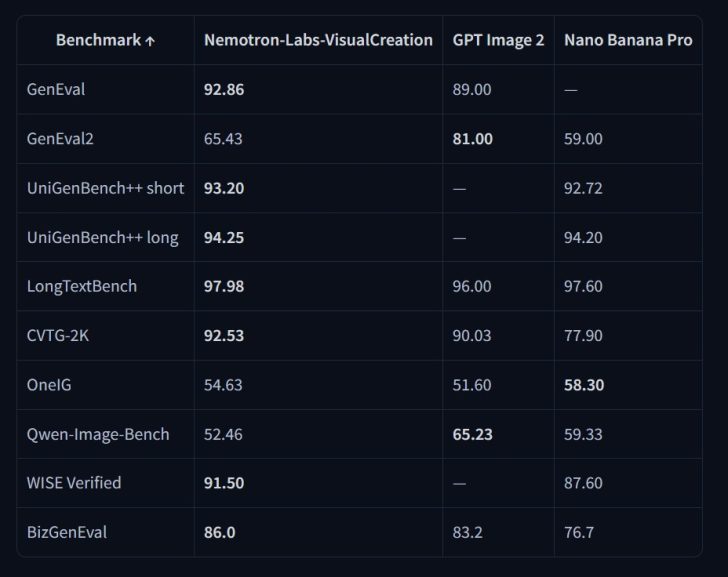
The benchmark numbers tell a more nuanced story than the headlines suggest. On LongTextBench, which measures dense text generation accuracy, the model scored 97.98 against 96.00 for GPT Image 2 and 97.60 for Nano Banana Pro. It also took GenEval at 92.86 versus 89.00. But flip to GenEval2, and GPT Image 2 reclaims the crown at 81.00 against 65.43. Qwen-Image-Bench shows a similar gap: 65.23 versus 52.46.
These are vendor-selected benchmarks with vendor-selected baselines. They show competitive performance, not dominance. The real story isn’t the scoreboard, it’s the architectural bet beneath it.
What “30B total, 3B active” actually means
The model packs 30 billion parameters into a Mixture-of-Experts layout but activates only 3 billion per token. That’s the same A3B pattern NVIDIA has been shipping across its Nemotron line, and it matters for a simple reason: inference cost tracks active parameters, not total.
The model builds on Nemotron 3 Nano, adding 196,560 visual tokens to the text vocabulary. The architecture uses a hybrid Nemotron-H design that blends Mamba-2 state-space layers with traditional attention mechanisms, refined through progressive mid-training and Group Relative Policy Optimization (GRPO).
| Specification | Detail |
|---|---|
| Total / active parameters | 30B / 3B (MoE) |
| Generation method | Autoregressive visual tokens, not denoising |
| Base model | Nemotron 3 Nano |
| Visual vocabulary added | 196,560 tokens |
| Context length | 262,144 tokens |
| Output sizes | Multiples of 16 per side, 1,024×1,024 among four recommended presets |
| Runtime | Linux, Python 3.12, CUDA 13.0 driver, reference sample uses four H100 80GB GPUs |
| Inference stack | Bundled code built on vLLM, Diffusers not supported |
| License | NVIDIA License, non-commercial research and evaluation only |
Context length runs to 262,144 tokens, and output dimensions must be multiples of 16 pixels per side. The reference configuration calls for four H100 80GB GPUs, though the bundled code runs on vLLM rather than Diffusers, so existing pipelines won’t load it without adaptation.
For those hoping to run this on consumer hardware, the math gets complicated. The Hugging Face repo ships f32 weights, meaning the file size clocks in around 133GB. Quantization to q4 would bring that down, but you’re still looking at serious VRAM requirements for the 3B active parameters to matter in practice.
Why “Pixel as Code” is more than a marketing term
The Nemotron-Labs-VisualCreation framework treats visual content as two complementary representations rather than forcing everything into one token format. Raster images flow through learned discrete visual tokens, while vector graphics, webpages, and documents are represented as explicit programs, SVG, HTML/CSS, plotting code.
A shared generate-render-inspect interface connects both paths to the same feedback loop, which means the system can route tasks based on the required balance of expressiveness and editability. The paper describes the raster path mathematically as p(Z|c)=∏ p(z_i|z_<i, c), an autoregressive factorization where each visual token depends on all previously generated tokens.
The research paper reports that the image tokenizer achieves a reconstruction PSNR of 29.57 dB versus 26.08 dB for Emu3.5 IBQ, tested on approximately 178,000 images across six visual domains. Encoding runs 7.13 times faster and decoding 10.93 times faster at batch size one on an A100.
The system-level results are arguably more interesting. With the Nemotron-native harness, planning, candidate selection, and targeted repair, enabled, GenEval2 Soft-TIFA GM jumps from 31.71 to 52.56 using the same raster generator. That’s a 65% relative improvement purely from the agent loop, which suggests the orchestration layer carries as much weight as the base model.

The license caveat that changes everything
The model is released under the NVIDIA License for non-commercial research and evaluation only. That’s a hard constraint for anyone building a paid product, and it puts NVIDIA’s release in a different category from permissively licensed models from Meta, Alibaba, or Google.
The company’s strategy here mirrors what NVIDIA has been doing all year with its Nemotron line. Open weights tuned for CUDA hedge NVIDIA against its biggest customers developing in-house silicon. By keeping commercial deployment behind its own license while giving academic teams and developers access to the architecture, NVIDIA gets ecosystem adoption without ceding the enterprise market.
This pattern extends beyond image generation. NVIDIA’s model compression and scalable architecture innovations with Star Elastic show the same underlying playbook: open enough to attract developers, controlled enough to protect the moat.
The timing also matters. The 4.4-month gap analysis of Chinese open-weight AI versus US closed models suggests the competitive landscape is shifting faster than most incumbents are comfortable with. NVIDIA’s release strategy sits somewhere between Meta’s full-open approach and OpenAI’s API-only model.
What’s withheld matters more than what’s released
Only one piece of the framework is public. The Nemotron-Labs-VisionCode branch, which generates the editable SVG and HTML artifacts, is being held back pending legal review. So is the harness that pairs with the image model.
That means developers can test raster generation but can’t yet exercise the full agentic loop that generates the system-level benchmark improvements. The VisionCode family, when evaluated separately, claims to beat Kimi K3.1 Pro on the aggregate across Chart2Code, MMSVG, Design2Code, and Image2Struct. But those claims are about the sibling models, not the released raster generator.
NVIDIA hasn’t given a date for the remaining components. If the reference implementation requires four H100s and the bundled stack is vLLM-only, the practical barrier to entry is steep even for research teams.
The autoregressive bet in a diffusion world
The bigger question this release raises is whether autoregressive image generation can match diffusion at scale. Diffusion models have dominated image generation for four years running, and the serving infrastructure, optimization techniques, and community expertise are all built around them.
Autoregressive models offer a different value proposition. They can inherit the tooling, batching strategies, and quantization techniques that the LLM ecosystem has spent years perfecting. vLLM-style serving, KV-cache optimization, speculative decoding, all of it becomes applicable to image generation if the visual tokens behave like text tokens.
That convergence is already happening across the industry. Meituan’s dNaViT and discrete vision tokenizer research points in the same direction: pixels as sequences, vision as language. NVIDIA’s contribution is the full agent loop around the token stream, which is closer to a systems-level bet than a model-level one.
The efficiency angle is worth taking seriously. If frontier image quality can be achieved with 3B active parameters rather than a 400B diffusion model, that changes the economics of image generation entirely. It’s the same argument NVIDIA made with NVFP4 quantization beating FP8 for language models, applied to vision.
What this means for practitioners
The practical implications depend on your use case and your tolerance for cutting-edge infrastructure. If you’re building a product that needs editable layout outputs, charts, slides, webpages, the VisionCode component is the one you want, and it’s not available yet. If you need raw raster generation with competitive density-text accuracy, the released model is worth evaluating, but you’ll need multi-GPU cloud infrastructure and vLLM expertise.
The developer community’s reaction has been measured but optimistic. The prevailing sentiment among those tracking the release is that this is the first autoregressive image model that might actually run on reasonable hardware, thanks to the MoE architecture. The f32 weights are a practical hurdle, but quantized versions are presumably on the way.
There’s also the question of output quality. Model releases increasingly ship fine-tuned and RL-optimized versions rather than base weights, which produces aesthetically pleasing results but reduces the dataset’s representational diversity. The broader concern is baked-in “slop”, samey aesthetics, predictable composition, homogenized output. NVIDIA’s GRPO training pipeline should reduce obvious artifacts, but it can’t solve the underlying problem of increasingly curated training data.
The Muse Glimmer breakthrough running on a single RTX 3090 shows what’s possible when efficiency is the primary design constraint. NVIDIA’s 3B active parameter approach is a step in that direction, but the four-H100 reference configuration is still a cloud-scale deployment reality.
Read the benchmark table honestly
| Benchmark | Nemotron-Labs-Image-30B-A3B | GPT Image 2 | Nano Banana Pro |
|---|---|---|---|
| LongTextBench | 97.98 | 96.00 | 97.60 |
| GenEval | 92.86 | 89.00 | n/a |
| GenEval2 | 65.43 | 81.00 | n/a |
| Qwen-Image-Bench | 52.46 | 65.23 | n/a |
The wins are real but narrow. The losses are genuine gaps. NVIDIA leads on dense text rendering and structured composition, GPT Image 2 retains advantages on harder reasoning-based generation and open-world benchmarks. The characterization “outperforms GPT Image 2” requires the qualifier “on selected benchmarks with available comparisons.”
For the open-weight ecosystem, though, the direction is clear. NVIDIA is positioning itself as a serious contender in multimodal generation, not just infrastructure. The company’s broader strategy spans redefining open-source AI transparency while keeping commercial moats intact.
The genuinely disruptive implication is that frontier image quality may not require frontier compute. A 30B model with 3B active parameters, trained on a hybrid Mamba-attention architecture with GRPO, is competitive with closed-source giants on key tasks. If that trend holds, image generation could follow the same cost curve that language models have been riding for the past two years.
The missing pieces matter, though. Without the VisionCode models, the harness, and a commercially viable license, this release is a research artifact with benchmark bragging rights. The full framework, when it arrives, will determine whether NVIDIA’s Pixel as Code vision has staying power or winds up as another ambitious paper and nothing more.