The headlines rolled in fast and predictable: “Mistral Gives Up on Frontier Models.” “Europe’s AI Champion Concedes.” The framing was clean, dramatic, and almost certainly wrong.
What actually happened is far more interesting. Mistral looked at the economics of the frontier AI race, the billions in compute, the vanishing margins, the zero-sum battle for benchmark points, and decided the trophy wasn’t worth the cost. Then they rebuilt themselves into something that looks a lot like a European Palantir.
The tell is in the revenue numbers: Mistral’s top line grew roughly 20x in a single year while they made this transition. That’s not a retreat. That’s a signal from the only people who actually know where model margins are headed.
The Economics No One Wants to Talk About
Here’s the uncomfortable truth that gets buried under all the AGI hype: being a frontier model lab is a terrible business. OpenAI and Anthropic are burning through capital at a rate that would make a 1999 dot-com CEO blush. The training runs cost hundreds of millions. The inference costs scale with adoption. And the moat? It’s measured in weeks, not years.
Arthur Mensch, Mistral’s CEO, has been unusually candid about this reality. His argument isn’t complicated: to deploy AI inside a regulated enterprise, you need to own the entire stack. Compute, models, platform, delivery. You can’t outsource any of it to a U.S. provider that could be cut off with an email.
This isn’t theoretical hand-wringing. When the US government restricted access to Anthropic’s Fable 5 in June 2026, developers who had built entire workflows on that API woke up to a dead endpoint. No warning. No grace period. The message was clear: how geopolitical constraints are driving open-source AI strategies in regulated environments. Mistral’s pivot isn’t just smart, it’s survival.
The Palantir Playbook, European Edition
Palantir’s Foundry software specializes in one thing: patching together data from disparate silos and making it actionable. It’s marketed to spies, police, healthcare agencies, and large enterprises. The $296 billion company also makes battlefield algorithms and has deployed command-and-control software in Ukraine. It’s sticky, it’s expensive, and it’s deeply embedded in government infrastructure.
Mistral is building the same thing, but for a market that’s suddenly desperate for alternatives.
French Prime Minister Sebastien Lecornu announced the government was working more closely with Mistral AI, framing it as a sovereignty imperative after U.S. restrictions on foreign access to Anthropic’s models. This follows a broader European backlash where Palantir’s “infamy” is opening doors for local challengers. The Dutch defense minister has pledged to swap Palantir for European providers when possible. Security services in Germany and Poland are looking for homegrown alternatives.

The opportunity is staggering. Europe needs to spend roughly $3 trillion over the next decade on cloud infrastructure, AI data centers, and LLM training if it wants to wean itself off U.S. and Asian suppliers. Guaranteed demand via a “Buy European” framework might be the EU’s most powerful lever.
The Stack That Makes It Work
Mistral’s strategy isn’t just about selling models. It’s about owning the entire deployment pipeline for customers who cannot, under any circumstances, have their AI provider disappear.
This means:
– Custom model training for specific regulatory environments and data classifications
– On-premise deployment on Dell and other certified hardware, not just cloud APIs
– Full platform tooling that turns messy enterprise data into structured, actionable records
– Consulting and integration services that bridge the gap between raw capability and operational reality
The boring layer that makes a model useful, resolving contact and company data before anything downstream fires, turning messy customer conversations into structured records, that’s where the durable money lives. None of those are frontier models. They’re the infrastructure that makes models relevant.
Mistral’s open-weights strategy serves this model perfectly. By releasing models anyone can download, inspect, and modify, they build distribution and community momentum while creating an ecosystem that doesn’t route revenue back to their competitors. It’s why Mistral’s CEO advocating for European AI competitiveness through regulatory and tax policy makes sense: the policy environment matters when your entire business model depends on sovereignty guarantees.
The Open-Weights Coalition and the Distillation Fight
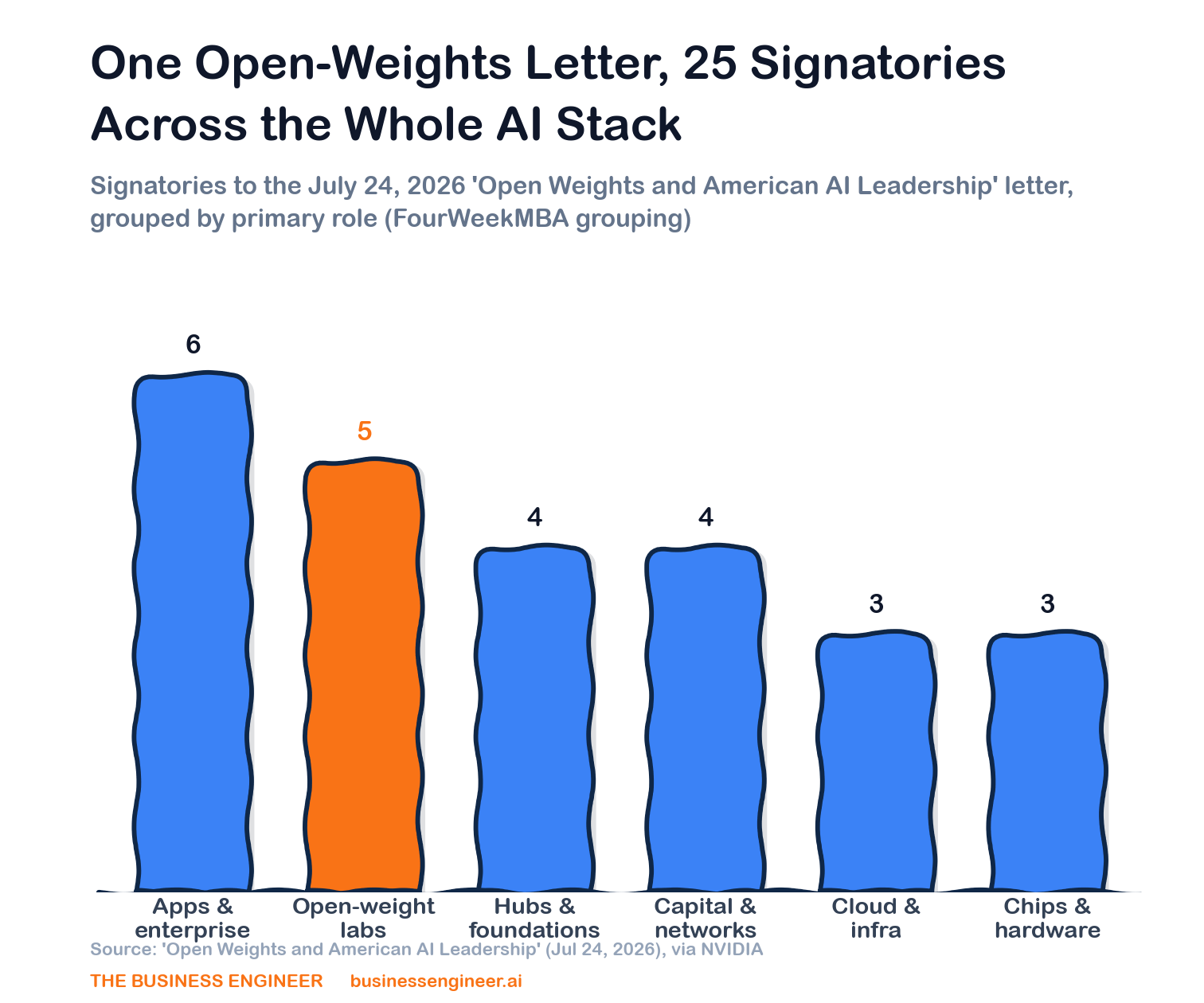
None of this happens in a vacuum. On July 24, 2026, twenty-five organizations including Nvidia, Microsoft, Meta, Mistral, and Palantir published the “Open Weights and American AI Leadership” letter. The coalition argues that open-weight models are essential for U.S. leadership, that they strengthen competition, and that they give customers control over their data.
Notably absent from the signatory list: OpenAI, Anthropic, and Google, the three labs whose frontier models are closed-weight.
The most consequential part of the letter isn’t the safety argument, it’s the defense of distillation. Training a smaller model on the outputs of a larger one is the primary way challenger labs close the gap to frontier capability without spending billions on pretraining compute. It’s also the technique at the center of the most active regulatory debates, including whether Chinese labs have used U.S. model outputs to advance their own systems.
By framing distillation as “a long tradition of learning from, building upon, and improving existing technologies”, the coalition is pre-emptively lobbying against the kind of broad distillation ban that would most benefit the closed frontier labs. The growing regulatory and identity verification demands in cloud AI platforms show where this is heading: a world where who can access what capability becomes a political question, not a technical one.
What Mistral Gains by Leaning Into Europe
The “unfair advantage” argument cuts both ways. Mistral is strategically positioned for adoption by European governments and companies because it’s European. In a world where the U.S. has shown it can shut down a model with an email, it makes no sense for any government or corporation to integrate an AI system into all their operations that can be turned off by a foreign country in less than an hour.
This isn’t protectionism, it’s prudent infrastructure planning.
Being excluded from markets outside Europe could become a constraint. But there are worse things than being limited to one of the largest markets in the world while positioning yourself as the likely leader in that market. The US and China are super-protective of their AI industries. Mistral’s chance of having a durable foothold in either is slim. They may as well focus on providing the EU with the stuff they cannot get anywhere else.
China’s push for AI sovereignty in regulated, non-Western tech stacks mirrors this playbook. The difference is that Mistral can sell to European defense and intelligence agencies without triggering the same geopolitical alarm bells.
Is This a Good Call for Europe?
The honest answer: it’s a good call for Mistral, and probably a mixed one for Europe.
On one hand, Mistral is still doing frontier model building. They’re just selling the whole stack now. Nothing is lost. They’ll still ink deals for the LLM model and train custom models for clients. It’s expensive, but they’ll do it.
On the other hand, resources are finite. Every engineer moved from research to deployment is one fewer person pushing the frontier. Europe will be further behind on the pure capability curve as a result.
But here’s the thing: it doesn’t matter. The market is voting with revenue, and the market wants deployable, sovereign, secure AI, not a slightly better benchmark score on MATH or GSM8K.
The companies that are actually surviving inside real enterprises aren’t the ones with the best models. They’re the ones turning messy customer conversations into structured records. They’re resolving contact and company data before anything downstream fires. They’re building the boring layer that makes the model useful.
That’s where Mistral just decided the durable money lives. And given that they have one of the handful of teams that can actually train a frontier model, they probably know something the rest of us don’t.
What This Means for Everyone Else
If you’re building an AI company, the Mistral pivot is a case study in strategic discipline. The frontier race is a trap. The real value is in owning the relationship with the customer and the infrastructure they depend on.
If you’re in an enterprise evaluating AI vendors, the sovereignty question just became your most important evaluation criterion. Can your provider survive a geopolitical disruption? Can they deploy in your air-gapped environment? Do they own their supply chain?
If you’re watching from the sidelines, this is the moment the AI industry stopped pretending it was a pure technology competition and started behaving like the infrastructure business it always was.
Mistral didn’t lose the race. They looked at the board and realized the trophy was a participation medal. They’re building something more durable: a full-stack enterprise platform that can’t be switched off by a foreign government, that runs on European infrastructure, and that has a 20x revenue growth curve to prove the market agrees.
Breaking closed monopolies in AI through open-source deployment for enterprise control isn’t just a strategy. For Mistral, it’s the only strategy that makes sense. And so far, it’s working.