LingBot-World’s Open-Source Release Breaks Google’s World Model Monopoly
For two years, Google’s Genie 3 has hovered over the world model landscape like a phantom, impressive in demos, technically superior in papers, but completely inaccessible to anyone outside Google’s walls. Researchers watched polished videos of emergent spatial memory and real-time interaction, knowing they couldn’t touch the model, test its limits, or build on top of it. That lock-in just shattered.
LingBot-World, released by Ant Group’s embodied intelligence division Robbyant, doesn’t just match Genie 3’s capabilities, it surpasses them in critical dimensions while giving the entire community full access to code, weights, and training methodologies. The technical report is explicit: LingBot-World achieves a dynamic degree score of 0.8857 on VBench, leaving Genie 3’s estimated performance in the medium range far behind. More importantly, it maintains 16 frames per second throughput with sub-second latency, and demonstrates emergent spatial memory that keeps objects consistent after 60 seconds out of view.
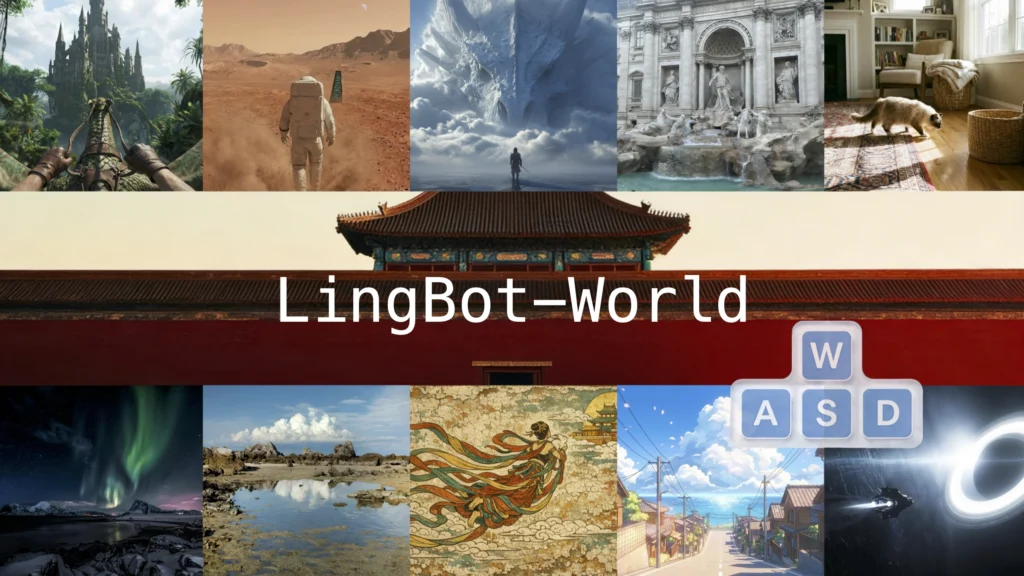
The proprietary AI model monopoly has been showing cracks for months. Broader trends show open-source AI models increasingly surpassing or matching proprietary systems across domains from coding to computer vision. LingBot-World represents the first time this pattern has reached world models, the foundational technology for robotics, embodied AI, and interactive simulation.
The Hardware Reality Check
Before diving into architecture, let’s address what developers are already asking: what does it actually take to run this thing? The Reddit thread on LingBot-World’s release cut straight to the chase. When someone asked about hardware requirements, the top reply was blunt: “If you have to ask, you can’t run it.”
- 8 GPUs on a single machine (A100 80GB recommended)
- Dual EPYC/Xeon or Threadripper Pro CPU
- 256GB to 1TB system RAM
- NVLink or very fast PCIe interconnects
- Fast NVMe storage for scratch space
Running this on Runpod costs $14-22 per hour. For context, that’s roughly $10,000 monthly if you kept it running, expensive, but not enterprise-impossible. The model uses FSDP (Fully Sharded Data Parallel) and implements a 14B parameter base architecture, though the total parameter count is higher due to its Mixture-of-Experts (MoE) design.
This hardware barrier explains why world models have remained proprietary. Google can allocate 8 A100s internally without blinking. Startups and academic labs can’t. By open-sourcing the model, Robbyant hasn’t eliminated the cost barrier, but they’ve shifted it from a permission problem to a resource problem, a crucial distinction in research democratization.
Architecture: Why LingBot-World Actually Beats Genie 3
The technical report reveals a three-stage training pipeline that transforms a standard video generator into an interactive world simulator:
- Stage I: Pre-Training starts with Wan2.2, a 14B parameter video diffusion model that establishes the visual prior. This is the “canvas” that understands textures, lighting, and basic physics.
- Stage II: Middle-Training is where the magic happens. The model becomes a bidirectional world model using a 28B parameter MoE architecture, two 14B experts where only one activates per timestep. The high-noise expert handles global structure, the low-noise expert refines details. This stage introduces:
- Progressive curriculum training from 5-second to 60-second videos
- Action controllability through Plücker embeddings for camera pose and multi-hot vectors for keyboard inputs
- Long-term consistency via extended context windows that emergently create spatial memory
- Stage III: Post-Training converts the bidirectional model into a causal autoregressive system using block causal attention. This enables KV caching and real-time generation at 16 FPS.
The result? On VBench metrics, LingBot-World scores 0.6683 imaging quality and 0.5660 aesthetic quality, both exceeding Yume-1.5 and HY-World 1.5. But the killer metric is dynamic degree: 0.8857, crushing competitors that hover around 0.72-0.76. This measures how richly the world responds to actions, a domain where Genie 3 was supposed to dominate.
The Data Engine Behind the Curtain
What makes this possible isn’t just architecture, it’s data curation at scale. LingBot-World’s training corpus combines three sources:
- Real-world footage (first and third-person) for visual diversity
- Game engine recordings with synchronized action labels (WASD, mouse movements)
- Synthetic Unreal Engine renders with ground-truth camera parameters
The team implemented a hierarchical captioning strategy that disentangles scene description from camera motion. Each video gets three captions:
- A narrative caption weaving environment and movement
- A scene-static caption describing only the environment (for decoupled control)
- Dense temporal captions with time-aligned event descriptions
This solves a fundamental problem: most video models conflate what they see with how they move. By separating these during training, LingBot-World learns to generate consistent scenes regardless of traversal path.
The Open-Source Advantage: More Than Access
Google’s Genie 3 is locked behind researcher agreements. You can’t benchmark it on your own tasks, can’t fine-tune it for robotics, can’t inspect its failure modes. LingBot-World gives you everything: code on GitHub, weights on HuggingFace, and a technical report that actually explains the methodology.
This transparency matters. Mistral’s release of open-weight models from 3B to 675B showed that openness drives adoption. But Alibaba’s Qwen 3 Max demonstrated how “open” can be misleading, releasing weights without training code or data creates a dead end for researchers. LingBot-World avoids this by providing the full pipeline.
The release also highlights the challenges of deploying powerful open-source AI. When Devstral 2 launched, the community quickly found alignment issues. With LingBot-World, the team is upfront about limitations: memory instability during ultra-long sessions, generation drift over minutes, and limited action granularity. This honesty builds the trust necessary for community contribution.
Use Cases: Beyond the Demo Videos
The Reddit thread asked the right question: “also the usecase?” World models aren’t just for making pretty videos. Three applications stand out:
- 1. Robotics Training: Embodied AI needs simulated environments where robots can fail safely. LingBot-World’s emergent spatial memory means a robot can “leave” an area and return to find it unchanged, critical for SLAM and navigation tasks.
- 2. Game Prototyping: Indie developers can generate explorable worlds from concept art, iterating on mechanics without building custom assets. The Fast version’s sub-second latency makes this interactive.
- 3. Synthetic Data Generation: The model’s ability to maintain geometric consistency across views makes it a source of training data for 3D reconstruction models, as demonstrated by point cloud extractions from generated videos.
The Fine Print: Limitations and Drift
No model is perfect. LingBot-World’s memory emerges from context windows, not explicit storage. After several minutes, environments start to “drift”, landmarks shift subtly, textures mutate. The team acknowledges this and plans explicit memory modules in future versions.
Action control is also coarse. You can navigate and look around, but fine manipulation (picking up a specific object) isn’t supported. The action space is expanding, but for now it’s primarily locomotion.
These limitations don’t diminish the achievement. They map a clear roadmap: stable memory, expanded action spaces, reduced hardware requirements through distillation.
Why This Breaks the Proprietary Lock
Google’s strategy with Genie 3 was classic tech moat-building: demonstrate superiority, publish papers, but keep the model locked. This works when competitors can’t catch up. But the open-source community has repeatedly shown that broader trends favor collaborative development over closed systems.
LingBot-World’s release creates a baseline that any researcher can improve. Want to add haptic feedback? Fine-tune on your robotics dataset? Implement a memory module? You can. The geopolitical threats to open-source AI make this even more critical, centralized control of foundational models risks innovation concentration.
Even institutional players are waking up. The ICC’s defection from Microsoft to open-source infrastructure shows that sovereignty matters. AI research needs the same principle: control over your tools.
The Bottom Line
LingBot-World doesn’t just match Genie 3, it makes Genie 3 irrelevant for anyone outside Google. The performance lead in dynamic degree, combined with full open access, shifts the competitive landscape. Researchers can now build on state-of-the-art world models without permission slips.
Yes, the hardware requirements are steep. Yes, generation drift remains a challenge. But the erosion of trust in corporate-controlled open source makes genuine transparency valuable. Robbyant delivered weights and code and methods.
The proprietary world model era lasted roughly 18 months. It ended on January 29, 2026.