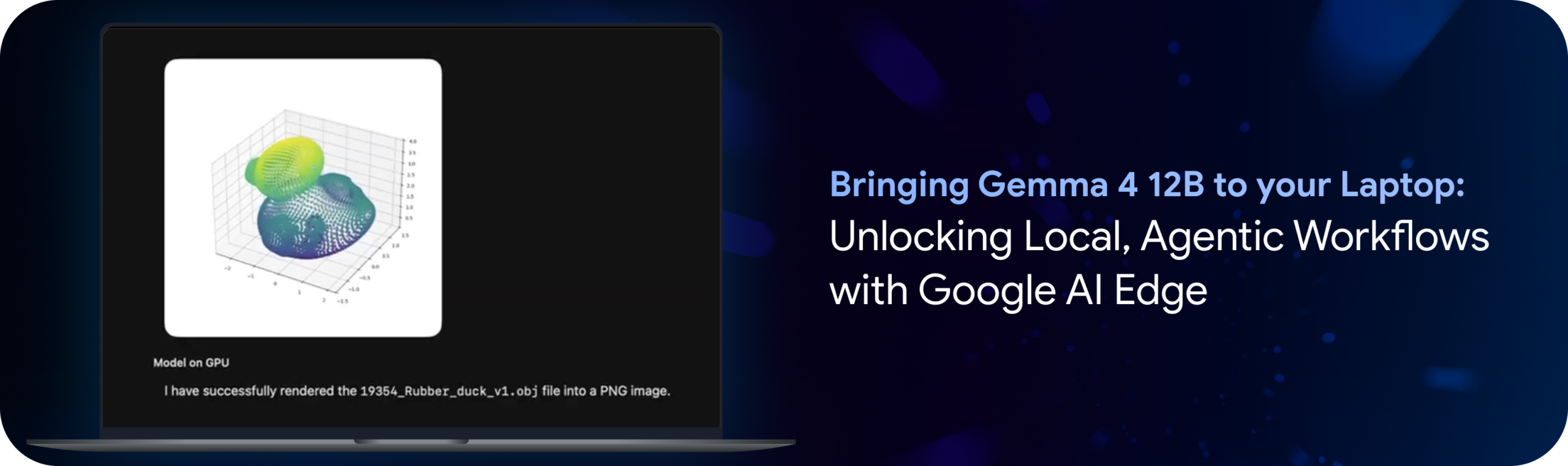
Gemma 4 12B runs on a standard laptop with 16GB of RAM. It processes video, audio, and text natively. It’s available under Apache 2.0. And it nearly matches the performance of its twice-as-large 26B sibling. This isn’t a promise for next year, it’s shipping right now on Hugging Face, Ollama, and LM Studio.
Let’s dig into why this is the most significant local AI release of 2026, and more importantly, what it actually means for developers building production systems.
The Architecture That Made Encoders Obsolete
Traditional multimodal models are architectural frankensteins. They bolt a vision transformer onto the side of an LLM, add a Whisper encoder for audio, then patch everything together with projection layers. Each encoder is hundreds of millions of parameters, adds latency, and creates alignment nightmares.
Gemma 4 12B throws that approach in the trash. Its unified architecture processes vision and audio inputs directly through the LLM backbone using simple linear projection layers.
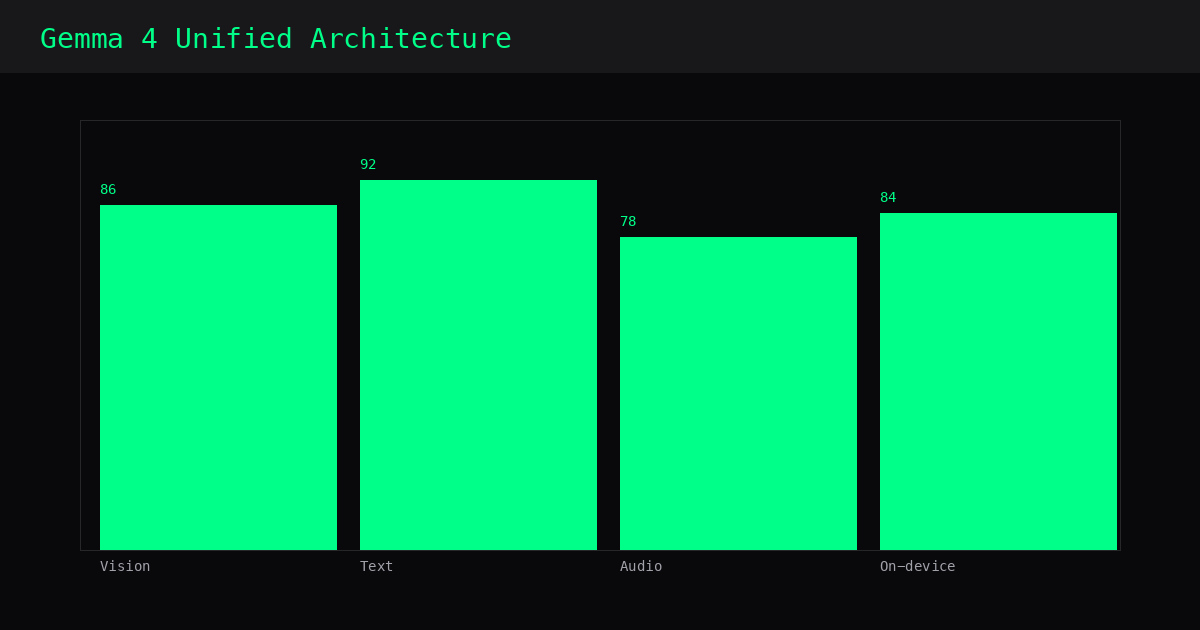
The math tells the story:
– Vision pathway: 30M parameters vs. 500M+ for traditional encoders, a 10x reduction
– Audio pathway: 5M parameters vs. 200M+ for Whisper-style encoders, a 40x reduction
This isn’t just academic. Fewer parameters mean lower memory, faster inference, and better cross-modal alignment because everything is learned jointly during pre-training. The model isn’t stitching together separate understandings of the world, it has one unified representation.
Benchmarks That Punch Way Above Their Weight Class
The natural question is whether this efficiency comes at the cost of capability. The benchmark data says no.
| Benchmark | Gemma 4 12B | Gemma 4 27B (old) | Context |
|---|---|---|---|
| MMLU Pro | 77.2% | 67.6% | Multi-task language understanding |
| GPQA Diamond | 43.4% | 42.4% | Graduate-level reasoning |
| MATH-Vision | 52.4% | 46.0% | Visual math reasoning |
| DocVQA | Strong | Moderate | Document understanding |
The 12B model doesn’t just approach the 27B model, it exceeds it on several key benchmarks. That’s what encoder-free architecture plus modern training techniques buys you.
For context on how this fits into the broader local model landscape, check out our deep dive on Gemma 4 12B’s encoder-free architecture.
The Real-World Demo That Matters
The most impressive technical achievement isn’t a synthetic benchmark. Google’s demo involved processing a five-minute video from an I/O keynote. The model analyzed 313 frames (one per second) alongside the full audio track, simultaneously. No splitting the problem into separate vision and audio pipelines. One model, one pass, unified understanding.
This capability has immediate practical applications:
– Meeting analysis: Feed a recorded presentation, get a summary that understands what was shown and said
– Content moderation: Analyze video uploads with context, a violent scene with a warning label is different from one without
– Education: Students upload lecture recordings and get searchable, contextual summaries
Three Paths to Running It Today
The model is available right now. Here’s how to get started based on your use case.
Option 1: Ollama (Zero Configuration, Maximum Speed)
# Pull the model
ollama pull gemma-4:12b

# Run interactively
ollama run gemma-4:12b

# Or via API for agent integration
curl http://localhost:11434/api/chat -d '{
  "model": "gemma-4:12b",
  "messages": [{"role": "user", "content": "Analyze this image and its caption for copyright concerns."}]
}'
This is the fastest path for local CLI work, agent frameworks, and integration with tools like Hermes, OpenClaw, or Claude Code. Apple Silicon users get Metal acceleration out of the box, expect 15-30 tok/s on an M2 Max.
Option 2: Hugging Face Transformers (Full Control)
from transformers import AutoModelForCausalLM, AutoTokenizer
import torch

model_id = "google/gemma-4-12b-it"
tokenizer = AutoTokenizer.from_pretrained(model_id)
model = AutoModelForCausalLM.from_pretrained(
    model_id,
    torch_dtype=torch.bfloat16,
    device_map="auto"
)

# Process image + text together
from PIL import Image
image = Image.open("chart.png")
messages = [{
    "role": "user",
    "content": [
        {"type": "image", "image": image},
        {"type": "text", "text": "Extract the key data points from this chart."}
    ]
}]
This gives you full control over quantization, multi-GPU splitting, and batch inference tuning.
Option 3: LiteRT-LM CLI (Google AI Edge)
litert-lm import --from-huggingface-repo=litert-community/gemma-4-12B-it-litert-lm gemma-4-12B-it.litertlm gemma4-12b
litert-lm serve

# Now point any OpenAI-compatible tool at localhost:9379
curl http://localhost:9379/v1/chat/completions \
  -H "Content-Type: application/json" \
  -d '{"model": "gemma4-12b,gpu", "messages": [{"role": "user", "content": "Hello!"}]}'
For teams already invested in GenUI’s cost-performance analysis of Gemma 4 models, this drop-in compatibility is a game-changer.
The Developer Community Is Already All In
The reception has been immediate and enthusiastic. The model hit 150M+ downloads across the Gemma family within days. Ollama shipped integration within 24 hours. Unsloth released dynamic GGUFs for 8GB deployment almost instantly.
One developer running a local voice agent stack reported: “I switched to Gemma 4 12B on my voice agent. For everyday agentic tasks and conversation, it is way faster and better than Qwen 3.6 35B.” That’s a 35B MoE model being outperformed by a 12B dense model, the architecture matters more than raw parameter count.
Another user running it on an RTX 5070 and M4 MacBook noted that “with web search enabled, it is as good as any cloud system.” The qualifier is important, local models with tool access can match cloud APIs for many practical tasks.
Where It Falls Short (Honest Assessment)
Let’s be clear about the limitations.
16GB is the floor, not the comfort zone. Quantized versions can run on 8GB, but you’ll be making trade-offs on quality and speed. Full-fat BF16 inference needs that 16GB of VRAM or unified memory. A laptop with an i9, 32GB system RAM, and only a 4GB GPU will struggle to the point of unusability.
Text-only output. The model is multimodal on input but generates text only. You can’t generate images or audio. For production pipelines, you’ll pair this with Stable Diffusion or Bark separately.
Not frontier-tier on everything. GPT-5.5 and Claude Opus 4.5 still outperform it on complex reasoning, legal analysis, and specialized medical tasks. The use case for Gemma 4 12B is privacy, cost, and latency, not absolute top-tier performance on every benchmark.
For those evaluating whether this fits their workflow, the trend of smaller, efficient local models suggests Gemma 4 12B is the leading edge of a broader shift, not an outlier.
The Sliding-Window Superpower
One architectural detail deserves special attention. Gemma 4 12B implements sliding-window attention with a 4K local window and 128K global context. This enables multi-agent inference on consumer hardware.
On an RTX 5090, the sweet spot is 16 concurrent agents at 64 tok/s each, 988 tokens per second total throughput. You can run parallel reasoning chains, ensemble voting, or agent swarms entirely locally.
This isn’t theoretical. Teams are already building:
– Tree-of-thought search with 8 parallel reasoning paths
– Multi-source research agents that read different documents simultaneously
– Voice agent stacks combining Gemma 4 12B with smaller ASR and TTS models for fully local smart assistants
One developer assembled a voice agent on a Raspberry Pi 5 with 8GB RAM, a respeaker mic array, and Gemma 4 12B running on a separate machine. The setup beats Alexa and Siri for responsiveness and privacy, all running locally.
The Licensing That Actually Matters
Apache 2.0 isn’t just a nice-to-have. It’s the difference between building a product and building a legal case.
- Commercial use: No restrictions, no revenue sharing
- Modification: Fork it, fine-tune it, embed it
- Redistribution: Ship it with your software
- Patent grant: Included
Compare this to Llama 3’s custom license with usage restrictions for apps with over 700M monthly users. Or Qwen’s custom terms. Or GPT-4’s closed ecosystem.
For startups and regulated industries (healthcare, finance, legal), this licensing clarity is the difference between “we can build this” and “we need to talk to legal first.”
Gemma 4 12B is the first model that genuinely delivers on the promise of local multimodal AI. It runs on hardware developers already own, processes video and audio natively without cloud dependencies, and ships with a license that doesn’t penalize commercial success.
The 16GB RAM requirement is reasonable for modern laptops. The performance gap with much larger models is closing fast. The architecture proves that encoder-free design isn’t just an academic curiosity, it’s a practical advantage.
If you’ve been waiting for a local model that doesn’t feel like a compromise, the waiting is over. Pull it from Ollama, spin up a LiteRT-LM server, or load it in Hugging Face. Your laptop has been capable of this all along. Google just gave it the software it needed.