At this point, someone circulates an article about data mesh vs. data fabric, and the conversation becomes an architecture debate before anyone has diagnosed the actual constraint. It’s a familiar story for anyone working in data engineering at scale, especially in regulated industries like banking, where the stakes of getting this wrong are measured in compliance violations and audit failures, not just missed deadlines.
The Centralization Trap: Doing 50% Less, But 100% Better
There’s a confession making the rounds in data engineering circles that captures the tension perfectly. A data engineer at a bank, whose team is supposed to centralize data collection for the entire org, admits they’ve started leaning hard toward decentralization. Not out of laziness, but because they’ve realized something uncomfortable: centralization should be about being focused on the absolute smallest denominator, which is smaller than most orgs assume, especially now when you have no clue what an optimal stack is gonna look like in 6 months.
Their conclusion? “We should be doing 50% less, but doing it 100% better.”
This is the quiet heresy spreading through enterprise data teams. The central team’s job isn’t to build everything, it’s to build the foundation that lets other teams build things themselves. But here’s where it gets messy: that philosophy collides head-on with the reality of regulated industries, where compliance can’t be a suggestion and audit trails aren’t optional.
The debate isn’t really about technology. It’s about accountability, capability, and who gets to own the risk.
What Each Approach Actually Proposes
Before the architecture wars escalate further, let’s be honest about what each side actually offers.
Data Mesh
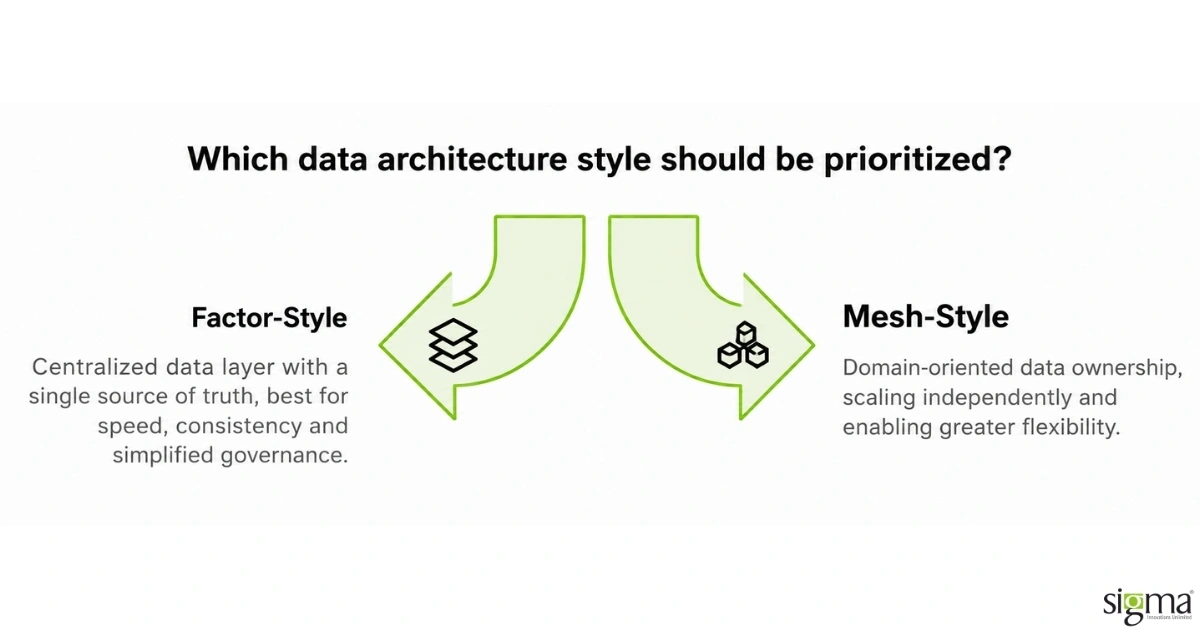
Data mesh is an organizational answer. It argues that the central data team is a structural bottleneck and that the fix is distributing ownership to the domains that generate the data. Each domain treats its data as a product, with an owner, documented interfaces, quality guarantees, and consumers it’s accountable to. A central platform team provides self-serve infrastructure, and federated governance sets the standards everyone follows.
Data Fabric
Data fabric is a technical answer. It argues the problem is fragmentation across systems and that the fix is a unifying layer of metadata, cataloging, and automated integration that lets consumers find and access data regardless of where it lives. Ownership stays roughly where it is. The intelligence goes into the metadata layer, increasingly using machine learning to infer relationships and automate integration work engineers previously did by hand.
Head-to-Head Comparison
The table below summarizes the key differences between the two approaches:
| Dimension | Data Mesh | Data Fabric |
|---|---|---|
| Primary nature | Operating model and ownership change | Technology and metadata layer |
| Core problem solved | Central team is a delivery bottleneck | Data is fragmented and hard to discover |
| Ownership | Distributed to domain teams | Largely unchanged, often central |
| Prerequisite | Domain teams with data engineering capability | Comprehensive metadata and catalog coverage |
| Governance style | Federated, standards agreed centrally | Centralized policy applied across sources |
| Main failure mode | Domains lack skills or incentive to own products | Platform deployed but adoption never happens |
| Time to first value | Slow, requires organizational change | Faster, incremental technical rollout |
The distinction that matters: mesh changes who is responsible, fabric changes how things connect.
The Diagnostic Question Most Teams Skip
Before comparing the two, answer one question honestly: when a data request takes too long, where does the delay actually occur?
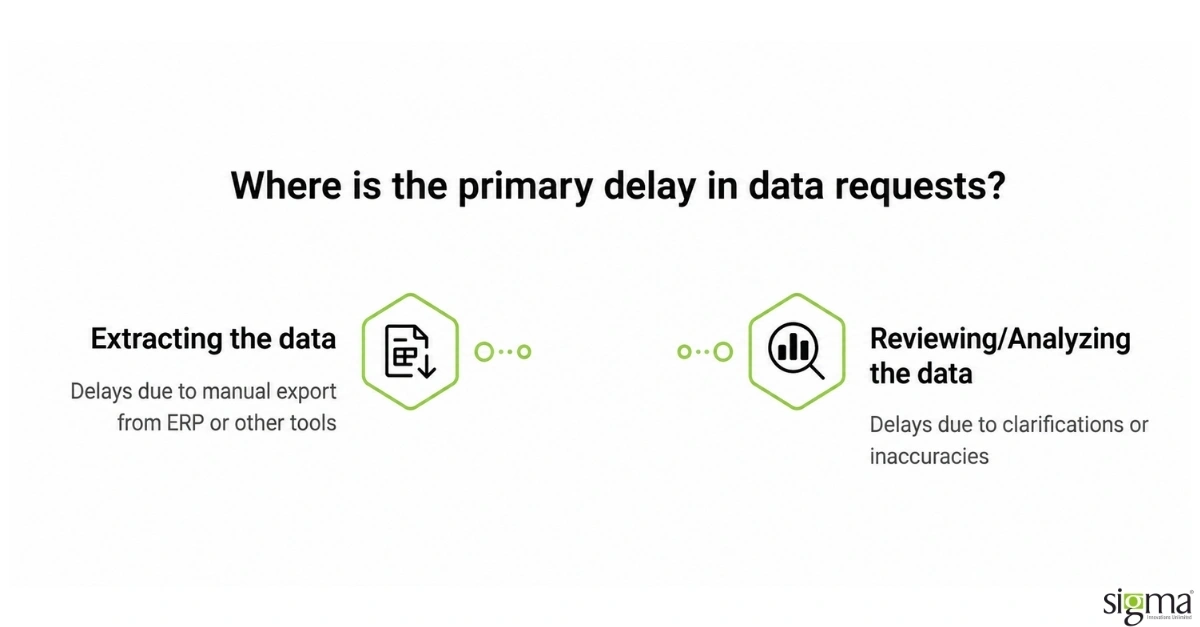
If the delay is that a small central team is saturated and domain experts are waiting in a queue for people who understand the data less well than they do, that’s an ownership problem. More tooling will not fix a queue. Data mesh architecture addresses it by moving the work to the people with the context.
If the delay is that people can’t find what exists, don’t know whether a dataset is trustworthy, or spend days reconciling three systems that describe the same entity differently, that’s a discovery and integration problem. Redistributing ownership won’t fix it and may make it worse, because now eight teams are independently producing datasets nobody can locate. Data fabric architecture addresses it by making the estate navigable.
Most organizations have some of both. The question is which one is currently the binding constraint, because that determines where the first investment goes.
The Layer Cake Approach: Where the Debate Actually Lands
Somewhere in the middle of this war, a pragmatic compromise is emerging. It goes something like this: a central data team should manage ingestion, bronze, and silver layers, or their equivalent. The silver-to-gold transition and reports can be more decentralized, but even that isn’t universally accepted.
One data governance professional put it bluntly: centralized data engineering is the bane of their existence. The business thinks their hands are clean, and getting business accountability established becomes nearly impossible. Their verdict? “Data mesh or die.”
But here’s what the mesh evangelists conveniently omit: it only works if domain teams actually have the engineering chops to own data products. Someone in marketing needs to be writing and maintaining pipelines, defining SLAs, handling consumer support, and monitoring quality. Many domain teams have no such capability and no headcount to acquire it. Ownership gets declared in a slide deck and nothing changes, except the central team now has less authority to fix problems it’s still blamed for.
The reality is that a proper semantic layer can solve the “one metric, three different values” problem that plagues decentralized gold layers. Analytics engineers embedded in domains, not just BAs with a SQL license, can manage their own gold-layer transformations. But if the central team keeps tight control over bronze and silver, quality stays consistent while velocity improves where it matters most.
Where Data Mesh Goes Wrong (And It Goes Wrong Expensively)
The failure modes of mesh are predictable enough to be almost boring. But naming them matters, because the cost of getting this wrong is enormous.
Failure One
Ownership without capability. The model assumes domain teams can own data products. That means someone in marketing writing and maintaining pipelines, defining SLAs, handling consumer support, and monitoring quality. Most domain teams lack the necessary data engineering, product management, and governance skills to own data products used in a data mesh model. As one consulting expert put it, “Most domain teams lack data engineering expertise, and forcing them to manage data pipelines without proper training leads to broken infrastructure and poor data quality.”
Failure Two
Skipping the self-serve platform. Mesh without genuinely usable shared infrastructure is just decentralization, which produces eight incompatible pipelines and no governance. And if the self-serve platform is difficult to use, domains will bypass it and build their own rogue infrastructure.
Failure Three
Treating federated governance as optional. Without agreed interoperability standards, domains produce data products that cannot be joined, recreating the original fragmentation with more owners. The fix requires automation, not committees: “Bake compliance, masking rules and access control directly into the self-serve platform deployment templates so domains get compliance ‘for free.'”
The Funding Elephant in the Room
Here’s the uncomfortable truth that rarely makes it into the architecture presentations: the biggest obstacle to decentralization isn’t technical, it’s financial.
“If you have a centralized funding model and not cross-functional funding, that can be a challenge”, notes Matt McClelland, senior managing director at FTI Consulting. Data mesh involves shared work across domains, which means organizations must find ways to fund priorities that span multiple departments. In most enterprises, there is no mechanism for cross-domain funding or shared priority alignment. The operational model will stall before it even gets going.
There are three diagnostic tests that reveal whether your organization is ready for decentralization, and they’re brutally effective:
- Time-to-data audit: Measure how long it takes a business unit to request, get approval for, and ingest a new external data source. If the bottleneck is purely bureaucratic rather than technical, the culture is highly resistant to self-serve models.
- Domain capability mapping: Audit the technical literacy of business units by classifying domain teams into tiers based on tech capability. If no business units have the skills to manage their own data endpoints, a mesh is premature.
- “Who pays?” test: Propose a scenario where Domain A needs a feature built by Domain B’s data team. If your current corporate structure has no mechanism for cross-domain funding or shared priority alignment, the operational model will stall.
Decentralization Is Not a Binary
The academic literature has recently started catching up to what practitioners have known for years: “decentralized” isn’t a switch you flip. Recent work from arXiv introduces a formal ontology that distinguishes decentralization from mere distribution, arguing that a system can be decentralized along some dimensions while remaining tightly centralized along others.
Consider vanilla federated learning. Data stays distributed across client devices, and model training happens locally, those dimensions are genuinely decentralized. But aggregation authority sits with a single server. The system as a whole is partially decentralized, not fully. The same logic applies to enterprise data: ledger replication might be distributed while consensus authority remains centralized, and that’s perfectly coherent.
This framing is useful because it forces a more honest conversation. Instead of asking “are we centralized or decentralized?” the real question becomes “which dimensions of our data architecture need to be decentralized, and to what degree?”
For a bank, the answer will look very different than for a tech startup. Compliance, audit, and regulatory requirements create a floor of centralized control that can’t be negotiated away, no matter how compelling the mesh evangelists’ pitch sounds. But that doesn’t mean every pipeline, every transformation, and every report needs to flow through a central bottleneck.
The Hybrid Reality
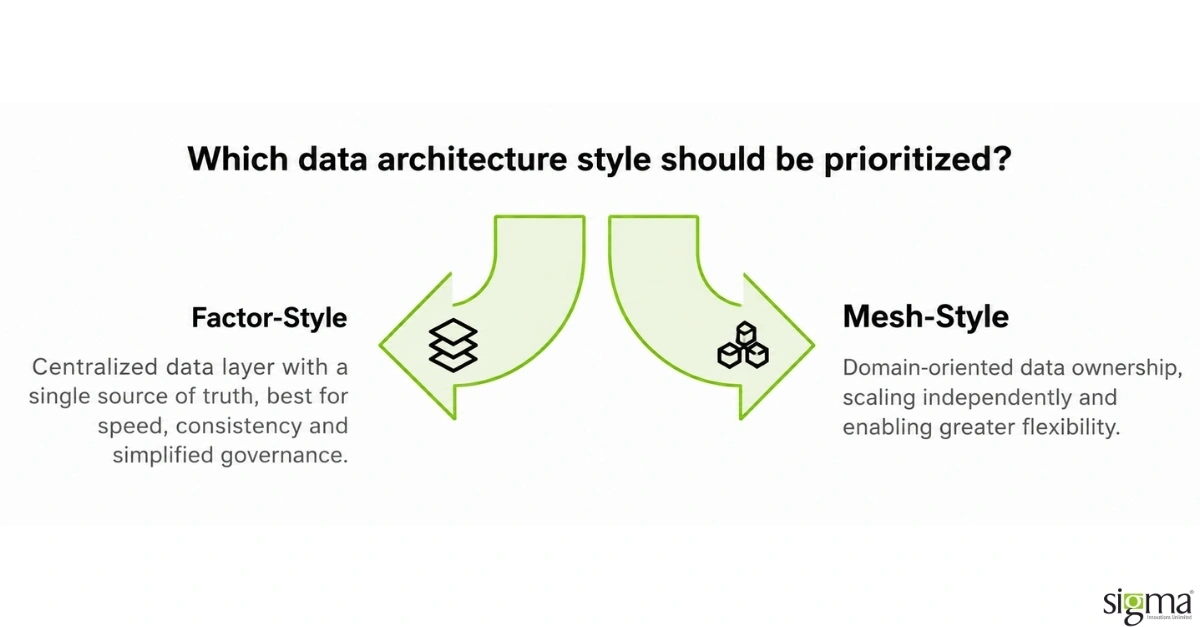
The strict either-or framing is a conference construct. Large organizations commonly adopt fabric-style technology, comprehensive cataloging, automated lineage, unified access, while selectively applying mesh-style ownership in domains capable of taking it.
That hybrid works because the two approaches are not opposed. A domain publishing a data product needs consumers to find it, which is a fabric concern. A catalog needs someone accountable for each entry, which is a mesh concern. The data architecture decision is less “which one” and more “which one first, and how far.”
Sequencing usually favors fabric-style foundations first, because cataloging and lineage deliver value incrementally without organizational change, and they make subsequent ownership distribution far easier to manage. As the research consistently shows, “I have yet to see any company with 100% in data mesh.”
For regulated industries specifically, the emerging playbook looks like this:
- Centralize the platform: Infrastructure, ingestion, bronze/silver layers, and policy enforcement stay central. Compliance gets baked into deployment templates, not bolted on afterward.
- Decentralize the product: Gold layers, reporting, and domain-specific transformations move toward the teams with business context, but only if they have the engineering capability to sustain ownership.
- Automate the governance: Metadata management, automated testing, policy-based access controls, and observability become core infrastructure, not afterthoughts.
- Sequence the rollout: Start with fabric-style foundations that deliver incremental value, then selectively distribute ownership to domains that demonstrate readiness.
The Future Is Messy, and That’s Fine
The “revolutionary” data mesh adoption mostly revolutionized committee meetings. Real organizations aren’t choosing between centralization and decentralization, they’re negotiating a shifting boundary between what must be controlled and what can be trusted to the edges.
The future of data engineering isn’t going to be defined by any single platform or trend. As the Loop Play analysis of emerging data engineering trends suggests, the shift is toward “modular, reusable pipeline components”, “batch plus streaming workflows”, “decoupled storage and compute”, and “observability and alerting by design.” None of these are purely centralization or decentralization plays. They’re all about building systems that can adapt, which means distributed responsibility bounded by shared standards.
This mirrors what we’re seeing across the broader technology landscape. The risks of centralized infrastructure control are pushing organizations toward resilience through distribution, while the shift toward powerful single-node systems proves that “scale out” isn’t the only answer. The lessons from early decentralized networks remind us that pure decentralization has its own failure modes. And in AI, we’re seeing decentralized inference shift from cloud to local devices, while institutions like the Internet Archive demonstrate that hybrid architectures balancing legacy and modern can survive for decades.
The data teams that win won’t be the ones that pick a side. They’ll be the ones that figure out where the line between central control and distributed ownership needs to sit for their specific organization, and then defend that boundary with automation, not dogma.
The debate isn’t about who’s right. It’s about who can move faster without breaking the things that must not break. And that answer is always going to be messier than a conference keynote suggests.