Gnutella’s Ghost: What the Web’s First True P2P Network Teaches Us About Over-Engineering
description: “The protocol that powered LimeWire scaled to millions of users without a single server, then died because the internet grew up. Its architectural failures are exactly what your modern distributed system is repeating.”
In the late 1990s, a handful of AOL employees named Justin Frankel and Tom Pepper, the same wizards who built Winamp, released an internal demo into the wild. Their employer promptly tried to stuff the toothpaste back into the tube, but the protocol they’d unleashed had no central server, no kill switch, and no owner.
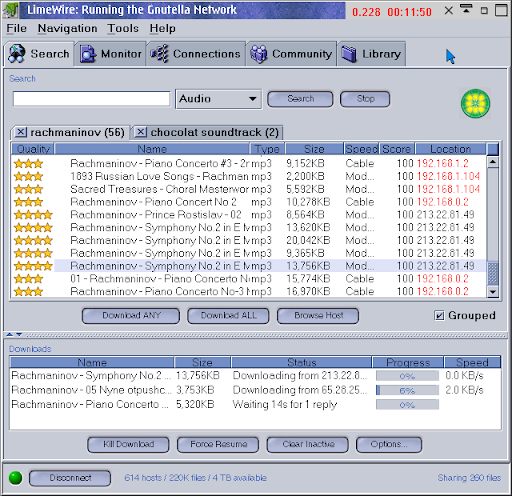
It was Gnutella, and it became the protocol that powered LimeWire, BearShare, and dozens of other file-sharing clients. At its peak, it connected millions of concurrent users who didn’t give a damn about decentralization as a philosophy. They just wanted to download “LinkinPark.mp3.exe” and hope it wasn’t a virus.
But here’s the part that matters for anyone building distributed systems today: Gnutella’s architectural choices, both its brilliant simplicity and its fatal flaws, are a perfect case study in the trade-offs your modern systems face. And almost everyone is repeating its mistakes, from blockchain maximalists to microservice architects.
Gnutella’s Ghost: What the Web’s First True P2P Network Teaches Us About Over-Engineering
description: “The protocol that powered LimeWire scaled to millions of users without a single server, then died because the internet grew up. Its architectural failures are exactly what your modern distributed system is repeating.”
In the late 1990s, a handful of AOL employees named Justin Frankel and Tom Pepper, the same wizards who built Winamp, released an internal demo into the wild. Their employer promptly tried to stuff the toothpaste back into the tube, but the protocol they’d unleashed had no central server, no kill switch, and no owner.
It was Gnutella, and it became the protocol that powered LimeWire, BearShare, and dozens of other file-sharing clients. At its peak, it connected millions of concurrent users who didn’t give a damn about decentralization as a philosophy. They just wanted to download “LinkinPark.mp3.exe” and hope it wasn’t a virus.
But here’s the part that matters for anyone building distributed systems today: Gnutella’s architectural choices, both its brilliant simplicity and its fatal flaws, are a perfect case study in the trade-offs your modern systems face. And almost everyone is repeating its mistakes, from blockchain maximalists to microservice architects.
The Protocol That Outlived the World That Created It
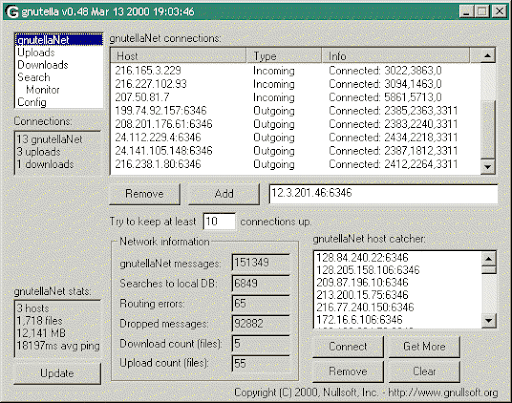
Let’s get one thing straight: Gnutella didn’t fail. It scaled to mainstream adoption, thrived for a solid decade, and is still running today. The network didn’t collapse under its own weight. It outlived the conditions that made it useful. As the author of the definitive modern analysis put it: “The real reason Gnutella faded is that it outlived the world that created it.”
The early 2000s were a perfect storm for a protocol like this:
– The music industry was in full denial mode about digital distribution
– MP3 players and solid-state storage became cheap and ubiquitous
– Dial-up made streaming impractical, so downloading was the only option
– Managing disk space, directories, and downloads was still a normal thing computer users did
Gnutella solved a real problem at massive scale, and its solution just happened to be decentralized. No one was slapping a “GnutellaCoin” sticker on it and hoping the price would moon. They just wanted music.
The Architecture in 23 Bytes
Every Gnutella message starts with a 23-byte header containing a message ID, payload type, TTL (time-to-live), hops count, and payload length. That’s it. Five core message types made the whole network work:
| Code | Message | Purpose |
|---|---|---|
| 0x00 | PING | Probe for live peers |
| 0x01 | PONG | Reply with IP, port, and sharing stats |
| 0x80 | QUERY | A search request, flooding through the network |
| 0x81 | QUERYHIT | A positive response with file results |
| 0x40 | PUSH | Firewall workaround for stuck uploaders |
The elegance is almost painful to look at. The protocol didn’t try to solve every possible attack vector. It didn’t implement complicated reputation systems or cryptographic identity management. It trusted the client to report its own file counts, bandwidth, and GUIDs.
The developers at LimeWire eventually added extensions like GGEP (Gnutella Generic Extension Protocol) and HUGE (Hash/URN Gnutella Extensions) to handle features like SHA-1 file identification, but the core remained brutally simple.
This simplicity was the secret sauce. A single developer could build a working Gnutella client, and they did. The ecosystem maintained genuine client diversity because the spec was small enough to fit in a developer’s head.
The Flood That Killed the Search
Here’s where the cautionary tale begins.
Gnutella’s search mechanism was a textbook flood-fill. Your query propagated outward from peer to peer, TTL decrementing at each hop. Results trickled back slowly, often taking full minutes to complete. The default TTL of 7 meant a query could reach up to 10,000 nodes in a best-case scenario, but in practice the exponential fan-out meant you were hammering every node within 7 hops.
This design had a fundamental scaling problem: every node had to process every query within its horizon. As the network grew past a few hundred thousand users, the message overhead became crushing. Peers spent more CPU and bandwidth forwarding queries than transferring files.
The fix came from LimeWire engineers in the form of Dynamic Query Routing using Bloom filters and a smarter network topology called “ultrapeer/leaf” architecture. This was the point where Gnutella stopped being a truly flat P2P network and became a hybrid system. A subset of nodes (ultrapeers) handled routing for hundreds of “leaf” nodes, creating implicit hierarchy.
This evolution is exactly what modern distributed systems are learning the hard way: pure decentralization of metadata and search doesn’t scale past a certain threshold without significant architectural intervention.
The “Good Enough” Search Trade-off
Gnutella’s query system was designed for the world of 1999, where a search returning 47 results over 90 seconds was acceptable because the alternative was… nothing. The protocol didn’t guarantee consistency, couldn’t sort results, and had no mechanism to handle malicious actors injecting fake results.
The same trade-offs haunt modern distributed search systems. Consider the architectural lesson in the “Good Enough” Deception we’ve written about: distributed search systems often sacrifice consistency and accuracy for availability, and then paper over the gap with client-side heuristics. Gnutella did exactly this. Users learned to spot fake files by looking at size mismatches and unusual filenames. The search system was an oracle of “maybe”, not “certainly.”
NAT, Firewalls, and the Death of Flat Routing
Here’s the architectural point that still catches teams off guard: the internet’s topology changed under Gnutella’s feet.
When the protocol was designed, running a public HTTP server on your laptop was trivial. NAT was uncommon. Residential ISPs gave you a real, routable IP address. By the mid-2000s, that world was gone. NAT, firewalls, and carrier-grade NAT (CGNAT) made it impossible for most nodes to receive inbound connections.
Gnutella’s response was the PUSH message, a hack that asked a firewalled uploader to connect back to the downloader. Think of it as calling someone and asking them to call you back because your phone can’t receive calls. It worked for some cases but was fundamentally a patch on top of a broken assumption.
Modern systems face this same problem when they assume network symmetry. The control plane bottleneck we’ve analyzed in microservice architectures echoes Gnutella’s struggle: when you decentralize data transfer but centralize routing/metadata, you create a hybrid system with all the failure modes of both approaches.
Bootstrapping: The Achilles’ Heel No One Wants to Talk About
Gnutella had no central registry of participants. To join the network, you needed to find at least one live peer already connected. This “bootstrapping” problem was solved by GWebCache, a federation of independently managed web servers running simple CGI/PHP scripts.
The cache servers had a few basic responsibilities:
– Record IP addresses of volunteers
– Store addresses of other GWebCache servers (redundancy)
– Provide lists of current network participants
This worked, but it created an invisible dependency on centralized infrastructure. The network was P2P in theory, but in practice, it relied on a handful of volunteer-run web servers to let new users in. If all the GWebCache servers went dark, the network would slowly wither as existing peers went offline.
Modern decentralized systems make this same trade-off while pretending it doesn’t exist. Every blockchain “fully decentralized” application has a bootstrapping dependency on DNS seeds, Infura nodes, or public RPC endpoints. The recent domain suspension of Anna’s Archive demonstrated this brutally: even the most ideologically pure decentralized content repositories remain hostage to centralized DNS registries.
The Free-Rider Problem: Why Trusting the Client Broke
Gnutella’s protocol trusted clients to report their own bandwidth, file counts, and sharing status. There was no verification mechanism. Predictably, the network suffered from severe free-rider problems. Studies from the early 2000s found that roughly 70% of Gnutella users shared no files at all. The network was a tragedy of the commons disguised as a file-sharing protocol.
The protocol had no choke points to enforce good behavior. You couldn’t restrict access by ratio, require reciprocal sharing, or penalize leechers. This wasn’t a bug in the implementation, it was a feature of the architecture. The same “permissionless” quality that made Gnutella impossible to shut down also made it impossible to govern.
BitTorrent solved this with choking algorithms and tit-for-tat bandwidth allocation. Private trackers added ratio enforcement. But these systems required either protocol changes (BitTorrent) or centralized components (trackers). Gnutella’s flat architecture couldn’t support either.
What Gnutella Got Right (That Crypto Keeps Getting Wrong)
The most painful lesson from Gnutella’s history is also the one that blockchain projects keep ignoring: simple protocols with multiple independent implementations outlast complex protocols with single reference clients.
The comment that keeps showing up in discussions about Gnutella is remarkably consistent: “The protocol is very simple and could support a client ecosystem that is actually diverse. This is my big gripe with many P2P projects. They build a spec that is so exhaustive it can only support one reference implementation.”
Gnutella had genuine client diversity. LimeWire led the market, but you could use GTK-Gnutella, BearShare, Shareaza, or roll your own. A developer in 2026 actually built a working client from scratch in TypeScript/Bun. The spec was small enough that independent implementations could interoperate.
Contrast this with modern P2P protocols like Secure Scuttlebutt or ActivityPub, which often have specs so complex that only one or two clients ever get built. The “reference implementation” becomes the de facto spec, and protocol diversity dies before it starts.
The Permanent Long Tail: A Quiet Victory
Gnutella didn’t get shut down. The RIAA couldn’t kill it. The network didn’t collapse. It just… faded. The conditions that made it necessary, expensive music, no streaming, users comfortable with manual file management, all disappeared.
The network still runs today at reduced capacity. GTK-Gnutella has a maintainer who helped write the 0.6 protocol spec and is still active. The GWebCache servers still respond to queries. The protocol outlived the companies that tried to commercialize it, the lawsuits that tried to stop it, and the internet that spawned it.
There are worse fates for a distributed system. The question isn’t whether your system will last forever, it’s whether it can adapt when the world changes. Gnutella couldn’t adapt to a world of NAT-heavy networks, streaming subscriptions, and users who don’t know what a filesystem is. But it didn’t need to. It ran its course and did its job.
What Your Distributed System Can Learn from Gnutella’s Ghost
The lessons for modern system design are uncomfortable but clear:
1. Decentralization comes in degrees, not absolutes. Gnutella’s pure P2P vision was rapidly modified with ultrapeer/leaf hierarchy, dynamic query routing, and Bloom filters. Every successful “decentralized” system introduces hierarchy and centralization at some layer. Pretending otherwise is marketing, not architecture.
2. Bootstrapping is a hidden centralization point. Every P2P system has a bootstrap dependency. If you’re building a distributed system that claims to be fully decentralized, find your bootstrapping dependency and treat it as a single point of failure, because it is.
3. Simple protocols win. Gnutella’s 5-message core spec allowed genuine client diversity. Over-engineered specs produce monocultures. The ecosystem that can have multiple independent implementations is the one that survives.
4. Metadata and search scale differently than data transfer. Gnutella could transfer files efficiently (simple HTTP GETs), but its search flooded every node. The same pattern appears in modern systems: you can make data storage/decentralized, but searching it remains a centralization magnet.
5. Trusting the client is an architectural decision, not a bug. Gnutella’s “trust the client” approach made the protocol simple and implementable. It also made abuse trivial. Every distributed system makes this trade-off somewhere. The question is whether you’re honest about it.
Gnutella didn’t die because it was badly designed. It died because it solved a problem that eventually stopped being a problem. The protocol is still out there, chugging along, waiting for a world that might need it again.
The question for every engineer building a distributed system today isn’t “will it scale?”, it’s “what world are you designing for, and how long will that world last?”
The world Gnutella was designed for lasted about a decade. That’s not a failure. That’s a successful, functional lifespan for a distributed system created by two developers who probably had no idea it would still be running twenty-five years later.
What’s your system’s expiration date, and are you building for it?