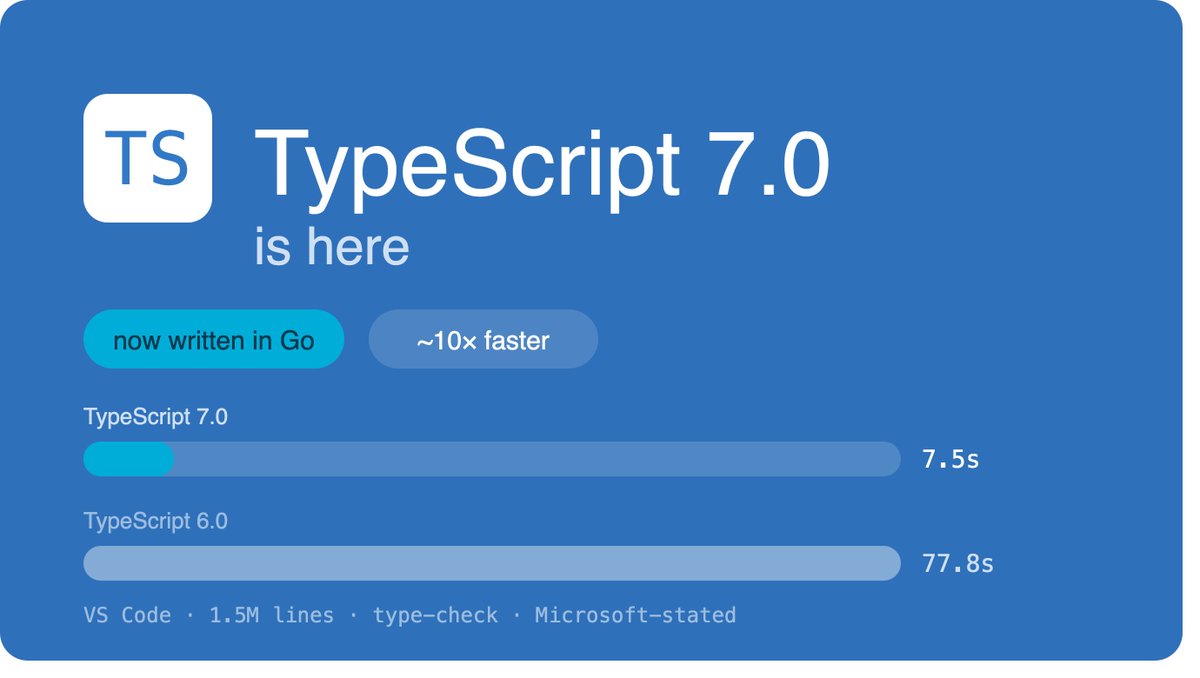
TypeScript 7 isn’t just another point release. It’s a fundamental rewrite of the compiler in Go that delivers 10x faster builds, true parallel type-checking, and a complete rethinking of how the TypeScript toolchain works. For teams managing large monorepos or sprawling codebases, this isn’t a nice-to-have, it’s a paradigm shift.
But let’s not pretend this is all sunshine and rainbows. The migration path is bumpy, embedded language support is in limbo, and the programmatic API that tooling depends on won’t arrive until 7.1. This is a trade-off, and understanding it is the difference between a smooth transition and a blocked pipeline.
The 10x Question: What Actually Changed?
The headline number, 10x faster, isn’t marketing fluff. The TypeScript team ran benchmarks on five major open-source projects, and the results are staggering:
| Codebase | TypeScript 6 | TypeScript 7 | Speedup |
|---|---|---|---|
| vscode | 125.7s | 10.6s | 11.9x |
| sentry | 139.8s | 15.7s | 8.9x |
| bluesky | 24.3s | 2.8s | 8.7x |
| playwright | 12.8s | 1.47s | 8.7x |
| tldraw | 11.2s | 1.46s | 7.7x |
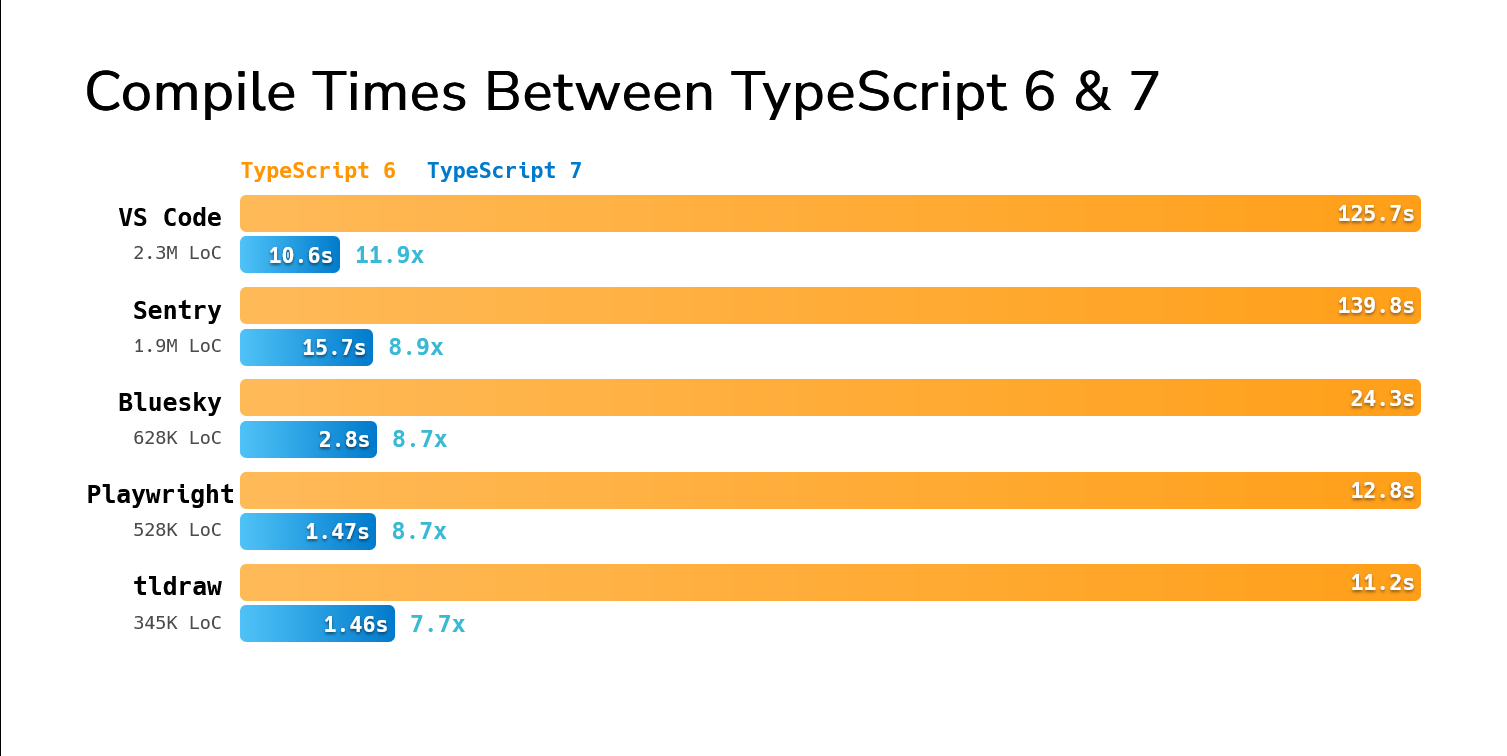
These aren’t synthetic benchmarks. VS Code’s own team reported that opening a file with an error went from 17.5 seconds to under 1.3 seconds, a 13x improvement in developer workflow.
But the real story isn’t just speed. It’s memory.
| Codebase | TypeScript 6 | TypeScript 7 | Memory Delta |
|---|---|---|---|
| vscode | 5.2GB | 4.2GB | -18% |
| sentry | 4.9GB | 4.6GB | -6% |
| bluesky | 1.8GB | 1.3GB | -26% |
| playwright | 1.0GB | 0.9GB | -11% |
| tldraw | 0.6GB | 0.5GB | -15% |
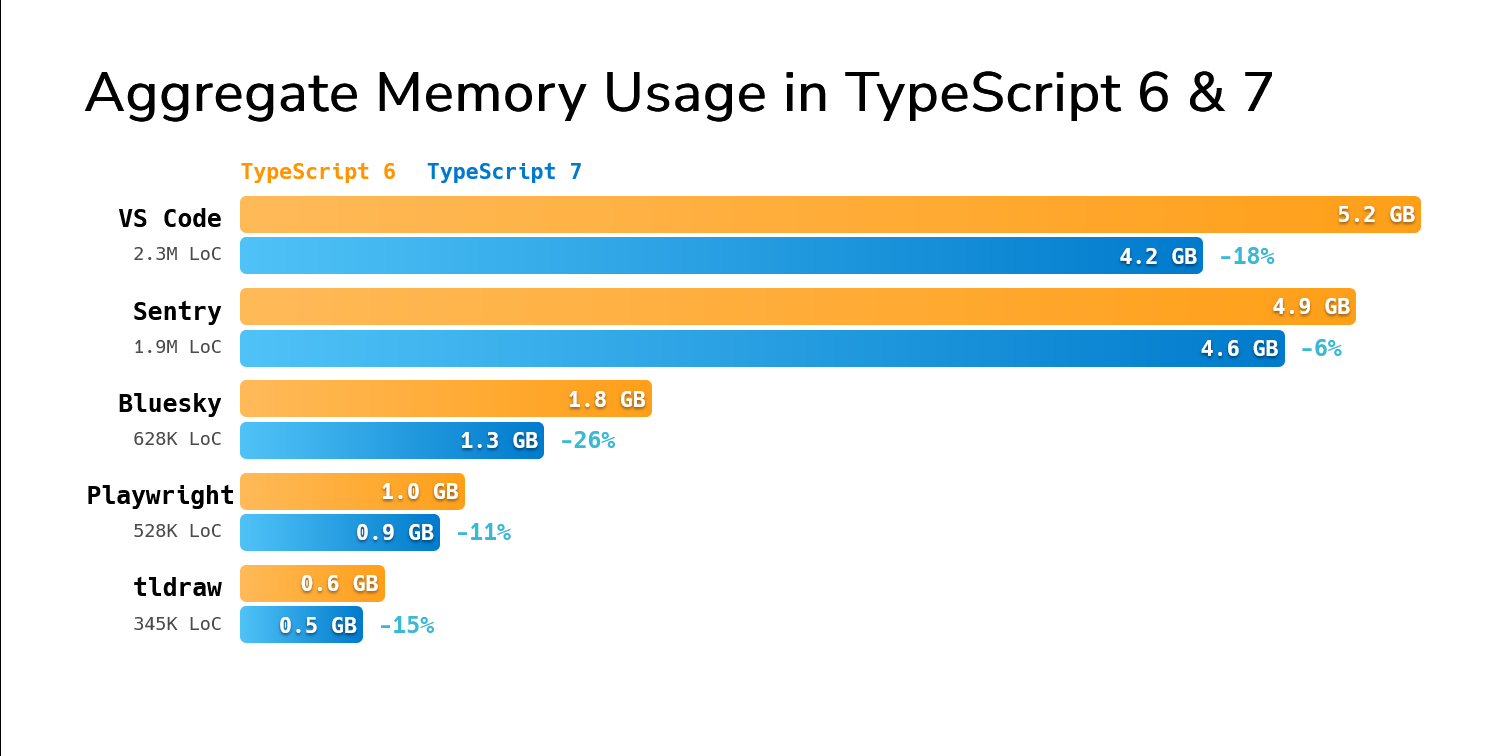
The compiler uses less memory while running faster. That’s not typical optimization, that’s a different class of engineering.
The Go Bet: Why Not Rust?
The TypeScript team didn’t just pick Go because it was trendy. They needed a language that could mirror the existing TypeScript codebase structurally, not rewrite it from scratch. Go’s garbage collection and straightforward concurrency model made it possible to port the compiler file-by-file while maintaining identical type-checking logic.
Rust would have been faster on paper, but the borrow checker would have forced structural changes that risked introducing bugs. The team chose correctness over marginal speed gains. Given that they had to maintain compatibility with TypeScript 6’s type semantics, this was the right call.
The port wasn’t a clean-slate redesign either. The Go codebase was written to produce identical results as the JavaScript version, preserving over a decade of battle-tested type-checking logic. This is why projects that compile cleanly on TypeScript 6 (with the right flags) compile identically on TypeScript 7.
Parallelization: The Hidden Architecture
TypeScript 7 introduces two new flags that fundamentally change how the compiler uses hardware: --checkers and --builders.
--checkers controls the number of parallel type-checking workers (default is 4). On machines with more cores, bumping this to 8 yields even better results:
| Codebase | TS 6 | TS 7 (–checkers 8) | Speedup |
|---|---|---|---|
| vscode | 125.7s | 7.51s | 16.7x |
| sentry | 139.8s | 12.08s | 11.6x |
| bluesky | 24.3s | 2.01s | 12.1x |
| playwright | 12.8s | 1.16s | 11x |
| tldraw | 11.2s | 1.06s | 10.6x |
But there’s a catch. These workers duplicate some work because they maintain their own view of the type system. Increasing checkers improves speed at the cost of memory. On CI runners with limited resources, decreasing this value to 1 effectively makes type-checking single-threaded.
For monorepos using project references, the --builders flag parallelizes builds across projects. But here’s the meta: --checkers and --builders multiply. Running --checkers 4 --builders 4 allows up to 16 concurrent type-checking workers. That’s a lot of memory pressure.
The Migration Tax: What You’ll Need to Change
TypeScript 7 adopts TypeScript 6’s new defaults as hard requirements. If you’re on TypeScript 5.x, this migration hits harder. Key changes include:
strictistrueby default (and can’t be turned off)moduledefaults toesnext(bye-byeamd,umd,systemjs)targetdefaults to the current ECMAScript versionrootDirdefaults to./(you’ll need to explicitly set it if your tsconfig sits outsidesrc)typesdefaults to[](old behavior requires"types": ["*"])baseUrlis completely removed (use relativepathsinstead)
Deprecated features that are now hard errors:
– target: es5 is gone
– downlevelIteration is gone
– moduleResolution: node/node10/classic is gone (use nodenext or bundler)
– esModuleInterop and allowSyntheticDefaultImports can’t be false
– alwaysStrict can’t be false
If you’re still on TypeScript 5.x, this is going to sting. The recommendation is to migrate to TypeScript 6 first, then tackle TypeScript 7.
The Embedded Language Problem
This is the elephant in the room. Tools like Volar, which provides TypeScript support for Vue, Svelte, Astro, and MDX, embed TypeScript’s API directly. TypeScript 7 doesn’t ship a stable programmatic API, that’s coming in 7.1.
This means if you’re using Angular, the Go-powered tsc can check your project in seconds, but your editor will still run on TypeScript 6’s language server. The VS Code extension for TypeScript 7 lets you toggle between the two, but it’s a workaround, not a solution.
The TypeScript team is working with project maintainers, but for now, embedded language workflows are stuck on TypeScript 6. This is a point-in-time issue, but it’s going to create friction for teams that depend on these frameworks.
The Watch Mode Revolution
TypeScript 7’s --watch mode has been rebuilt from the ground up using a Go port of Parcel’s file watcher. The original Go standard library doesn’t have native file watching, and pure polling turned out to be computationally expensive for large projects with deep node_modules trees.
The solution was a port of @parcel/watcher from C++ to Go. The result is a self-contained, cross-platform watcher that delivers significant resource improvements and stable performance across all operating systems. For developers who spend their days in --watch mode, this alone is worth the upgrade.
The Real-World Impact
The numbers from early adopters tell a compelling story:
- Slack reported that TypeScript 7 eliminated 40% of their merge queue time, bringing CI type-checking from 7.5 minutes to 1.25 minutes. Their editor experience went from “unusable” to instant.
- Vanta saw up to 9x faster builds on their largest projects.
- Microsoft’s News Services team saved 400 hours a month waiting for CI builds.
- Canva developers went from waiting 58 seconds for their first error to 4.8 seconds.
The VS Code team documented their own migration extensively, and the runtime evolution and architectural shifts in the JavaScript ecosystem we’re seeing with Deno 2.8 echo this theme: the age of waiting for tools is ending.
The Type System Changes
Beyond performance, TypeScript 7 introduces meaningful type system improvements. The most notable is how template literal types handle Unicode:
type HeadTail<S> = S extends `${infer Head}${infer Tail}` ? [Head, Tail] : never;

type Result = HeadTail<"![😀]abc">;
// TypeScript 7: ["![😀]", "abc"]
// TypeScript 6: ["\ud83d", "\ude00abc"]
Previously, TypeScript followed JavaScript’s UTF-16 indexing, splitting surrogate pairs. The new behavior aligns with how developers intuitively think about strings, following for...of iteration rather than JavaScript’s internal encoding.
This is a breaking change for any type-level string manipulation that modeled UTF-16 code units. If you have string Length utilities at the type level, audit them.
JavaScript analysis has also been reworked for consistency with .ts files. Standalone ? types, @enum, @class constructors, and Closure-style function syntax are all gone. If your JSDoc codebase relied on these, you’ll need to update.
Running Side-by-Side
For teams that depend on TypeScript’s programmatic API (typescript-eslint, ts-jest, etc.), Microsoft has published @typescript/typescript6. This package provides a tsc6 executable and re-exports the TypeScript 6 API.
The recommended approach is to install both versions using npm aliases:
{
  "devDependencies": {
    "@typescript/native": "npm:typescript@^7.0.2",
    "typescript": "npm:@typescript/typescript6@^6.0.2"
  }
}
This lets npx tsc use TypeScript 7 while downstream tools can continue relying on TypeScript 6. It’s not elegant, but it works.
The Road to 7.1
TypeScript 7.0 is a runtime-only release. The team is already working on 7.1, which will ship a stable programmatic API. For teams building custom tooling, this is the version to target.
The nightly builds will resume under the standard typescript package with the next tag, and the @typescript/native-preview package will be deprecated.
Architectural Implications
For large-scale TypeScript projects, this changes the calculus around type-checking. Previously, teams often offloaded full type-checking to CI because local editor performance was unacceptable. TypeScript 7 makes local type-checking feasible again, which means faster feedback loops and more rigorous type checking in development.
But there’s a Jevons Paradox at play here. As type-checking becomes cheaper, teams will use more of it. Expect to see more complex type-level programming, more aggressive type inference, and more reliance on the type system for runtime validation.
For those implementing TypeScript implementations of authorization patterns, the faster compilation means you can afford more sophisticated type-level constraints without paying the productivity tax.
The Bottom Line
TypeScript 7 is a major architectural milestone, not just for the language itself but for the entire JavaScript ecosystem. The Go port proves that static analysis tooling can be both correct and fast, and it raises the bar for what developers should expect from their toolchain.
If you’re on TypeScript 6, the migration is straightforward in terms of compatibility, but requires updating your configuration. If you’re on TypeScript 5.x, plan for a more involved migration through 6.0 first.
The embedded language ecosystem will catch up with 7.1. For everyone else, there’s no reason to wait. Install TypeScript 7 today, and prepare for a new era of developer productivity.
npm install -D typescript@latest