One character. That’s the only thing standing between an attacker and your AI agent’s credentials. A single injected character in an HTTP Host header is all it takes to bypass authentication on millions of servers running AI agents, MCP (Model Context Protocol) tools, and the infrastructure connecting them to user data, email accounts, databases, and even industrial equipment.
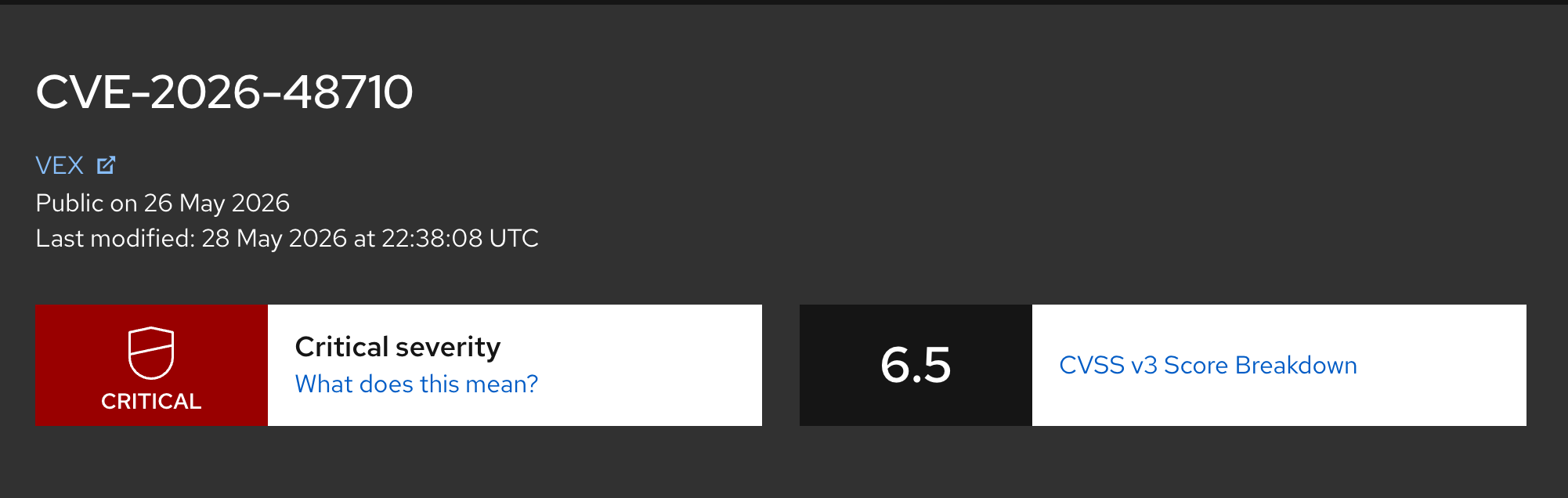
The vulnerability, tracked as CVE-2026-48710 and branded BadHost, was discovered in Starlette, an open-source framework that receives 325 million weekly downloads. If you’re building AI infrastructure in Python, something in your stack almost certainly depends on it. Starlette is the foundation FastAPI is built on, and FastAPI is what a significant portion of the Python AI tooling ecosystem runs on.
This isn’t a theoretical risk. X41 D-Sec, the security firm that discovered the vulnerability during an OSTIF-sponsored audit, ran a scanner and found real production systems, live, connected to actual sensitive data, reachable through a single malformed HTTP header. Clinical trial databases. Full mailbox access. SSH keys to industrial bastion hosts. Personal identity verification data. All sitting behind authentication that evaporates when you know the trick.
How BadHost Works: The Simplicity Is Terrifying
The mechanics of BadHost are embarrassingly simple. That’s precisely what makes it dangerous.
Starlette reconstructs URLs by concatenating the HTTP Host header with the requested path. It never validates whether the Host header actually contains a valid value. Attackers can inject path components into the Host header, creating a mismatch between what the routing system sees and what the authentication middleware evaluates.
Here’s the concrete example from the researchers at X41 D-Sec:
GET /protected HTTP/1.1
Host: example.com/health?x=
Starlette’s routing system sees the request path as /protected. But request.url.path, the attribute that authentication middleware relies on, reconstructs the URL as example.com/health?x=/protected. The middleware thinks the user is requesting the /health endpoint, which is publicly accessible. Authorization granted.
That’s it. One inconsistency between how routing and authentication interpret the same request. X41 D-Sec researchers found that authentication in multiple apps relying on request.url was trivially bypassed. Beyond that, the vulnerability enables SSRF (server-side request forgery) exploits and, in some cases, remote code execution.
The bug carries a CVSS severity rating of 7 out of 10, but both X41 D-Sec and Secwest argue this “materially understates” the threat. X41 D-Sec described it as having “critical severity”, and the data they found exposed supports that assessment.
What Was Sitting Exposed: The Scanner Results
X41 D-Sec partnered with Nemesis to create a public scanner. The results paint a grim picture of the AI ecosystem’s security posture. Here are the types of systems they found exposed:
| Category | Data Exposed |
|---|---|
| Biopharma AI | Clinical trial databases, M&A data, SSRF |
| Identity Verification | Face analysis, KYB, live PII, internal codebase |
| IoT/Industrial | SSH to devices via bastion, remote code execution |
| Email/SaaS | Full mailbox read/send/delete, S3 export, webhooks |
| HR/Recruitment | Candidate PII, hiring pipeline data |
| CMS/Marketing | Subscriber lists, mass email campaign capabilities |
| Document Management | Read, upload, modify scanned documents |
| Cloud Monitoring | AWS topology, distributed traces, metric queries |
| Cybersecurity | Asset inventory, live Nuclei scanner access |
| Personal Health/Finance | Nutrition logs, expenses, subscriptions |
The industrial entry is the most alarming. SSH access to devices through a bastion host means attackers could execute code on physical infrastructure. Every other category represents credentials or data that attackers can monetize, weaponize, or use for lateral movement.
Why MCP Servers Are the Perfect Target
MCP (Model Context Protocol) servers are the backbone connecting AI agents to external systems. They store credentials for email accounts, calendars, user databases, third-party services, everything an agent needs to be useful. That also makes them the perfect target.
The vulnerability ripples through the dependency chain. Starlette is the core of FastAPI, which is baked into VLLM, LiteLLM, Text Generation Inference, most OpenAI-shim proxies, and countless agent harnesses and evaluation dashboards. If you’re using any of these tools, you’re running Starlette underneath.
As one developer noted in the discussion about this vulnerability: “There are probably still tens of thousands of ollama instances exposed to the internet.” The combination of exposed AI endpoints and a trivial auth bypass creates a “recipe for disaster”, especially as dependency chains grow deeper. Every package brings its own 10+ dependencies, and somewhere in that tree is a vulnerable version.
The NSA has already issued guidance on MCP security risks, highlighting the broader challenge of securing AI infrastructure that was built fast and deployed faster.
Who’s Affected: The Full Scope
The vulnerability affects all Starlette versions prior to 1.0.1, which was released on Friday, May 22, 2026. The patch came with unusual speed, the typical 30-day disclosure window wasn’t observed, which suggests the discoverers and Starlette maintainers recognized the severity.
Any framework or application that depends on Starlette inherits the vulnerability:
- FastAPI, the most widely used Python web framework for AI services
- VLLM, the LLM inference server where the bug was originally discovered
- LiteLLM, a proxy for multiple LLM providers
- MCP servers, especially those using HTTP/SSE transport (stdio-mode servers are not affected)
- Gradio, the Hugging Face UI framework
- Ray Serve, BentoML, model serving platforms
- Google ADK-Python, when using custom middleware
One important clarification: if you’re running MCP servers in stdio mode (the default for most local Claude Code setups), there’s no HTTP listener to exploit. But anyone running SSE or HTTP transport is exposed.
The Debate: Overblown or Underestimated?
The developer community is split on BadHost. Some argue the risk is exaggerated:
“It’s just a way to fake URL paths. You can’t impersonate a user. I can’t think of one production FastAPI app where this would be a serious security risk.”
That misses the point. The exploit doesn’t impersonate users, it bypasses path-based authentication middleware. If your app relies on URL path matching to control access to different endpoints, BadHost renders that control meaningless.
Consider this scenario from a production engineer:
“At my dayjob we use OPA to auth at route/URL level done as a global dependency. This bug would have provided an auth bypass for many of our GET endpoints. Fortunately, cloudfront blocks these requests.”
The key insight: many production systems implement authentication at the middleware layer using route-based logic, not as per-endpoint dependencies. That pattern is vulnerable. The FastAPI documentation explicitly recommends using Depends() or Security() for each route, but not everyone follows that pattern.
What to Do Right Now: The Fix
The fix exists. Starlette 1.0.1 patches the issue. The hard part is ensuring you’ve updated the actual dependency, not just the top-level package.
1. Check Your Dependency Tree
Don’t just update FastAPI. Starlette is a transitive dependency. Run:
pip show starlette
If you’re using VLLM, check its specific virtual environment:
pip show starlette # in your vllm environment
The version should be 1.0.1 or greater. If it’s not, update:
pip install --upgrade starlette
2. Use the Public Scanner
The Nemesis scanner at mcp-scan.nemesis.services can check whether a given server is vulnerable. Run it before assuming your stack is clean.
3. Fix Your Authentication Pattern
Don’t use request.url.path for security decisions. Replace it with scope["path"], which reflects the actual request path rather than the reconstructed URL.
Better yet, use FastAPI’s Depends() or Security() on each route or route group rather than relying on global middleware for authentication.
4. Add Proxy-Level Validation
Deploy a reverse proxy (Nginx, Caddy, HAProxy) that validates and normalizes Host headers before they reach your ASGI server. Most properly configured proxies already strip malformed headers, which is why this vulnerability primarily affects systems without them.
The Bigger Picture: AI Infrastructure Security Is Broken
BadHost isn’t an isolated incident, it’s a symptom of a deeper problem. The AI agent ecosystem was built fast, on top of tools that weren’t designed for the kind of sensitive access MCP servers now routinely handle. The trust boundaries in AI architecture were drawn hastily, and the security assumptions baked into that infrastructure deserve more scrutiny than they’ve been getting.
The parallel to the TanStack npm compromise is instructive. In both cases, the trust we place in dependency chains, and the assumption that upstream packages have been properly audited, proves fragile. As AI tools proliferate, the attack surface grows exponentially.
Tools like the MCP security scanner mcp-safeguard are emerging to address this gap, applying 52 detection rules across prompt injection, credential exposure, endpoint exposure, and tool poisoning. But these are reactive measures. The fundamental problem is architectural.
BadHost got patched because it was discovered during a sponsored audit. The next vulnerability might not surface as cleanly. If you’re running anything in the Python AI ecosystem, VLLM, FastAPI, MCP servers, agent harnesses, check your Starlette version right now. The scanner is free. The patch is available. The alternative is someone reading your email, exporting your S3 buckets, or SSH-ing into your infrastructure through a single malformed HTTP header.
One character. That’s all it took.