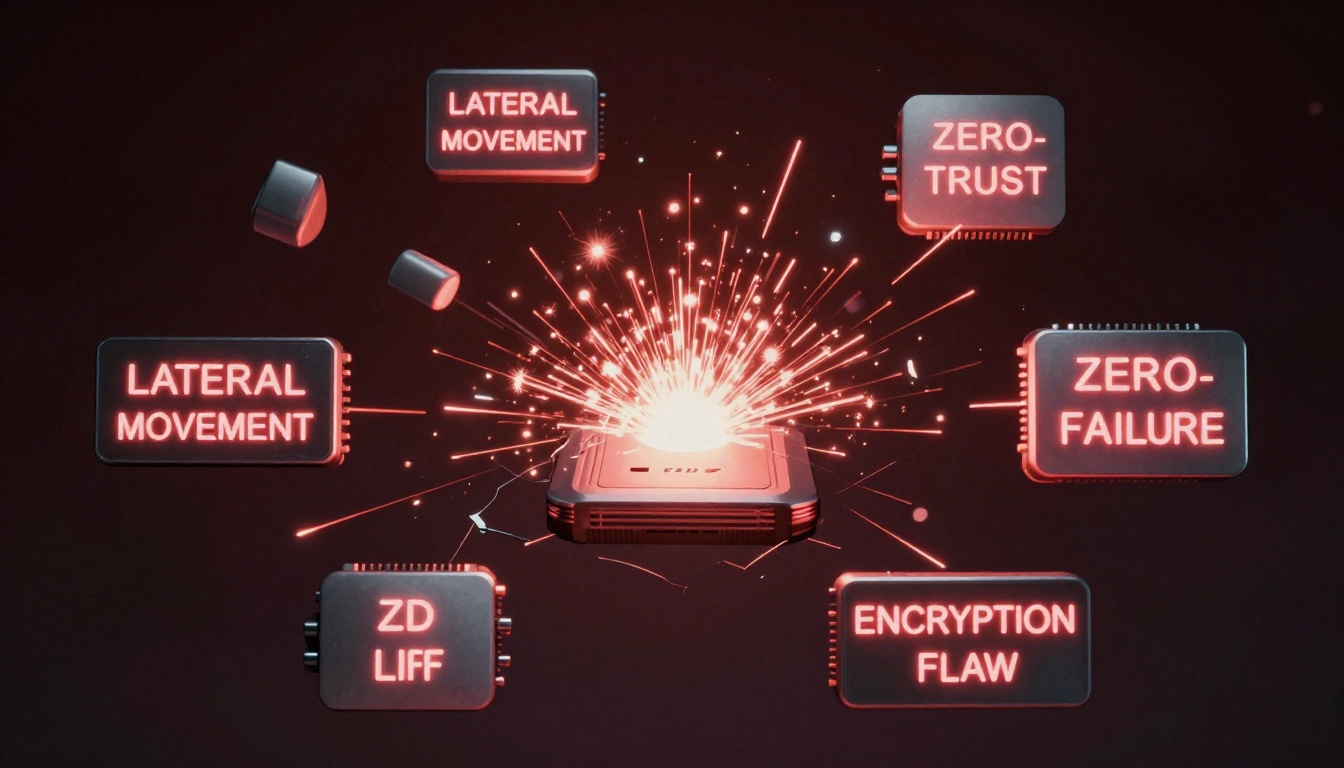
The AirSnitch research team didn’t just find a vulnerability, they proved that Wi-Fi client isolation, a security feature deployed in virtually every enterprise network, fails 100% of the time. Every. Single. Network. If you’re building microservices or distributed systems, this isn’t just a networking problem. It’s a preview of your next security incident.
The 100% Failure Rate That Should Terrify You
Researchers from UC Riverside presented their findings at NDSS 2026: they broke client isolation in every tested Wi-Fi network, from cheap home routers to enterprise-grade WPA3-Enterprise deployments. The attack didn’t require exotic hardware or nation-state resources, just a fundamental understanding of how isolation actually works (or rather, doesn’t).
The irony is brutal. Client isolation was specifically designed to prevent users on the same network from attacking each other. As one analysis noted, “Rather ironically, this very protection mechanism turned out to be the weak link.” The same pattern haunts distributed systems: our “secure” service-to-service communication mechanisms often become the attack vector we least expect.
What Wi-Fi Client Isolation Promised (And Why It Failed Miserably)
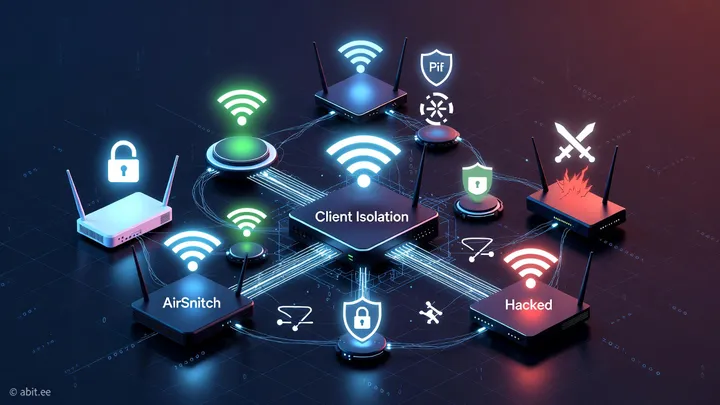
Wi-Fi client isolation operates on a simple principle: devices connected to the same access point shouldn’t see each other’s traffic. In a coffee shop, your laptop shouldn’t access the file shares of the person at the next table. In an enterprise, the marketing team’s devices shouldn’t probe the engineering subnet.
The AirSnitch research identified three structural flaws that make this promise impossible to keep:
-
Shared group encryption keys for broadcast traffic: Many networks use a single key for all broadcast communication. If an attacker captures it (and they can), they can inject malicious packets that appear legitimate to the network stack.
-
Single-layer enforcement: Isolation is often enforced at only one layer, typically Layer 2 (MAC filtering) or Layer 3 (IP routing), leaving other layers exposed. An attacker can bypass MAC filtering by operating at the IP layer, or vice versa.
-
Weak synchronization of client identity: Wi-Fi systems fail to consistently link a device’s identity across network layers. This allows attackers to slip past routing rules by presenting inconsistent identities at different layers.
The result is full man-in-the-middle capability: bidirectional traffic interception, uplink and downlink control, and the ability to target not just other clients but internal backend devices.
Your Microservices Are Running the Same Broken Playbook
If you’re feeling smug because you “don’t do Wi-Fi”, stop. These architectural failures have direct parallels in how most organizations build distributed systems:
Shared secrets between “isolated” services: Just like Wi-Fi’s group keys, microservices often share API keys, service tokens, or signing certificates. When one service is compromised, that secret becomes a skeleton key for lateral movement. The multi-tenancy isolation challenges in databases, mirroring Wi-Fi client isolation failures in distributed environments, show how shared credentials become catastrophic when isolation assumptions break.
Layer-specific security policies: Your Kubernetes network policies might block pod-to-pod traffic, but do your application-layer permissions match? Can a compromised service use its valid service account token to access Kafka, Redis, or the metadata service at a different layer? The hidden costs of loose coupling in event-driven systems, analogous to lateral movement risks in poorly isolated networks, reveal how attackers exploit gaps between network and application controls.
Inconsistent identity enforcement: Your service mesh might enforce mTLS with SPIFFE IDs, but does your database use the same identity? Does your message broker? Does your custom authorization service? When identity isn’t synchronized across every layer, you get the same bypass AirSnitch exploited.
Three Architectural Lessons From the Wi-Fi Graveyard
1. Defense in Depth Means All Depth, Not Just Your Favorite Layer
Wi-Fi isolation failed because it assumed enforcing at one layer was sufficient. Distributed systems make this mistake constantly: network policies without workload identity, WAF rules without service-level authorization, API gateways without database row-level security.
The AirSnitch attack worked by moving between layers, bypassing MAC filtering at Layer 2 by operating at Layer 3. Your microservices face the same threat: an attacker with a compromised pod can use IP spoofing, DNS rebinding, or service token theft to jump between security contexts.
The fix: Every critical operation needs enforcement at multiple layers. A database query should be filtered by:
– Network policy (which pods can reach the DB)
– mTLS identity (which service is making the request)
– Application-level permissions (what data that service can access)
– Database RLS (which rows match that service’s tenant)
2. Consistent Identity Is Non-Negotiable (And Harder Than You Think)
The Wi-Fi identity synchronization flaw allowed attackers to present one identity to the access point and another to the network stack. Sound familiar? It’s exactly what happens when your service mesh uses SPIFFE, your cloud provider uses IAM roles, your database uses usernames, and your SaaS integrations use OAuth, all without a unified identity model.
How identity verification systems can enable surveillance and overreach, paralleling unintended consequences in client isolation failures demonstrates what happens when identity becomes fragmented: you lose the ability to audit, enforce policy, and respond to incidents.
The fix: Adopt a single identity framework that spans every component. SPIFFE/SPIRE can provide X.509 certificates for services, but you need to map those to database users, cloud IAM roles, and application users. This isn’t trivial, it requires a control plane that translates and enforces identity consistently.
3. Shared Secrets Are Lateral Movement Accelerants
Wi-Fi’s group encryption key meant one compromise affected the entire network. In microservices, shared API keys, service tokens, or signing secrets create the same blast radius.
The challenges in coordinating changes across services, relevant to securing inter-service communication and access controls highlight how shared secrets make it nearly impossible to revoke access without breaking everything. When you rotate a shared secret, you need to coordinate deployment across dozens of services, so you don’t rotate it often, or at all.
The fix: Move to short-lived, automatically rotated credentials. SPIFFE certificates with 1-hour TTLs. Cloud provider workload identity (AWS IAM Roles for Service Accounts, Azure Managed Identities, GCP Workload Identity). Vault dynamic secrets. Anything that eliminates long-lived shared credentials.
From Wi-Fi to Service Mesh: Mapping the Solutions
Service meshes like Istio and Linkerd attempt to solve these problems, but they can replicate the same failures if misconfigured. They enforce mTLS (good), but often rely on shared root certificates (bad if compromised). They provide identity (good), but sometimes don’t integrate with your application’s identity model (bad).
The SaaS architecture best practices from recent research emphasize: “Treat every call, including intra-service traffic, as coming from an untrusted network. Mutual TLS between microservices and short-lived, signed service tokens closes the door on lateral movement.”
This is the right mindset, but implementation matters. The monorepos as distributed systems, highlighting architectural lessons for securing component boundaries shows that even in “monolithic” codebases, you need the same boundaries as microservices. The security model must be consistent regardless of deployment topology.
The Zero Trust Reality Check
AirSnitch proves that “trusted internal network” is an oxymoron. Zero trust isn’t just a buzzword, it’s an admission that isolation mechanisms will fail, and you need defense-in-depth to compensate.
The Everfox Trusted Thin Client approach for Azure Government demonstrates this principle at the hardware level: “Even if an endpoint is compromised, attackers cannot move between classification domains due to hardware-enforced separation.” This is isolation done right: multiple independent enforcement mechanisms, no shared secrets between domains, and consistent identity verification at every boundary.
For microservices, this means:
– Assume any service can be compromised: What can it access? What can it do? Limit blast radius.
– Verify at every hop: Not just at the API gateway. At the service entry, at the database connection, at the message publish.
– Use hardware security where possible: TPM-backed identity, confidential computing enclaves, HSM-managed keys.
Practical Steps: Hardening Your Distributed Systems Today
1. Audit Your “Isolation” Mechanisms
List every control that prevents Service A from accessing Service B’s data or functionality. For each control, ask:
– What layer does it enforce? (Network, authn, authz, application, database)
– What identity does it use? (IP, service account, user, certificate)
– What happens if that identity is compromised? (Can you revoke it? Does it affect other services?)
If you only have one control between critical services, you have Wi-Fi-level security.
2. Implement Layer-Spanning Policies
Use policy-as-code frameworks like OPA or Cedar to define security policies that reference consistent identities across layers. A policy might look like:
package authz

# Service identity from mTLS certificate
service_identity := input.attributes.request.http.headers["x-service-id"]

# User identity from JWT
user_identity := input.attributes.request.http.headers["x-user-id"]

# Enforce: Service can only access data for its tenant AND user's tenant
allow {
    service.tenant == user.tenant
    service.tenant == input.attributes.request.http.headers["x-tenant-id"]
}
This ensures identity synchronization across network, application, and business logic layers, exactly what Wi-Fi isolation lacked.
3. Eliminate Shared Secrets (Yes, All of Them)
Create a migration plan:
– Phase 1: Inventory every shared API key, service token, and certificate
– Phase 2: Replace with workload identity (IAM roles, pod identity, SPIFFE)
– Phase 3: Implement automated rotation for any remaining long-lived secrets
– Phase 4: Add detection for secret leakage in code repos and logs
The governance failures in decentralized data applications, reflecting risks of weak isolation in networked systems shows what happens when you skip this: credential sprawl that becomes impossible to track, let alone secure.
4. Gain East-West Visibility
Traditional monitoring watches North-South traffic (client to API). You need East-West visibility (service-to-service). This means:
– Collecting network flows between pods/services
– Logging every inter-service call with identity context
– Monitoring service mesh telemetry for anomalies
– Using eBPF-based agents to capture kernel-level events
The IPS deployment patterns for lateral movement prevention show that “eBPF-based agent on nodes collects network events, sidecar policy manager pushes per-pod rules, SIEM receives alerts.” This architecture gives you the visibility to detect the “pre-flight” reconnaissance phase that precedes actual attacks.
The Isolation Illusion
AirSnitch’s 100% success rate isn’t a Wi-Fi problem, it’s an architectural problem. Any system that relies on a single layer of enforcement, shared secrets, or inconsistent identity will fail the same way. The only variable is how long it takes attackers to weaponize it.
Your microservices aren’t more secure than public Wi-Fi just because you use Kubernetes and mTLS. They’re only more secure if you’ve eliminated shared secrets, enforced consistent identity across every layer, and built defense-in-depth that assumes isolation will fail.
The question isn’t whether your isolation mechanisms work. AirSnitch already answered that: they don’t. The question is what happens when they fail, and whether your architecture contains the blast radius, or turns a single compromised service into a network-wide catastrophe.
Start auditing your isolation today. Your next security incident is already testing the gaps.