The email landed on a Tuesday morning: “Strategic initiative to migrate from Cloudera to Databricks, Q3 deadline.” For a data engineer who’d spent five years mastering Sqoop imports, Impala queries, and Airflow DAGs, this wasn’t a promotion, it felt like a career obituary. The panic that followed? Justified. The claim that kicked off this existential crisis? A recruiter’s casual dismissal: “No one uses Airflow or Hadoop in 2026.”
The recruiter was half-right, dangerously half-wrong, and completely misunderstood the difference between orchestration and processing. Let’s dissect this orchestration reckoning with the nuance it deserves.
The False Equivalence Problem
First, let’s address the elephant in the server room: Airflow and Hadoop are not the same thing. Hadoop hasn’t been “a thing” for greenfield projects since approximately 2018. It’s a legacy platform for batch processing that revolutionized big data in the 2000s but now belongs in the same conversation as mainframes, relevant for maintaining existing systems, career suicide for new development.
“Nobody is really writing net new greenfield code in hadoop anymore.” That’s not controversial, that’s established fact. The real debate is about Airflow, and the answer is far messier than your cloud vendor’s sales pitch would have you believe.
The Airflow Paradox: More Popular, More Problematic
Airflow remains the cockroach of data orchestration: it survives everything, adapts to anything, and somehow costs more to exterminate than to live with. The numbers don’t lie, Airflow’s community is still growing, and major enterprises run thousands of DAGs daily. But that ubiquity masks a growing resentment.
The pain points are real and quantifiable. Take GCP Composer (managed Airflow): a “cheap” environment runs $600/month, with premium setups exceeding $1,000 when you factor in logs, support, and taxes. That’s $30K annually for a tool that’s supposed to save you money. One engineer reported their team paying $60K/year to Prefect plus infrastructure costs before migrating to Composer for $30K/year total, a “savings” that still feels like extortion.
The infrastructure tax is staggering. Benchmarking data from a recent Medium analysis reveals Airflow consumes 1.2GB of RAM at idle, nearly identical to its peak usage. That’s a static footprint regardless of workload. Compare that to lightweight alternatives like Cronicle (51MB) or Ofelia (<20MB), and you’re looking at a 20-200x efficiency gap. For an MVP on a $5/month VPS, Airflow isn’t just overkill, it’s economic sabotage.
The “Compute-First” Coup
The real shift isn’t away from orchestration, it’s toward integrated orchestration. Modern data platforms like Databricks and Snowflake have realized that selling compute is more profitable than selling coordination. Why let Airflow siphon off your margin when you can embed scheduling directly into your platform?
This is the recruiter’s actual point: for PySpark + Databricks pipelines, a standalone orchestrator feels like using a freight train to deliver a pizza. Databricks Workflows, Snowflake Tasks, and similar cloud-native schedulers promise “seamless” integration with zero infrastructure overhead. The pitch is seductive: keep your logic and scheduling in one ecosystem, avoid the GKE startup lag, and stop paying for a separate conductor when the orchestra can direct itself.
But here’s what you lose: flexibility. Airflow’s superpower isn’t scheduling, it’s orchestrating heterogeneous systems. When your pipeline needs to hit a REST API, trigger a dbt job, spin up a Dataproc cluster, and notify Slack, Airflow (or Dagster, or Prefect) remains the universal adapter. Cloud-native schedulers excel within their walled gardens but become awkward when you step outside.
The Alternative Reality: A Crowded Field
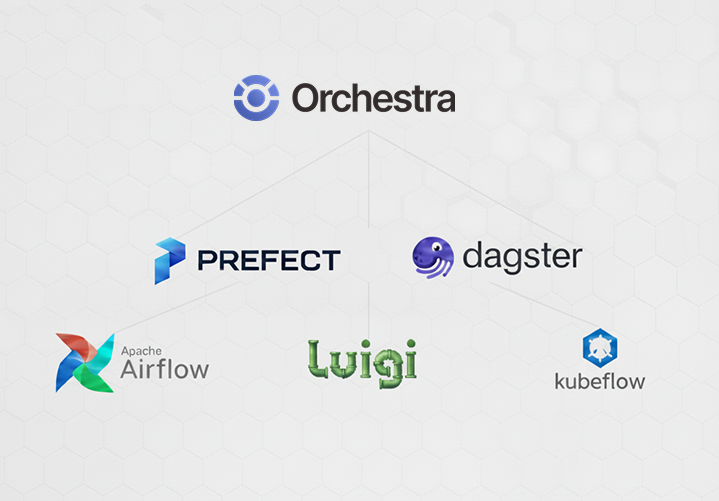
If Airflow is legacy, what’s modern? The 2026 orchestration landscape looks like a knife fight in a YAML store:
- Dagster: Asset-centric, strong lineage, but still Python-heavy and requires infrastructure management
- Prefect: Event-based, great UI, but advanced features hide behind paywalls
- Kestra: YAML-native, polyglot-friendly, but maturing
- Orchestra: Serverless, declarative, but trades control for convenience
The evaluation criteria have shifted. Teams now prioritize:
– Time-to-value (minutes vs. hours of setup)
– Built-in observability (not logging into Kibana at 3 AM)
– Low operational overhead (serverless is the new black)
– Multi-language support (SQL, Python, APIs, not just Python DAGs)
– Real-time readiness (batch-first is batch-only)
Airflow scores poorly on most of these. Its Python-centric model forces everything into DAGs, creating what one engineer called “a Python packaging exercise” where orchestration should be.
The Career Calculus: Skills That Survive
Let’s address the panic attack. If you’re a data engineer with 5 years of Airflow experience, are you obsolete? The consensus from hiring managers is blunt: we don’t care about your orchestrator.
“If you already can do python, sql, and dbt then you should be fine picking up any scheduler/orchestrator”, one engineering lead explained. The market is demanding Snowflake, Databricks, and BigQuery expertise. Spark, Python, SQL, and dbt are the durable skills. Airflow is just the current conductor, the music matters more than the baton.
This aligns with the broader trend toward full-stack data generalists. The engineers thriving in 2026 aren’t those who can debug Airflow’s Celery backend, they’re the ones who can write PySpark, model data in dbt, and understand business context. The rise of the full-stack data generalist isn’t about knowing less, it’s about knowing what actually drives value.
The real career risk isn’t Airflow obsolescence, it’s cloud illiteracy. Companies want experience with AWS, GCP, or Azure not because they’re better, but because the learning curve is steep and training is expensive. One Airflow expert on GCP Composer can “sail through” interviews, while a Hadoop veteran without cloud experience faces a career cliff.
The Nuanced Truth: When Legacy Wins
Here’s where the recruiter’s absolutism crumbles. Airflow remains the right choice when:
– You’re orchestrating multiple technologies across clouds
– You need complex dependency management beyond cron
– You require replayability for data correction
– Your team has existing Airflow expertise and migration costs exceed benefits
“Standalone orchestration is nice to have when you are orchestrating many different technologies and need to link dependencies. It’s also nice when you need to ‘replay’ data assuming you wrote your dags properly.”
The key phrase: assuming you wrote your dags properly. The real Airflow killer isn’t Databricks, it’s bad engineering. The tool’s flexibility becomes a liability when teams create DAGs that are untestable, unobservable, and unmaintainable. Cloud-native schedulers win by constraining choice, not by superior architecture.
The Migration Reality Check
For those facing the Cloudera-to-Databricks migration, the path isn’t binary. The migration from on-prem Hadoop is less about tool replacement and more about architectural paradigm shift. You’re not just swapping schedulers, you’re moving from a world where you own the infrastructure to one where you rent the platform.
This transition exposes Airflow’s dirty secret: it was never designed for cloud-native workflows. The KubernetesOperator is a band-aid on a monolith, and the real-world usage patterns show teams quietly ignoring best practices because the complexity tax is too high.
Meanwhile, the Spark vs. Hadoop MapReduce debate is settled. Spark won on every metric except cost for petabyte-scale batch jobs. But that victory created a new problem: when your processing engine is also your orchestrator, you lose the separation of concerns that made Airflow valuable in the first place.
The 2026 Orchestration Reckoning
So, is Airflow obsolete? The answer is infuriatingly consultant-esque: it depends.
Hadoop is dead for new projects, a legacy system to maintain, not a skill to learn. Airflow is in hospice care: still widely used but increasingly questioned. The real story is the fragmentation of orchestration into specialized niches:
- MVP stage: Cronicle or Ofelia (sub-60MB footprint)
- Growth stage: Prefect or Dagster (balance of control and convenience)
- Enterprise scale: Airflow or Orchestra (governance and heterogeneity)
- Cloud-native: Databricks Workflows or Snowflake Tasks (platform lock-in)
The recruiter’s claim wasn’t entirely wrong, just oversimplified. The industry is moving away from standalone orchestration toward integrated data platforms. But that movement creates new problems: vendor lock-in, limited flexibility, and the risk of putting all your eggs in one cloud basket.
The Survival Strategy
If you’re a data engineer in 2026, here’s your playbook:
- Master fundamentals: Python, SQL, dbt, Spark, these transcend orchestrators
- Learn one cloud platform deeply: AWS, GCP, or Azure, pick one and own it
- Understand both paradigms: Be able to write DAGs and configure Databricks Workflows
- Embrace the full-stack mindset: The career pivot from mainframes teaches us that adaptability beats specialization
- Optimize what you have: Before migrating off Airflow, optimize your DAGs. You might find the problem isn’t the tool, it’s the implementation
The orchestration reckoning isn’t about tool obsolescence, it’s about value extraction. In 2026, paying $30K/year to schedule cron jobs feels as absurd as hiring a full-time conductor for a garage band. But for complex, multi-system orchestration, Airflow remains the least-worst option, until something truly better emerges.
The real controversy? We’re not having the right debate. The question isn’t “Is Airflow dead?” It’s “Why are we still paying so much to move data from A to B?” And that’s a question your cloud vendor definitely doesn’t want you to ask.
The bottom line: Hadoop is a legacy skill. Airflow is a transitional technology. The future belongs to engineers who can orchestrate across platforms, not those who swear allegiance to any single tool. The 2026 data engineer is a generalist who can navigate Databricks, debug a Prefect flow, and, when absolutely necessary, restart a stuck Airflow DAG at 3 AM without crying.
The recruiter was wrong about obsolescence, but right about urgency. The shift is happening. Your move isn’t to abandon Airflow overnight, it’s to stop treating orchestration as a career and start treating it as a means to an end. The data is what matters. Everything else is just scheduling.