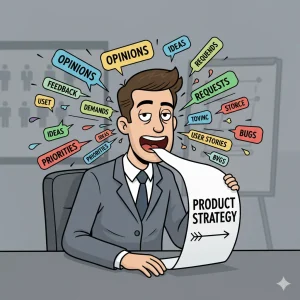
This isn’t a failure of your technical skills. It’s a failure of communication. You’re speaking the language of complexity management, stability, maintainability, technical debt. They’re speaking the language of uncertainty reduction, speed, market learning, agility. You’re both looking at the same work through utterly different lenses.
And if you can’t bridge that gap, your architectural genius doesn’t matter.
The Two Loops: Where Communication Dies
At the core of this mismatch is a fundamental misalignment in what a business is. A company isn’t a monolith with a single goal. It’s two competing, parallel loops running simultaneously.
The First Loop is the domain of product managers, marketers, sales, and leadership. Their primary monster isn’t a slow database query, it’s uncertainty. Every day they don’t know if their product-market fit is right is a day of runway burned, a day of competitive advantage lost. Their weapon? Speed. The faster they ship something, the faster they learn what works. Their story is simple: requests pour in, we build fast, we learn from the market, we repeat.
Then there’s the Second Loop. This is the senior developer’s home turf. Once you have paying customers, a new beast emerges: complexity. Every new feature, every conditional, every additional service is a potential source of instability, a future bug, a spike in the pager duty alert volume. The senior developer’s primary responsibility shifts from building fast to building stably. Their story is different: every new request adds complexity, threatening the very system they are tasked with keeping alive.
The conflict is baked in. The business needs both loops to run. It needs to chase new markets and serve existing customers. The senior developer, however, often only communicates the cost of the first loop from the perspective of the second.
“You want to add a social feed? That’s 20 new database tables, a caching layer redesign, and will increase our incident rate by 15%.”
But the product lead hears: “I’m saying ‘no’ to learning if our users want community features.”
Your expertise isn’t wrong. Your framing is fatal.
The Four Hidden Roles (Where Code Is the Least of It)
The leap from a mid-level coder to a senior engineer isn’t about writing more complex algorithms. It’s a career change. As research into senior engineer roles shows, senior engineers spend 50-70% of their time on activities that never show up in a git log.
These “hidden roles” are precisely where communication breakdowns occur:
- System Designer: Making decisions that outlive your code. This is where architectural trade-offs are born, the choice between eventual consistency and strong reads, between a monolith now and a microservice maze later. When you present this as a technical “best practice”, you’ve lost your audience. They need to know which business goal it serves.
- Mentor: Your biggest leverage isn’t your own code, but elevating the team’s output. Mentorship isn’t code review. It’s about teaching how to think about problems, which includes teaching junior engineers to see the two loops and communicate trade-offs effectively.
- Technical Debt Manager: The boring work that keeps everything running. Here, the translation failure is most acute. To you, refactoring a legacy service is a “complex, risky migration.” To the business, it needs to be framed as: “This work will cut our time-to-market for new features by 30% next quarter.” It’s not about cleaning up a mess, it’s about unlocking future speed, a direct answer to the First Loop’s uncertainty problem.
- Cross-Functional Translator: This is the communication role. It’s about speaking the language of the business. As Tanya Reilly notes in The Staff Engineer’s Path, this is “managing up”, providing technical context so others can make informed decisions. It’s not about saying “no.” It’s about giving stakeholders enough information to say “yes” to the right things.
The silent killer is that most senior developers are promoted for their prowess in roles 1 and 3 (the “Second Loop” skills), then suddenly find their success hinges on mastering role 4, a skill they were never trained for.
From Problem Avoider to Uncertainty Solver
The archetypal senior developer, as Tuhin Nair puts it, is a problem avoider. They ask, “Do we really need that?” and “Can we make do for now?” This is a superpower of complexity reduction. But when communicated raw, it sounds like obstructionism.
The copywriter’s prescription is brilliant: Don’t explain away someone else’s problem using your own problems.
Stop saying: “We can’t build that because it adds too much complexity to the database layer.
Start saying: “Can we try something quicker?”
This phrase is a masterclass in translation. “Quicker” speaks directly to the First Loop’s hunger for speed and uncertainty reduction. “Something” implies an alternative path. “Try” lowers the stakes, making it an experiment rather than a commitment.
Instead of being the gatekeeper of complexity, become the architect of speed through simplicity. Your value isn’t in preventing work, it’s in finding the fastest, most stable path to a validated business hypothesis.
- Need to test user demand for a new analytics feature? Don’t spin up a new data pipeline. Can you add a single chart using existing log data?
- Want a new user onboarding flow? Instead of rebuilding the entire auth service, can you add a clever UI toggle to the existing one?
You’re not saying no. You’re saying, “Let me use my expertise to get you the learning you need, faster and with less risk.” This is the essence of differentiating senior engineering mindsets.
The AI Accelerant: When Speed Destabilizes Scale
Enter AI-powered development. It feels like a wrecking ball aimed at the senior developer’s carefully managed world. The First Loop is supercharged, product managers can now “vibe-code” entire features. The pressure to “just ship it” is overwhelming.
AI accelerates the First Loop (speed, market learning) while actively destabilizing the Second Loop (stability, complexity management). It worsens understandability, debuggability, and maintainability, all the “bilities” a senior developer is tasked with protecting.
This creates a brutal paradox. Leadership sees AI as the ultimate uncertainty reducer. You see it as the ultimate complexity generator. And you’re both right.
Your old arguments about “code quality” or “maintainability” sound like relics. You need a new frame.
From Developer to Editor: A Radical Proposal
What if we stopped trying to make developers responsible for both loops within a single system? What if we decoupled the goals entirely?
Imagine a Speed System and a Scale System.
The Speed System is the “vomit draft” of software. It’s where AI agents, junior devs, and rapid prototypes live. Its only KPI is learning velocity. Code quality is secondary, the goal is to get something to market for feedback. It embraces the chaos of AI-generated code.
The Scale System is the senior developer’s domain. It’s the edited, final draft. It’s where features proven in the Speed System are re-engineered for stability, scalability, and long-term maintainability. Its KPI is reliability and cost of change.
This framing changes the conversation completely. Now, when asked for a feature, you can say:
“Great idea. Let’s build a Speed version in 3 days to test the hypothesis. If it works, we’ll plan the Scale version for production in 6 weeks.”
You’ve just aligned yourself with the First Loop’s need for speed and protected the Second Loop’s need for stability. You’re not a bottleneck, you’re a strategist.
This model also directly addresses the AI challenge. Let AI run wild in the Speed system. Your job shifts from coder to editor, using your deep architectural judgment to decide what gets promoted, refactored, and solidified in the Scale system. This is the future of senior engineering: curating and hardening, not just creating.
The Whiskey Glass Mindset: Serve the Right Drink
Communication failure isn’t about being right or wrong. It’s about serving whiskey in a wine glass. No matter how good the whiskey is, the presentation feels off.
Your architectural trade-offs are the answer to business uncertainty. A stable, well-designed system is the enabler of long-term speed. Technical debt isn’t just a tech problem, it’s a business risk that prevents architectural decay through enforcement and crushes future agility.
The senior developer who masters this translation doesn’t just build better systems. They build systems that actually get built. They move from being the person who says “no” to being the person who says “here’s how we win.” They stop fighting the First Loop and start architecting for it.
That’s the real promotion. Not to a higher pay grade, but to a crucial bridge between chaos and craft. And in an era where AI is handing everyone a megaphone for chaos, that bridge has never been more valuable.