
In 1995, Brendan Eich had ten days to build Mocha (later JavaScript). Under that pressure, he ported Java’s Date implementation, bugs and all, because “Make It Look Like Java” was the mandate. Thirty years later, that decision remains one of the most expensive shortcuts in software history, requiring a nine-year, cross-industry effort to undo. Temporal, the new JavaScript time API that just reached Stage 4 in TC39, isn’t just a better date library. It’s a case study in why understanding systemic architectural failures requires treating time as a first-class failure mode, not a presentation-layer inconvenience.
The $84 Million Weekly Tax on Bad Primitives
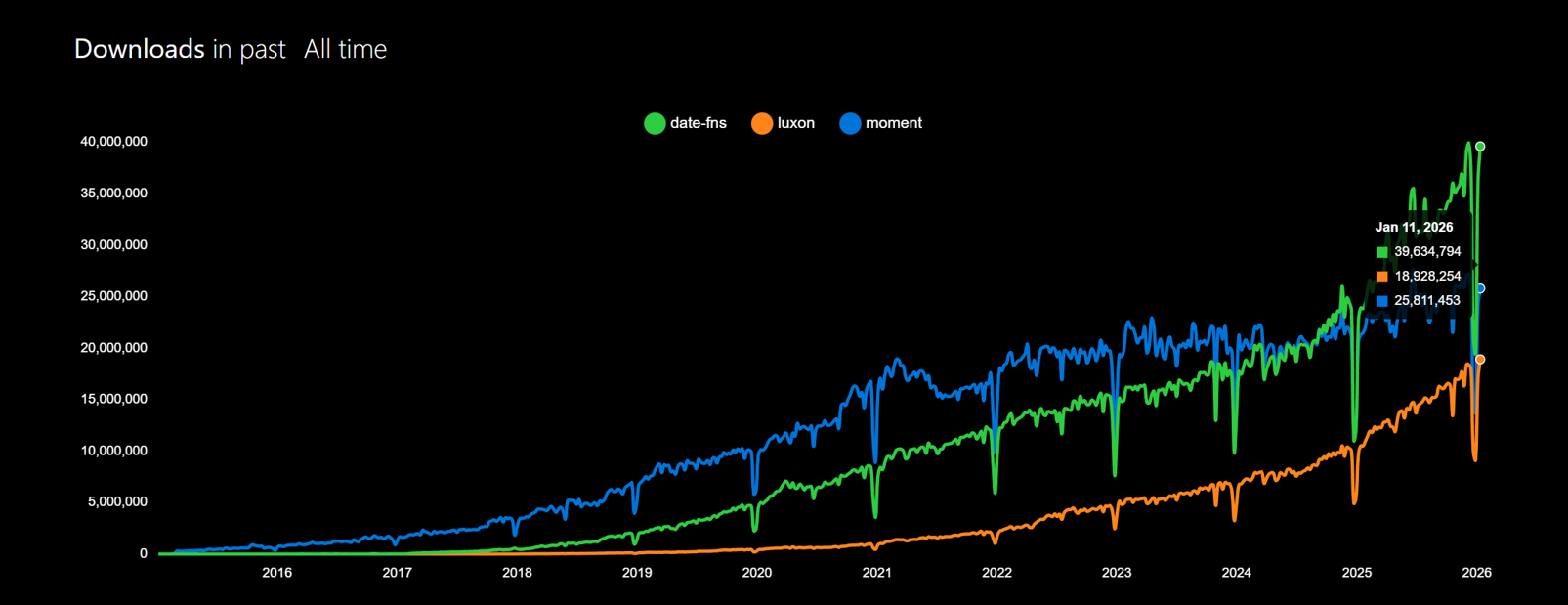
The JavaScript ecosystem has been paying for that 1995 decision every day since. Developers downloaded date-fns, Luxon, and Moment.js a combined 84 million times per week as of January 2026, over 4 billion annual downloads just to paper over a broken primitive. Moment.js alone ships with 4.15MB of locale data that can’t be tree-shaken because most developers don’t know which time zones they’ll need at build time.
The State of JS survey consistently ranks dates as the #2 language pain point, behind only static typing, and ahead of TypeScript support. That’s remarkable: developers find JavaScript’s type system less painful than its date handling.
The old
Dateobject represents a toxic compromise: a mutable, millisecond-precision timestamp that pretends to be a calendar date while silently converting to the machine’s local time zone.
This creates exactly the kind of subtle distributed bugs that bring down financial systems and scheduling applications.
Why Date Was an Architectural Disaster
The original Date design violates nearly every principle of robust system architecture:
- Mutability by default meant helper functions accidentally mutated original objects when developers expected immutability:
const date = new Date("2026-02-25T00:00:00Z");

function addOneDay(d) {
  // oops! Mutating the original
  d.setDate(d.getDate() + 1);
  return d;
}

addOneDay(date);
// date is now "2026-02-26" without any assignment- Ambiguous parsing created undefined behavior across browsers. The string
"2026-06-25 15:15:00"(note the space instead of ISO 8601’sT) might parse as local time in Chrome, UTC in Firefox, or throw a RangeError in Safari depending on the version. When your distributed system depends on timestamp agreement, “sometimes UTC, sometimes not” is a partition waiting to happen.
- DST arithmetic bugs silently corrupt scheduling logic:
const billingDate = new Date("Sat Jan 31 2026");
billingDate.setMonth(billingDate.getMonth() + 1);
// Expected: Feb 28
// Actual: Mar 02 (overflows into next month)
For a financial terminal like Bloomberg’s, where users trade across every time zone on earth, and governments change DST rules with minimal notice, these aren’t edge cases. They’re daily operational hazards that require managing risks in architectural modernization at scale.
The Nine-Year Standardization Gauntlet
Temporal reached Stage 4 in March 2026, nine years after Maggie Johnson-Pint first proposed it to TC39 in 2017. That timeline reveals the brutal complexity of fixing foundational primitives.
The proposal had to satisfy contradictory requirements: immutable value semantics for functional programming patterns, nanosecond precision for high-frequency trading, calendar-aware arithmetic for internationalization, and explicit time zone handling for distributed systems. The resulting specification is larger than all of ECMA-402 (the Internationalization spec combined).
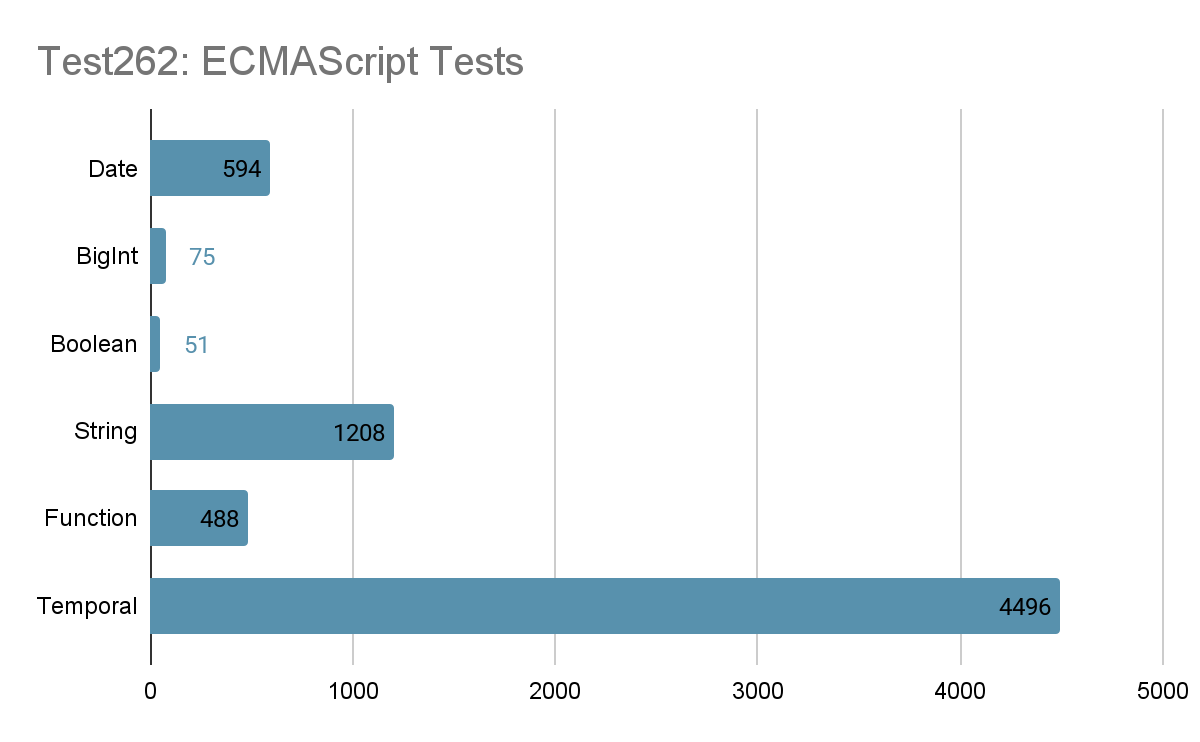
With 4,496 Test262 conformance tests, Temporal is the largest addition to ECMAScript since ES2015. For comparison, the legacy Date object has 594 tests. The new API isn’t just a wrapper, it’s a fundamental reimagining of how a programming language should model time.
The implementation required unprecedented collaboration. Mozilla’s André Bargull implemented the spec single-handedly in Firefox, but other engines needed a different approach. Google and the Boa JavaScript engine collaborated on temporal_rs, a Rust library that now passes 100% of tests and serves as shared infrastructure for multiple engines. This is nearly unprecedented: multiple competing JavaScript engines sharing a core library to ensure behavioral consistency.
Time as an Architectural Primitive
Temporal treats time not as a string formatting problem, but as a type system problem with distinct categories:
Temporal.Instant
Represents an exact moment in nanoseconds since Unix epoch, what distributed systems need for causality tracking. Unlike Date, it carries no time zone information and is always comparable.
Temporal.ZonedDateTime
Combines an instant with an explicit time zone and calendar. This is the type you need for scheduling future events where “9:00 AM America/New_York” must remain 9:00 AM even if DST rules change between now and then.
PlainTypes
Temporal.PlainDate, PlainTime, PlainDateTime represent “wall clock” time without time zone awareness, useful for birth dates, recurring schedules, and other concepts where “March 11th” doesn’t depend on where you are in the world.
The distinction matters because distributed systems fail when nodes disagree on causality. If Server A logs an event at 2:30 AM on the day DST springs forward, and Server B logs an event at 2:45 AM, which happened first? In the old model, both might parse as the same timestamp or throw errors. Temporal forces explicit handling of these gaps:
// London DST starts: 2026-03-29 01:00 -> 02:00
const zdt = Temporal.ZonedDateTime.from(
  "2026-03-29T00:30:00+00:00[Europe/London]",
);

const plus1h = zdt.add({ hours: 1 });
// → "2026-03-29T02:30:00+01:00[Europe/London]"
// 01:30 doesn't exist, Temporal accounts for the transition
The Calendar Problem
Most developers ignore calendar systems until they can’t. Temporal supports non-Gregorian calendars (Hebrew, Chinese, Islamic, etc.) as first-class citizens because “add one month” means different things in different calendrical contexts.
const today = Temporal.PlainDate.from("2026-03-11[u-ca=hebrew]");
// 22 Adar 5786

const nextMonth = today.add({ months: 1 });
// 22 Nisan 5786 (correct Hebrew month arithmetic)

// Legacy Date would add one Gregorian month (March → April)
// then display in Hebrew calendar: 24 Nisan 5786 (wrong day)
This isn’t just internationalization trivia. Financial systems, contract management, and regulatory compliance often require specific calendar systems. Treating them as formatting layers over Gregorian dates creates subtle data corruption that only appears when calculating interest across calendar boundaries or scheduling religious holidays.
What Architects Should Learn
1. Primitives shape ecosystems for decades
A ten-day decision in 1995 cost the industry billions in developer hours, library maintenance, and bug fixes. When you choose a primitive representation, especially for time, money, or identity, you’re not solving a local problem. You’re creating a constraint that thousands of developers will work around for generations.
2. Type safety is a distributed systems concern
Temporal’s verbosity (Temporal.Now.zonedDateTimeISO() vs new Date()) isn’t ergonomic regression, it’s explicitness that prevents distributed bugs. The API forces you to decide whether you’re dealing with an instant, a local time, or a zoned time at the moment of creation, not when serializing across the wire.
3. Shared infrastructure beats competitive advantage
The temporal_rs collaboration between Google, Mozilla, Bloomberg, Igalia, and university researchers demonstrates that some problems are too expensive to solve competitively. When the correctness of time handling affects the entire ecosystem, shared Rust libraries beat proprietary optimizations.
The Road Ahead
Temporal ships in Firefox 139, Chrome/Edge 144, and TypeScript 6.0. Safari remains the holdout (partial support in Technology Preview), continuing its tradition as the new IE6 for web standards adoption.
For architects building distributed systems, the migration path is clear: treat Date as deprecated. Use Temporal.Instant for server-side timestamps, Temporal.ZonedDateTime for user-facing scheduling, and the Plain types for calendar dates without time components. The polyfills exist, the specification is stable.
After thirty years, JavaScript finally has a temporal model that acknowledges time is hard, time zones are political, and calendars are cultural. It only took nine years of standardization, thousands of tests, and a shared Rust library to fix a ten-day mistake.
When your system design treats time as a formatting afterthought rather than a consistency primitive, you’re not saving time. You’re just borrowing it from the engineers who will spend their 3 AM pages fixing DST bugs.