In a blind evaluation with 85 internal WorkBuddy users across 259 tasks, Hy4 Flash scored 2.79 out of 4 on user satisfaction. Claude Haiku 5.5 scored 2.81. That’s a statistical tie with a frontier-adjacent model, at a fraction of the cost. The median task completion time? 6.7 minutes at roughly RMB 0.26 per task.
Here’s the part that should make every enterprise AI decision-maker sit up: Hy4 Flash actually outperforms the larger Hy4 Preview on Tencent’s internal WorkIndex benchmark, scoring 42.1 versus 39.7, while running at 1/13th the cost per task. The “smaller” model is now the default recommendation for most enterprise workflows.
The Architecture Behind the Price Tag
What makes Hy4 Flash different isn’t any single breakthrough. It’s three architectural bets stacked together, each designed to shave cost without gutting quality.
Hybrid Attention: The KV Cache Shrinks to 1/24 of Hy3
The model interleaves sparse attention (IndexPool) with sliding-window attention (SWA) at a 1:3 ratio. The 42-layer backbone follows a pattern of 2 sparse layers, then ten repetitions of three SWA layers followed by one sparse layer. Sparse layers select up to 2,048 tokens via group-level selection, SWA layers look at a fixed 512-token window.
Both use Multi-head Latent Attention (MLA), the same formulation DeepSeek popularized, which compresses key-value representations into a lower-rank space before caching. The result: KV cache size drops to just 1/24 of Hy3’s and 1/6 of Hy4’s. For teams running long-context workloads, this is the difference between swapping GPUs and just… running.
LatentMoE: Cheaper Experts, Same Intelligence
Most MoE models route tokens to experts operating at full hidden-size dimensionality. Hy4 Flash’s 512 routed experts per layer work in a compressed latent space of 1,536 dimensions, versus the backbone’s 3,072. Each token activates only 16 routed experts plus one shared expert.
The team ran scaling ladder experiments similar to the MAI-Thinking-1 paper, reaching a conclusion that contradicts the “sparsity is everything” crowd: at fixed active parameters, increasing sparsity improves compute efficiency, but cutting active parameters while holding total size fixed hurts quality significantly. Active parameters define your compute budget, and reducing them means less compute and a weaker model.
One of the team members put it bluntly in the Reddit AMA: “An overly sparse MoE architecture is inference-unfriendly: it consumes a lot of GPU memory while not fully utilizing the compute (FLOPs). We can easily afford a model of the same total size but with more active parameters, while achieving the same inference throughput.”
Engram: N-Gram Embeddings That Skip the Transformer
The most unusual addition is Engram: 63.5B parameters of learned bigram and trigram embeddings retrieved through multi-head hash lookups. At four specific layers (indices 1, 11, 21, and 31), the model looks up embeddings using 8 hash heads per n-gram order, each drawing from a 10.3-million-entry hash vocabulary.
The intuition: common word pairs and triples don’t need a full transformer pass to be recognized. A hashed lookup table can cover them cheaply, freeing attention and MoE layers to spend compute on harder, context-dependent patterns. It’s a throwback to classic n-gram language models, resurrected inside a modern architecture.
The Cost Math That Changes Procurement Decisions
Let’s look at the pricing Tencent announced: approximately US$0.070 per million input tokens, US$0.281 per million output tokens, and US$0.003 per million cached input tokens. For teams running agentic workloads with heavy context reuse, that cached token price is the real headline, it’s the same order of magnitude as Hy4 Flash’s inference economics, which already reset expectations for what “cheap” means.
The per-task cost comparison is even more striking. On WorkIndex, Hy4 Flash delivers average cost per task at:
– 1/13 of Hy4 Preview
– 1/20 of full Hy4
– 1/8 of DeepSeek-V4.1-Flash-1017 (Max tier, peak-hour pricing)
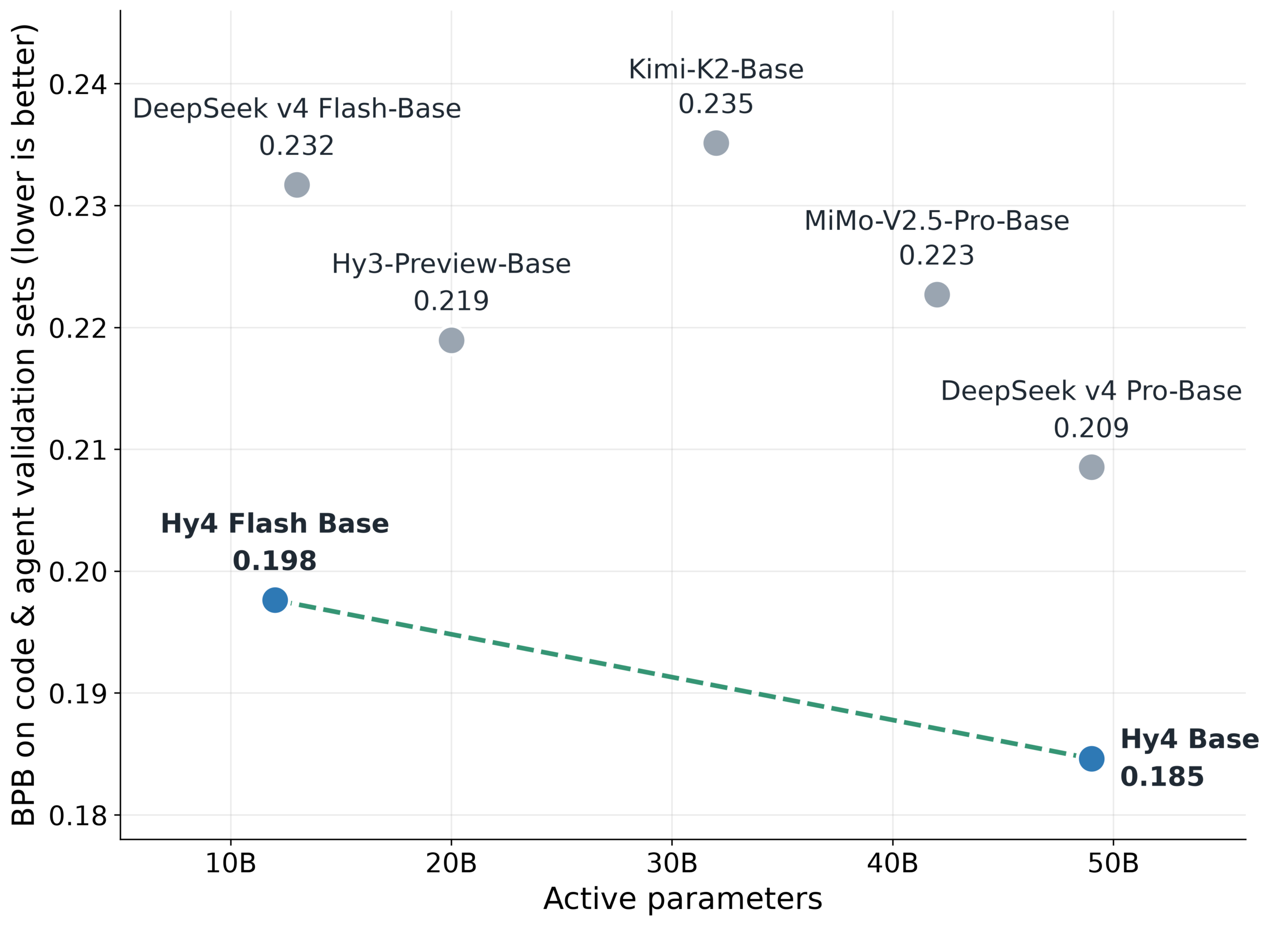
That last comparison matters. DeepSeek’s Flash model was already positioned as the cost-efficient option. Tencent just undercut it by an order of magnitude while maintaining competitive benchmark scores, Hy4 Flash beats DeepSeek-V4-Flash-Base on Social IQa (80.1 vs 72.5) and U-MATH (69.8 vs 57.4).
Real-World Performance: Beyond Benchmark Theater
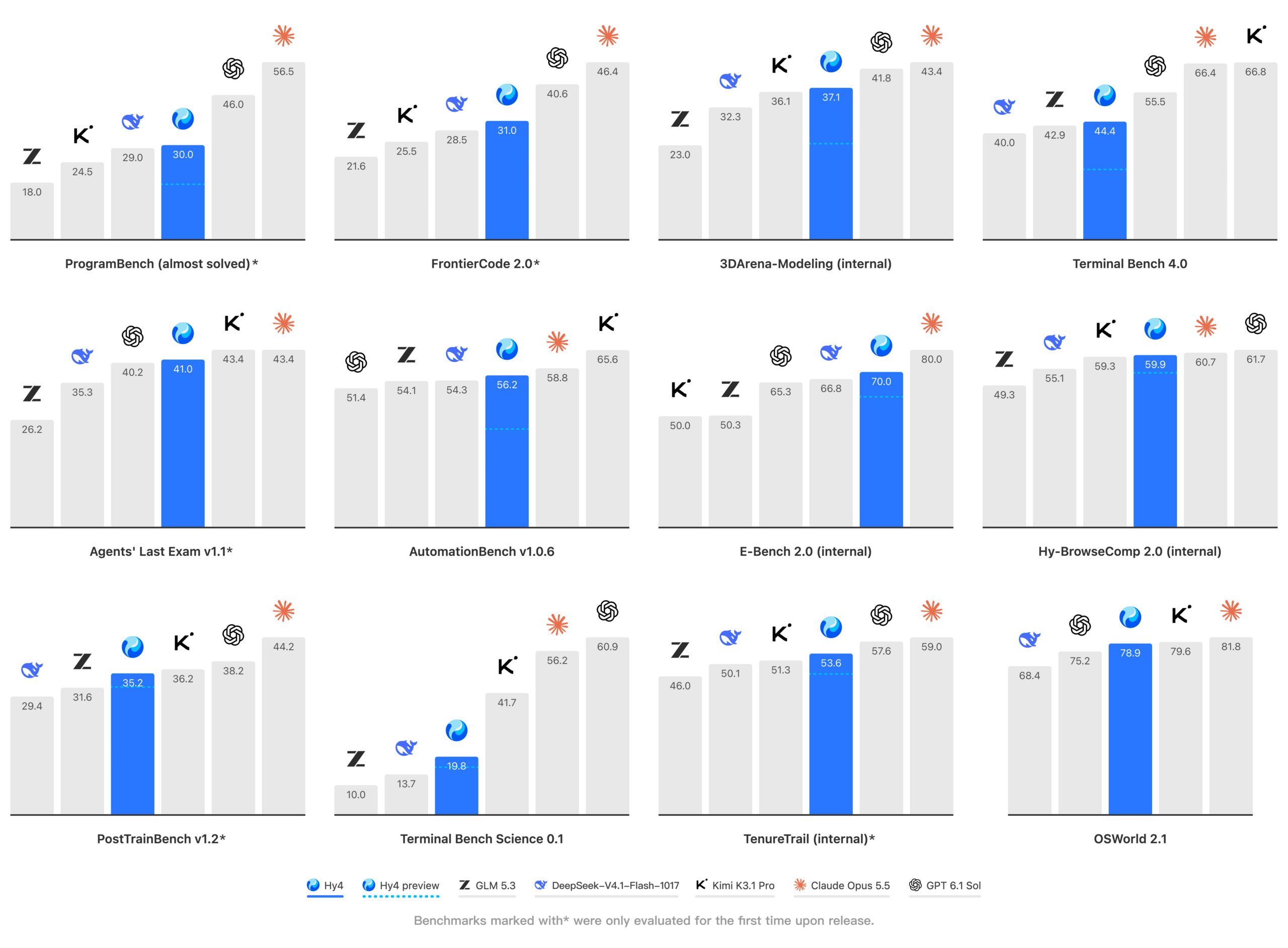
Tencent’s evaluation strategy deserves attention because it represents a philosophical shift. Instead of relying solely on public benchmarks “detached from everyday work”, they built WorkIndex, an internal benchmark grounded in tasks from their WorkBuddy product. It spans eight evaluation sets: slide creation, slide editing, human-AI slide co-writing, Markdown human-AI co-writing, document editing, spreadsheet repair, audio/video processing, and visual understanding.
The metrics focus on what actually matters to enterprise teams: deliverable quality, single-turn output length, and task turnaround time. Reinforcement learning during post-training cut average end-to-end output tokens by 50%, a move that directly addresses the “verbose AI” complaint that plagues so many enterprise deployments.
Early adopters are already seeing results. One developer reported that Hy4 Flash saturated their internal benchmark for agentic coding and PR review, finishing faster than Qwen 3.8 Flash Next, GLM 5.3 Flash, and DeepSeek V4.1 Flash. The preliminary finding: Hy4 Flash completes tasks with significantly fewer tool calls and more thinking than competing models.
The Speculative Decoding Advantage
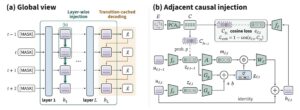
DFly2, the built-in 5-layer drafter (0.85B parameters), handles speculative decoding by reusing the target model’s KV cache and sparse indices rather than maintaining its own. This yields three advantages:
- Constant cost: each draft token attends to at most ~2K keys, regardless of context length
- Zero extra KV memory: no separate KV cache for the drafter
- PD-disaggregation ready: prefill-to-decode transfer adds only one last-layer hidden state
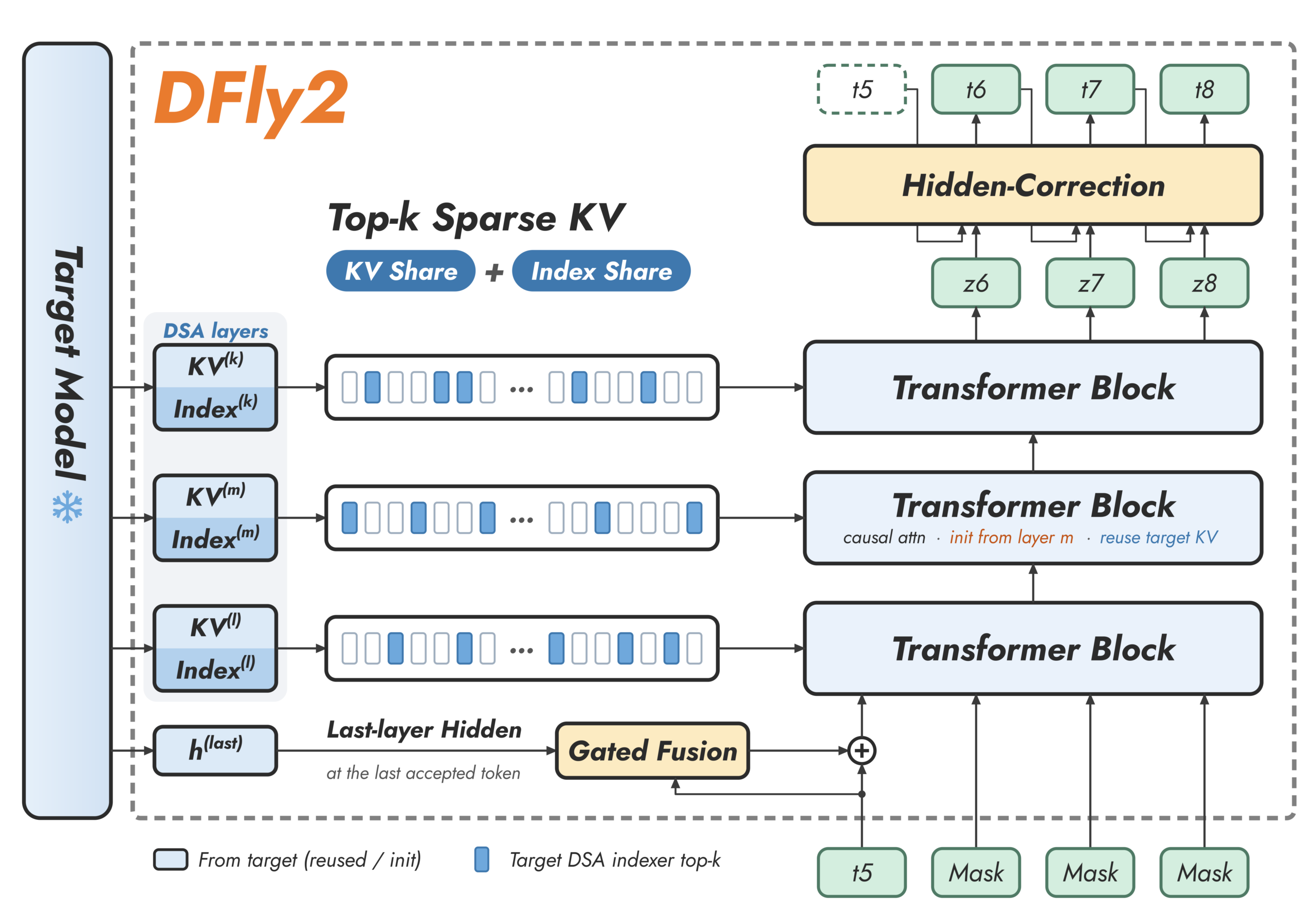
Combined with megakernel optimizations and 4-bit quantization, Tencent reports decoding speeds past 150 tokens per second. This isn’t just a nice-to-have, it’s the difference between a model that feels responsive in production and one that makes users watch a spinner.
Where Hy4 Flash Falls Short
Honesty requires acknowledging the gaps. On raw pretraining benchmarks, Hy4 Flash trails full Hy4 consistently. The gap on SimpleQA is stark: 37.5 versus 57.2. For long-tail factual recall, fewer active parameters means less knowledge density.
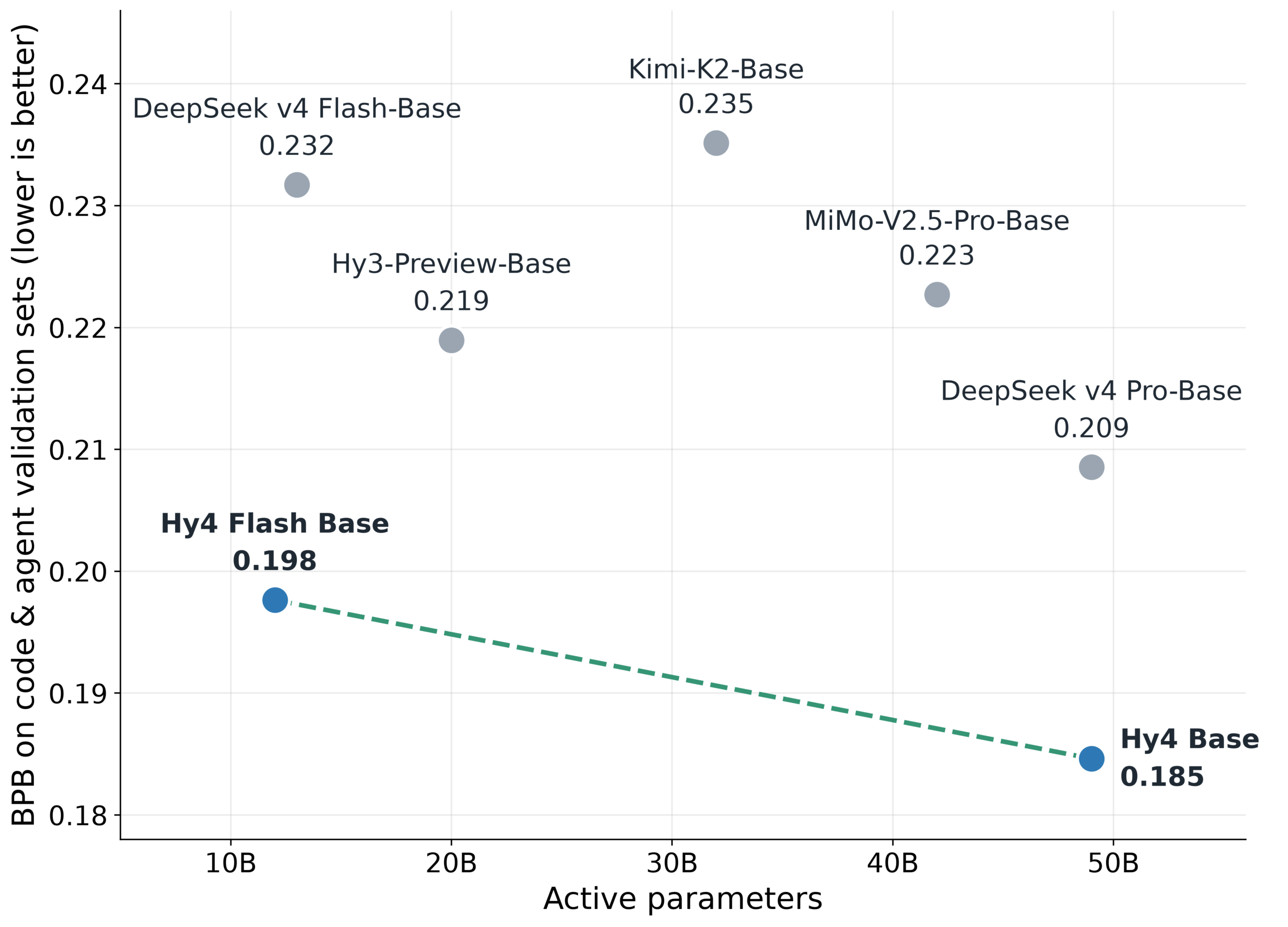
As the full benchmark results show, DeepSeek-V4-Pro-Base still tops the table on code benchmarks like MBPP-plus (79.1 vs 73.7 for Hy4 Flash). The gap between open models and top proprietary models remains significant on research-level mathematics, long-horizon coding, and advanced visual question answering.
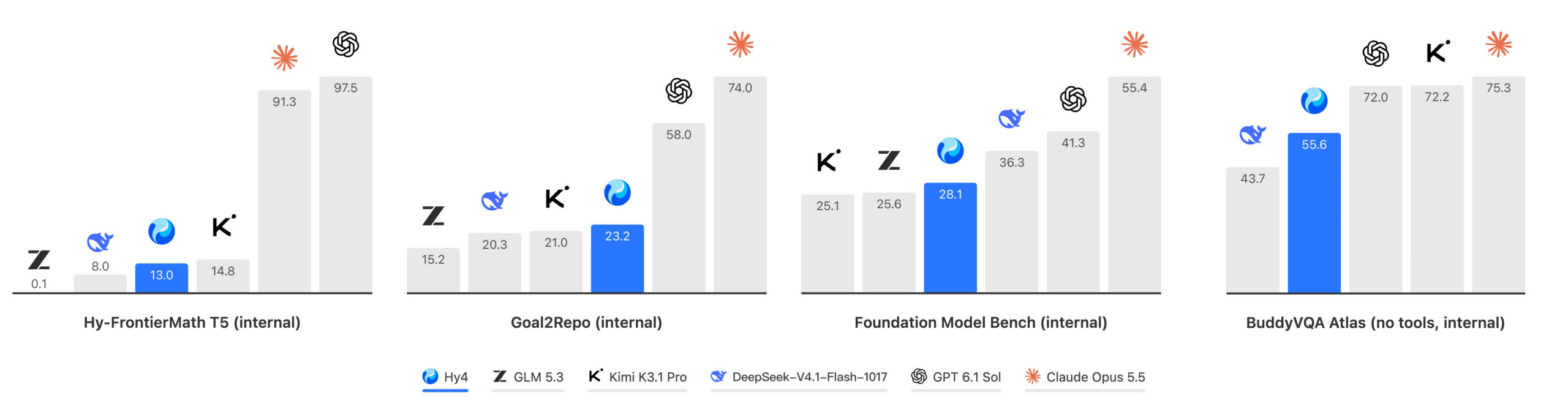
Tencent’s recommendation is explicit: use Hy4 Flash for everyday productivity tasks, deep search, document processing, slide creation, simple frontend demos, computer use. Reach for full Hy4 when the job requires long-horizon software engineering or a higher intelligence ceiling.
What This Means for Enterprise Architecture
The Hy4 Flash release signals something bigger than a single model drop. It validates a shift from “biggest is best” to “fastest to value.” For teams evaluating the sustainability of multi-hundred-billion-parameter models, Hy4 Flash offers a pragmatic alternative that doesn’t sacrifice usability.
The open-weight release under the Tencent Hy License, with variants on Hugging Face, ModelScope, and GitCode, extends the open-source ecosystem strategy that’s been quietly building momentum. Combined with extreme model compression techniques and efficient MoE architectures, Tencent is positioning itself as the efficiency leader in open AI.
The Deployment Playbook
For teams ready to test Hy4 Flash, deployment is straightforward. The vLLM recipe uses the official prebuilt image:
docker run --gpus all \
  -p 8000:8000 \
  --ipc=host \
  -v ~/.cache/huggingface:/root/.cache/huggingface \
  vllm/vllm-openai:hy4-flash tencent/Hy4-flash-FP8 \
    --tensor-parallel-size 8 \
    --speculative-config '{"num_speculative_tokens":5,"method":"dfly"}' \
    --attention-backend FLASHMLA_SPARSE \
    --tool-call-parser hy_v4 \
    --reasoning-parser hy_v4 \
    --enable-auto-tool-choice \
    --port 8000 \
    --served-model-name hy4-flash
SGLang users have an equally simple path with lmsysorg/sglang:hy4-flash. The OpenAI-compatible API means existing integrations work with minimal changes.
The Verdict
Hy4 Flash isn’t the most intelligent open-weight model available. It isn’t the cheapest per token. What it is, is the first model that meaningfully optimizes for cost per completed task, the metric that actually matters when AI becomes a daily tool rather than a demo.
The blind evaluation data suggests users can’t tell the difference between Hy4 Flash and Claude Haiku 5.5 in practice. The cost data makes the economic case unambiguous. For enterprise teams running high-volume AI workflows, that combination is harder to ignore than any benchmark score.
The tradeoff is real: for complex, long-horizon engineering tasks, full Hy4 remains the better choice. But for the 80% of enterprise AI work that involves documents, slides, spreadsheets, and routine automation, Hy4 Flash looks like the pragmatic answer to a question too few vendors are addressing: how do we make AI cheap enough and fast enough to use for everything?