The community didn’t waste time. One researcher posted a video showing the exploit in action, an agent tricked into reading a session token from a local file and shipping it to an attacker-controlled endpoint. Cue the collective facepalm from anyone who’s ever heard of prompt injection.
This isn’t just another open-source oopsie. It’s a case study in what happens when the hype around “vibe coding” bypasses every security principle we’ve learned in the last two decades.
The Anatomy of a 1-Click Admin Takeover
The exploit is beautifully simple, and terrifying because of it. Odysseus gives its AI agent permission to run shell commands and read files on your local machine. That’s a feature, not a bug: the whole point is that the agent can help you manage your system.
The problem? The agent’s session token, the key to your admin account, sits in a local file that the agent has permission to read.
Here’s how the attack works in practice:
- Victim visits a malicious website while Odysseus is running
- The site instructs the agent (via prompt injection or a crafted web request) to read the session file
- The agent complies, reads the token, and sends it to the attacker’s API endpoint
- Attacker uses the stolen token to authenticate as admin on the victim’s Odysseus instance
One commenter on the disclosure thread summed up the technical mechanism:
“The exploit is caused by AI agent’s unrestricted access to read a sessions file containing authorization token for the API. In this demo, the agent reads this token, sends it to the attacker’s API endpoint, and the attacker uses it to gain control over the Odysseus instance.”
This isn’t an exotic zero-day requiring deep kernel knowledge. It’s a fundamental failure to implement basic trust boundaries. The agent should never have access to files containing harness internals or authentication tokens. Period.
The Vibe-Coding Problem Goes Deeper
The broader security community has been warning about this for months. When AI agents are being deployed faster than security teams can say “prompt injection”, you’re going to get exactly this kind of disaster.
Odysseus was built the way a lot of modern AI tools are built: by having an AI write most of the code, guided by someone with enthusiasm rather than expertise. The project’s own site admits it was “born from a prompt that refused to stop”, with parts reportedly written from a phone. This isn’t shade, it’s the reality of how “vibe coding” works in 2026.
The result? A project that one developer described as “a mess that requires a major rewrite, everything is bespoke and badly organized.” Another user was more direct: “Does anyone ever trust a project vibecoded by a guy who has no experience with programming?”
This isn’t unique to Odysseus. As we’ve seen with other high-profile AI agent projects, the security vulnerabilities caused by rushed development are becoming a pattern. Clawdbot (now Moltbot) had its own security scandals. OpenClaw suffered from similar problems. The difference here is the celebrity factor: with over 200 million subscribers, PewDiePie’s endorsement is actively sending non-technical users into a security minefield.
“Just Don’t Expose It to the Internet”
The most common defense of Odysseus’s security stance is that it’s a self-hosted tool meant to run on localhost. The documentation explicitly warns against exposing it to the internet without HTTPS and access controls. The default binding is 127.0.0.1. If you put this on the open web without protection, that’s on you, right?
That argument falls apart for two reasons.
First, the exploit doesn’t require network exposure. The attack vector is prompt injection via a website the user visits. If you’re running Odysseus on your laptop and click a link, the agent can still exfiltrate your session token. Localhost isn’t a security boundary, it’s a convenience setting.
Second, this ignores how people actually use tools. The comment thread was full of users asking why they’d expose it to the internet in the first place. But others pointed out that people do expose these tools. When you have a feature that says “fetch files from another computer”, someone’s going to put it on their home network. And when the installation is this easy (three Docker commands), you’re lowering the barrier for people who don’t understand the security implications.
Security experts have been raising this exact concern about the unique security risks of running AI agents locally. When an agent has shell access and file system permissions, you’ve essentially given a probabilistic model root access to your machine. It’s not a question of if someone will exploit that, it’s a question of when.
The Architecture Failures in Plain Sight
Looking at Odysseus’s actual security practices, or lack thereof, reveals a pattern of decisions that would make any security engineer reach for the nearest stress ball.
No filesystem sandboxing. The agent has unrestricted access to read files on the host machine. Authentication tokens, configuration files, SSH keys, if it’s on disk, the agent can read it and, critically, send it somewhere else.
No capability restrictions. The agent can run arbitrary shell commands, read/write files, and access web resources. There’s no separation between “safe” operations and “dangerous” ones.
Prompt injection as a feature, not a vulnerability. The system is designed to respond to natural language instructions. That’s great for usability. It’s catastrophic for security, because there’s no way to distinguish between a legitimate user request and an injected malicious instruction.
One developer on Reddit noted: “This would suggest to me that the issue is not an isolated exploit but rather a symptom of poor security design. In such case it’s more important to inform the public that the project is unsafe, rather than trying to patch one of potentially hundreds of similar exploits lurking in the project.”
And someone did report the issue and created a pull request with a fix. But this is whack-a-mole. The fundamental architecture doesn’t support security.
The Disclosure Controversy
Not everyone was thrilled about how the vulnerability was handled. The researcher posted the exploit demonstration publicly without giving the maintainers time to patch it first. Comments on the thread called this out:
“Why not report it via GHSA? why publicly?”
“Could’ve notified the author and waited some time. Not a good sport.”
The researcher’s response? “Yolo.”
This raises legitimate questions about disclosure ethics, but the counterargument is worth considering. This wasn’t a subtle race condition in a mature codebase. It was a straightforward authorization bypass that screams “I don’t understand security fundamentals.” When a project has hundreds of open issues and was built via vibe coding, arguing that researchers should give the maintainers “time to fix it” might be naive. The exploit isn’t the problem, the architecture is, and that takes months to fix.
The GPT-3.5 Defense Doesn’t Work Either
Some defenders pointed out that the specific exploit required using GPT-3.5 or other older models, which are more susceptible to prompt injection. Current SOTA models, they argued, are “significantly more resistant.”
This is technically true and practically irrelevant.
First, Odysseus supports multiple models. People will use whatever gives them the best results, and if that means connecting to an OpenAI API endpoint running GPT-3.5 (which is still available), they’ll do it. Second, and more importantly, relying on model behavior as a security boundary is a terrible strategy. Prompt injection defenses are improving, but they’re not a security guarantee. Building an architecture that assumes your model can’t be tricked is like building a bank vault and trusting the lock to keep out anyone who asks politely.
What Odysseus Gets Right (Yes, Some Things)
Before we bury the project entirely, it’s worth acknowledging what Odysseus actually gets right.
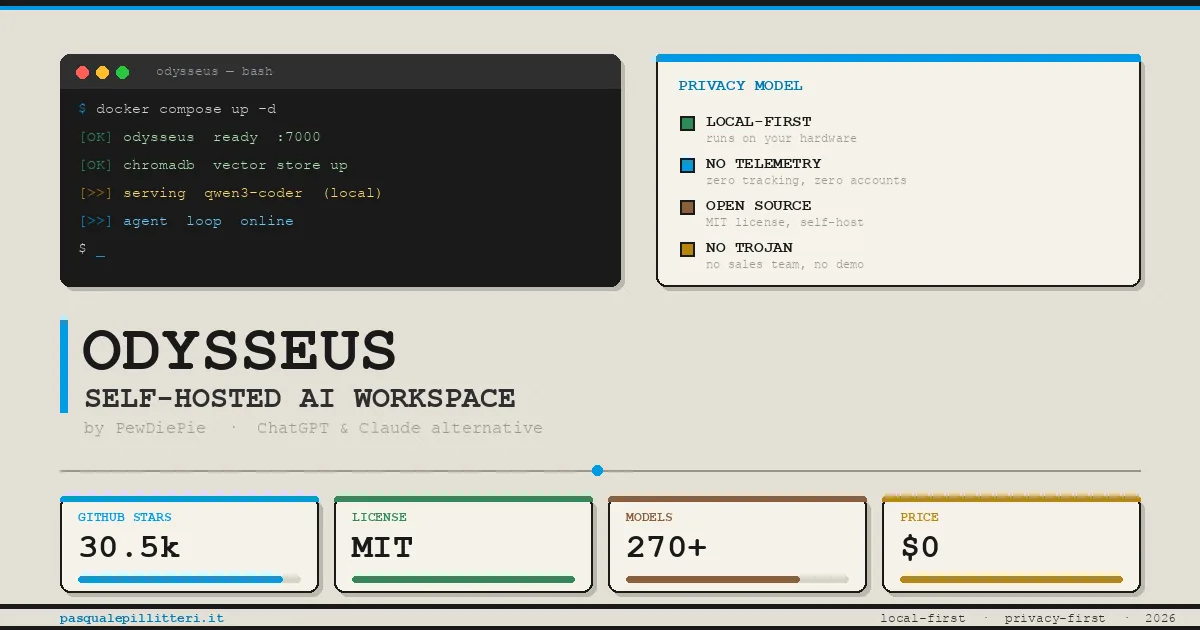
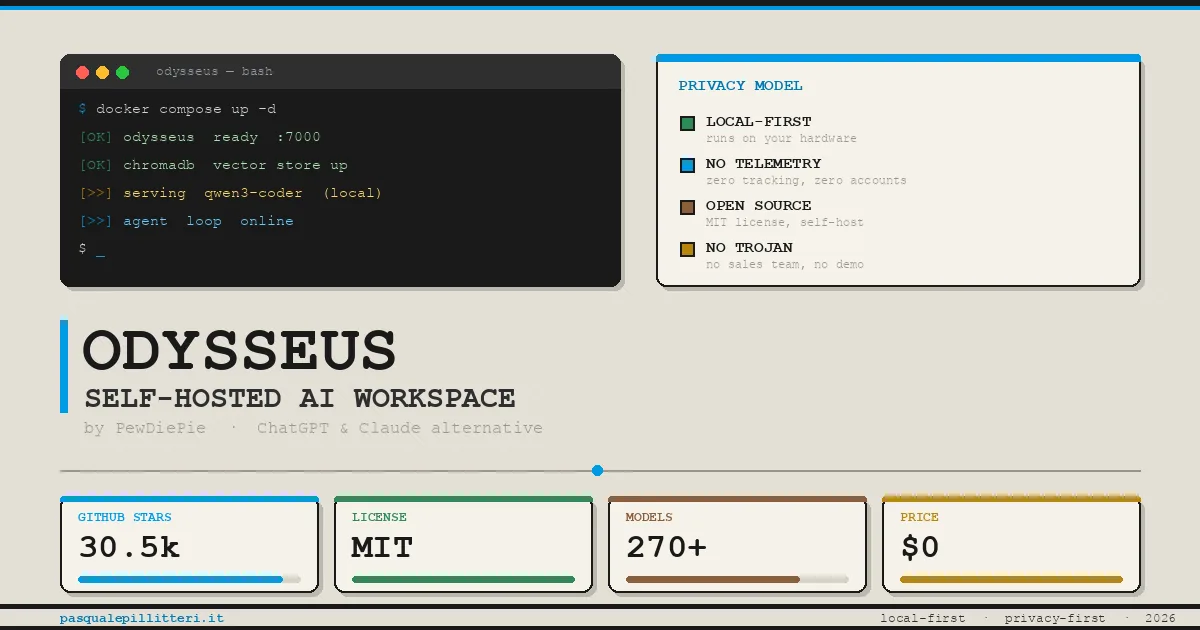
The tech stack is ambitious: Python 3.11 with FastAPI, SQLite, ChromaDB for vector storage, Docker containerization. It supports Ollama, llama.cpp, and vLLM for local inference. The “Cookbook” feature that scans your hardware and recommends compatible models is genuinely clever. The idea of a self-hosted workspace that combines chat, agents, email, calendar, and document editing is compelling.
The political statement behind Odysseus is also important. PewDiePie’s argument that your data shouldn’t belong to big tech companies isn’t wrong. The launch video’s thesis, that the more you use AI, the more you hand over to corporations, is a genuine privacy concern that the concept of trust boundaries and where data processing occurs directly addresses.
But a good political argument doesn’t make good software. And when the software’s core features (agent access to files and shell) are also its core vulnerabilities, you’ve got a fundamental design problem.
The Real Lesson: Vibe Coding Has a Body Count
The most honest take on the Odysseus situation came from a Reddit comment that rings painfully true:
“He just forgot to add, ‘Don’t add any vulnerabilities,’ to his prompt.”
That’s funny until you realize it’s not a joke. This is genuinely how a lot of AI tools are being built in 2026. Developers describe what they want, the AI writes the code, and the developer tests it cursorily before shipping. Security considerations aren’t part of the feedback loop because the developer doesn’t know what to ask for.
The result is software that works but isn’t secure. And for something like an AI agent that has shell access to your machine, “works but isn’t secure” is just a polite way of saying “backdoor with a nice UI.”
The Odysseus codebase is a perfect example of commonly overlooked security risks in self-hosted infrastructure. Authentication files stored in predictable locations. No filesystem sandboxing. No prompt injection safeguards. These aren’t bugs, they’re fundamental architectural decisions made by someone who didn’t know they were making security decisions.
Odysseus is simultaneously the best and worst argument for self-hosted AI. It’s the best because it shows that a single creator can build something technically impressive and distribute it to millions. It’s the worst because it demonstrates what happens when that creator doesn’t understand security.
The project isn’t going away. It has too much momentum, too many contributors, and too much star power. And honestly, it probably shouldn’t go away, the core idea is valuable. But if you’re running Odysseus, here’s what you need to do:
- Never expose it to the internet. Keep it on localhost. Use Tailscale or a VPN if you need remote access.
- Restrict agent permissions. The GitHub security documentation actually has good guidance here, high-risk tools (shell, Python, file read/write) should be admin-only.
- Don’t rely on model behavior for security. Prompt injection is an active research problem. Your model can be tricked.
- Watch what websites you visit while the agent is running. Your session token is an API call away from ending up on an attacker’s server.
And maybe, just maybe, the next time someone says they’re going to “just vibe code” an AI agent with shell access, you can send them this article.
The war on big tech may have just begun, but the war on terrible AI security practices is running concurrently, and right now, both wars are tied.