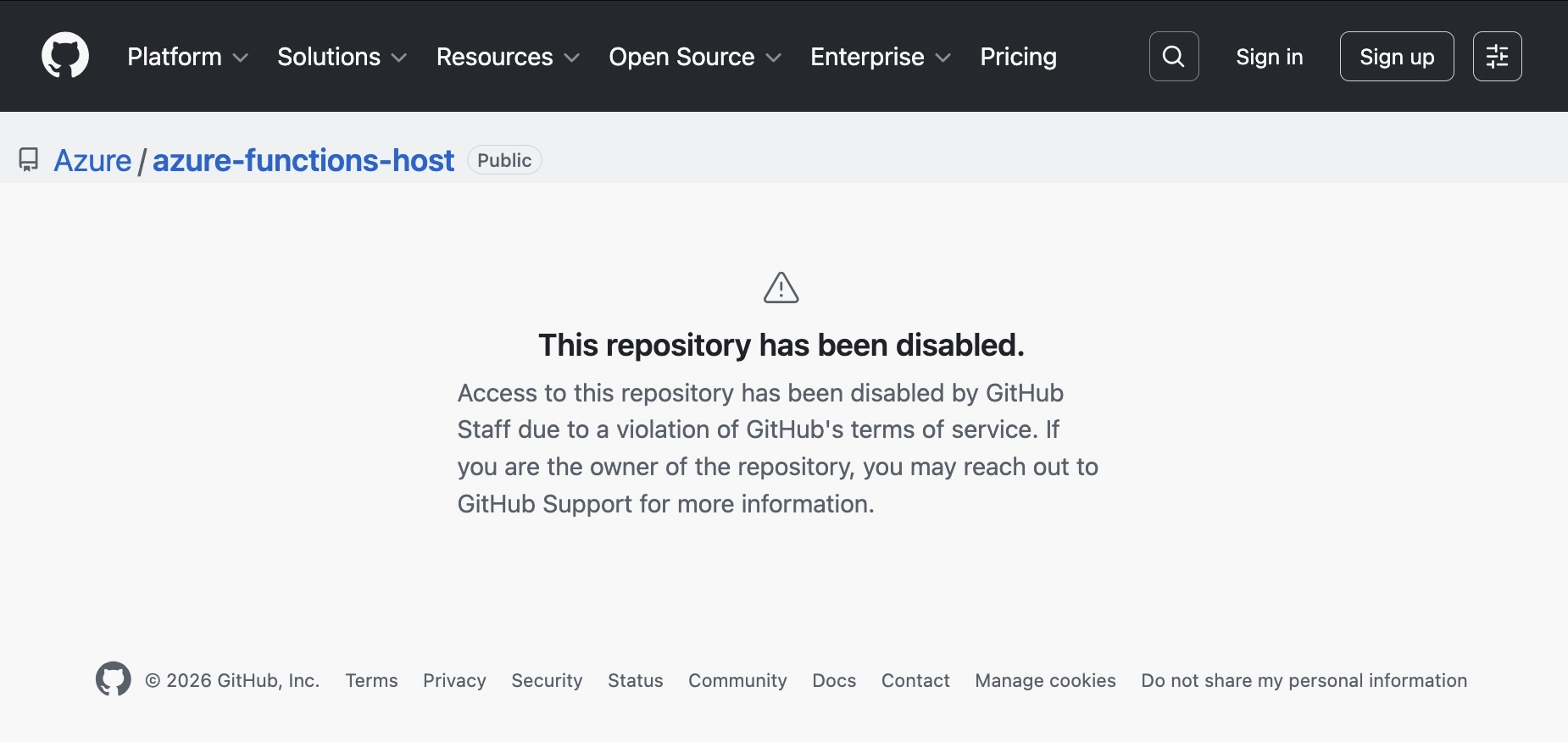
On June 8, 2026, Microsoft did something that should terrify every AI developer: it cut off access to at least 70 of its own open source repositories on GitHub. Not because of a licensing dispute or a code quality issue. Because hackers had breached the projects and injected password-stealing malware directly into the code.
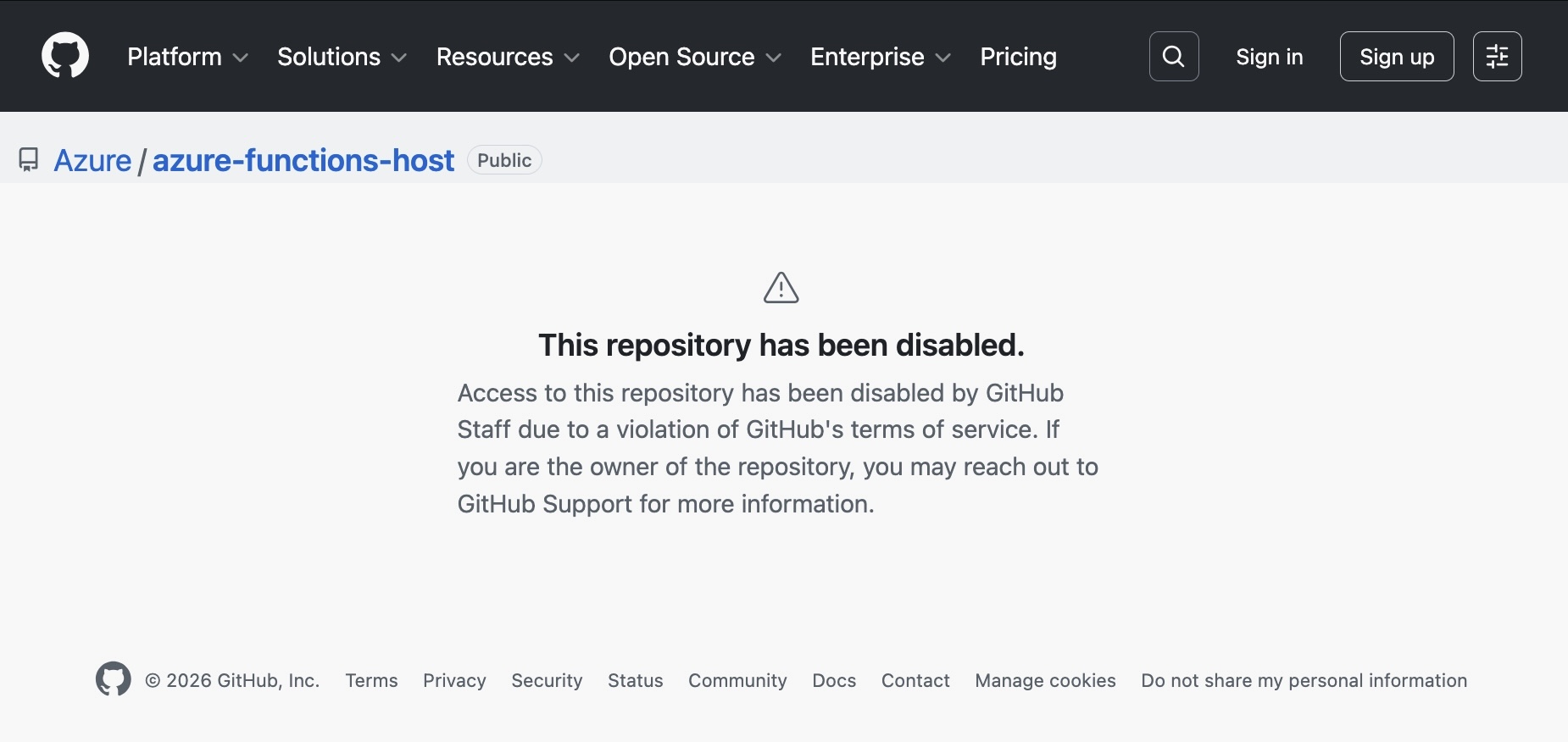
The compromised tools targeted developers using Claude Code, Gemini’s CLI, VS Code, and Azure services. The malware, dubbed “Miasma” by security firm Cloudsmith, stole credentials when developers opened the compromised tools in their AI coding environments. Microsoft confirmed the takedown. The repositories displayed a message: “Access to this repository has been disabled by GitHub Staff due to a violation of GitHub’s terms of service.”
Here’s the uncomfortable part: this is Microsoft’s second supply chain breach in weeks. In mid-May, attackers compromised Microsoft’s Durable Task project. Security researchers now call this a “re-compromise”, meaning Microsoft either failed to fully eradicate the initial intrusion or faced an entirely new one. Either explanation is bad.
This isn’t a story about a single hack. It’s a story about a broken trust model that’s about to get much, much worse.
The Dependency Crisis Has Reached AI Tools
The modern AI development stack is assembled, not written. A typical AI pipeline pulls from PyTorch, Hugging Face transformers, LangChain, vector databases, MCP servers, and a dozen other dependencies. Each one is a trust decision. Each one can be weaponized.
The problem isn’t just that dependencies exist. It’s that the AI development ecosystem operates with an implicit assumption that code from major vendors like Microsoft is intrinsically trustworthy. That assumption just collapsed.
Security firm Cloudsmith documented how the Miasma malware spread: the attackers didn’t need to find zero-days in Azure. They compromised the build chain for Microsoft’s open source tools, injecting credential stealers that executed when developers ran the tools they downloaded. The software supply chain attack surface here maps directly to what Docker’s security team has identified as a four-stage problem:
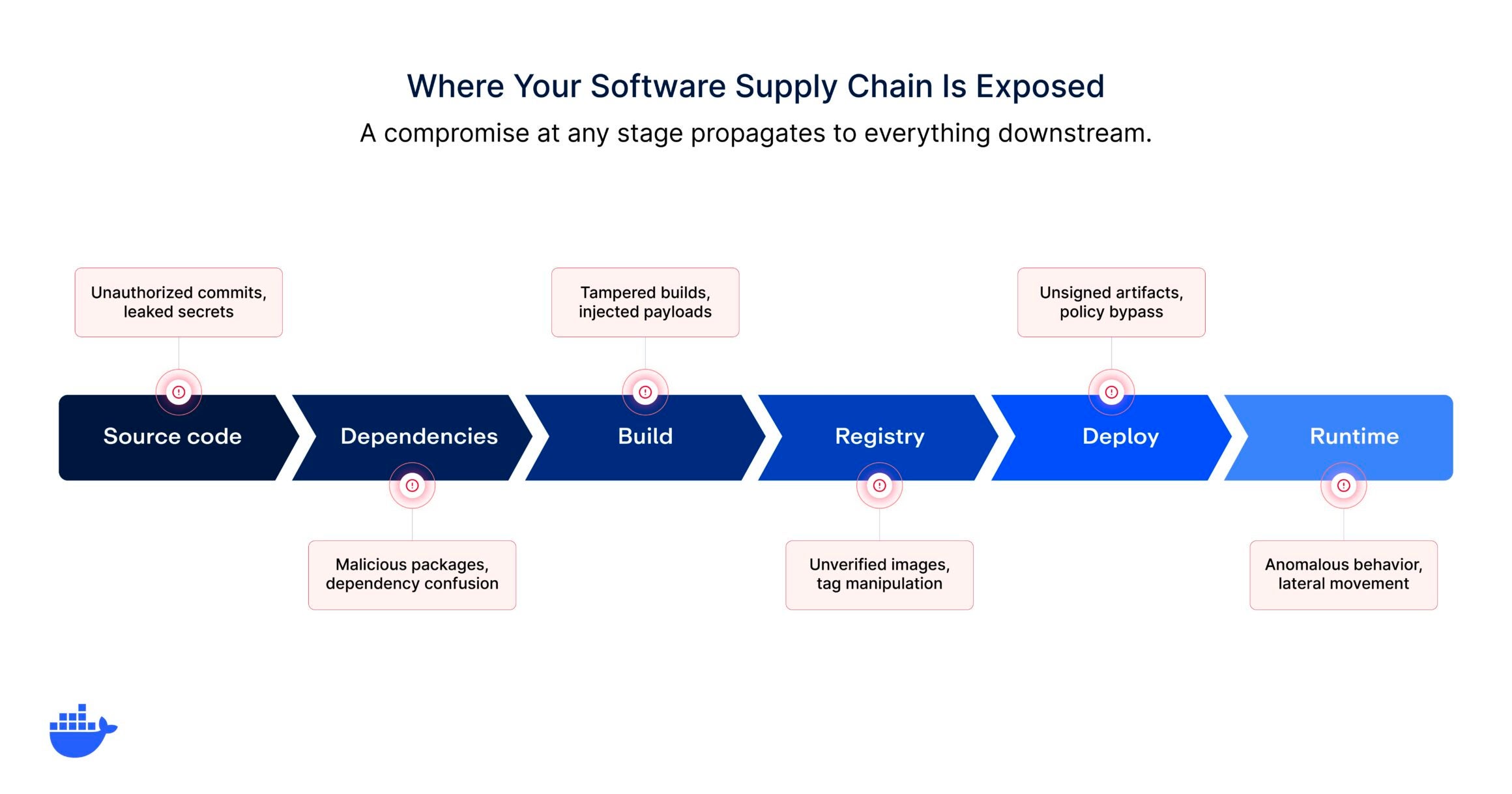
Source code, dependencies, build, registry, deploy, runtime. Attackers can hit any stage. In Microsoft’s case, they hit the source and build stages simultaneously.
Why AI Developers Are the Perfect Target
Attackers aren’t targeting AI developers because they’re mean. They’re targeting them because AI developers are the highest-value targets in any organization.
Consider the access profile of a typical AI engineer: cloud credentials for GPU clusters, access to model weights, API keys for multiple LLM providers, database connections for vector stores, deployment tokens for production inference endpoints. A single compromised developer workstation can cascade into a full organizational breach.
The Zscaler ThreatLabz 2026 AI Security Report found that AI transaction volume grew 83.3% year over year. The agents driving those interactions are embedded inside enterprise environments, and most organizations lack effective governance over how those systems operate. When the tools building those agents are compromised, the attack surface compounds.
This is why the Microsoft hack matters beyond the immediate credential theft. It demonstrates that attackers understand the AI development supply chain better than many defenders do. They’re not guessing. They’re targeting the exact pipeline stages that security teams have left unverified.
The Zero Trust Gap in AI Pipelines
Most organizations apply zero trust principles to user access, API gateways, and cloud infrastructure. Very few apply them to their development dependencies. The result is a blind spot that attackers are exploiting with increasing precision.
Anthropic’s recently published Zero Trust for AI Agents guide outlines three maturity tiers: Foundation, Enterprise, and Advanced. The foundation tier includes cryptographic agent IDs and short-lived tokens. The enterprise tier adds X.509 certificates with lifecycle management and mutual TLS. The advanced tier incorporates HSM-based identity and attestation.
| Control Domain | Foundation | Enterprise | Advanced |
|---|---|---|---|
| Agent Identity | Cryptographic IDs, short-lived tokens | X.509 certs + lifecycle, mTLS | HSM/TPM identity, attestation |
| Access & Privilege | RBAC, deny-by-default | ABAC, dynamic elevation | Continuous authz, JIT/JEA |
| Isolation | Identity-based isolation | Per-agent sandboxing | Confidential computing |
| Observability | Logs + request IDs | Immutable trails, distributed tracing | SIEM streaming, full provenance |
The guide makes a critical observation: “friction-only controls no longer qualify” because AI has compressed the time between vulnerability discovery and exploitation. Static API keys and rotation policies are now gaps, not baselines.
Yet most AI development pipelines are still operating at a sub-foundation level. They’re pulling dependencies from registries without verifying signatures, running build processes without provenance attestation, and deploying artifacts without SBOMs.
The OWASP Response: Treating AI Coding Agents as Supply Chain Actors
The OWASP Application Security Verification Standard (ASVS) for AI systems has a specific appendix on AI-assisted secure coding (Appendix C). Its opening line should be required reading for every engineering leader:
“Treat the AI coding agent as an actor in the supply chain, not as a passive helper. It has identity, authority, and the ability to act on its own behalf or to be acted upon by an attacker.”
This framing is worth sitting with. An AI code-review bot reading a malicious PR description can be prompt-injected into approving code it was meant to reject. The injection doesn’t have to be subtle. It just has to reach the bot’s context window. As the OWASP document notes, “Your own agent can be turned against you.”
The appendix specifies controls that directly address the Microsoft hack pattern:
AC.4.1 requires that AI-generated code goes through human code review by a qualified engineer, not the same identity that requested the generation. AC.8.1 mandates that autonomous agents cannot approve, merge, sign, or deploy artifacts they generated, and that this constraint is enforced by the source-control system and CI system, not just policy.
These controls exist because the attack vectors are well understood. The gap is in implementation.
The “Re-compromise” Problem
The most alarming detail in the Microsoft breach is the “re-compromise” finding. OpenSourceMalware noted that the June 2026 incident appears to be a continuation or repeat of the May 2026 Durable Task compromise. This isn’t just a failure to expel an attacker. It’s a failure of the incident response process itself.
When a supply chain incident occurs, the response playbook should include:
- Immediate containment: revoke every credential that touched the compromised workflow
- Forensic analysis: determine the entry point, lateral movement, and data exfiltration
- Provenance reconstruction: identify every artifact produced by the compromised pipeline
- Downstream notification: alert consumers of affected packages or images
- Rebuild and re-sign: produce clean artifacts from verified source, with fresh attestations
A re-compromise suggests that step 3 and 5 weren’t completed. The attacker maintained a persistence mechanism, or the remediation didn’t change the underlying vulnerable pattern.
For organizations building AI tools on top of Microsoft’s ecosystem, this creates a trust calculation problem. Can you trust the next version of the same tool? How do you verify that the build process has been cleaned? The OWASP guidance is clear: require signed provenance attestations for every artifact, and reject artifacts that are missing required origin metadata.
Why This Is a Software Architecture Problem
This isn’t just a security operations issue. It’s a software architecture problem, and it needs architectural solutions.
The broader open source supply chain crisis and similar attacks demonstrate that the implicit trust model is failing across ecosystems. The axios compromise earlier in 2026 showed that even the most widely used packages are vulnerable. The architecture of trust needs to shift from “I trust this publisher” to “I can verify this artifact.”
For AI pipelines specifically, this means:
Artifact verification at every stage. Not just scanning for known vulnerabilities. Verifying cryptographic signatures, checking provenance attestations, and enforcing policy at build, registry, and deployment boundaries. Docker’s supply chain security guidance emphasizes that “signing, attestation, and hash verification at transition points prevent tampered artifacts from propagating.”
Dependency pinning with hash verification. Pin every dependency to specific hashes, not just version ranges. If a package’s hash doesn’t match the expected value, the build fails. This prevents tampered updates from propagating into the pipeline, even if the registry is compromised.
Isolated build environments. Build processes should run in ephemeral, network-isolated environments that are destroyed after each run. This limits the blast radius of a compromised build runner and prevents cross-contamination between builds.
AI-BOM generation. Just as SBOMs (Software Bill of Materials) document every component in a traditional application, AI-BOMs should document the models, datasets, and AI-specific dependencies in every pipeline. This enables rapid response when a new vulnerability is disclosed.
The how elite stewardship creates single points of failure in supply chains is relevant here. Microsoft’s open source repositories are maintained by teams, not individuals, but the same trust concentration problem applies. The organization becomes a single point of failure. If its build infrastructure is compromised, all its downstream consumers are affected.
The Tension Between Velocity and Security
AI development moves fast. Models are released weekly. Agents iterate in production. Dependencies are updated constantly. Security controls that add friction are perceived as blockers, not enablers.
But the Microsoft hack demonstrates the cost of this velocity. The malware injected into those repositories reached developers before detection. It ran on machines with access to production environments. It stole credentials that could be used for lateral movement.
The tension is real. Every security control adds latency. Every verification step slows development. But the alternative is trusting that Microsoft’s build pipeline will never be compromised again, which history just proved isn’t a safe bet.
Anthropic’s Zero Trust guide addresses this directly: “Expect the Advanced tier to become Enterprise standard as the space evolves, and Enterprise to become Foundation.” The floor is rising. Controls that seemed excessive six months ago are becoming baseline requirements.
What AI Teams Should Do Right Now
The Microsoft hack isn’t an isolated incident. It’s a signal that the attack surface of AI development tools is expanding faster than defenses. Here’s a practical checklist:
- Audit your current dependency trust model. Are you verifying signatures on every package? Do you have hash pinning for critical dependencies? Are your CI/CD pipeline steps signed and verified?
- Implement SBOM generation. Every build should produce an SBOM. Every deployment should consume it. This creates the transparency needed for rapid incident response.
- Review AI tool access patterns. What credentials do your AI coding tools access? What systems can they reach? The Zscaler guidance on blast radius is direct: count the number of systems, data domains, and write permissions each agent holds. If any of those numbers feel large, scope them down.
- Build incident response playbooks for supply chain compromise. Not just for network intrusions. Specific playbooks for prompt-injected agents, compromised dependencies, and re-compromise scenarios.
- Apply least privilege to AI agents. Not just to users. Every AI agent should have a scoped, short-lived identity with just-in-time permissions. The OWASP AC.8 controls are a good starting framework.
The business risks in open source dependencies used in AI pipelines compound this urgency. When commercial viability conflicts with open source maintenance, the users relying on those projects face sudden, unpredictable security outcomes.
The Bottom Line
Microsoft will restore those repositories. The tools will be recompiled and re-signed. Developers will download the new versions and move on. But the underlying trust architecture hasn’t changed.
The Microsoft hack reveals a fundamental mismatch between how we build AI tools and how we secure them. We assemble pipelines from dozens of components, trust them implicitly based on publisher reputation, and rarely verify what actually runs. Attackers have noticed.
The architectural solution isn’t more scanning. It’s a shift from implicit trust to continuous verification. Signed artifacts, provenance attestation, policy-as-code enforcement, and dependency verification at every stage of the pipeline. These controls exist. The gap is in adoption.
AI development velocity is impressive. But velocity without verification is just speed, and speed without direction leads to crashes.
The next supply chain compromise won’t be Microsoft’s. It will hit a smaller project with less visibility, and it will propagate through the AI ecosystem before anyone notices. The question isn’t if this happens again. It’s whether your pipeline architecture can survive it.