Scroll down the latest AI Leaderboard at LLM Stats, past the flurry of new releases from OpenAI, Anthropic, xAI, and a dozen Chinese labs. Keep scrolling. Past GPT-5.6 Sol at #1, past Claude Mythos Preview at #2, past the entire top 10. You won’t find a single Google model until you hit rank 16 or lower, and even there, it’s just the older Gemini 3.1 Pro, not the flagship that was supposed to dominate 2026.
This isn’t a blip. It’s a signal.
Google, the company that invented the Transformer architecture, owns DeepMind, and operates the world’s largest AI compute infrastructure, has completely disappeared from the frontier model conversation. The question isn’t just “what happened?” but “what does this mean for the rest of the industry?”
The Leaderboard That Exposes the Gap
Let’s be specific about what we’re seeing. The LLM Stats composite score aggregates reasoning, coding, agent performance, speed, and price into a single ranking. Here’s the brutal reality as of July 2026:
| Rank | Model | LLM Stats Score | Organization |
|---|---|---|---|
| 1 | GPT-5.6 Sol | 57.9 | OpenAI |
| 2 | Claude Mythos Preview | 56.9 | Anthropic |
| 3 | Claude Fable 5 | 56.7 | Anthropic |
| 4 | Kimi K3 | 55.6 | Moonshot AI |
| 7 | Claude Opus 4.8 | 52.6 | Anthropic |
| 10 | GPT-5.5 | 48.8 | OpenAI |
| 11 | GLM-5.2 (Open Source) | 47.6 | Zhipu AI |
| … | … | … | … |
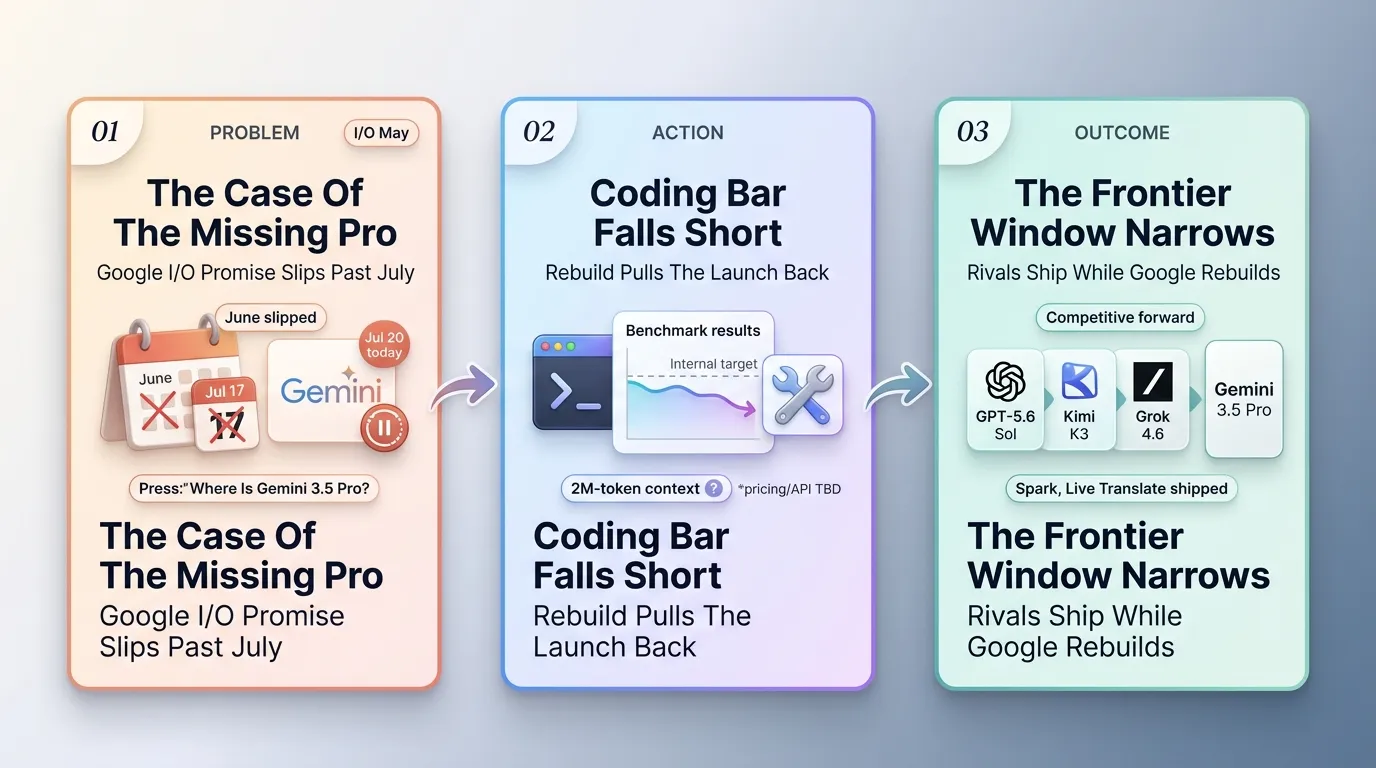
Where’s Google? The best showing is Gemini 3.1 Pro, which sits at rank roughly 16-20 depending on the day. But here’s the kicker: Gemini 3.1 Pro was released in late 2025. The model that was supposed to compete with this generation, Gemini 3.5 Pro, has now missed its own deadline three times.
Why Gemini 3.5 Pro Keeps Slipping
The LA Times and Bloomberg both published deep dives this week, and the picture isn’t pretty. According to multiple current and former employees cited in the LA Times investigation, the core problem is coding performance. Google’s internal benchmarks showed Gemini 3.5 Pro falling short on software engineering tasks, and rather than shipping a model that underperformed its predecessor on a commercially critical category, leadership pulled it back for a full rebuild.
But the reporting reveals deeper structural rot:
- Internal fragmentation: Google Cloud, DeepMind, and the Android team are all building competing AI coding tools. Nobody owns the strategy.
- Purist engineering culture: Some senior Google engineers reportedly opposed AI-generated code, believing all important code should be human-written to “Google standards.”
- The capacity bottleneck: Even when engineers want to use AI for coding, they often hit compute constraints due to internal competition for TPU resources.
This isn’t a technology problem. Google has the talent, they invented the Transformer. It’s an organizational problem, and it’s killing their ability to ship.
The Strategic Pivot Theory: On-Device AI or Cop-Out?
One popular theory on developer forums is that Google is strategically pivoting away from the frontier model race toward on-device inference and product integration. The argument goes: Google doesn’t need to win benchmarks when it owns search, Android, Chrome, and YouTube.
There’s some truth here. Google has been shipping smaller, locally-runnable models through its Gemma line, and Gemma 4 12B recently made waves in the local AI community. The company is also reportedly investing heavily in world models and multimodal generation.
But this narrative has a hole: Apple is doing the same thing, and they’re doing it better. Apple has tighter hardware-software integration, a more disciplined engineering culture, and no internal teams actively undercutting each other. If the game is on-device AI, Google’s bureaucracy is a liability, not an asset.
Meanwhile, Google’s public-facing models, the ones millions of users interact with through search and Android, are getting worse relative to the competition. Flash models are fine for quick tasks, but users are increasingly routing complex queries to Claude or ChatGPT. That erodes the very ecosystem Google is trying to protect.
The Open Source Surge That’s Leaving Google Behind
The most interesting subplot here is the rise of open-source alternatives. GLM-5.2 from Zhipu AI now sits at rank 11 on the leaderboard with an LLM Stats Score of 47.6, and it’s completely open-source, released under MIT license at $1.18 per million tokens. DeepSeek’s V4 series dominates the LiveCodeBench coding benchmarks.
Chinese open-source models now handle between 30-46% of enterprise API token traffic on US platforms, up from 4.5% in early 2025. That’s a tenfold market share explosion in 18 months.
For enterprise architects, this is the real story. The “Google tax” on AI infrastructure isn’t just about pricing premium, it’s about missing out on state-of-the-art capabilities. If you’re building an agentic system or a coding assistant, the best open options aren’t from Google. They’re from Chinese labs that move faster, ship more openly, and don’t have internal teams fighting over whose coding tool gets priority.
What This Means for Practitioners
If you’re an engineer or architect evaluating AI infrastructure today, here’s the practical takeaway:
Stop waiting for Google. Gemini 3.5 Pro might ship eventually, maybe in August, maybe never, but the window where Google was a default choice for frontier capabilities has closed. Plan your architecture around Anthropic for agentic workflows, OpenAI for reasoning, and open-source Chinese models for cost-sensitive deployments.
Start taking open-source seriously. The gap between proprietary and open-weight models has collapsed dramatically.
Watch the compute wars. Google’s advantage has always been its proprietary TPU infrastructure and vast data. But if they can’t turn that into competitive models, their cloud business faces an existential threat. Why pay a premium for Google Cloud AI when the best models run on Kubernetes anywhere?