
Your pull request pipeline is lying to you. The code passes all checks, the LLM-generated functions work perfectly in isolation, and your team merges with confidence. But six months later, your architecture looks like a house where every room was built by a different contractor who never saw the blueprint. Welcome to design drift in the age of AI-assisted development.
The Invisible Rot in Your Codebase
The problem isn’t that LLM-generated code is bad, it’s that it’s just good enough to be dangerous. Developers on Reddit have been sounding the alarm: code that works but slowly diverges from intended architecture, accumulating technical debt in the blind spots of traditional review processes. This isn’t the dramatic technical debt of monolithic functions or copy-pasted code blocks. It’s a more insidious erosion, where each PR incrementally pulls your system away from its architectural north star.
The research shows a clear pattern. When teams rely on single PR checklists, they quickly hit a wall. As systems grow and organizational maturity demands more comprehensive checks, for architecture, security, performance, conventions, those checklists get ignored because they slow reviews down. The result? A false sense of security. Your CI pipeline is green, but your architecture is quietly turning into spaghetti.
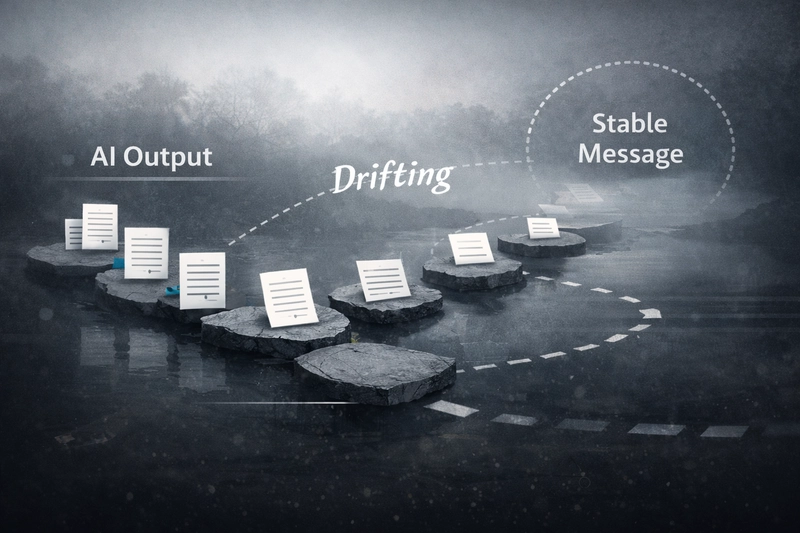
Why LLMs Are Architecture’s Perfect Saboteurs
Here’s the uncomfortable truth: LLMs are trained to generate code that looks correct, not code that fits your architecture. IBM’s research on code LLMs reveals that these models excel at pattern completion, but they lack the deep contextual understanding that separates a working function from a well-architected system. They don’t understand your domain boundaries, your dependency rules, or the subtle conventions that keep your codebase maintainable.
When a developer asks an LLM to “create a validator for user input”, the model draws from millions of code examples across the internet. It produces something fluent, functional, and completely oblivious to your team’s specific architecture. Maybe it creates a standalone utility when it should extend your existing validation framework. Maybe it introduces a new dependency that violates your layering constraints. Maybe it duplicates logic that already exists in a helper class the developer didn’t know about.
The code works. The tests pass. The PR review focuses on syntax and obvious bugs. But architectural consistency? That’s a casualty of efficiency.
The Context Collapse Problem
The core issue isn’t generation quality, it’s context stability. As one developer on the DEV Community articulated, “AI isn’t failing to write. It’s doing exactly what it’s designed to do, produce fluent language from the information it’s given. The problem shows up later, when that output has to hold steady over time.”
This is architectural drift in a nutshell. Each LLM-generated PR is a black box of context that the model never truly understood. Your architecture isn’t just a collection of patterns, it’s a living set of constraints, trade-offs, and historical decisions that exist in your team’s collective memory. When an LLM generates code without access to that memory, it fills in the gaps with statistical averages from its training data.
The result is what researchers call “unstructured context overwhelming an AI system.” When everything is included, your entire codebase history, architectural decisions scattered across Confluence, tribal knowledge in Slack, nothing is prioritized. The system has no way to tell what matters most, so it averages. And average code is exactly what destroys architectural integrity.
The Failure Pattern in Your PR Pipeline
The sequence is predictable and devastating:
- Broad instruction: “Add payment processing for the new subscription tier”
- Wide pool of context: The developer pastes relevant files, maybe some architectural docs
- Fluent, confident output: The LLM generates clean, well-structured code
- Small misalignments: It creates a new payment service instead of extending the existing one, introduces a database dependency that violates your hexagonal architecture
- Constant steering: Reviewers catch the obvious issues but miss the architectural violations
Each PR in isolation looks fine. But after twenty such PRs, your payment processing logic is scattered across three services, your domain boundaries are blurred beyond recognition, and your “hexagonal architecture” has more holes than a fishing net.
As IBM’s experts warn, this creates “fragility in codebases” where subtle bugs and inefficiencies propagate, especially in critical systems. The fluent output masks the instability underneath.
What Developers Are Actually Experiencing
The Reddit discussion reveals a community grappling with this exact problem. Teams using LLM-assisted coding report increased design drift that traditional PR processes can’t catch. The checklist fatigue is real, long checklists get ignored because they slow reviews down, but short checklists miss the architectural nuances.
One developer’s experience with CoPilot is telling: they built an instruction file from the Awesome CoPilot repository, but found it “meh.” What actually worked? ArchUnit test suites that prevent design pitfalls early. Another commenter noted that LLM-based review tools like Code Rabbit and Claude can be taught about specific patterns, but they struggle to detect architectural drift as such, deviations from established patterns that require deep contextual understanding.
The consensus is clear: automation is key, but not all automation is equal. Linting and formatting as pre-commit hooks catch syntax issues. Security scanners catch CVEs. But architectural drift? That requires a different level of intelligence.
The Solutions That Actually Work
1. Architecture as Executable Tests
The most promising solution emerging from the trenches is architectural testing frameworks like ArchUnit. These aren’t traditional tests, they’re codified architecture rules that run in your CI pipeline. Want to enforce that no service depends on the presentation layer? Write a test for it. Want to ensure all validators extend a base class? Write a test for it.
As one developer reported: “The ArchUnit test suite I added worked really well. Even devs liked it since it prevented them from some ‘design’ pitfalls very early in their work.” This shifts architecture from documentation that nobody reads to tests that block merges.
2. Make the Correct Thing the Easy Thing
The most elegant solution might be the simplest: redesign your architecture so the right way is the lazy way. If adding a new validator requires modifying five files, nobody will do it correctly. If it requires copying a class and adding one line to a registry, they’ll follow the pattern.
This means creating archetype projects, code generators that understand your architecture, and tooling that makes the golden path frictionless. When the architecture is easy to plug into, you don’t need checklists to enforce it, developer laziness works in your favor.
3. LLM-Aware Code Review
Some teams are successfully using LLMs to review LLM-generated code. Tools like Code Rabbit can be taught your specific patterns and will flag violations consistently. The key is in the system prompt: you must explicitly tell it what architectural patterns to enforce.
But this approach has limits. As one commenter noted, “I don’t think there’s anything that can easily detect something like architectural drift as such, or deviations from established patterns of the application.” LLM reviewers can catch known patterns, but they struggle with the subtle, context-specific architectural decisions that aren’t in their training data.
4. Context Structuring, Not Just Prompt Engineering
The DEV Community research makes a critical point: “When everything is included, nothing is prioritised.” The solution isn’t longer prompts, it’s structured context. This means:
- Architectural decision records (ADRs) that are machine-readable, not just markdown files
- Explicit dependency maps that tooling can analyze
- Codified patterns that serve as ground truth for both humans and LLMs
- Versioned architecture schemas that evolve with your system
Without this structure, you’re just feeding noise to the LLM and hoping for signal.
The Hard Truth About Developer Roles
IBM’s research on code LLMs reveals a troubling trend: developers are shifting from “code producers to code curators”, orchestrating AI-generated code instead of writing it. This sounds efficient, but it comes with a cost.
The experts warn of “cognitive atrophy”, when developers rely heavily on code suggestions, they become less fluent in debugging and algorithmic thinking. It’s like using GPS so much you lose your natural sense of direction. In the architectural context, this means developers who can’t reason about the system’s design can’t effectively curate LLM output.
The result? Junior developers skip learning foundational concepts like compilers, memory management, and system design because the LLM handles it. But when the LLM generates architecturally unsound code, they lack the expertise to recognize it. The code works, so it must be good, right?
What Needs to Change
1. Treat Architecture as Code
Your architectural constraints must be executable, not just documented. Use tools like ArchUnit, custom linting rules, and dependency checkers that run in CI. If an architectural rule can’t be automated, question whether it’s a real rule or just aspirational documentation.
2. Structure Your Context
Before feeding context to an LLM, structure it. Create a “context protocol” that includes:
– The specific architectural pattern to follow
– Relevant ADRs with clear versioning
– Dependency constraints
– Examples of correct implementations from your codebase
Don’t dump your entire codebase into the prompt. Curate the context like you’d curate a museum collection, every piece should have a purpose.
3. Hybrid Review Models
Use LLMs for first-pass reviews (syntax, obvious bugs, known pattern violations) but require human architects for architectural significance. And make the human review focus on architecture, not style. The question isn’t “is this code good?” but “does this code belong?”
4. Continuous Architectural Grooming
Just as you refactor code, you must refactor architecture. Regular sessions where the team reviews the system for drift, updates ADRs, and adjusts automated checks are essential. Architecture isn’t a one-time decision, it’s a continuous process.
The Bottom Line
LLM-generated code isn’t going away. The productivity gains are too significant to ignore. But the architectural cost is real, and it’s compounding silently in repositories around the world.
The problem isn’t the LLMs, it’s our failure to adapt our processes. We’re using 20th-century review processes for 21st-century code generation. Checklists and manual reviews can’t scale against the flood of AI-generated code that looks right but doesn’t fit.
The solution isn’t more rigorous human review. That just creates bottlenecks and checklist fatigue. The solution is making architecture executable, context structured, and the correct path the easy path.
Your architecture is dying a death by a thousand PRs. Each one looks innocent. Each one passes review. But collectively, they’re rewriting your system’s design without anyone noticing.
The time to fix this isn’t when everything breaks. It’s now, before the drift becomes a chasm. Because by the time you notice the architectural rot, the cost of fixing it will be measured in quarters, not sprints.
Start with one ArchUnit test. Structure one ADR. Automate one architectural rule. Small steps, but steps that compound in the right direction, unlike the silent drift that’s compounding in the wrong one.