The announcement itself was a single changelog entry. But the implications ripple across pricing, enterprise governance, and the entire competitive landscape of AI coding assistants. This isn’t just another model drop, it’s a signal that the walled garden just got a door.
The First Open-Weight Model in the Copilot Picker
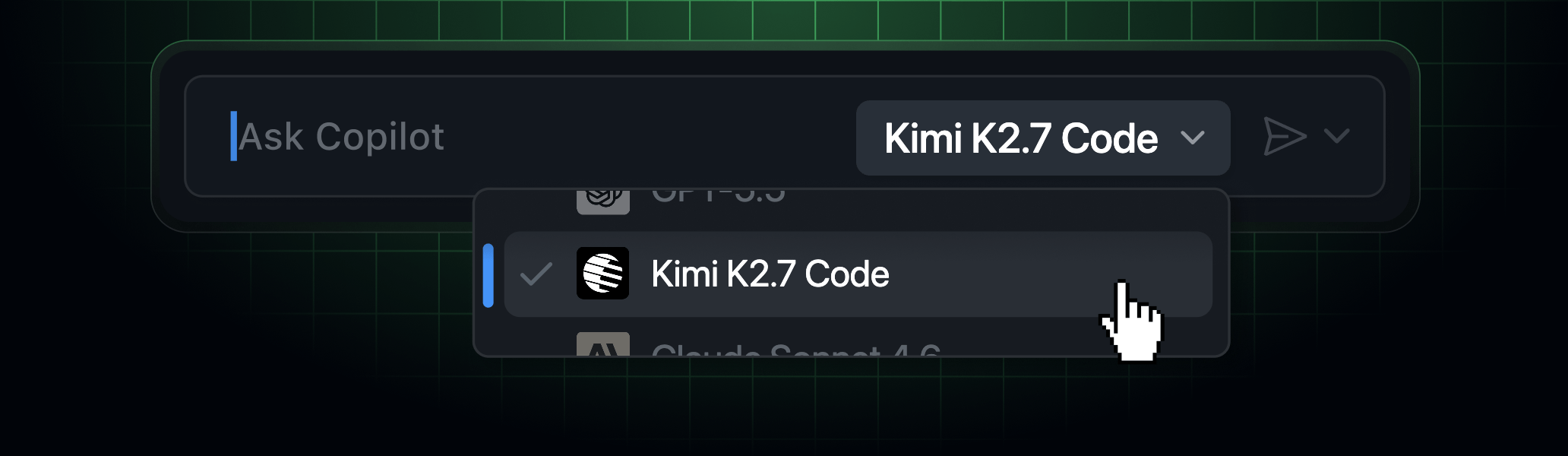
Kimi K2.7 Code, developed by Moonshot AI, is now a selectable option in the GitHub Copilot model picker. This makes it the first open-weight model to sit alongside Claude, GPT, and Gemini in Microsoft’s flagship AI coding platform.
The model is hosted by GitHub on Microsoft Azure, and billed at provider list pricing under usage-based billing. For Copilot Pro, Pro+, and Max subscribers, it’s rolling out now across Visual Studio Code, Visual Studio, JetBrains, Xcode, Eclipse, and the Copilot CLI. Business and Enterprise plans will follow in the coming weeks, but with a critical caveat: it’s off by default for those tiers, and administrators must explicitly enable the policy.
This isn’t just another model drop. It’s the first time an open-weight model has been offered as a first-class, selectable option in the Copilot model picker. The gate has been opened.
The Pricing Reality Check
Let’s talk about the elephant in the room: Copilot’s pricing situation. The June 2026 pricing change was, to put it mildly, a shock to the system. What once cost $10 a month for unlimited usage now operates on a token-based system where 1 AI Credit equals $0.01. A single heavy session with a frontier model can burn through $5-10 in minutes.
This is where Kimi K2.7 becomes interesting. At provider list pricing, it’s positioned as a lower-cost alternative. The pricing breakdown is straightforward:
- Input: $0.95 per million tokens
- Cache hit: $0.19 per million tokens
- Output: $4.00 per million tokens
Compare that to GPT-5.4 mini at roughly $1.60 input and $16 output, and the cost advantage becomes clear. For teams burning through Copilot credits, Kimi offers a way to stretch the budget without leaving the IDE.
The Open-Weight Precedent That Changes Everything
This isn’t just about one model. GitHub explicitly states that Kimi K2.7 Code is “the first open-weight model offered as a selectable option in the Copilot model picker.” The word “first” carries weight here.
The developer community on Hacker News immediately recognized the significance. As one observer noted, this is the first open weight model on Copilot, and it’s good to see that Microsoft sees the competition from closed frontier model providers. The model is hosted on Azure exactly as intended with open weight, and it’s much more likely that it’s not getting routed or otherwise tampered with.
This matters because enterprise teams have been hesitant to route their code through Chinese-hosted model APIs. By hosting Kimi on Azure with explicit guarantees that prompts and responses are not sent to the original model developers, GitHub removes the compliance objection. The model is open-weight, but the inference happens inside the Microsoft ecosystem.
The Pricing Earthquake That Made This Necessary
Let’s be honest: the timing of this release is not coincidental. GitHub Copilot’s June 2026 pricing restructure sent shockwaves through the developer community. The old $10/month unlimited plan is gone, replaced by a token-based system where 1 AI Credit equals $0.01. Heavy users found their monthly budgets exhausted within days.
The community reaction was swift and brutal. One developer reported that their Copilot quota finished in “maybe 2-3 prompts with Claude 4.8 Opus.” Another described the price hike as “insane”, noting that their department was forced to switch to Claude Code. The sentiment was widespread: Copilot’s pricing rug-pull had damaged trust.
Kimi K2.7 enters this environment as a lifeline. At roughly the price of GPT-5.4 mini, it offers a lower-cost alternative for teams that want to keep using Copilot’s harness without burning through their monthly credits on premium models.
What the Benchmarks Actually Say
The performance claims around Kimi K2.7 Code are, predictably, impressive. Moonshot’s own documentation states that K2.7 Code is its strongest coding model, improving long-horizon coding while reducing overthinking tendencies by about 30% on average. The community consensus on Hacker News puts its performance at roughly Sonnet 4.6 level.
But there’s a catch. As one developer noted, “I used a number of times Kimi K2.7 and I was disappointed. It would run in circles for things that Claude would do in one shot.” The caveat was that this experience came via Ollama cloud, and the quantization may have degraded performance.
The GitHub-hosted version on Azure should be the full model, not a quantized variant. But until independent benchmarks appear, treat the vendor claims with appropriate skepticism. The competition among AI coding models on benchmarks remains fierce, and Kimi’s actual performance in real-world coding tasks is still being validated.
The Harness Matters More Than the Model
A recurring theme in the community discussion is that the harness, the system prompts, tool definitions, and context management, matters as much as the underlying model. Multiple developers reported that Claude through Copilot performs worse than Claude through Claude Code, even though it’s the same model.
One developer put it bluntly: “Their harness is terrible compared to any of the other CLI based harnesses I test against. Like shockingly bad.” Another noted that “a simple side by side comparison will show dramatic underperformance 3 or 4 times out of five.”
This means Kimi K2.7’s performance in Copilot may not reflect its true capabilities. The model itself might be competitive with Sonnet 4.6, but the Copilot harness could be holding it back. If you’re evaluating Kimi, consider testing it through other interfaces like OpenCode or direct API access to get a baseline.
Enterprise Governance: The Admin’s Dilemma
For organizations, Kimi K2.7 presents a governance challenge. GitHub explicitly warns that Business and Enterprise admins should “review open-weight models against their own security, compliance, and data-governance requirements before enabling them.”
The risks are real. Open-weight models can be fine-tuned by attackers to generate malware or regurgitate training data containing proprietary code. Common mitigations include mandatory weight encryption at rest, detailed access and inference logging, and explicit organizational policies that prohibit external redistribution.
But there’s also a compliance upside. The model is hosted on US-based Azure AI Foundry infrastructure managed by GitHub and Microsoft, with explicit guarantees that customer prompts and responses are not sent to the original model developers. This addresses the primary objection enterprises have had against using Chinese-developed models.
The Pricing Paradox
Here’s where things get interesting. The community is split on whether Kimi K2.7 actually saves money. At $0.95 input, $0.19 cached input, and $4.00 output per million tokens, it’s cheaper than GPT-5.4 mini but not dramatically so. The real savings come from its cache hit pricing, at $0.19 per million tokens for cached input, it’s significantly cheaper than many alternatives.
But the broader context is that Copilot’s pricing restructure has made every model more expensive. The old $10/month unlimited plan is gone. Now, a single heavy session with a frontier model can cost $5-10. Kimi offers a way to reduce that burn rate, but it’s not a silver bullet.
The community’s response has been to explore alternatives. One developer noted that “OpenCode is an ez way as well” to access Kimi models. Another pointed to Cloudflare’s offerings. The message is clear: Copilot’s pricing changes have opened the door for competitors, and Kimi’s integration is as much about retention as it is about innovation.
What This Means for the AI Coding Landscape
The introduction of open-weight models into Copilot is a validation of the growing capabilities of open models in coding. It signals that the gap between open and closed models is narrowing, and that platforms can no longer afford to ignore the open-weight ecosystem.
For developers, this means more choice, but also more complexity. The question is no longer “which AI coding assistant should I use?” but “which model should I route each task to?” The broader landscape of AI coding assistants and self-improving code is evolving rapidly, and the ability to switch between models based on cost, capability, and task complexity is becoming a core skill.
Kimi K2.7 Code in GitHub Copilot is a significant milestone, but it’s not a revolution. It’s a pragmatic response to market pressure, pricing backlash, and the undeniable maturation of open-weight models. The real test will come in the next few months as developers actually use it, compare it against alternatives, and decide whether the cost savings justify any performance trade-offs.
For now, the advice is straightforward: test it on non-critical tasks, set session limits, and keep an eye on the bill. The era of unlimited AI coding assistance is over. The era of strategic model selection has begun.