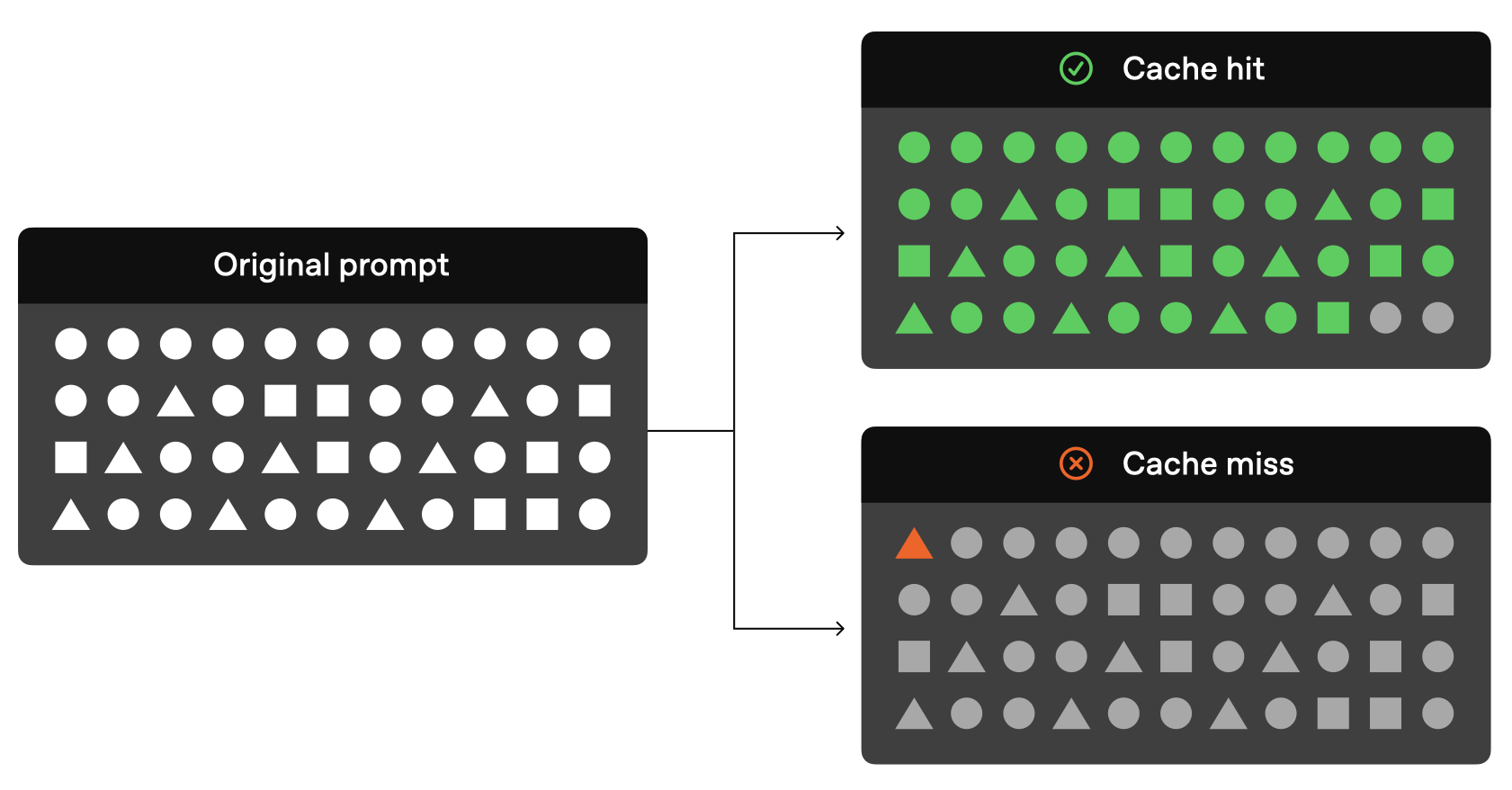
Your Kubernetes cluster is working exactly as designed. That’s the problem.
Every request gets distributed evenly across your vLLM replicas. Round-robin, least-connections, whatever your load balancer defaults to, it’s all doing what it was built to do. And in the process, it’s quietly forcing your GPUs to recompute thousands of tokens they’ve already processed.
Let me show you how bad this gets.
The 7,000-token Problem Nobody’s Talking About
Imagine you’re serving a 70B parameter model. In BF16, those weights alone need around 140 GB of GPU memory. You’re running four 80 GB GPUs with tensor parallelism, which means those four GPUs form exactly one model replica.
Now scale to two replicas.
Replica A has processed a customer’s 7,000-token prefix, say, a system prompt with tool definitions and conversation history from an agent loop. The KV cache for that prefix is sitting there, warm and ready. Replica B has never seen those tokens.
With ordinary round-robin routing, the next request in that conversation may land on B. B doesn’t have the cached KV state, so it processes all 7,000 tokens from scratch. The GPU does the same prefill computation that A already completed. Valuable HBM bandwidth wasted. Time-to-first-token (TTFT) spikes. And the cost multiplies with every turn of the conversation.
This isn’t hypothetical. It’s the default behavior of every standard Kubernetes Service in production today.
Why “Sticky Sessions” Isn’t the Answer
When this problem comes up, someone inevitably suggests sticky sessions. And sure, they’d help, if the goal was to pin each user to one replica forever.
But sticky sessions are a sledgehammer where you need a scalpel. They don’t know anything about what’s cached, they just know where the user was last. Consider these scenarios:
- Replica A has a massive queue while B sits idle. Sticky routing sends the request to A anyway, and the user waits.
- A different request shares a 5,000-token system prompt with a session on B, but the user’s individual session was on A. Sticky sessions miss the overlap entirely.
- A pod restarts, its cache is cold, and your session affinity config now points to a dead endpoint.
As the Gateway API Inference Extension spec evolves, it’s clear the community recognizes this: routing decisions need to account for cache locality, KV-cache capacity, active requests, and queued token work, not just session identity.
The real question isn’t “which replica did this user hit last?” It’s “which replica has the most useful prefix cached, and is picking it actually cheaper than recomputing somewhere else?”
What Your Load Balancer Doesn’t Understand
Here’s the uncomfortable truth: Kubernetes isn’t doing anything wrong. It understands pods, GPUs, networking, and failures. It simply doesn’t understand tokens, KV caches, or inference queues. Those are concepts from the inference layer, not the infrastructure layer.
Consider what a genuinely intelligent routing decision needs to weigh:
| Factor | What it means in practice |
|---|---|
| Useful prefix cache | How many tokens does this replica already have cached for this request’s prefix? |
| Available KV-cache capacity | Will the request fit, or will storing new tokens evict useful cached state? |
| Active requests & queued token work | Is this replica actually free, or is it processing a backlog? |
| Cache reuse vs. queueing cost | Is waiting for the cache-holder cheaper than recomputing everything elsewhere? |
A standard kube-proxy round-robin doesn’t evaluate any of these. It doesn’t even know they exist.
The good news? This problem is solvable. Projects like llm-d router implement configurable scoring systems that evaluate exactly these trade-offs, integrating with vLLM replicas via the Gateway API Inference Extension’s Endpoint Picker (EPP) pattern.
The Anatomy of an Agentic Prompt
To understand why this matters more every year, look at how agentic workloads actually behave.
An agent’s prompt consists of two parts: the prefix, system prompt, tool definitions, accumulated conversation history, and the new content, the latest tool result or user message. In a typical agent loop, that prefix stays largely identical across calls while the new content sliver at the end changes.
Each tool call adds its result to the end of the context, so the prefix only grows as the session runs. For a long agentic workflow, you’re looking at 20, 50, or even 100+ tokens of context that repeat across every request.
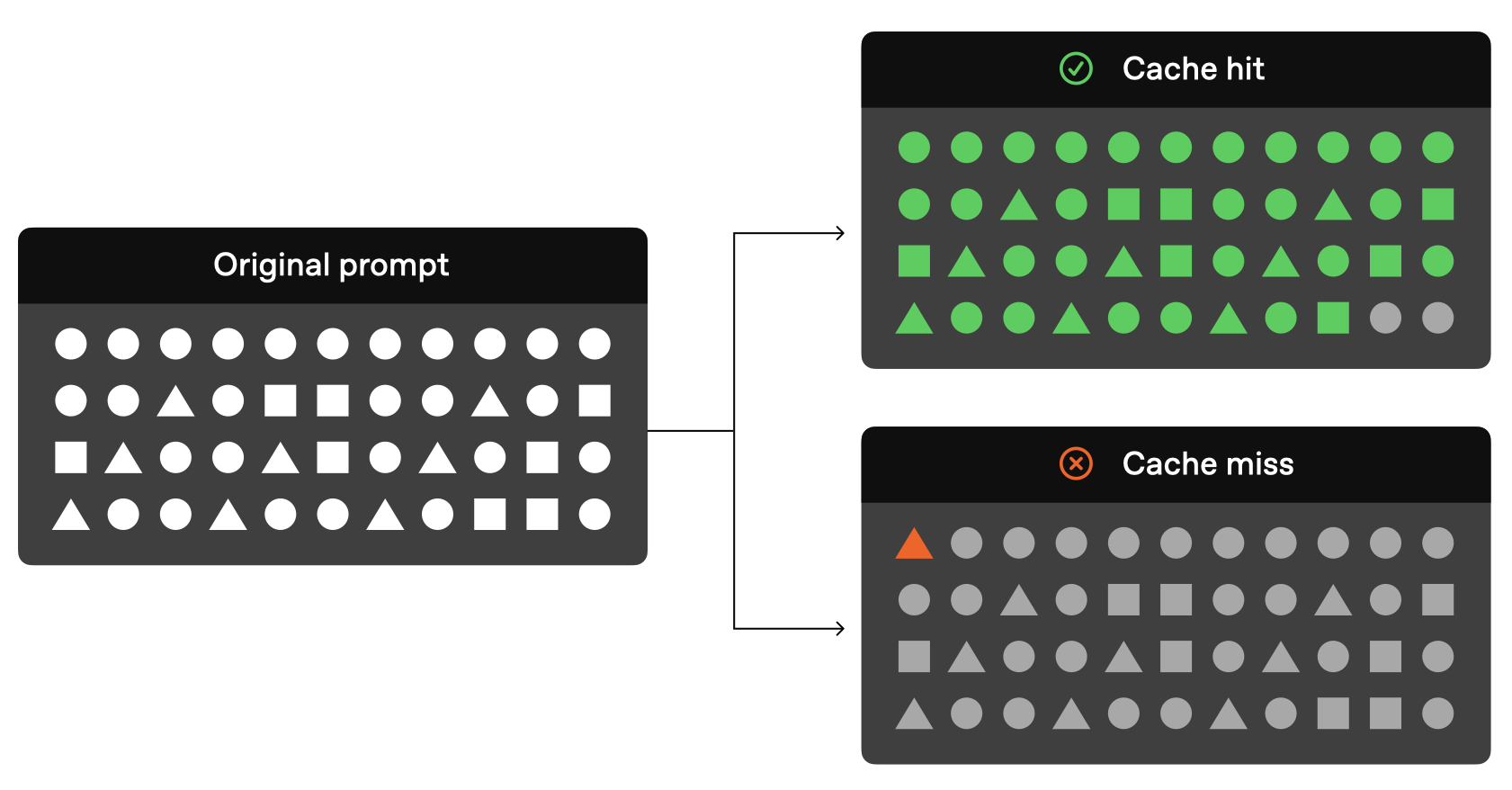
Without prefix caching, the serving engine rebuilds KV state for the entire prompt before generating the first token. With it, cached tokens are skipped, and prefill covers only the uncached suffix, dramatically reducing TTFT and computational cost.
But here’s the catch: a warm cache sitting on one node is only useful if the next call actually lands there.
The Recipe for Repeated Prefill
When your load balancer scatters an agent’s turns across workers with no awareness of cache state, you get the worst of both worlds:
Without cache-aware routing
Every turn triggers a full recompute of an ever-growing prefix. TTFT gets worse as the session progresses, not better.
With prefix-aware routing
Requests go to workers already holding matching prefixes, so prefill covers only the new tokens. TTFT tracks the size of the new content, not the entire history.
The math gets uglier with scale. A recent release note from oMLX illustrates just how expensive naive KV handling gets: legacy cache storage for an 84K-token session consumed 282.7 GB, moving to a linear storage layout dropped it to 15.3 GB for 94K tokens. Cache management is not a footnote, it’s the difference between viable and bankrupt infrastructure.
Building the Right Routing Layer
So what does proper LLM-aware routing look like in practice? The Gateway API Inference Extension (GAIE) defines the InferencePool resource type, which groups inference endpoints running the same model. An Endpoint Picker (EPP) component, implemented by projects like the llm-d Router, selects the optimal endpoint based on inference-specific metrics.
The request flow looks like this:
- Request arrives at the Gateway (an Envoy Gateway, for example)
- The
HTTPRouteselects anInferencePoolas the backend - The EPP evaluates endpoints based on prefix cache content, memory utilization, and queue length
- The EPP returns the best endpoint to the Gateway
- The Gateway forwards the request to the selected inference server
The key insight? An InferencePool groups model server pods into a routable Gateway API backend, and the EPP learns what’s cached where by streaming metadata from the inference engines. vLLM can publish KV cache events over ZMQ, the EPP consumes those events to build an accurate picture of cache locality across all replicas.
This approach doesn’t just consider one dimension. The llm-d router’s scoring mechanism uses multiple plugins, weighing prefix cache reuse against queue depth. Because purely cache-affinity-based routing can create hot spots, the worker with the best cache might be overwhelmed while an idle worker with a partial cache would serve the request faster.
The “It’s Too Hard” Objection
There’s a legitimate skepticism here. A skeptic might point out that distributed, disaggregated inference is genuinely hard, and that moving KV state over network interconnects (even fast ones like NVLink) can introduce contention that erases caching benefits.
That’s fair. Routing decisions are cost-benefit calculations, not rule-based lookups.
But the alternative, ignoring cache state entirely, guarantees repeated computation. The question isn’t whether to build smarter routing, it’s how quickly you can get there.
The inefficiency is also compounding with the growing economic pressures of LLM inference at scale. Every token recomputed is compute paid for twice. Every user waiting on a slow TTFT is revenue lost.
What Actually Works in Production
From the field, here’s what separates teams that handle this well from those that don’t:
1. Instrument first. You can’t fix what you can’t see. Metrics like cache hit rate, TTFT, routing decisions, and latency percentiles tell you whether your requests are hitting warm replicas. The oMLX release notes above show that understanding cache behavior at a granular level leads to 20x memory reductions. Apply the same rigor to inference metric collection with tools like Prometheus and Grafana.
2. Deploy an Endpoint Picker. Start with the llm-d Router in gateway mode. It integrates with existing Gateway API infrastructure and works with agentgateway or Envoy AI Gateway. The configuration is more involved than a kubectl apply, but the payoff is measurable TTFT improvement.
3. Design prompts for cacheability. Cache hits only happen on exact prefix matches. Static content belongs at the beginning of the prompt, dynamic content goes at the end. Changing, deleting, or reordering earlier content invalidates the cache. Context truncation and summarization can also reset the reusable prefix, balance savings from shorter prompts against the loss of cache reuse.
4. Consider what oversimplifying routing choices costs. The dangers of oversimplifying architectural decisions when scaling systems apply directly here. A “simple” load balancer that ignores inference state is a deferral of complexity, not an elimination of it. You’ll pay later in GPU hours.
Measuring Whether It’s Working
The final piece is observability. Routing decisions happen fast, and you need visibility into whether they’re working.
- Cache hit rate tells you the percentage of matching prefixes successfully reused.
- TTFT by request pattern distinguishes cached-prefix hits from full recomputes.
- Routing behavior metrics reveal whether requests are reaching the replicas expected.
- KV cache utilization per replica identifies imbalances that could benefit from stale cache eviction or rebalancing.
Without these, you’re flying blind, and cache misses become user-visible performance problems you can’t explain.
The Takeaway
Traditional Kubernetes load balancing is a fine tool for stateless services. For LLM inference, “stateless” is a myth you can’t afford to believe.
The difference between infrastructure that runs agents well and infrastructure built for how agents actually behave comes down to whether routing considers the state of your inference fleet. The teams that crack this will deliver dramatically better TTFT and slash their GPU bills. The ones that don’t will keep paying for prefill computation they’ve already purchased, once per request, per replica, forever.
Prefix caching is table stakes. Prefix-aware routing is the infrastructure layer that makes it work. The choice isn’t between simple and complex routing, it’s between paying for compute twice or thinking about state. And the hidden cost of naive load balancing is just one of the hidden cost trade-offs in running LLMs efficiently that too many teams discover only after the invoice arrives.