Hugging Face just dropped a fully open-source, real-time voice AI pipeline that claims to be a drop-in replacement for OpenAI’s Realtime API. And here’s the kicker: it runs on a MacBook Pro.
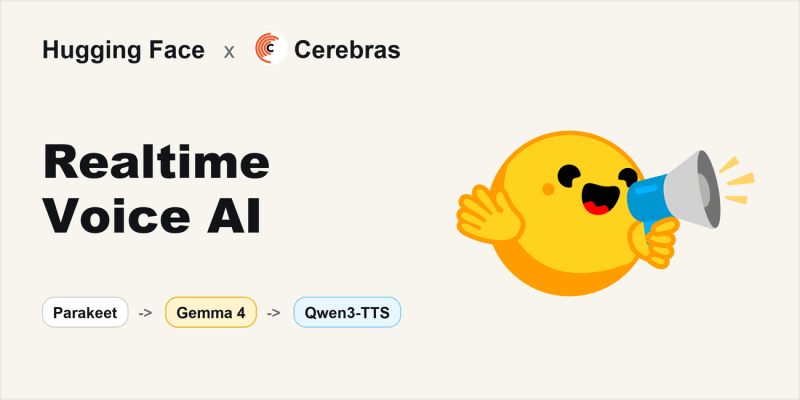
The demo, announced by Hugging Face’s Andi, chains together Nvidia’s Parakeet for speech recognition, Google DeepMind’s Gemma 4 31B running on Cerebras hardware, and a custom inference implementation of Alibaba’s Qwen3TTS for text-to-speech. The entire stack is fully open-source on GitHub, and the web demo is live on Hugging Face Spaces.
This isn’t just another open-source project. It’s a direct challenge to the closed, single-vendor voice AI ecosystem that OpenAI has been building.
The Architecture: Four Vendors, One Pipeline, Zero Black Boxes
The pipeline is a cascaded speech-to-speech loop with four distinct layers, each explicitly swappable:
- Speech Recognition: Nvidia’s Parakeet handles ASR
- Language Model: Google DeepMind’s Gemma 4 31B (or 12B/E4B for local setups)
- Inference Hardware: Cerebras provides the compute for the LLM layer
- Text-to-Speech: Alibaba’s Qwen3TTS, served via a custom inference implementation
The key insight here isn’t the individual components, it’s the architecture. This is a four-vendor, fully open pipeline where every layer is explicitly swappable. Compare that to OpenAI’s Realtime API, which is a single-vendor black box where you get what you’re given and you don’t complain about it.
Why Tail Latency Matters More Than Speed
The most interesting technical argument in Hugging Face’s post isn’t about raw speed, it’s about tail latency. The P95 latency, not the median, is what makes or breaks a conversational voice experience.
Here’s the problem: a voice assistant that responds in 200ms 95% of the time but takes 3 seconds 5% of the time feels broken. Those occasional multi-second stalls destroy the illusion of natural conversation. The user stops treating it like a person and starts treating it like a slow API call.
Cerebras addresses this by providing stable, predictable inference at the tail. Their wafer-scale architecture doesn’t have the same memory bandwidth bottlenecks that GPU clusters hit under load. The claim is that P95 latency stays close to median latency, which is the actual metric that matters for production voice systems.
The Local Angle: Running on a MacBook Pro
Here’s where this gets spicy. The demo isn’t just a cloud-only flex. Andi from Hugging Face confirmed that the pipeline runs locally on a MacBook Pro M3 with 36GB of RAM using the Gemma 4 E4B model. The 31B version, served by Cerebras at roughly 1300 tokens per second, is the cloud variant, but the smaller models are genuinely local-capable.
One developer in the thread confirmed running a similar setup on CPU-only hardware (Termux on Android) using Qwen ASR + Gemma 4 E2B + Chrome native TTS, and described it as “actually impressive.” Another pointed out that even the E2B model handles conversation and tool calling just fine.
This is significant because it means you’re not locked into a cloud API for voice AI. You can run this on a laptop, on a robot, or on edge hardware without sending audio data to a third party.
The 9,000-Robot Reality Check
This isn’t a demo that exists only in a Hugging Face Space. The same speech-to-speech pipeline already powers over 9,000 Reachy Mini robots in production. That’s a real deployment story, not a benchmark cherry-pick.
For robotics and embodied AI, the difference between a snappy reply and an occasional multi-second stall isn’t a benchmark metric, it’s whether people keep talking to the thing. A robot that pauses for three seconds mid-conversation feels broken, regardless of how fast it is the other 95% of the time.
The Honest Caveats
Let’s not pretend this is a perfect solution. The pipeline has real limitations:
No published head-to-head latency numbers. The claim of being “dramatically faster and more stable” than OpenAI’s Realtime API is Cerebras’ framing, not something the reader can independently verify. The blog post doesn’t publish comparative benchmarks.
Cascaded architecture complexity. A four-vendor cascaded stack has inherent challenges with interruptions and barge-in. When you chain ASR → LLM → TTS, handling the user cutting off the AI mid-response gets complicated. End-to-end voice models handle this more naturally.
TTS accent limitations. The Qwen3TTS model has a strong English accent in some languages. German, for example, reportedly sounds noticeably accented. Japanese is better, but multilingual quality is uneven.
The Cerebras dependency. While the pipeline is open-source, the 31B model’s impressive speed comes from Cerebras’ proprietary hardware. Running locally means using the smaller E4B or 12B models, which have different capabilities.
What This Means for Developers
The practical implication is straightforward: you now have an open reference architecture for voice AI that you can inspect, modify, and deploy without vendor lock-in.
For developers building voice interfaces, the useful frame here is that P95 tail latency, not median response time, is what makes a conversation feel broken. The Cerebras-hosted inference layer claims to address this, but the real test will be whether it holds up once you stack tool calls and multi-turn flows on top of it. That’s where cascaded speech-to-speech pipelines usually crack.
The pipeline’s modularity is its strongest feature. If Parakeet doesn’t work for your use case, swap it. If Qwen3TTS has too strong an accent in your target language, replace it with Kokoro or another TTS model. If you want to run everything locally, drop down to Gemma 4 E4B and accept the capability trade-off.

The Open-Source Voice AI Landscape
This release sits in a broader context of open-source voice AI acceleration. We’ve seen NVIDIA’s quantization techniques for running models locally push the boundaries of what’s possible on consumer hardware, and Hugging Face’s Transformers v5 performance improvements have made local inference dramatically more efficient.
The open-source model capabilities and agentic performance comparisons we’ve been tracking show that the gap between open and closed models is narrowing fast. Gemma 4 31B on Cerebras is a concrete example of that trend, an open-weight model running at over 1000 tokens per second, enabling use cases that were previously the exclusive domain of proprietary APIs.
The Verdict
This is a meaningful step forward for open-source voice AI. The pipeline is real, it’s running in production on thousands of robots, and it’s fully inspectable and modifiable. The modular architecture means you can swap components as better models emerge, rather than being locked into a single vendor’s roadmap.
The honest assessment: this isn’t a drop-in replacement for OpenAI’s Realtime API in every scenario. The cascaded architecture has different failure modes than end-to-end models. The TTS quality is uneven across languages. The local deployment story requires model size trade-offs.
But as an open reference architecture for voice AI, it’s invaluable. Every layer can be inspected, swapped, and improved. That’s something no proprietary API can offer.
For developers building voice interfaces, the takeaway is clear: the open-source voice AI stack is now viable for production use. The open-source model capabilities and agentic performance comparisons we’ve been tracking show this trend accelerating. The question isn’t whether open-source voice AI can compete with proprietary APIs anymore. It’s whether you can afford to ignore the flexibility and control that open architectures provide.
The demo is live on Hugging Face Spaces. The code is on GitHub. Go break it, fix it, and make it better. That’s the whole point.