Data engineers have been living a lie. We’ve built elaborate pipelines, deployed intricate orchestration, and maintained sprawling catalogs, all while the data itself remained a black box. Your code gets version control, your infrastructure gets Infrastructure-as-Code, but your actual data? A murky swamp where changes happen invisibly and nobody can tell you exactly what broke, when, or why.
That’s finally changing. A new UI tool brings Git-style diffing to DuckLake tables, letting you compare snapshots, inspect row and cell-level changes, and collapse unaffected ranges, just like you would in a code review. If you’re a data engineer who’s ever spent three hours hunting down a phantom column rename that broke your dashboard, this is your moment.
The Missing Piece in the Lakehouse Story
Let’s set the scene. DuckLake, DuckDB’s lakehouse format, hit version 1.0 back in April 2026. It’s an elegant answer to a real problem: how do you get multiple processes writing to DuckDB without tripping over each other? The answer: store data as Parquet in object storage, and keep the catalog, which files constitute which table version, in a real database like PostgreSQL.
But here’s the dirty secret: versioning and visibility are two different things. DuckLake can traverse snapshots, sure. The metadata is all there. But seeing what changed between two snapshots? That’s been a manual, painful process involving SQL queries, custom scripts, and more EXCEPT clauses than any sane person should write.
Granted, the ecosystem has resisted this for a while.
The Diff That Feels Like Home
Here’s what the tool actually does, and why it hits different: it gives you a familiar interface for data changes. You’re not learning a new paradigm, you’re getting the one you already know from code review, applied to tables.
You can see total row and column differences at a glance. Click into any changed cell to see the exact before/after values. And crucially, it collapses unaffected row ranges. This is the killer feature. If you’re diffing a 3-million-row table but only 25 rows changed across 3 ranges, you see those three ranges. Just like a Git client collapses unchanged hunks in a code file, this collapses unchanged data ranges in your table.
That might sound trivial until you’ve tried to eyeball a diff between two 10GB Parquet files.
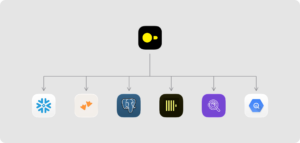
The implementation details are worth noting. The tool works with both local and Postgres DuckLake catalogs, with data stored either locally or on S3. For those deep-diving into a single table, there’s a snapshot filter that shows only the commits touching that specific table, useful when you’ve got dozens of commits spread across unrelated tables. This was inspired by LLDB’s “stack-collapse” feature, which lets you filter to instructions that directly affect the thread you’re debugging. The cross-domain inspiration is exactly what data tooling has been missing.
Why This Matters More Than You Think
The broader context here is that DuckDB itself has been on a tear. The benchmark data from a recent deep-dive shows the gap between the old guard and the new reality:
| Engine | Q1 | Q2 | Q3 | Peak Memory |
|---|---|---|---|---|
| DuckDB 1.5.6 (SQL on Parquet) | 16 ms | 36 ms | 44 ms | 237 MB |
| Polars 1.36 (eager) | 10 ms | 127 ms | 351 ms | 3.3 GB |
| pandas 2.3 | 126 ms | 347 ms | 661 ms | 3.4 GB |
| SQLite 3.53 | 1,800 ms | 3,584 ms | 4,529 ms | 52 MB |
DuckDB answers analytical queries on 11.2 million taxi trips in 16, 44ms with a fraction of the memory of its competitors. Now add snapshot versioning and visual diffing on top of that foundation, and you’ve got something genuinely compelling.
This isn’t just about convenience. It’s about trust. When a data quality issue surfaces, the first question is always “what changed?” With transparent diffing, you can answer that question in seconds instead of hours.
The Deeper Implications
What we’re witnessing is the convergence of two paradigms: the analytical power of modern OLAP engines and the developer experience we’ve come to expect from version control systems. And it’s about time.
Think about what Git did for software development. It didn’t just track changes, it enabled review workflows, accountability, and safe experimentation. You could branch, test, and merge with confidence because you could see exactly what you were changing.
Data engineering has never had that. Your ETL scripts are versioned. Your schema migrations are versioned. But the data itself? It’s a continuous stream of undocumented mutations, with the only “history” being whatever audit logs happen to capture.
The change here is philosophical, not just technical.
What This Means for the Warehouse Debate
There’s a broader context worth noting. The line between “laptop database” and “enterprise warehouse” is blurring faster than most people realize. DuckDB 2.0 ships on October 21, 2026, today, as I write this, with Quack, the client-server protocol, graduating to stable. DuckLake sits alongside it as the file-based lakehouse format for shared access. And now you can layer familiar version control semantics on top.
The arguments for BigQuery or Snowflake as the default “source of truth” get weaker when embedded analytics can handle hundreds of gigabytes with millisecond latency and now offer snapshot diffs. The managed warehouses still win on governance at scale, but the gap is narrowing.
One prediction: within 18 months, this kind of diffing will be table stakes for any serious lakehouse tooling. Delta Lake, Iceberg, and their ilk all support time travel, but most teams still struggle to make that functionality genuinely usable. This tool shows what “usable” looks like.
The Reality Check
Before I get accused of being a shill, let’s be honest about the limitations.
First, this is still early-stage tooling. The Reddit thread that sparked this whole discussion is small, 44 upvotes, a handful of comments. The creator is upfront that it’s part of a larger product (Coco Alemana) rather than a standalone open-source tool.
Second, there are real technical issues lurking under the surface. A GitHub issue I found on a different project highlights a classic problem: when you diff against a DuckLake table, you need to be sure you’re diffing against the snapshot at the time of creation, not the live lake table. If the lake moves on, your diff reports spurious modifications. That’s a subtle bug class that’s not unique to this tool, it’s a fundamental challenge of distributed versioned state.
Third, cell-level diffing is hard to get right. What counts as a “change”? A reordered row? A column that moved position but has identical values? Type coercion that changes the representation but not the value? These edge cases will balloon in complexity as the tool matures.
The Bigger Trend
This tool is part of a larger movement toward treating data as a first-class citizen in the development workflow. We’ve seen it with the rise of declarative pipeline DSLs, and we’re seeing it now with version control semantics applied to tables themselves.
Even the AI-assisted development world is wrestling with similar questions. Anthropic built its own internal version control system to handle massive-scale code changes, and tools are emerging that rethink version control for real-time, AI-driven collaboration beyond Git’s commit model. The parallels to data versioning are obvious: when machines produce changes at scale, humans need better tools to review and understand what happened.
Similarly, AI foundation models for tabular data are making it easier to analyze and understand the structure of data itself, but without reliable diffing, you can’t know if the data your model trained on is the same data you’re serving in production.
A Modest Proposal
Here’s my unsolicited advice to the data engineering community: stop treating version control as a code-only concern. Start demanding version control semantics from your data tooling.
When you evaluate a lakehouse format, ask about snapshot traversal. When you pick a query engine, ask about time travel. When you choose your data tooling, ask whether you can see what changed between Wednesday and Thursday, not just that it changed, but exactly what.
The DuckDB ecosystem is getting this right. DuckLake provides the versioning primitives, and tools like this provide the visibility layer on top. The result is a stack where data becomes auditable, reviewable, and debuggable in ways that were previously reserved for code.
That’s not a nice-to-have. That’s the difference between data engineering as a dark art and data engineering as an engineering discipline.
The Bottom Line
Someone on Reddit called DuckLake “seriously underrated” and said diffing “should be the default for all OLAP systems at this point.” I’m inclined to agree. The capabilities are there, snapshot traversal, time travel, catalog-based versioning, but without a usable interface for actually seeing changes, those capabilities remain theoretical.
This tool is one of the first to bridge that gap. It’s not perfect, it’s not complete, and it’s not even DuckDB or DuckLake’s official tooling. But it demonstrates what’s possible when you apply version control paradigms to analytical data tables.
Data engineering has spent a decade building more elaborate ways to process data. Maybe it’s time we got better at understanding what our data is doing when we’re not looking at it.
This post was inspired by and references the original Reddit thread and Coco Alemana’s DuckLake integration page. For a deeper look at where DuckDB fits in the broader data stack compared to pandas, Polars, and warehouse systems, check out the comprehensive DuckDB explainer.