The data engineering community has been watching the DuckDB phenomenon with a mix of admiration and mild confusion. Here’s a database that runs inside your process, queries CSV files like they’re nothing, and has somehow amassed 40 million downloads per month. It’s the database equivalent of that friend who shows up to a black-tie event in cargo shorts and somehow gets invited back.
So when AWS quietly acquired DuckLabs last month, the industry collectively raised an eyebrow. The terms were redacted, the strategic rationale was vague, and everyone was left to speculate.
Now we know why. And the answer is a lot more interesting than “AWS wanted a cool project to throw money at.”
The First Move: DuckDB Gets Embedded in Aurora PostgreSQL
On September 30, 2026, AWS announced that Amazon Aurora PostgreSQL now supports direct querying of Apache Iceberg and Parquet data. The headline feature: you can now join live transactional data with historical records stored in your data lake, all in a single query, using your existing PostgreSQL tools.
But here’s the actual story buried in the announcement: DuckDB is now embedded directly inside Aurora PostgreSQL. It’s not a partnership, not a connector, not a “managed service.” The analytical engine is running inside the database.
This is a fundamentally different architectural approach than what we’ve seen before. Let’s unpack why it matters.
The Architecture That Died: Reverse ETL Was Always a Band-Aid
Before this announcement, if your application needed to combine recent transactions in Aurora with five years of historical data sitting in S3, you had exactly one practical option: build a reverse ETL pipeline. Copy data from your data lake into your operational database, keep it synchronized, and pray the lag doesn’t bite you.
As Esra Kayabali, Principal Solutions Architect at AWS, wrote in the announcement: “Previously, if your application needed to combine recent transactional data in Aurora with historical records stored in Amazon S3, a common approach was to build reverse ETL pipelines that duplicated data, increased infrastructure costs, and required ongoing engineering effort to keep everything synchronized.”
This challenge has a name in the industry: the operational-analytical divide. Transactional databases store rows together for fast writes. Analytical databases store columns together for fast reads. They’re in different corners of this grid:
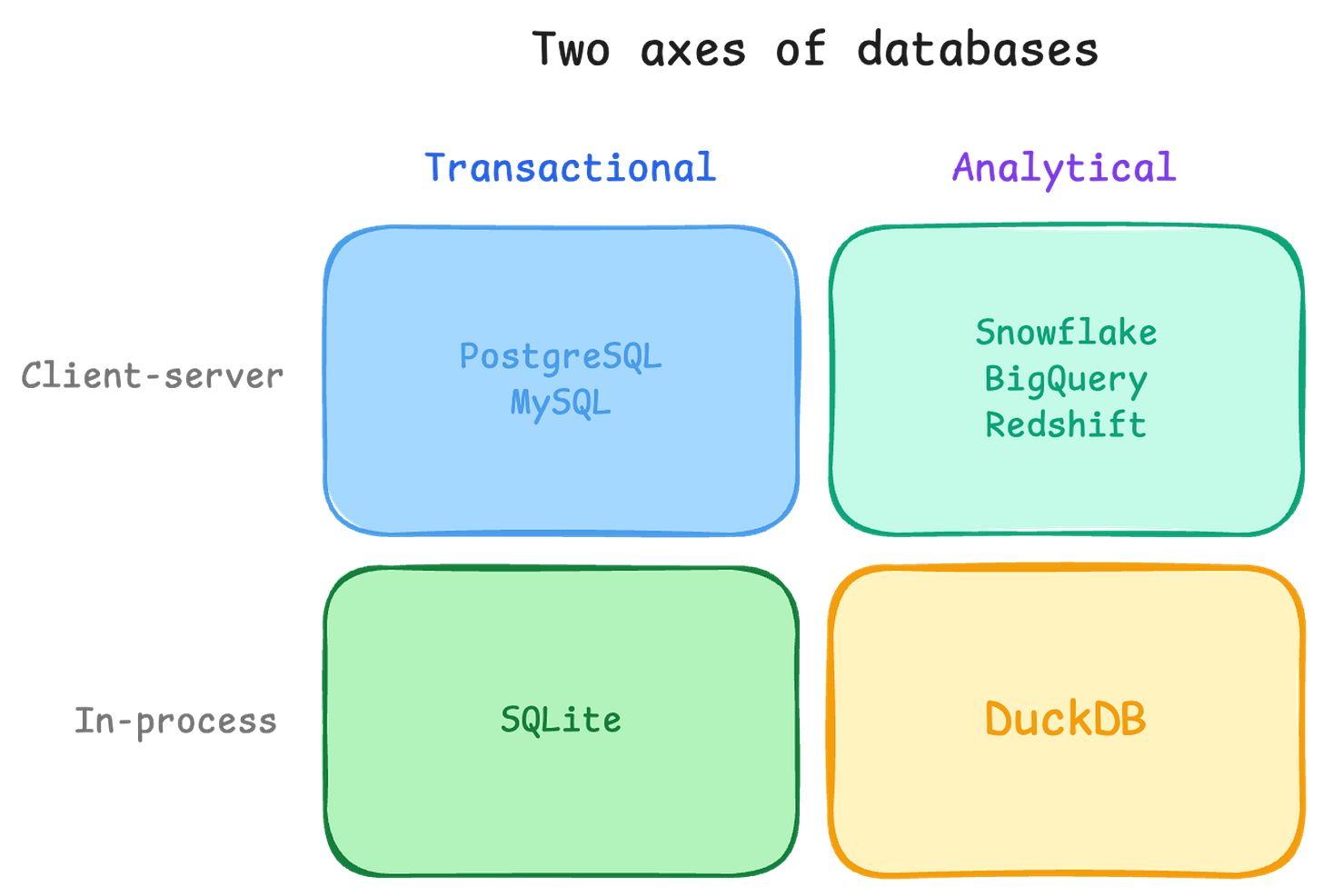
PostgreSQL does transactions brilliantly. Snowflake does analytics brilliantly. And for the last decade, the industry’s answer to “how do I combine both” has been to build increasingly elaborate data pipelines that shuffle data between them.
DuckDB’s superpower has always been that it sits in a category of its own: an in-process analytical database. It doesn’t need a server. It doesn’t need a network connection. It just works wherever you run it. And now AWS has taken that engine and stuffed it inside Aurora.
How It Actually Works
The implementation is elegantly simple from a user perspective. You create an Aurora PostgreSQL cluster, attach an IAM role with the AuroraAnalytics feature, and enable the aurora_analytics extension:
CREATE EXTENSION aurora_analytics;
Then you create a foreign table pointing at your Parquet data in S3:
CREATE FOREIGN TABLE transaction_history ()
SERVER aurora_analytics_server
OPTIONS (
    location 's3://<my-bucket>/finance/transaction_history.parquet',
    format 'parquet'
);
Notice the empty parentheses in the CREATE FOREIGN TABLE statement. Aurora automatically reads the schema from the Parquet file metadata, no manual column definitions required. If you have hundreds of tables in a Glue Data Catalog database, a single IMPORT FOREIGN SCHEMA statement bulk-creates them all.
Then the interesting part. You can run a single query that combines live operational data with historical archive data:
SELECT merchant, category, amount, transaction_date, 'recent' AS source
FROM recent_transactions
WHERE customer_id = 'C-1001'
UNION ALL
SELECT merchant, category, amount, transaction_date, 'historical' AS source
FROM transaction_history
WHERE customer_id = 'C-1001'
  AND transaction_date >= CURRENT_DATE - INTERVAL '5 years'
ORDER BY transaction_date DESC
LIMIT 15;
DuckDB handles the analytical scan of the Parquet data under the hood, while Aurora handles the operational data. No network hops. No ETL. No duplication.
The AI Agent Angle Nobody’s Talking About
Here’s where this gets genuinely interesting. AWS didn’t build this feature for humans. They built it for agents.
Kayabali wrote: “This challenge only grows as you increasingly embed AI agents into your applications, where it is impractical to predict and pre-replicate every dataset an agent might need.”
Think about what an AI agent actually does when it interacts with data. It pokes. It experiments. It runs exploratory queries on small datasets before figuring out what it really wants to do. This is exactly the behavior DuckDB was designed for.
The AWS acquisition announcement made this explicit: “And what works for everyday queries also (unsurprisingly) works very well for agents because agents behave a lot like people when interacting with data. They poke. They experiment. They run exploratory analysis on small data sets before figuring out what they really want to do. DuckDB ends up being naturally optimized for AI agents to use.”
If you’re building an agent that needs to enrich a live transaction with historical context, you have two options. You can try to pre-compute every possible lookup the agent might want, which is impossible, or you can give the agent a direct line to the data it needs.
This is why respected analysts like Rachel Stephens at RedMonk have called this a strategic masterstroke. AWS is positioning itself as the default infrastructure for agentic AI, and that infrastructure needs to include embedded analytical capabilities, not just more API endpoints.
The Competitive Chess Game
Let’s be clear about what this move disrupts. The moment DuckDB is embedded in Aurora, the rationale for a whole class of “query federation” tools starts to evaporate. If your operational database can natively query your data lake with analytical performance, why would you pay for a separate tool to do the same thing?
This also puts pressure on the blurring lines between databases and data lakehouses in modern analytics. The industry has been moving toward “one platform for all your data needs” for years. Snowflake wants to be your transactional database. Databricks wants to be your data warehouse. And now AWS is saying: your PostgreSQL database can be your analytics engine too.
The timing is notable. Databricks just released Lakebase, their serverless Postgres implementation over open lake storage. Snowflake has been touting their Postgres compatibility. The whole industry is converging on the same insight: Postgres is the protocol, and the data lake is the storage, and whoever connects them most seamlessly wins.
AWS just moved the goalposts by an order of magnitude. Instead of building a separate analytics engine, they embedded an existing one directly into their flagship relational database.
The “DuckDB Everywhere” Strategy
Here’s the thing that makes this acquisition so strategically interesting: Aurora is just the first stop. The AWS blog post explicitly states that “future improvements to the open source engine can continue to bring performance and functionality gains to Aurora and other AWS services.”
Not “to Aurora.” To other AWS services.
DuckDB’s unique position in the database landscape makes it incredibly versatile. It runs in browsers via WebAssembly. It runs on MacBooks with 8GB of RAM. It runs inside data pipelines. And now it runs inside Aurora.
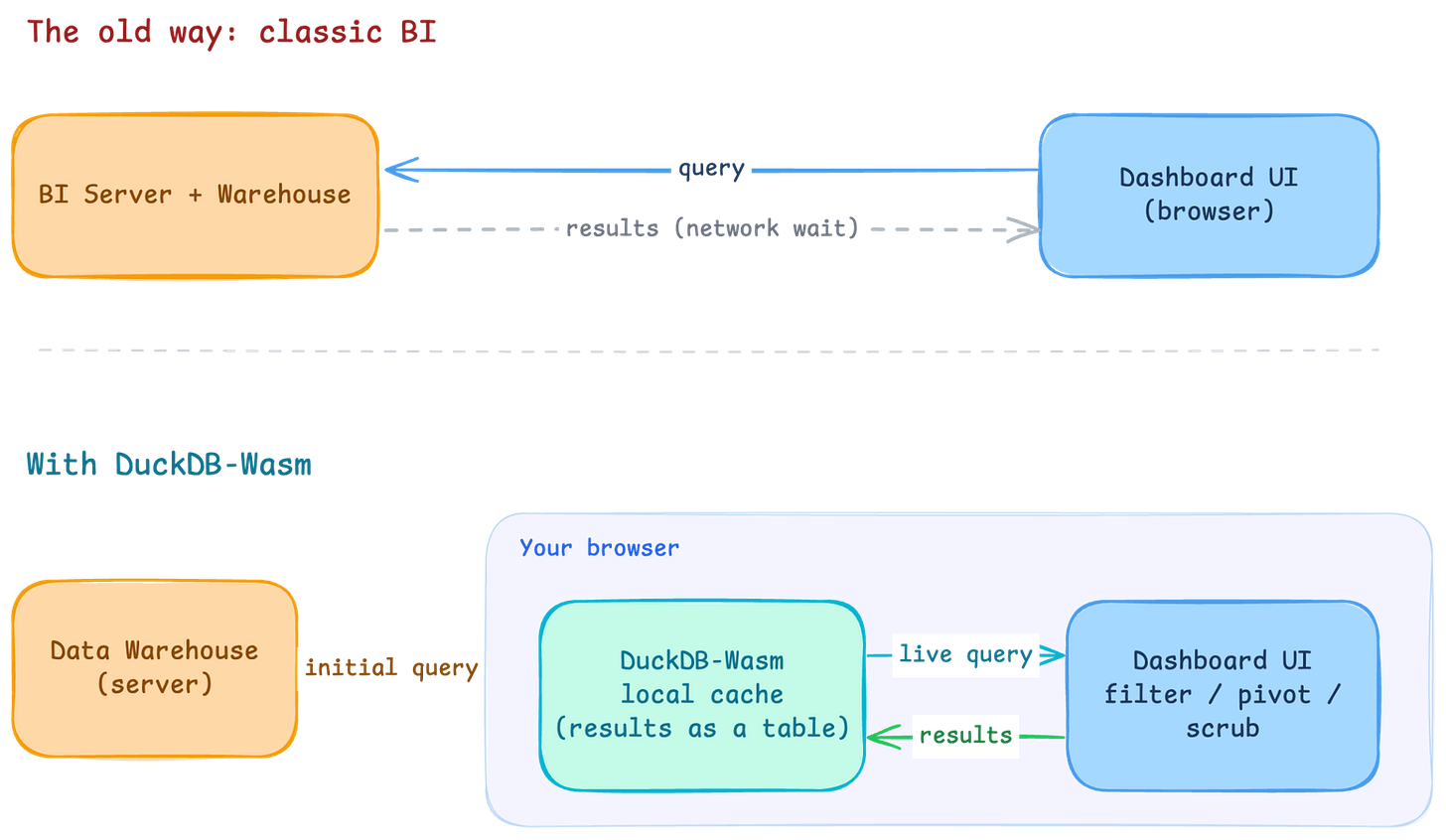
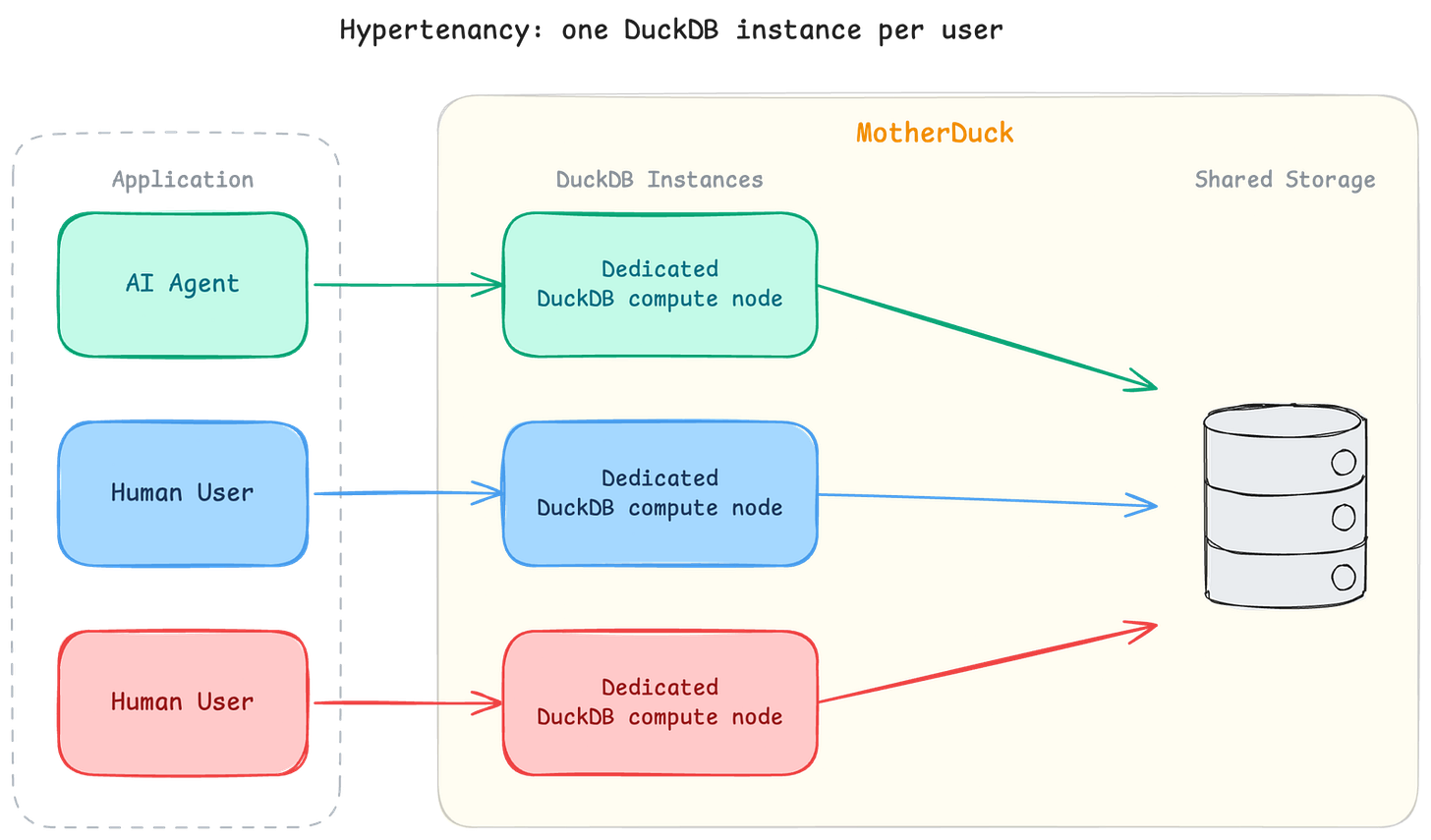
The MotherDuck team demonstrated what DuckDB enables at scale with their hypertenancy architecture, giving every user or agent their own dedicated compute node while sharing the same storage. That’s a fundamentally different multi-tenancy model than anything else in the cloud database space. Now imagine AWS applying that pattern across their services.
The Real Cost Analysis
Let’s talk about what this actually costs, because the answer is “a lot less than you might think.”
AWS says the feature is available in all commercial regions at no additional feature charge. You pay only for:
– The incremental Aurora compute your queries consume
– S3 request costs for reading data lake files
That’s it. No separate licensing. No per-query fees. No “premium analytics add-on” upcharge.
This is a strategic pricing move. AWS isn’t trying to monetize the DuckDB integration directly, they’re trying to make Aurora stickier and prevent customers from moving to competing analytics platforms. It’s the same playbook AWS used with S3: make the infrastructure so cheap and so integrated that leaving becomes more expensive than staying.
What This Means for Your Architecture
If you’re running Aurora PostgreSQL today, this feature is immediately useful for several patterns:
Real-time dashboards with historical context. Instead of building a pipeline to pre-aggregate historical data, your dashboard can directly query the data lake. The query below shows how easily you can surface recent transactions alongside five years of history.
AI agents that need current and archived data. When your agent can’t predict what data it will need, giving it direct query access to both operational and historical data is the only scalable approach.
Single-digit-millisecond access to hot data. For workloads needing low latency, you can materialize data lake records into native Aurora tables using standard SQL commands like CREATE TABLE AS SELECT or MERGE INTO. The materialized tables live in Aurora and are queried like any other PostgreSQL table.
Offloading analytical scans from production workloads. Read queries can run on any Aurora instance in your cluster, whether writer or read replica. You can offload analytical scans from operational workloads without building a separate read-only environment.
The performance optimizations are also worth noting. Aurora applies predicate pushdown and column pruning so only relevant data is read. It caches frequently accessed data. You can inspect behavior per query using aurora_analytics_stat_statements(), which reports metrics like rows scanned, bytes read from S3, and cache hits. This is the kind of observability that makes a feature real versus just a marketing announcement.
The Elephant in the Room: What Happens to DuckDB the Project?
The open-source community has a well-earned skepticism about acquisitions. History is littered with projects that got absorbed, mothballed, or subtly compromised after being acquired by giants.
The official announcement promises that projects will remain open source. The Aurora integration is explicitly built around DuckDB’s open-source code, and AWS says “future improvements to the open source engine can continue to bring performance and functionality gains.”
But let’s be realistic. AWS’s track record with open source is nuanced. They’ve been excellent stewards of some projects (like Firecracker) and questionable with others. The critical test will be whether the DuckDB team can maintain its independence and continue pushing the boundaries of what an in-process analytical database can do.
For now, the signals are positive. The DuckDB team has a long history of academic rigor, the project originated at the Centrum Wiskunde & Informatica in Amsterdam, the birthplace of Python. The integration into Aurora is technically sound and respects the project’s architecture. But the long-term stewardship question remains.
One thing that gives me some hope is the sheer breadth of use cases DuckDB serves. It’s not just AWS’s toy, it’s embedded in tools like PostHog’s data warehouse, Evidence’s BI platform, and dbt v2. Amazon has a demonstrated history of maintaining the open-source projects they’ve adopted when there’s a broad ecosystem dependent on them. That ecosystem now includes millions of monthly downloads and countless production systems.
The Edge Computing Angle
The topic description mentioned edge computing, and here’s where the theoretical becomes practical. DuckDB was never just about running analytics in the cloud. Its in-process architecture makes it perfect for edge environments where you can’t run a full database server.
AWS has been investing heavily in edge computing with services like IoT Greengrass and Snow Family. Now imagine combining DuckDB’s lightweight analytical processing with AWS’s edge infrastructure.
A realistic scenario: a factory with sensors generating streaming data. An edge device runs DuckDB to perform real-time analytics on the sensor data locally. Historical data gets stored in S3 when connectivity is available. When an operator needs to compare current sensor readings with historical patterns, the edge device queries both local results and cloud data, with DuckDB handling the analytical processing on both sides.
This is speculative, but it’s the kind of architecture that the Aurora integration makes plausible. DuckDB’s engine is now proven to work embedded in enterprise-grade database systems, not just as a developer tool.
The Verdict
The acquisition was announced in August. The first product integration shipped in September. That’s an remarkably fast turnaround for AWS, which is not known for moving quickly on integrating acquisitions.
This pace suggests the DuckLabs team wasn’t just absorbed, they were integrated in a way that preserves their technical identity. The Aurora feature has the feel of something built with the DuckDB team, not just chemically bonded to it.
The broader implications for the analytics landscape are significant. The data sovereignty and regional cloud infrastructure strategies conversation becomes more complex when analytical processing can happen inside a relational database without any additional infrastructure. And enterprises skeptical of maintaining complex data pipelines will find this approach increasingly appealing.
The next twelve months will be telling. AWS has promised DuckDB integration across “other services”, and the pattern of the future is becoming clear:
The database is no longer a destination. It’s an embedded capability. The distinction between operational and analytical databases is dissolving, and DuckDB is the catalyst.
The companies that win the next wave of data infrastructure won’t be the ones with the best warehouse or the fastest query engine. They’ll be the ones that make analytical processing so embedded, so invisible, and so cheap that it just happens wherever data exists.
AWS’s acquisition of DuckLabs is the clearest signal yet that they intend to be that company. And they’ve just demonstrated that they’re willing to fundamentally reshape their most successful relational database to make it happen.
The era of “just add ETL” is over. Whether you’re ready or not, the growing skepticism toward AI-driven data systems in production environments is about to collide with a completely new way of thinking about where analytical processing happens.
DuckDB was always the disruptor. Now it has the full weight of AWS behind it.
The question isn’t whether your architecture will change. It’s whether you’ll adapt before the tools you’re currently paying for become redundant.