You’re a backend developer. You’ve got DynamoDB, fast, scalable, forgiving. Your BI dashboard is running on daily Glue exports to Athena, and it works fine until someone asks you a devastating question: “Can we get this in real-time?”
The air leaves the room. You know the nightly batch export is a ticking clock. Your CEO wants sub-minute latency on customer metrics, your ops team wants live inventory dashboards, and your data warehouse is still catching up on last night’s dump.
This isn’t a hypothetical. A recent post on r/dataengineering from a developer facing exactly this scenario sparked serious discussion. The thread’s top response was blunt: “You’re doing this backwards.”
They weren’t wrong. But the good news? There’s a playbook for this.
The Glue-Athena Trap: Why Batch Is a Dead End
Let’s be honest about the pipeline you’ve already built. AWS Glue jobs running daily, dumping Parquet into S3, querying with Athena, feeding Tableau. It works. It’s cheap. It’s also about as “real-time” as a mailed letter.
The fundamental problem isn’t just latency, it’s the architectural ceiling you’ve hit. DynamoDB’s single-table design, its JSON nesting, its lack of native SQL support, these aren’t bugs, they’re features that make batch extraction painful.
When you run a daily export, you’re doing a full table scan. For a table with 10 million items? That’s not just slow, it’s expensive. And Athena pricing ($5 per TB scanned) means your “cheap” pipeline gets expensive fast as data grows.
The dirty truth: Your batch pipeline will collapse under its own weight before you hit production scale. The question is whether you architect for streaming before or after that collapse.
CDC: The Only Honest Way to Stream from DynamoDB
Change Data Capture (CDC) sounds like magic, but it’s actually just engineering. Instead of scanning the entire table to find what changed, you read the transaction log, DynamoDB Streams in this case, and capture only the mutations.
Here’s what a CDC-based architecture looks like for DynamoDB to Redshift:
DynamoDB → DynamoDB Streams → Lambda/Kinesis → Firehose → S3 (staging) → Redshift
AWS recommends this exact pattern for real-time warehousing. DynamoDB Streams captures item-level changes with a 24-hour retention window. Each shard emits events for inserts, updates, and deletes.
But here’s where it gets spicy: DynamoDB Streams retention is only 24 hours. If your downstream pipeline fails for longer than that, you’re doing a full rebuild. This is the hidden operational risk that nobody talks about.
Your stream processing infrastructure needs to be more reliable than the data it’s carrying. And AWS DMS, the tool most people reach for? It’s not built for this.
The AWS DMS Nightmare: Learning from Others’ Pain
AWS Database Migration Service (DMS) was released in 2016 for one job: migrating databases. Not continuous CDC. Not real-time streaming. Migration.
Yet somehow, it’s become the default recommendation for DynamoDB-to-Redshift pipelines. This is a mistake the community is learning the hard way.
DMS has at least nine critical limitations for CDC workloads, and several of them will kill your production pipeline:
Replication slot mismanagement in PostgreSQL-based sources causes WAL bloat that can crash your database. One fintech company learned this the hard way when their DMS replication slot wasn’t properly managed, causing WAL files to grow until the database ran out of storage. Recovery required a full table reload and hours of downtime.
Scalability constraints limit you to 100GB memory per replication instance. For a DynamoDB table with high throughput, you’ll hit this ceiling fast.
Silent failures are the worst. DMS tasks can fail or stall without clear error messages. You think everything’s fine until someone checks the dashboard and sees data from three hours ago.
Schema evolution is manual. Any column addition requires a task restart.
These common integration pain points in data pipelines are exactly why experienced teams skip DMS for continuous CDC and build on streaming-native tools.
Reference Architecture: The Right Way to Build This
Let me show you the architecture that works. It’s not simple, but it’s reliable.
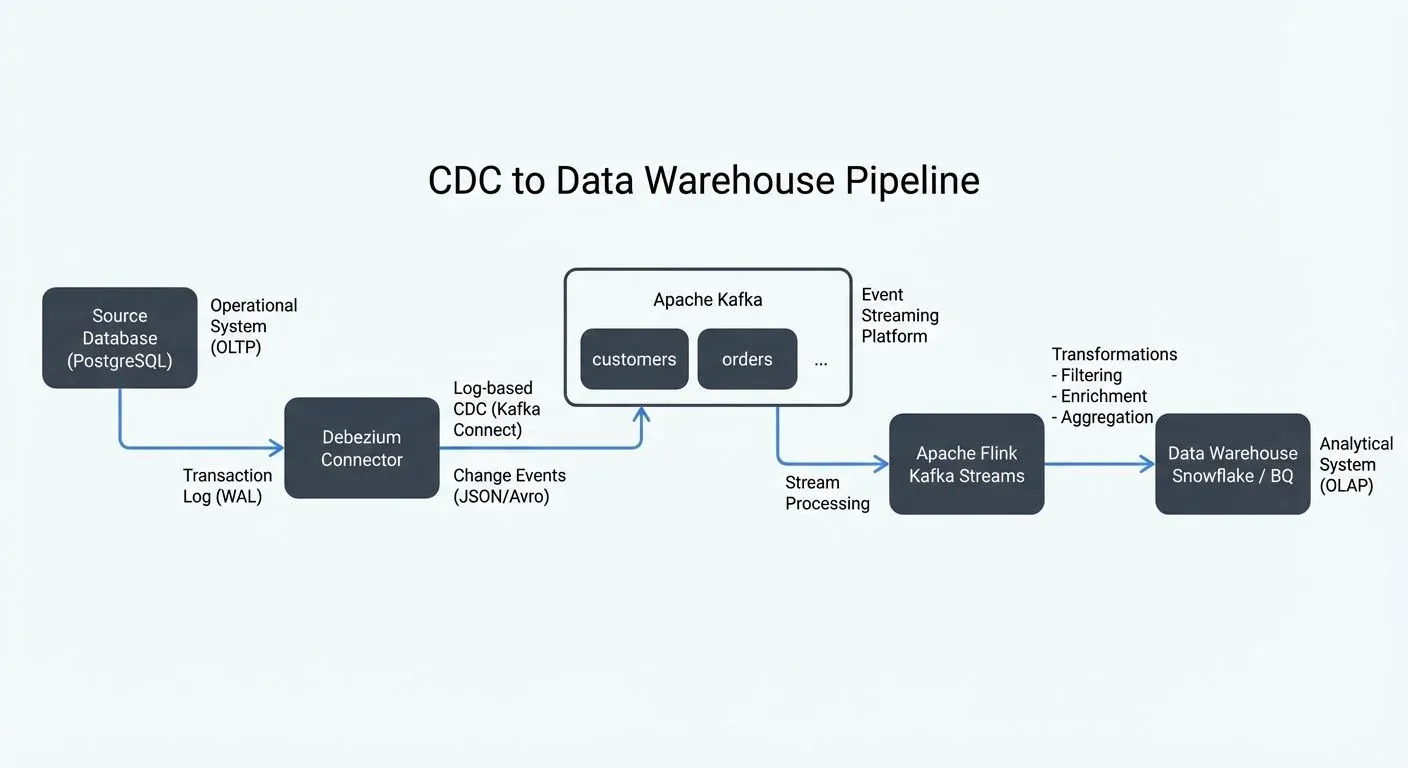
The Stack
- Capture Layer: DynamoDB Streams → AWS Lambda (or Kinesis Data Streams)
- Transport Layer: Amazon Data Firehose (or Kafka/Conduktor for higher throughput)
- Staging Layer: S3 with Iceberg/Delta Lake format for ACID transactions
- Warehouse Layer: Redshift with auto-ingest from S3
- Transformation Layer: dbt for modeling and materialization
The Debezium Alternative
If you want true streaming with replay capabilities, Debezium + Kafka is the open-source standard. Here’s the Debezium configuration for PostgreSQL-based CDC (conceptually similar for DynamoDB Streams):
{
  "name": "dynamodb-cdc-connector",
  "config": {
    "connector.class": "io.debezium.connector.dynamodb.DynamodbConnector",
    "table.include.list": "orders,customers,products",
    "aws.region": "us-east-1",
    "dynamodb.streams.poll.interval.ms": "1000",
    "snapshot.mode": "initial",
    "topic.prefix": "prod",
    "key.converter": "org.apache.kafka.connect.json.JsonConverter",
    "value.converter": "org.apache.kafka.connect.json.JsonConverter"
  }
}
The beauty of Debezium is exactly-once semantics and automatic schema evolution detection. It publishes a schema registry event when columns change, and downstream consumers can react programmatically.
The Incremental Loading Pattern
Once data reaches Redshift, you need a loading strategy. The append-only pattern is simplest:
CREATE TABLE customer_changes (
    change_id BIGINT PRIMARY KEY,
    customer_id VARCHAR(255),
    name VARCHAR(255),
    email VARCHAR(255),
    operation_type VARCHAR(10),
    change_timestamp TIMESTAMP,
    dynamodb_sequence_number VARCHAR(100)
);
But for BI dashboards, you’ll want the upsert pattern:
MERGE INTO customer_warehouse AS target
USING customer_cdc_stream AS source
ON target.customer_id = source.customer_id
WHEN MATCHED AND source.operation = 'UPDATE' THEN
    UPDATE SET name = source.name, email = source.email
WHEN MATCHED AND source.operation = 'DELETE' THEN
    DELETE
WHEN NOT MATCHED AND source.operation = 'INSERT' THEN
    INSERT (customer_id, name, email)
    VALUES (source.customer_id, source.name, source.email);
The dbt Transformation Layer: From Raw Streams to Data Marts
So you’ve got data streaming into Redshift. Now what? That single massive Athena SQL file needs to become a structured transformation pipeline. This is where dbt shines.
Your typical dbt project will have three layers:
Staging (stg_orders.sql): Minimal transformations, type casting, renaming, deduplication from CDC events.
WITH source AS (
    SELECT *,
        ROW_NUMBER() OVER (
            PARTITION BY order_id
            ORDER BY change_timestamp DESC
        ) AS rn
    FROM raw_orders_cdc
    WHERE operation_type != 'DELETE'
)
SELECT * EXCEPT rn
FROM source
WHERE rn = 1
Intermediate (int_order_metrics.sql): Business logic, aggregations, joins, calculations.
Mart (dm_daily_orders.sql): Ready-for-BI denormalized tables.
SELECT
    DATE_TRUNC('day', order_timestamp) AS order_date,
    COUNT(DISTINCT order_id) AS order_count,
    SUM(order_total) AS revenue,
    COUNT(DISTINCT customer_id) AS unique_customers
FROM int_order_metrics
GROUP BY 1
The trick with near-real-time dbt is micro-batching. Instead of running full refreshes every hour, you run incremental models every 5 minutes:
models:
  - name: dm_daily_orders
    config:
      materialized: incremental
      incremental_strategy: merge
      unique_key: order_date
      partition_by: order_date
This keeps your BI dashboard fresh without hammering Redshift with full rebuilds. One clever approach from the community is to “materialize everything as views” or use dbt’s incremental materialization with a time-based filter that only processes the last N minutes of CDC events.
The Build vs. Buy Decision That Haunts Teams
The question of whether to build this yourself or buy a managed solution is legitimately painful. Nowhere is this more acute than CDC for DynamoDB.
The “build” path: Lambda + Firehose + dbt + Redshift. You own everything, you debug everything, you scale everything. The operational cost is real.
The “buy” path: Managed platforms like Fivetran or Estuary handle the ingestion, schema mapping, and CDC. The cost is $500-$2000/month for a moderate pipeline, plus per-GB data movement fees.
There’s no universally correct answer, but the decision framework matters:
If your DynamoDB table has fewer than 10 writes/second and you have a dedicated data engineer? Build it. The Lambda-Firehose-dbt stack is well-documented and cost-effective.
If your table has 100+ writes/second, multiple consumers, or you’re a team of backend devs without data engineering depth? Buy it. The time you’ll spend debugging CDC latencies, schema drift, and replay failures will outweigh the subscription cost. This is the classic build vs. buy decision for data pipelines that teams get wrong more often than they get right.
The Hidden Cost: Schema Evolution in Real-Time
Let me tell you about the thing that will wake you up at 3 AM.
Your product team adds a discount_code field to the DynamoDB orders table. CDC captures it immediately. Your staging table doesn’t have the column. Redshift rejects the record. The Firehose error logs fill up. Your dashboard goes stale.
Now you’re sprinting to alter the table, backfill the data, and figure out what else you missed.
Schema evolution is the silent killer of real-time pipelines. Source databases change. CDC captures everything. Your warehouse needs to handle it gracefully.
Solutions exist but they’re not trivial:
- Schema-on-read: Land raw CDC events as JSON in a Variant/SUPER column, then parse at query time. Flexible but slow.
- Schema registry: Use Confluent Schema Registry to version schemas and auto-evolve downstream tables. Robust but adds infrastructure.
- Manual gating: Review schema changes before they propagate. Safe but introduces latency.
The teams that nail this use a combination: automatic evolution for additive changes (new columns), manual review for breaking changes (column type modifications, renames).
Performance Metrics: What “Real-Time” Actually Means
“Real-time” sounds impressive until you define it. For DynamoDB to Redshift pipelines, here are the realistic targets:
| Metric | Target | Warning Zone | Critical |
|---|---|---|---|
| End-to-end latency | <60 seconds | 2-5 minutes | >10 minutes |
| Replication lag | <5 seconds | 30 seconds | >2 minutes |
| Data loss tolerance | 0% | Any | Any |
| Throughput | 10K events/sec | 50K events/sec | 100K events/sec |
If your pipeline can sustain <60 seconds end-to-end latency at 10K events/second with zero data loss, congratulations, you have real-time BI.
But here’s the rub: Redshift’s auto-ingest from S3 has a natural latency floor of 1-5 minutes for micro-batches. If you need true sub-second latency, Redshift isn’t the answer, you should be looking at Redis or Elasticsearch for the hot path.
What You Should Actually Do This Week
- Stop using Glue daily exports for your BI layer. Convert them to incremental CDC streams.
- Kill the DMS experiments. Build on DynamoDB Streams + Lambda/Firehose for your first version. You’ll have fewer surprises.
- Structure your dbt project with staging, intermediate, and mart layers from day one. That monolithic SQL file is technical debt that compounds daily. Managing that technical debt proactively will save you from a painful rewrite down the line.
- Plan for schema evolution before it bites you. Add a raw CDC landing table with Variant types, even if you don’t use it yet.
- Set up consumer lag monitoring on your DynamoDB Streams. If your Lambda/Firehose falls behind, you need alerts before your data goes stale.
The Bottom Line
Building real-time BI from DynamoDB is absolutely achievable. It’s also harder than it looks. The tools exist, DynamoDB Streams, Firehose, Redshift, dbt, and they work well together. But the operational complexity of CDC, schema evolution, and latency management is real.
The teams that succeed aren’t the ones who find the perfect architecture on the first try. They’re the ones who accept that streaming pipelines require fundamentally different operational practices than batch. They monitor lag. They plan for failures. They test schema changes.
And they never, ever use DMS for long-term CDC.
The community is clear on this one. Now it’s your turn to build something that doesn’t fall over at 3 PM on a Tuesday.