Remember when running --dangerously-skip-permissions felt like playing Russian roulette with your entire filesystem? Docker just built the bulletproof vest.
Coding agents like Claude Code, Copilot CLI, and Codex have a dirty little secret: they perform best when you stop babysitting them. But giving an LLM unchecked shell access is how you end up with rm -rf executed on the wrong directory at 2 AM. The “revolutionary” permission bypass mostly revolutionized anxiety.
Docker’s answer is Docker Sandboxes, disposable, isolated microVM environments designed specifically for AI agents that need to run unattended. This isn’t just another container feature. It’s a fundamental shift in how we think about securing autonomous code execution.
The Immutability Lie That Broke Containers
Here’s the uncomfortable truth: containers were built on an assumption that AI agents violate daily. Mark Cavage, Docker’s President and COO, laid it out bluntly on Software Engineering Daily: agents mutate their environments. They download packages, modify configs, spin up services, and connect across networks. That’s the whole point.
Traditional containers assume immutability. You build an image, deploy it, and it stays static until you tear it down. But a coding agent’s entire value proposition is changing the environment to accomplish a task. It installs dependencies, edits configuration files, runs test suites, all while deciding what to do next based on what it encounters.
This creates a security paradox. The more useful the agent, the more damage it can do when something goes wrong. And something will go wrong, whether through prompt injection, a hallucinated command, or just plain bad luck.
Why unsecured local AI agents pose critical security risks isn’t hyperbole. A standard container shares the host’s kernel. That’s efficient, but it also means a compromised agent has a much larger attack surface than you’d like.
MicroVMs: The Goldilocks Solution
Docker Sandboxes sidestep this by running each agent inside its own microVM. Unlike a standard container that shares the host kernel, a microVM emulates hardware and runs its own kernel. It’s a harder security boundary, closer to a full VM, but without the startup cost that makes traditional VMs impractical for ephemeral workloads.
Each sandbox gets its own Docker daemon, filesystem, and network. The agent can build containers, install packages, and modify files to its heart’s content. Your host stays untouched.
The demo is almost comically simple:
$ sbx run claude
Starting claude agent in sandbox 'claude-ai-project'...
⣿ Mounting workspace: ~/projects/ai-project
⣿ Network policy: deny all, allow 42 hostnames
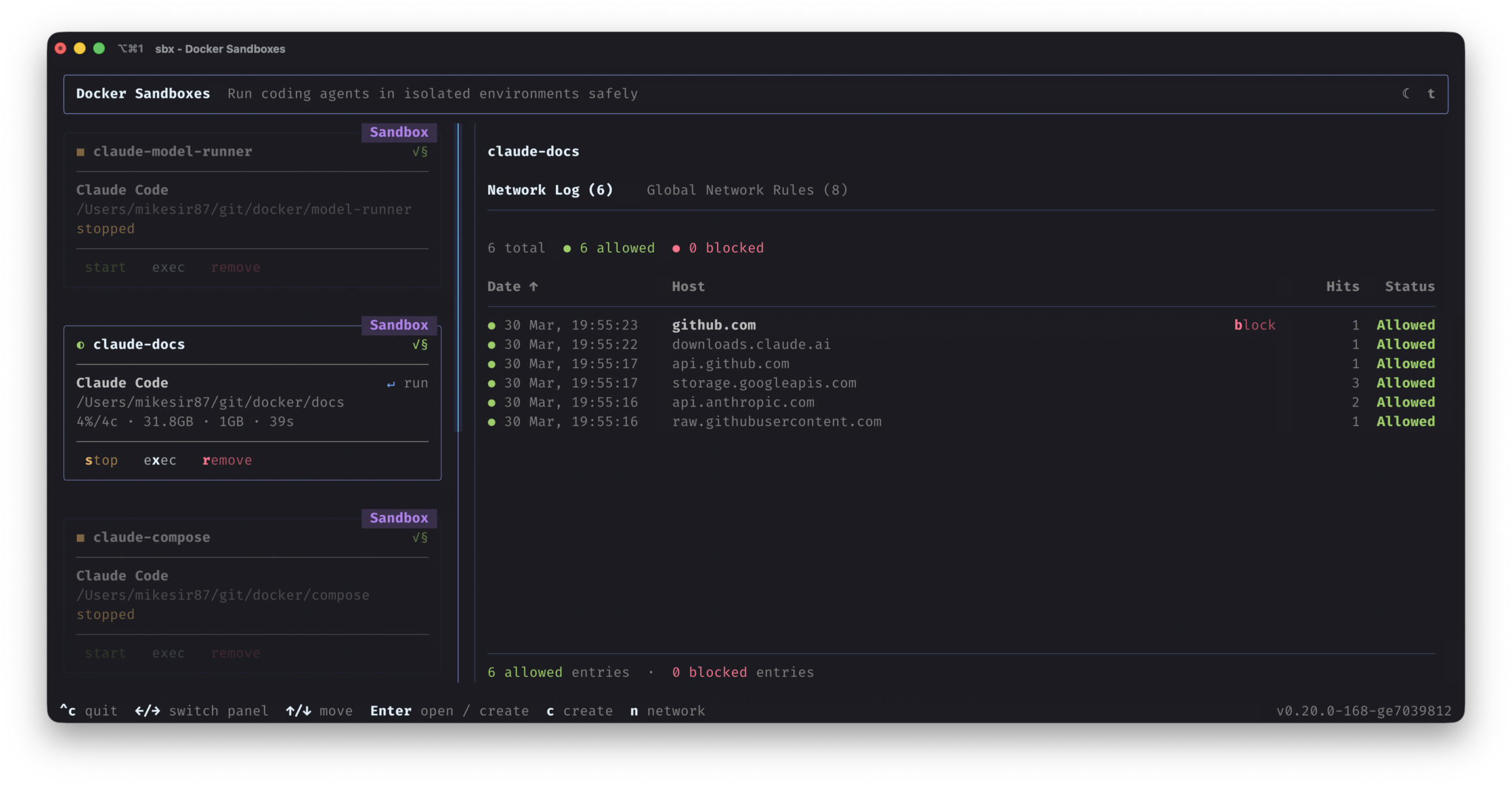
That’s it. One command and your agent is running in a disposable environment with network controls applied. When the experiment’s done, tear it down with another command. No lingering processes, no stray configs, no “wait, did that agent actually modify my .bashrc?”
YOLO Mode, But With Training Wheels
The feature Docker calls “YOLO mode”, technically --dangerously-skip-permissions, is the real game-changer. For years, this flag was the devil’s bargain: maximum agent autonomy for minimum safety. You’d let Claude run without approval prompts, then hold your breath waiting for disaster.
Sandboxes make YOLO mode defensible. The agent gets full autonomy inside its sandbox. It can install packages, modify configs, spin up Docker containers, and work unattended. The microVM boundary contains the chaos. Your host remains untouched.
This addresses the core tension in agent-based development: agents do their best work when given freedom. Constant permission prompts break flow and slow down iterations. But unrestricted access is how you end up with surprise AWS bills and corrupted dotfiles.
The sandbox approach lets you have both speed and safety. The agent runs fast because it’s not stopping to ask permission. It can’t run wild because the microVM boundary physically prevents it from touching your host system.
The Isolation Stack, Explained
Here’s where Docker’s implementation gets interesting. The sandboxes run on a custom-built isolation stack that sits between traditional containers and full VMs:
| Feature | Docker Sandboxes | Firecracker microVMs | gVisor | Kata Containers |
|---|---|---|---|---|
| Isolation type | MicroVM with container ergonomics | MicroVM | OS-level sandbox | Lightweight VM |
| Overhead | Low-to-moderate | Moderate | Low-to-moderate | Moderate |
| Best for | AI agent experiments | Multi-tenant workloads | Container compatibility | Secure containers |
| Startup speed | Fast | Moderate | Fast | Moderate |
Docker’s approach emphasizes the disposable lifecycle, creating and destroying sandboxes rapidly for iterative AI workflows. Each run gets its own boundary, limiting cross-session contamination and simplifying cleanup.
This model works particularly well for AI workloads because they’re inherently iterative. You’re not running long-lived production services. You’re running experiments: testing prompts, evaluating agent behavior, iterating on logic. Each experiment deserves isolation from the last.
What Actually Happens Inside the Sandbox
Let’s get practical. When you run sbx run claude from your project directory, Docker mounts only that workspace into the microVM. The agent sees your project files but not your entire filesystem.
Network controls are applied by default. The sandbox blocks all network access except to explicitly allowed hostnames. Your agent can reach GitHub and npm, but it can’t phone home to some random IP address.
The filesystem controls are equally strict. Agents can write only to the mounted workspace and session temp directories. Everything else, including critical system paths and your SSH keys, remains off-limits.
For credential management, this is where it gets clever. Docker supports masking environment variables and files, so the agent sees placeholder sentinel values instead of real secrets. The sandbox proxy swaps in the real credentials only when making outbound requests to approved hosts. Your GITHUB_TOKEN never appears in the agent’s logs or memory.
The Governance Layer Nobody Talks About
Individual sandboxes are great for individual developers. But what happens when you need to enforce these controls across an entire organization? That’s where Docker AI Governance enters the picture.
The governance layer centralizes three critical controls: network access policies, filesystem restrictions, and MCP (Model Context Protocol) governance. Define them once, enforce them everywhere.
For organizations deploying AI agents at scale, this matters more than the sandbox itself. Without centralized controls, you get a Wild West of individual developers configuring their own security boundaries, which means some won’t configure any at all.
The audit logging is equally important. When an agent does something unexpected, you need to know what happened. Sandbox audit logs capture the decision chain, tool invocations, and data movement. This turns agent behavior from a black box into something inspectable and accountable.
Gavriel Cohen, creator of NanoClaw, captured the philosophy succinctly: “You don’t trust agents with security, you build walls around them.” The governance layer is how you build those walls consistently and enforce them uniformly.
The Unresolved Problems
Sandboxes solve the isolation problem, but they’re not a complete security solution. Three issues remain:
1. Credential trust is still hard.
Giving agents scoped, trustworthy access to sensitive services and data is still an unsolved problem. Sandboxes contain the blast radius, but the question of what an agent should be able to access remains an organizational decision.
2. Network policy complexity.
Allowing broad domains like github.com creates potential data exfiltration paths. The proxy makes allow decisions based on client-supplied hostnames without inspecting TLS traffic by default. Domain fronting and similar techniques could potentially reach hosts outside the allowlist.
3. The human remains the weak link.
Sandboxes prevent the agent from modifying your host system. They don’t prevent the agent from doing something stupid within its sandbox, like exfiltrating data through approved network channels or making decisions with unintended consequences.
As the n8n team noted in their AI agent sandbox guide, runtime isolation alone isn’t enough. Workflow-level controls, credential scoping, and layered enforcement are what keep agents safe when any single layer fails. The critical sandbox escape vulnerability (CVE-2026-25049) in n8n’s JavaScript expression evaluator proved that point painfully.
What This Means for Your Workflow
If you’re already running coding agents, Docker Sandboxes change the math on how much autonomy you can safely grant. The tradeoff between agent speed and host security just got significantly more favorable.
For individual developers, the value is immediate: run agents with --dangerously-skip-permissions and stop worrying about corrupted dotfiles. Sandboxes are free to use, including for commercial work, only organizational governance requires a paid subscription.
For teams, the value compounds: consistent security policies across every developer’s machine, centralized audit logging, and the ability to experiment with agent autonomy without waiting for security review.
The install is refreshingly straightforward:
# macOS
$ brew trust docker/tap && brew install docker/tap/sbx

# Windows
> winget install Docker.sbx

# Ubuntu
$ curl -fsSL https://get.docker.com | sudo REPO_ONLY=1 sh
$ sudo apt-get install docker-sbx
Then launch agents for Claude Code, Codex, Copilot CLI, Kiro, OpenCode, or any other supported agent, all running in isolated environments.
The Verdict
Docker Sandboxes represent a genuine paradigm shift in AI agent security. They acknowledge what practitioners have known for years: you can’t trust agents to behave, so you build walls around them. The microVM approach provides stronger isolation than containers while maintaining the ergonomics developers expect.
The unresolved challenges, credential scoping, network policy enforcement, and the inherent unpredictability of LLM behavior, remain active research areas. Docker’s AI Governance layer addresses some of these gaps, but architectural challenges in multi-step AI agent workflows will persist regardless of sandbox technology.
But for the immediate problem of “how do I let my coding agent run without destroying my machine”, Docker Sandboxes deliver. The disposable, isolated microVM pattern is exactly the kind of pragmatic solution that makes autonomous agents actually viable for everyday development.
Your agent gets the freedom it needs to work effectively. Your host stays pristine. And YOLO mode becomes something you can use without needing a second machine and a prayer.
Just remember: sandboxes contain the blast radius. They don’t eliminate it. The real-world examples of AI agents escaping containment should keep you humble about what these systems can do, even inside a cage.