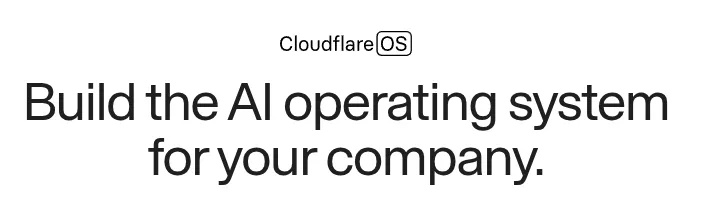
The tech community collectively raised an eyebrow when Cloudflare announced it was open-sourcing an “operating system.” The Slashdot comments were predictably merciless, a bunch of people correctly pointing out that this is not a traditional OS and demanding to know why marketing gets to pervert perfectly good terminology.
Here’s the thing: the pedants are right, but they’re missing the point. Cloudflare OS isn’t pretending to be Linux. The “OS” framing matters for a different reason, it represents the most ambitious attempt yet to treat edge infrastructure as a programmable platform where the boundary between application logic and infrastructure genuinely disappears.
Let’s dig into what was actually announced and why the architecture deserves more attention than the naming debate.
The “OS” That Isn’t
Cloudflare’s official announcement describes the project as “an open platform for agents, apps, and work.” The GitHub repo is more explicit about the terminology, clarifying that they use “operating system” in two senses: as an operating system for the company to be productive with AI safely, and as an operating system for AI workloads, analogous to how a traditional OS manages compute workloads.
Call it an AI sandbox if you prefer. Call it an agent orchestration layer. Call it whatever doesn’t make you angry. The substance below the naming is what matters.
Three components define Cloudflare OS:
- An agent workspace, isolated runtimes where agents can write and execute code, grounded in company-curated context and skills
- A security governance framework, Gatekeepers that mediate all access to internal data and services
- A platform for modifiable apps, full-stack applications that agents generate and users can continue editing
The interesting architecture sits in how these pieces connect to Cloudflare’s edge network, specifically through Cloudflare Workers and the newer Dynamic Workers that power the isolated runtimes.
Why the First Version Failed (and What They Fixed)
Cloudflare ran the first version internally starting in May 2026, thousands of employees across every function, many outside engineering, using it daily. The first iteration had problems that expose real architectural lessons.
Apps were static rather than live software connected to internal systems. Most deterministic jobs still required running an agent skill and consuming model tokens, an inefficient approach when the task was essentially a fixed sequence of steps.
But the most fundamental issue was around data flow and authorization. This is where the architecture gets genuinely interesting.
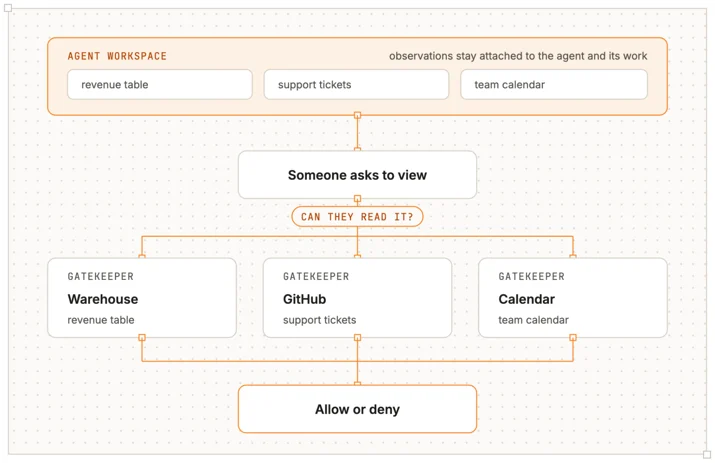
The team realized that MCP servers told them which tools an agent could call, but not which underlying resources the agent had observed. The distinction matters enormously: an agent that reads a sensitive database table and then generates a dashboard app creates a new pathway for that data. If someone else accesses the dashboard, they might be seeing data they shouldn’t.
This is the core insight that makes Cloudflare OS architecturally notable. Traditional access control secures entry points. Cloudflare OS tracks what has been seen and propagates that context through the system.
Capabilities, Not Credentials
The security model inverts the typical approach to permissions. Instead of granting agents broad access and hoping they behave, every agent and app starts with access to nothing. Resources are granted through typed bindings:
const issues = await env.PROJECT.listIssues({
  teamId: "ENG",
  state: "open",
});
That env.PROJECT reference is a capability object, permission to use a specific resource under a specific policy. The underlying credentials remain completely isolated from the agent and any generated code. Server code runs in a Dynamic Worker with global outbound networking disabled. Client code runs in a sandboxed frame in the browser. Neither can reach the Internet except through explicitly provided capabilities.
This is a meaningful departure from how most AI agent frameworks work. Rather than giving an agent an API key and hoping the model doesn’t do something catastrophic, the platform enforces the principle of least privilege at the architectural level.
Gatekeepers: The Interesting New Primitive
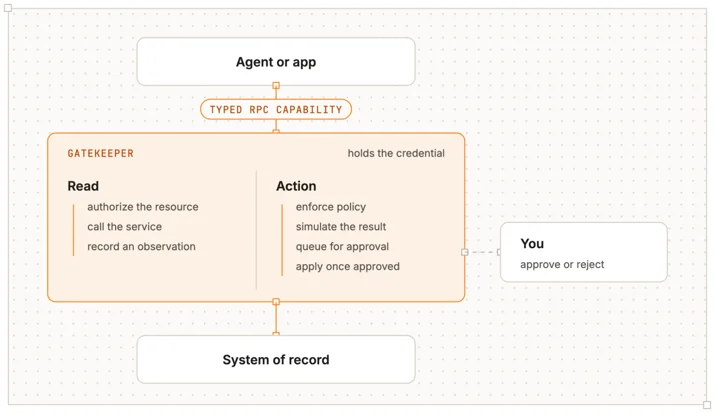
The Gatekeeper pattern deserves attention. A Gatekeeper is a Worker that sits between Cloudflare OS and external services. It understands the service’s API, its resources, and operations that can be performed on them.
Giving an agent access to your entire GitHub account is too broad. A Gatekeeper can restrict it to a single repository, allow reading issues but not source code, mask specific fields, apply rate limits, and require human approval before merging pull requests.
The agent sees a small TypeScript API. The Gatekeeper handles OAuth, holds credentials, enforces policy, records what was read, and mediates anything with externally visible side effects.
This pattern has broader implications beyond Cloudflare’s platform. It’s essentially a standardized way to build safe AI access layers for existing services, a pattern that could become as fundamental as the API gateway.
Policy Follows Data, Literally
Here’s where Cloudflare OS does something most platforms don’t: it tracks every resource an agent observes and keeps that observation log attached to the agent’s work.
When another person tries to open a workspace, interact with an agent, or view something it produced, Gatekeepers verify that person’s access to the observed resources, not just to the app or document itself.
The same log informs policies governing external requests. Reading sensitive data can prevent the agent from writing to certain sources, inviting collaborators, handing work to another agent, or making outbound requests.
This “policy follows data” approach addresses a class of security problem that’s largely unsolved in the AI agent space. Most platforms secure access at the perimeter. Cloudflare OS attempts to secure information flow through the system, a distributed data-centric security model that feels like a preview of how enterprise AI governance will need to work.
Every App Is a Worker, And That’s the Architecture Story
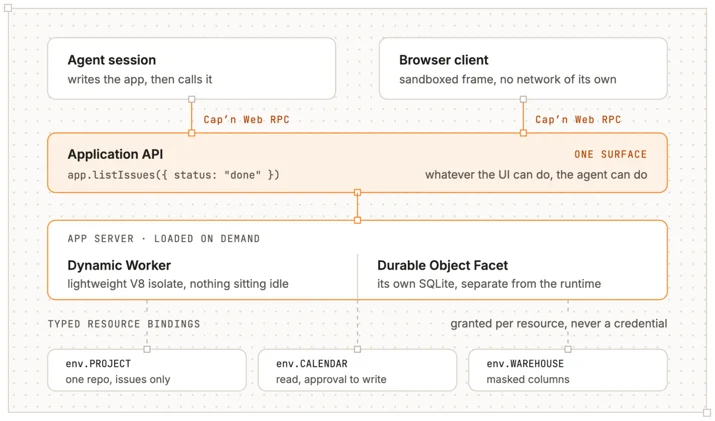
The “app platform” aspect might be the most technically interesting piece for developers. When you ask a workspace to build an app, the agent produces two parts: client code for the browser UI and server code that stores state and implements behavior.
The server loads on demand as a Dynamic Worker, instantiated as what Cloudflare calls a Durable Object Facet. The facet gives each app its own SQLite database, separate from the runtime managing it. Dynamic Workers use lightweight V8 isolates, every app gets an isolated runtime without needing a dedicated server or container.
The browser client talks to the server using Cap’n Web, Cloudflare’s open-source object-capability RPC system. A server method can be called from the client like a normal JavaScript function:
const issues = await app.listIssues({
  status: "done",
});
The special part: the agent can also call the same method. If you can build a tool to do a job, agents can use your tool to do the job when you’re not there.
This is the architecture insight that connects to broader trends. The “app as a Worker with its own state” pattern collapses the traditional layers of application architecture, frontend, API server, database, into a single deployable unit that runs on the edge. This aligns with the vision Cloudflare outlined in its Cloudflare Computer announcement, an edge-native platform unifying compute, data, networking, and security.
The implications extend beyond Cloudflare’s ecosystem. We’re seeing AI-native databases integrate inference into data layers and local AI execution on unified-memory hardware, all pointing toward architectures where computation and data live closer together and where the layers between them blur.
The Blueprint Sharing Model
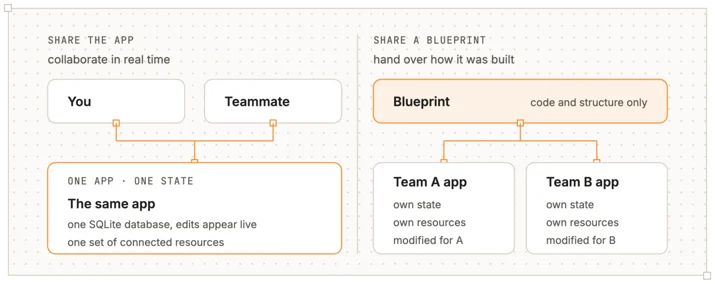
One of the more clever design decisions is how sharing works. When you share an app, you have two options:
- Share the app itself, other people collaborate in real time using the same state
- Share a blueprint, other people create their own copy with independent state
A blueprint contains the original app’s code but not its SQLite data, conversation history, credentials, or connected resources. Each new app starts fresh with independent state and resources.
This matters for governance. Sharing a blueprint doesn’t accidentally propagate access to sensitive data or credentials. It also creates a viral loop: when someone builds something useful, sharing the blueprint lets teammates create their own version, which they can then modify with AI. No feature requests. No waiting on the original developer.
Model Agnosticism and Cost Control
Cloudflare OS works with any model. All inference calls route through Cloudflare AI Gateway, giving organizations a central control point for model selection and routing.
The cost management angle is practical rather than flashy: not every task needs a frontier model. Summarizing unread emails doesn’t require the most expensive model available. AI Gateway provides the tools to route tasks to appropriate models and set budgets and rate limits.
Every request is attributed to the person, team, or workspace that made it. Administrators can see where inference spend is going and decide what happens when limits are reached.
This model-agnostic approach connects to broader trends in efficiency innovations in transformer architectures and performance trade-offs in LLM optimization. The ability to route tasks to different models based on complexity is becoming an operational necessity as organizations scale AI adoption.
Deterministic Workflows: The Pedestrian Innovation That Matters
While the AI hype cycle focuses on autonomous agents, one of the most practical features is the ability to convert agent sessions into mostly deterministic workflows. Not every job needs a full agent session, many are known sequences with one or two places where judgment matters.
A workspace can turn those jobs into code for predictable steps and use a model only where it adds value. Workflows run on demand, on schedule, or when an event occurs in a connected system.
This is the kind of pragmatic engineering that actually moves the needle in enterprise adoption. It also addresses one of the biggest cost problems with agentic AI: why burn tokens on a deterministic process that can be expressed as code?
What This Means for the Broader Architecture Landscape
Stepping back, Cloudflare OS represents a concrete answer to a question that’s been floating around: what happens when the boundary between infrastructure and application logic dissolves?
The execution model is telling. Every app is an isolated V8 isolate with its own SQLite database. Server code runs on the edge. Client code runs in a sandboxed frame. Network access flows only through explicitly provided capabilities. Security is enforced by the platform, not bolted on by developers.
This architecture has implications for how we think about building software:
- The “file” becomes an application. Most productivity suites offer documents, spreadsheets, and presentations. Cloudflare OS lets each “file” be its own full-stack app, with client code, server code, an API, and durable state.
- Agents and humans share the same interface. When you build a tool with an API, agents can call that same API. The distinction between user-facing and agent-facing tools collapses.
- Security follows data, not just access. The observation log pattern, tracking what agents have seen and enforcing policy based on that context, could become a foundational pattern for AI governance.
- The edge becomes the default deployment target. Everything runs on Cloudflare’s network. No containers to manage, no servers to provision, no VPCs to configure.
These trends connect to what we’re seeing elsewhere: streaming inference models optimized for low-level edge performance and the broader movement of AI workloads running closer to users and data.
The Skeptical View
The critiques have merit. This is Cloudflare’s platform, running on Cloudflare’s network, using Cloudflare’s services. Calling it “open source” is true, the code is on GitHub under Apache 2.0, but deploying it effectively means committing to the Cloudflare ecosystem.
The supply chain concerns raised in the Slashdot comments are legitimate. Any platform built on npm dependencies carries supply chain risk. Cloudflare’s scale helps, but it doesn’t eliminate the problem.
And the “OS” framing, whatever the GitHub README says, still carries marketing stench. The mapping of concepts, kernel to workshop-backend, device drivers to Gatekeepers, processes to gadgets, is the kind of conceptual metaphor that’s clever enough to sound meaningful while obscuring what’s actually new.
The Takeaway
Call it an AI sandbox. Call it an agent orchestration platform. Call it Cloudflare’s attempt to own the enterprise AI middleware layer. The naming debate is noise.
What’s worth paying attention to is the architecture: capabilities-based security that tracks data flow, agent-generated apps that run as isolated edge workers, deterministic workflows that minimize token consumption, and a governance model where policy follows what agents have observed.
Cloudflare OS is available on GitHub, with a starter repository for deployment. You can deploy it into your own Cloudflare account in a few minutes.
The bigger question is whether this architecture becomes a template for how organizations build AI-native software, or whether it remains a Cloudflare-specific curiosity. Given that the platform runs on open standards like MCP and uses open protocols like Cap’n Web, the foundations are there for broader adoption.
The “OS” label might be wrong. The underlying shift, from infrastructure as something you operate to infrastructure as something you program, is real, and it’s happening now.
Whether you adopt Cloudflare OS or build something similar, the architectural patterns it introduces, capabilities over credentials, policy that follows data, apps that are also API endpoints for agents, are the ones that will define the next generation of application platforms.