
The C-suite’s favorite story for the last few years has been the simple math of automation: Invest in AI, reduce headcount, watch the margin soar. It’s a clean, investor-friendly narrative. The problem? According to hard data recently published by Fortune, it’s a story that’s largely fictional.
A Gartner survey of 350 global executives at billion-dollar-plus companies delivers a stunning reality check: while 80% of companies that piloted AI reported workforce reductions, those cuts had no correlation to higher ROI. The companies firing people were just as likely to see “smaller returns or even worsened outcomes” as the ones reaping genuine value. Helen Poitevin, VP Analyst at Gartner, minced no words: “Chasing value only through headcount reduction is likely to lead most organizations down a path of limited returns.”
We’re witnessing a mass corporate delusion: the conflation of headcount reduction with operational efficiency. This post is a cold splash of data on that fantasy.
The Allure of Simple Math
The logic boards presented to executives are seductive in their simplicity. The AI suite costs $X million annually. If it automates tasks for Y number of $Z-salaried employees, you can cut Y employees and pocket the difference. Net savings: (Y * Z) – X. It’s arithmetic. It’s defensible. It’s also a dangerously incomplete model.
The reality on the ground is far messier. The outplacement firm Challenger, Gray and Christmas reported that AI was the leading reason cited for layoffs in March and April, with nearly 50,000 jobs cut so far this year. But as Apollo chief economist Torsten Slok has argued, invoking the Jevons paradox, efficiency gains often create more demand, leading to more jobs, not fewer. The most telling quote comes from OpenAI’s Sam Altman himself, who speculated that a portion of these layoffs are pure “AI washing”, where companies “are blaming AI for layoffs that they would otherwise do.”
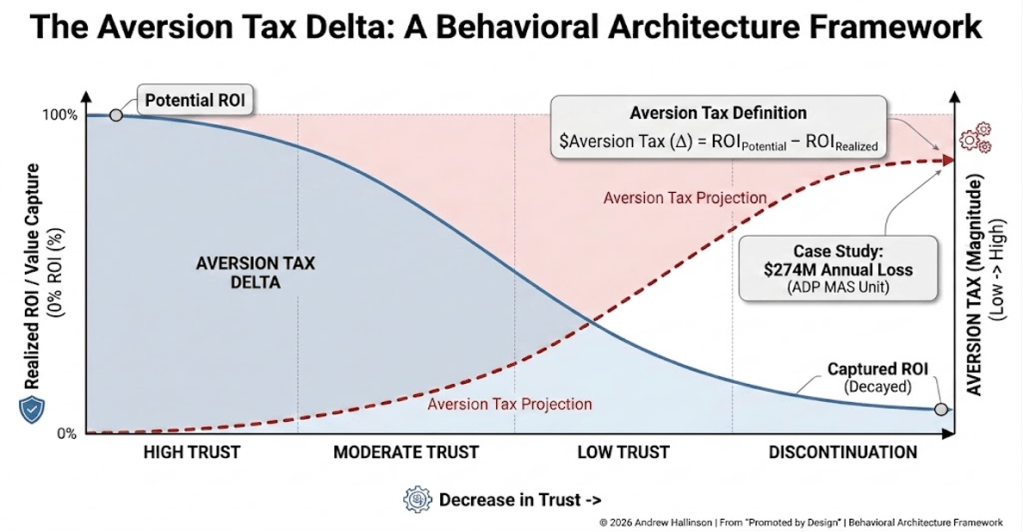
This creates what one senior operations leader calls the “aversion tax delta”, the gap between potential and realized ROI. As detailed on CIO.com, if your beautiful 99%-accurate AI tool is only used by 10% of your team because they don’t trust it or it disrupts their workflow, your effective “tax” on that investment is 90% . You built a Ferrari, but no one took the parking brake off.
AI’s Hidden Tax: The Costs You Never Budgeted For
The financial model for AI ROI is collapsing under the weight of costs that never made it onto the initial spreadsheet. A CX Today analysis breaks them down:
- The Governance Sinkhole: Once AI touches customer data or regulated processes, you don’t just deploy it, you own a living system. Ongoing monitoring, model retraining, compliance audits, and risk management frameworks like NIST’s become permanent, unbudgeted operational functions.
- The Amplification Trap: Here’s the brutal twist: automation can increase agent workload. When an AI system handles the 70% of straightforward queries, the remaining 30% are the complex, angry, or bizarre edge cases. These don’t vanish, they get dumped on human agents who now spend their entire day on high-stress, high-skill escalations. The work shifts from execution to exception management.
- The Human Friction Premium: This is the core of the aversion tax. People distrust black-box recommendations and will override them with “gut feelings.” They hold machines to impossible standards of perfection, as research shows humans are “far less forgiving of a 5% error from a machine than a 20% error from a human peer.” The result? “Your multi-million-dollar investment becomes shelfware.”
This explains why Gartner found that companies achieving the highest ROI were not the ones firing people. They were using AI for “people amplification”, making existing workers more productive. They were treating the tech as a force multiplier for their talent, not a replacement for it. This aligns with a growing sentiment that the real impact of AI will be a polarization of the workforce, creating a scenario where you’re either unemployed or exhausted, with little middle ground.
From Hype to Reality Check: Where the ROI Actually Lives
So if not headcount reduction, where is the value? The data points to three concrete areas:
- Velocity, Not Just Volume: At ADP, shifting the focus from restrictive “data governance” to empowering “data democratization” for their OneData migration didn’t just cut heads, it pulled their project completion date forward by eight months and increased migration velocity by 367%. The ROI was in acceleration.
- Upskilling and Redeployment: The most successful AI implementations create new roles: AI trainers, output validators, prompt engineers, and ethics auditors. They redeploy staff from repetitive tasks to higher-judgment, oversight, and creative roles that the AI enables but cannot perform.
- Error Reduction and Quality: This is the silent ROI killer (or maker). An AI that reduces critical errors in order fulfillment or compliance reporting by even a few percentage points can save millions, far outweighing the salary of a few mid-level analysts. This is ROI through risk mitigation and quality enhancement.
The irony is that the very act of laying off experienced staff to “pay for” AI often destroys the institutional knowledge needed to implement it successfully. You’re sawing off the branch you’re standing on. For a deeper exploration of what happens when automation goes wrong at scale, consider the catastrophic results when an AI agent hallucinates based on an old wiki and breaks a core system.
A Playbook for Avoiding the Paradox
If you’re a leader navigating this, here’s a pragmatic, data-backed path forward, synthesized from the failures and successes observed:
- Ban “Headcount ROI” as a Primary KPI. Make your primary metrics about business outcomes: customer satisfaction (CSAT/NPS) improvements, process cycle time reduction, error rate declines, revenue per employee, or new product development speed.
- Budget for the Full Lifecycle, Not Just Deployment. Your Year 2 and 3 operational budget must include line items for model monitoring, retraining, human-in-the-loop oversight, compliance, and exception handling. If you only budget for Day 1, you’re planning for failure by Month 6.
- Design for Augmentation, Not Replacement. Start every AI initiative by asking: “How will this tool make our best people 10x better?” Not “How many people can this replace?” Structure pilots to measure the productivity lift of augmented teams, not just the potential for reduction.
- Conduct a Pre-Mortem. Before you sign the purchase order, gather the team that will use the tool and ask: “We are one year from now, and this AI project has failed. Why did it fail?” You’ll uncover the real adoption barriers, distrust, workflow disruption, poor explainability, before you spend a dime.
- Treat Cultural Integration as a Technical Requirement. As argued in the CIO piece, “You cannot code your way out of a culture problem.” Invest in change management, transparent communication, and creating “behavioral architects” alongside your AI engineers.
The Gartner study is a wake-up call. It confirms what many on the front lines have suspected: the AI Layoff Paradox is real. Companies are using the most powerful productivity tool in a generation to execute the oldest, bluntest cost-cutting play in the book, and it’s backfiring. The financial markets may reward the layoff announcements, but the operational realities, stalled projects, demoralized survivors, and hidden compliance time bombs, will eventually exact their own tax.
The real opportunity isn’t in using AI to do less with fewer people. It’s in using AI to do radically more with your existing, now supercharged, talent. The alternative is to join the growing list of companies that poured millions into automation only to discover they were merely financing their own failure. The choice is stark: be the company that amplifies its workforce, or be the one that subtracts from it and wonders where the ROI went.