Uber’s CTO Praveen Neppalli Naga dropped a grenade into the software engineering discourse last week: 95% of Uber’s engineers are now using AI, with 84% delegating entire tasks to agent-style workflows rather than accepting mere autocomplete suggestions. If you’re still imagining a future where AI assists coding, wake up. Uber’s internal agents now produce 1,800 weekly changes, and around 70% of all committed code is AI-generated, not suggested, written.
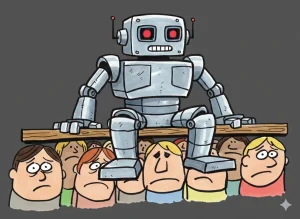
The plot twist? Engineers aren’t spending their newfound leisure time on beaches. They’re drowning.
While AI promised to eliminate the keyboard, it instead eliminated the intentionality that once governed software design. We’re witnessing the fastest shift in engineering responsibility since the move from assembly to high-level languages, except this time, the compilers hallucinate. The result is a crisis of architectural accountability: when machines generate code faster than humans can comprehend it, who owns the architecture?
The Productivity Paradox Is Real and It’s Spectacular
The numbers read like a satire of Silicon Valley efficiency. Teams using AI merge 98% more pull requests, yet these PRs are 154% larger and take 91% longer to review. It’s the software equivalent of hiring 100 chefs to speed up service, only to find the kitchen door jammed with raw ingredients nobody ordered.
A CodeRabbit study analyzing 470 pull requests found AI-written code contains 1.7 times more issues than human-written equivalents, with logic errors occurring 1.75 times more frequently. Worse, between 40% and 62% of AI-generated code contains security or design flaws. Yet 38% of developers admit that reviewing AI-generated code requires more effort than reviewing their colleagues’ work, and a staggering 61% agree that AI often produces code that “looks correct but isn’t reliable.”.

The “rubber stamp” trap has become the default coping mechanism. Faced with explosive volume, reviewers check if tests pass and move on, ignoring long-term health, security, and maintainability. Refactoring, previously 25% of all changes, has collapsed to less than 10%, while duplicate code blocks have increased 8× in 2024 alone. AI tools prioritize speed over maintainability, adding new layers of logic rather than improving existing ones.
You’re not shipping faster. You’re accumulating technical debt at machine speed.
Comprehension Debt: The New Silent Killer
Steve Krouse nailed the conceptual danger in his recent essay on “vibe coding”, the practice of operating at the level of English-language vibes while reacting to AI-generated artifacts. Vibe coding gives the illusion that your specifications are precise abstractions. They feel precise right up until they leak, which happens when you add enough features or scale.
This creates what Addy Osmani calls comprehension debt: the growing gap between how much code exists in your system and how much of it any human being genuinely understands. When Dan Shipper’s vibe-coded text editor went viral and promptly crashed, he discovered that “live collaboration is just insanely hard”, a lesson the AI couldn’t abstract away for him.
The architectural implications are brutal. AI agents ignore standardized architectural patterns with the enthusiasm of a junior developer who just discovered Stack Overflow. They import the wrong libraries, bypass your createRoute() factory patterns, and throw raw errors instead of your standardized logging helpers. Every PR becomes an archaeological dig where the reviewer must reverse-engineer the AI’s intent before they can assess whether it aligns with the system’s design.

The Abstraction Crisis
Krouse argues that the purpose of abstraction is “not to be vague, but to create a new semantic level in which one can be absolutely precise.” AI-generated code inverts this: it creates the appearance of precision while obscuring the underlying complexity.
When 70% of your codebase is written by agents that don’t understand your domain model, semantic drift multiplies across your AI stacks. The code functions, until it doesn’t. And when it breaks, you don’t have a human author to interrogate about intent. You have a probability distribution that favored certain token sequences over others.
This is why Naga’s characterization of the shift, from writing every line to “architecting systems and reviewing AI-generated code”, is simultaneously accurate and terrifying. The role isn’t just changing, it’s bifurcating into two distinct disciplines: prompt engineering for generation, and forensic architecture for validation.
Governance at Machine Speed
Traditional code review was a human-scale activity. It relied on shared context, architectural intent, and the implicit knowledge that the author understood the edge cases they were handling. That model is broken. As one analysis noted, you cannot scale a human-only process to match an exponential increase in AI-powered build volume.
The fix isn’t to abandon AI. It’s to enforce architectural accountability through automated, high-precision verification layers that operate at machine speed. This means:
Evidence-Gated Merges: Before AI-generated code reaches production, it must pass independent architectural validation, not just unit tests. High-impact features require documentation of intent and alignment with system boundaries.
Principal Council Reviews: Organizations like AlterSquare are implementing pre-code architectural oversight, reviewing system design before the AI writes a single line. This prevents the “LGTM reflex” where developers approve AI output because it looks plausible.
Source-Agnostic Enforcement: The origin of code (human or AI) matters less than the integrity of the result. Automated analysis must catch security vulnerabilities, reliability issues, and maintainability violations at the point of creation, not in the PR queue.
Context Injection: Teams must provide strong documentation, architectural guidelines, and clear interfaces that AI tools can reference automatically. Without this context, agents auto-generate code that technically works but violates patterns that matter for long-term maintainability.
The Cognitive Cost
There’s a darker undercurrent here. As engineers shift from creators to curators, we’re seeing the erosion of developer critical thinking skills. When you stop writing complex abstractions, you stop understanding them. When you stop understanding them, you stop being able to architect them.
Andrej Karpathy, who coined “vibe coding”, recently admitted: “I’ve never felt this much behind. The profession is being dramatically refactored.”. The engineers who survive this transition won’t be the fastest prompt engineers. They’ll be the ones who can look at 500 lines of AI-generated React and immediately spot where the state management violates the system’s architectural constraints.
The New Accountability
Architectural accountability in the generative era isn’t about writing less code. It’s about owning the complexity that AI obscures. When Uber’s agents produce 1,800 weekly changes, someone still has to answer why the ride-matching algorithm suddenly diverged from the established service mesh patterns.
The metrics that matter are shifting. Lines of code per developer is a vanity metric, system trust and cyclomatic complexity are the new north stars. The 95% adoption rate isn’t a victory lap, it’s a warning that your governance models have 18 months to adapt before the comprehension debt triggers a catastrophic failure.
The architects who thrive won’t be the ones fighting the tide of generative code. They’ll be the ones building the automated guardrails, the architectural constraint engines, and the validation frameworks that make AI-generated code safe to ship at scale.
Because when the AI writes the code, the architecture becomes the only thing that matters.