The Star Schema Cult vs. the Snowflake Heretics: Who’s Actually Right About Your Data Warehouse?
Denormalized performance or normalized maintainability? The dimensional modeling debate heats up when 10x growth is on the line.
There’s a moment every data engineer faces. You’re designing a dimensional model, your fact table is shaped beautifully, dimensions are mapped, and then, bam, you hit the fork in the road. Do you keep that shared Dim_Region table connected to both Dim_Customer and Dim_Driver, creating a clean, normalized snowflake? Or do you embed those region attributes directly into each dimension, sacrificing purity for a pristine star?
One engineer recently brought this exact dilemma to the internet, and the resulting discussion reveals everything that’s right, and wrong, with how we think about dimensional modeling today.
The stakes: a marketplace platform with over a million registered users, 10k, 20k daily active users, and a 10x growth projection on the horizon. No pressure.
The False Dichotomy That Won’t Die
Here’s the thing about the star vs. snowflake debate: it’s been framed as a religious war for so long that most engineers have forgotten there’s actual nuance underneath.
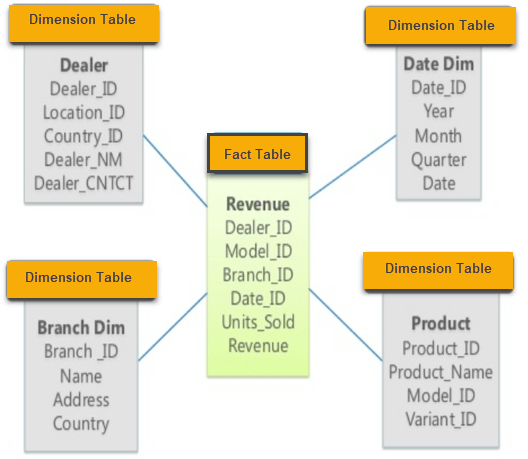
Star schema: Every dimension in a single denormalized table. Fewer joins, simpler SQL, faster queries. The layout resembles a star with your fact table at the center and dimensions radiating outward like points.
Snowflake schema: An extension of the star where dimensions are normalized into linked sub-dimension tables. Region attributes live in Dim_Region, not duplicated across Dim_Customer and Dim_Driver. Storage savings, better integrity, more joins.
The comparison table writes itself:
| Aspect | Star Schema | Snowflake Schema |
|---|---|---|
| Structure | Flat, simple | Branched, normalized |
| Query speed | Faster (fewer joins) | Slower (more joins) |
| Storage | More redundant | Less redundant |
| Data integrity | Weakly enforced | Strongly enforced |
| Ease of use | Simpler for analysts | More complex design |
But here’s the dirty truth that table obscures: for a low-cardinality lookup table like Region, the performance difference is probably negligible.
When Low Cardinality Breaks Your Assumptions
The original poster asked a genuinely good question: “Region is relatively low count. That shouldn’t slow the joins right? Even if it strays from the ideal star schema.”
The engineering consensus? They’re mostly right. When you’re joining a large number of customer records to a small region lookup table with proper indexing on the ID, the performance impact is real but often imperceptible. Modern query optimizers handle these joins with embarrassing efficiency.
But there’s a critical qualifier: whether that performance impact is noticeable, or worth the cost-benefit of snowflaking, only you can tell. That’s not a cop-out, it’s the honest answer.
The real decision factors are more subtle:
Do most queried attributes of Dim_Customer include region attributes? If yes, and your BI tool needs to join through to region every time a marketing analyst pulls a report, you’re adding a join to nearly every query. With 10x growth on the horizon and high concurrency, that’s not nothing.
How do region attribute changes need to be handled? If you denormalize region attributes into Dim_Customer and Dim_Driver, a region rename or restructuring becomes a dimension update affecting potentially millions of customer rows. Keep them in a shared Dim_Region and it’s a single row update.
The Real Elephant: Aggregate Tables
One commenter cut through the noise with something more valuable than doctrine: making a separate table for region has more to do with whether you have fact tables at the region-only level, aggregate or summary tables.
This is where rethinking traditional dimensional modeling actually matters. If you’re building summary tables for regional performance analytics, you need Dim_Region as a first-class dimension connected to those aggregates. Denormalizing region into Dim_Customer doesn’t eliminate that requirement, it just makes your model messier.
The Date Dimension Defense
The thread took an unexpected turn when someone questioned the normalized date field. “I think your bigger problem is you normalized a date field??”
This deserves a smackdown. A dedicated date table as a role-playing dimension isn’t just standard, it’s been how fact and dimension tables are treated in data warehouses for over 30 years. The date dimension is how you store attributes about the date itself: month, day of week, fiscal quarter, sales comparable date, holiday flags, you name it.
The key insight: your date key should be a numeric integer value (like 20260807), not a text timestamp. That keeps joins fast while giving you access to all those rich time-based attributes.
This is a hill worth dying on. Anyone questioning whether a date dimension belongs in a dimensional model hasn’t yet experienced the joy of building a year-over-year sales comparison without one.
The Maintainability Trap Nobody Talks About
Here’s what the star schema evangelists conveniently omit: denormalization isn’t free. It’s a tax you pay in ETL complexity and integrity risk.
When region attributes are embedded in three different dimensions, a region rename means:
- Updating
Dim_Region(if it still exists for fact-table relationships) - Updating every denormalized copy in
Dim_Customer - Updating every denormalized copy in
Dim_Driver - Backfilling historical rows if the change shouldn’t retroactively apply
- Coordinating deployment timing so queries don’t see inconsistent data mid-update
That’s not a trivial operation. It’s a schema change on live systems that can easily become a production incident if you’re not careful.
The snowflake schema’s normalization naturally sidesteps this: update one row in Dim_Region, and every dimension referencing it sees the change immediately.
What the 10x Growth Projection Actually Means
Here’s where most of the advice in that Reddit thread misses the mark. The OP is designing for 10x growth, from 1 million to 10 million registered users. That changes the calculus.
With 10x growth, you’re looking at:
More concurrent queries hitting your warehouse
Larger fact tables requiring more skillful partitioning and indexing
Increased pressure on join performance across all dimensions
A greater chance that someone will need to query a huge customer set joined to region simultaneously
The “low cardinality = negligible performance impact” argument holds at 1 million rows. It starts to wobble at 10 million. But here’s the secret: the join to a small lookup table will rarely be your bottleneck.
Your bottlenecks will be:
Fact table scans on filtered subsets
Aggregation operations over millions of rows
Insufficient sort keys or distribution keys on massive tables
Query concurrency limitations in your warehouse engine
If you’re hitting performance problems with a region lookup join, you’ve got bigger fish to fry, likely related to why denormalization benefits OLAP systems in the first place.
A Pragmatic Middle Ground
Let’s get practical. Here’s a decision framework that takes the religious zealotry out of the equation:
Go snowflake when:
- The shared dimension is genuinely used across multiple context tables and fact tables
- Attribute changes need to propagate uniformly
- You need region-level summary tables anyway
- Your team understands the join implications and designs around them
Go star when:
- The dimension is only used with one context table
- Query patterns almost always include the dimension attributes
- Your BI tooling struggles with multi-path joins
- You need dead-simple SQL for less technical users
Embrace the hybrid when: You’re in the gray zone, which is most of the time. Keep Dim_Region for fact-table relationships and summary aggregates. Denormalize region attributes into dimensions only if query patterns demand it. This isn’t cowardice, it’s engineering.
The Bottom Line
The star vs. snowflake debate is a proxy for a deeper question: what are you optimizing for?
Performance (star) and maintainability (snowflake) are both legitimate goals. The problem is that most teams pick one without honestly assessing which failure mode hurts more.
For the marketplace platform in question, here’s my recommendation: keep Dim_Region as a shared dimension, especially since it’s already connected to the fact transaction table. The join to a low-cardinality dimension won’t kill you, even at 10x scale. But invest in proper query design, partitioning strategy, and monitoring.
And if someone tries to purity-test you for not having a “pure star schema”? Challenge the orthodoxy right back. Kimball’s patterns are tools, not Ten Commandments. The goal is serving your business with fast, accurate, maintainable analytics, not winning a schema beauty contest.
The real question isn’t star or snowflake. It’s whether you’ve thought through what happens when region attributes change, how your BI tools will query this structure, and whether you’re setting realistic expectations for your data scale.
Everything else is just table shapes on a diagram.