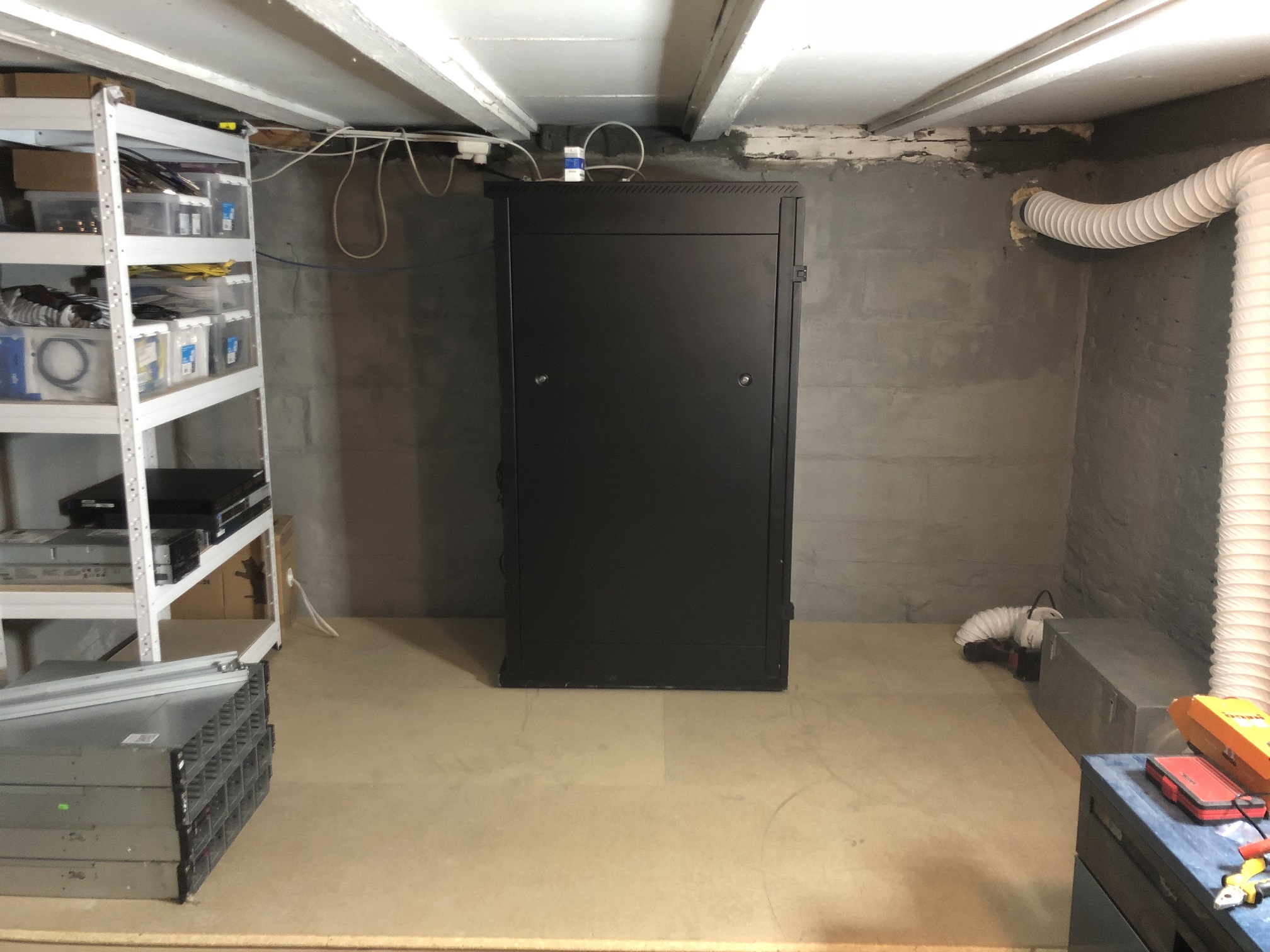
Somewhere in a suburban basement, a 5U rackmount server hums with four RTX PRO 6000 Blackwell GPUs. Total: 384GB of VRAM, 24 cores of Threadripper PRO, and 256GB of ECC RAM. Its owner calls it "Cerebro." Its job? Running personal AI agents.
This isn’t a small company’s compute budget. It’s one enthusiast’s hobby, a hobby they started to save money on API calls. The original "we’ll save money" argument, as they admit, "did not survive contact with the hardware shopping list."
Welcome to the prosumer AI arms race, where "local AI" has stopped meaning "a laptop with Ollama" and started meaning "enterprise-grade infrastructure in your utility closet."
The Escalation Ladder Nobody Advertises
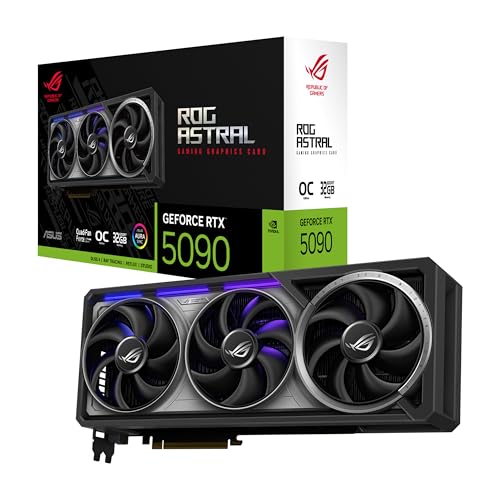
The path to a basement supercomputer follows a predictable curve. It starts innocently: running models on a MacBook. Then upgrading a gaming PC with an RTX 5090. Then adding a Mac Studio M3 Ultra "for unified memory."
Each step solves one limitation and creates two new desires.
The 384GB build in question runs four 300W Max-Q blower-style RTX PRO 6000s, chosen specifically to fit in a single chassis without melting the house down. The original plan called for a 4U case, logistics forced a 5U upgrade mid-project. That’s the pattern: local AI isn’t a destination, it’s a treadmill with a PCIe slot.
It’s Not About the Money (Obviously)
Here’s the uncomfortable truth the "it’s cheaper than API calls" crowd doesn’t want to hear: the economics of local AI are absurd unless you’re running models 24/7.
A used RTX 3090 build lands around $1,085 and pulls roughly $12, $20/month in electricity, that one can justify itself if you’re hammering APIs daily. But the moment you cross into multiple enterprise GPUs, the break-even math dissolves. One commenter on the original post didn’t mince words: this is "bragging for someone with huge amounts of disposable income."
The counterargument, and it’s a good one, is that local AI has become a hobby, not a cost-saving strategy. For the same reason someone buys a $5,000 CNC router or a $3,000 3D printer, enthusiasts are buying GPUs to tinker, build, and learn. The value proposition isn’t financial, it’s the sheer joy of owning the stack.
As one user put it, local LLMs feel like 3D printers: the GPU is already paid for, so a two-hour agent run on a shower idea that goes nowhere costs nothing. "You stop asking whether an idea is worth the tokens", they noted, a kind of creative freedom that cloud APIs, with their per-token pricing and rate limits, can never replicate.
The "Build Anything" Instinct
The most striking pattern across these builds isn’t the hardware, it’s what people do with it once the infrastructure exists.
One user with a 128GB unified-memory mini-PC describes waking up and deciding to build a Japanese visual novel translation tool, OCR the text, feed it through a local LLM, patch it back into the game. Done in a couple of hours. In the same week, they’d written a house temperature tracking system, a mobility scooter mapping app, and 17 Skyrim mods.
"The future is now" isn’t hyperbole when you read that list.
Another user, a chemist by training, uses local models to build personally tailored coaching apps and decision-support tools. Not because they’re a developer, they’re not, but because the barrier to "just build it" has collapsed. This is the quiet revolution: people who would have previously downloaded whatever app was closest to their need can now generate exactly what they want.
There’s a caveat buried in the comments, though. For CAD and engineering work, AI-generated STL files are still "5-10 years out" from matching a human engineer. The gap between what the models can do and what they’re confidently wrong about remains a real friction point. But even skeptics concede the trajectory: a model that fails at generating a simple part can, when told to fetch the relevant docs and try again, succeed. The harness matters as much as the model.
The Software Is the New Battleground
The hardware gets the headlines, but the software layer might matter more. One builder created somora, an open-source agent harness built "with heavy agent assistance", to manage roles, memory, and model switching across their fleet. It’s MIT-licensed and explicitly designed for people who want their own setup, not a vendor’s locked-down workflow.
This DIY ethos extends to the stack itself. The ODS framework (Ollama + Open WebUI + n8n + ComfyUI) turns any PC into a private AI server with a management dashboard. Want to expose it to the internet? The guidebook recommends Tailscale, WireGuard, or Cloudflare Tunnel, and warns that exposing Ollama’s API without authentication is an open invitation for strangers to burn your GPU cycles.
The infrastructure questions are real, too. Model storage needs scale with library size: a 2TB NVMe holds ~30, 40 quantized models, while heavy users with datasets should plan for 4TB+. A Synology DS1821+ NAS with 10GbE expansion can centralize all of it.
Distributed Inference: The Next Escalation
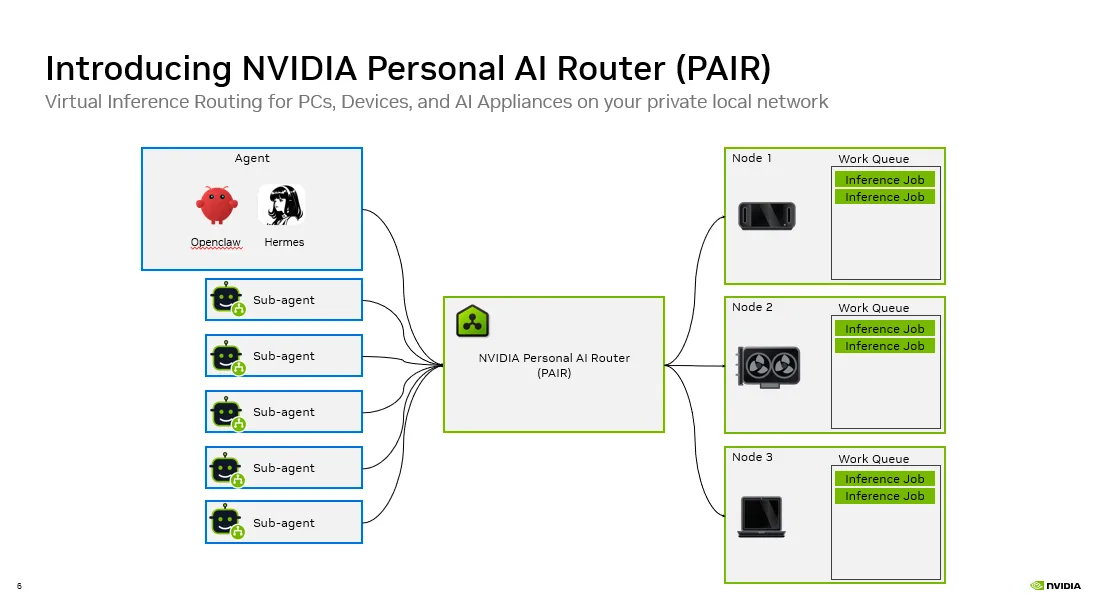
When one machine isn’t enough, the community is discovering something interesting: you don’t need to consolidate. NVIDIA’s Personal AI Router (PAIR) is an open-source virtual inference router that distributes independent inference requests across every compatible machine on your local network, RTX 20-series and newer, RTX PRO workstation GPUs, DGX Spark units, even Apple M4+ silicon.
The architecture is refreshingly pragmatic. PAIR doesn’t merge GPUs or shard models, that’s not what home clusters need. Instead, it proxies existing Ollama and LM Studio interfaces, so agent harnesses don’t change at all. The router discovers available nodes via mDNS, pairs them with mTLS encryption, and schedules each independent request to an eligible node based on readiness, engine state, model presence, and GPU utilization.
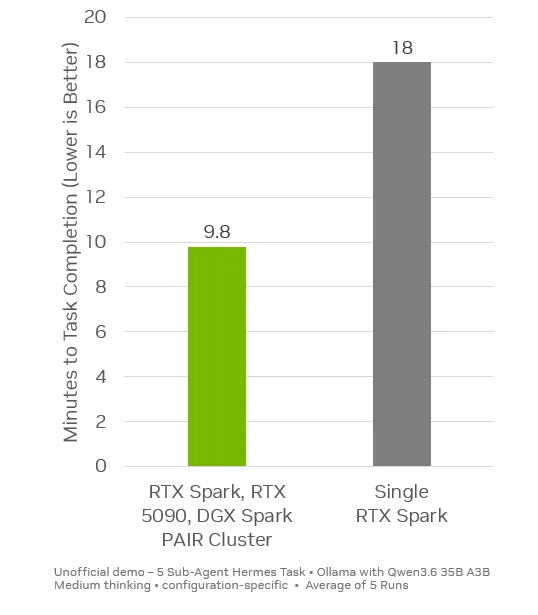
The demo results are compelling. A five-subagent Hermes workload analyzing a synthetic household inbox took 18 minutes on a single RTX Spark laptop. The same workload across a three-device PAIR cluster, RTX Spark, DGX Spark, and RTX 5090, finished in 8 minutes 48 seconds.
The build-your-own-cluster ethos extends to dedicated hardware. DGX Spark owners report running DeepSeek Flash 0731 at 50-60 tokens per second across two machines, with both units drawing only 300-350W combined, quiet enough to run 24/7. "At 8 concurrency, throughput drops to about 20 tps per run, giving around 180 tps aggregated", numbers that start to look genuinely competitive with API access, minus the per-token anxiety.
The Quantization Sweet Spot
One of the most useful findings for anyone considering a local build: quantization tiers matter more than model size. Testing of Qwen3.8-Flash-Next across quant levels shows Q6 is "noticeably better than Q4, while there is only a small improvement from Q6 to Q8." The full benchmark table tells the story:
| Model (qwen4exp A3B, CPU-only) | Size | t/s (prefill) | t/s (generation) |
|---|---|---|---|
| Q3_K – Medium | 83.80 GiB | 57.77 | 7.19 |
| Q4_K – Medium | 103.68 GiB | 50.41 | 6.75 |
| Q5_K – Medium | 147.41 GiB | 45.59 | 6.37 |
| Q6_K | 157.54 GiB | 47.61 | 6.16 |
| Q8_0 | 175.29 GiB | 44.22 | 5.96 |
The marginal quality gain from Q6 to Q8 costs a 10% throughput hit and 18GB of RAM. Meanwhile, Q5 sits surprisingly close to Q6 in quality metrics, making it the value sweet spot for CPU-bound systems.
The Real Bottleneck Once VRAM Stops Being One
The most honest assessment comes from the 4× RTX PRO 6000 owner themselves: "Fitting a model is only the beginning. Context length, concurrent requests, inference-engine support and cooling all matter. More VRAM also makes it very easy to invent more workloads."
That’s the paradox of local AI infrastructure. Every hardware purchase enables a new software ambition, which reveals a new hardware gap. The 5090 machine and Mac Studio remain integrated into the setup, "different jobs can run on different machines", because consolidation isn’t the goal. Utilization is.
What This Actually Means
The prosumer AI movement sits awkwardly between two worlds. Hobbyists are building what used to be called "data center infrastructure" and putting it under desks. NVIDIA is actively courting them with PAIR and DGX Spark. And the economics, despite the "it’ll never break even" crowd, are increasingly defensible for heavy users who value privacy and unlimited experimentation.
The honest take? Local AI is becoming a lifestyle infrastructure decision, not a purely financial one. The people building these systems aren’t doing it to save money. They’re doing it because owning the hardware means owning the capability, no rate limits, no data leaving the house, no subscription to cancel.
If you’re considering your own build, the practical guidance is consistent across every source: size the VRAM to the models you actually need, don’t chase the quantization rabbit hole past Q6, and remember that a used RTX 3090, still ~$650-750 for 24GB of VRAM, remains the best value per dollar in local AI.
And when you’re explaining to your partner why the basement needs 384GB of VRAM? Point to the extreme-scale local AI rigs doing 10-GPU portable builds, and tell them it could be worse. It always could.