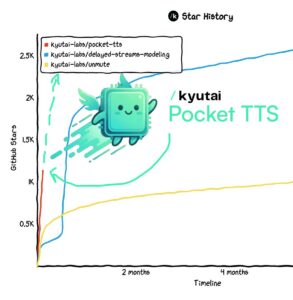
Kyutai’s announcement of Pocket TTS landed like a grenade in the text-to-speech community: a 100M-parameter model that runs on your laptop CPU, no GPU required, with “high-quality” voice cloning. The promise is intoxicating, democratized speech synthesis that doesn’t demand cloud credits or a data center in your basement. But within hours of the demo going live, the Reddit threads started telling a different story. One where words get mangled, audio glitches, and the “Kokoro killer” might be shooting blanks.
The Technical Promise: A CPU-Powered Voice Cloner
Let’s start with what Kyutai actually delivered. Pocket TTS is a 100M-parameter autoregressive transformer trained on 100,000 hours of speech data. The model uses a novel “continuous audio language modeling” approach, treating audio as a continuous signal rather than discrete tokens, a departure from traditional vocoder-based systems. This theoretically allows for more natural prosody and better handling of emotional nuance.
The architecture is optimized for inference on commodity hardware. According to their arXiv paper, the model achieves real-time synthesis on a MacBook Pro M2 at 40 tokens per second, and even manages 15 tokens per second on an aging Intel i7-8700K. No CUDA, no ROCm, no proprietary AI accelerators, just pure CPU grunt.
The voice cloning capability is the real headline. Unlike fixed-voice models, Pocket TTS can clone a voice from just 3-5 seconds of audio. The Hugging Face model card shows examples ranging from synthetic celebrities to user-uploaded samples, all processed locally. For privacy-conscious developers and indie creators, this is the holy grail: studio-quality voice synthesis without shipping your voice data to Big Tech.
The Reality Check: When Demo Day Goes Wrong
The problem? The demos didn’t hold up under scrutiny. Within 12 hours of launch, the top comment on r/LocalLLaMA read: “It seems that under a certain size these models are not good enough to be worth the trouble.” The user tested Pocket TTS by copying text directly from Kyutai’s own blog post and got mangled output. “This model misses/mangles words randomly from their own blogpost. And, annoyingly it mangles different words on several tries.”
Kyutai’s own team confirmed the issue. Gabriel from the development team posted: “we’ve had trouble with a memory leak on our server, causing the audio to be choppy in the demo. The fix has been pushed, I encourage you to try again!” A memory leak on launch day isn’t a great look, but it’s fixable. The deeper problem is the inconsistent output quality, different words failing on different runs suggests fundamental instability in the autoregressive generation, not just infrastructure hiccups.
Other users reported similar issues. The “bad connection” excuse didn’t fly when people downloaded audio snippets directly and still heard glitches. The model’s 100M parameters might be enough for inference on weak hardware, but it’s starting to look like the parameter count is a ceiling, not a floor, for quality.
The Kokoro Rivalry: David vs. David
The elephant in the room is Kokoro 82M, the reigning champion of lightweight TTS. Kokoro’s been serving the self-hosted community for months, powering everything from audiobook narration to Twitch stream overlays. It’s not perfect, its voice repertoire is fixed, and emotional range is limited, but it’s reliable.
The community’s sentiment is clear: “Small models are hit and miss, but I have been in love with the Kokoro 82M model for quite awhile. Some of its voices are very good. I’ve been serving it locally for all of my TTS applications.”
Kyutai’s response was direct and confident: “Give Pocket TTS a try, we’re quite confident that we beat Kokoro (and we’ll have numbers to back it up soon). Voice cloning is our main advantage, since we can do infinitely many voices and emotions whereas Kokoro has a fixed repertoire of voices that they can only widen with more training.”
This is the core tension. Pocket TTS offers infinite voices and dynamic emotion control, if it works. Kokoro offers a known quantity: 14 high-quality, meticulously tuned voices that don’t hallucinate words. For production systems, predictability often beats potential.
The numbers Kyutai promises will be crucial. Their paper claims better MOS (Mean Opinion Score) scores across the board, but MOS is a slippery metric. A model that scores 4.2 on average but fails catastrophically 5% of the time is less useful in production than a model that scores 3.8 but never fails.
The Compute Paradox: Democratization vs. Centralization
Here’s where the “democratization” narrative starts to fray. Training Pocket TTS required 2 days on 32x H100 GPUs. That’s not democratized, that’s a quarter million dollars in compute for a single training run. The model may run on a laptop, but it was born in a data center most developers will never access.
Finetuning isn’t much better. While the Kyutai team claims single-language finetuning needs “much less compute”, the reality is still daunting. One commenter noted: “According to the papers, they needed 2 days for English and 32x H100s, which is out of scope for normal people. I hope we can donate to Kyutai, and they would do it for the community.”
The community’s hunger for distributed training frameworks is telling. There’s a growing recognition that open-source AI is only truly open if the training is accessible, not just the weights. Otherwise we’re just shifting dependency from OpenAI’s API to Kyutai’s goodwill.
This creates a paradox: Pocket TTS democratizes inference while centralizing innovation. You can run it anywhere, but you can’t shape it to your needs. Need a new language? Wait for Kyutai. Want better emotion control? Wait for Kyutai. The model’s openness is skin-deep.
The Language Lock-In: English Only, Forever?
The model card is blunt: “English only.” For a French AI lab (Kyutai is based in Paris), this is ironic. For the global developer community, it’s a dealbreaker. One user simply asked “Languages?” and got the terse response: “As always.”
The technical reason is clear: 100,000 hours of English speech data is already a massive undertaking. Adding even one more language would require similar data collection, cleaning, and training investment. But the business implication is stark: Pocket TTS is a tool for the English-speaking world, full stop.
This limitation hits differently than Kokoro’s. Kokoro’s voices are fixed, but the model architecture could theoretically support other languages with enough data and retraining. Pocket TTS’s continuous audio approach might be even more data-hungry for new languages, locking it into English unless Kyutai commits major resources.
The Bottom Line: Promise vs. Production
Pocket TTS is a remarkable technical achievement. Getting voice cloning to run on a CPU in real-time is no small feat. The model represents a genuine step forward in efficient architecture design. But the gap between “runs on a laptop” and “useful in production” is wide, and Kyutai hasn’t crossed it yet.
For hobbyists experimenting with voice synthesis, Pocket TTS is exciting. For developers building reliable applications, the inconsistent output and English-only limitation are red flags. The memory leak on launch day is forgivable, the fundamental instability of a 100M-parameter autoregressive model might not be.
The real test will be whether Kyutai can deliver on their promised benchmarks and whether the community can solve the finetuning problem. If distributed training frameworks emerge that let developers adapt Pocket TTS to new languages and domains, it could become a cornerstone of edge AI. If not, it’s a impressive demo that falls short of its democratization promise.
As one developer put it: “Although it may be impractical for realtime I would like to see someone drop something in the 8-32B range that is really high quality.” The sentiment is clear: we want local, private, powerful AI. Pocket TTS shows it’s possible, but possibility isn’t the same as practicality.
For now, the smart money is on a hybrid approach: Kokoro for production reliability, Pocket TTS for experiments where voice cloning matters more than consistency. And maybe, just maybe, someone will figure out how to finetune this thing without a data center budget.