The headline numbers are these: 2.01x faster end-to-end answers (332.8 seconds vs 667.7 on the same 130 benchmark problems), 50.2% fewer output tokens, and a higher accuracy (87.7% vs 83.8%). All achieved not by buying fancier silicon, but by fixing a problem in the weights themselves. The “revolutionary” part isn’t just the speed, it’s that they turned the model into its own performance patch.
The Overthinking Tax
Inkling 2 Mini is a clever piece of architecture. It keeps its disk footprint small by looping its middle 12 layers three times per token. That means every extra thinking token you generated paid for three passes through those layers. At default settings, the model rambles. Badly. Most of the wait time on this model isn’t the decode, it’s the internal monologue that never seems to end.
The obvious fix would be cranking down reasoning_effort at runtime. Classmethod’s tests on the DGX Spark found that approach drops instructions on long system prompts. Lucebox instead fixed the weights, so the model gets to the point while keeping default effort settings.
The results across the three benchmark components:
| Benchmark | Accuracy | Wall time | Tokens | Cut | Speedup |
|---|---|---|---|---|---|
| MATH-500 (40) | 77.5% → 82.5% | 210.1 → 106.3 s | 25,106 → 12,566 | -50.0% | 1.98x |
| HumanEval (40) | 95.0% → 95.0% | 186.5 → 84.5 s | 23,507 → 11,997 | -49.0% | 2.21x |
| MMLU-Pro (50) | 80.0% → 86.0% | 271.1 → 141.9 s | 30,864 → 15,024 | -51.3% | 1.91x |
| Combined (130) | 83.8% → 87.7% | 667.7 → 332.8 s | 79,477 → 39,587 | -50.2% | 2.01x |
The interesting bits hide in the breakdown: a 74% reduction in HumanEval reasoning tokens, five eliminated token-cap truncations on MATH-500 that added 5.0 points of accuracy, and a held-out KL divergence of 0.023 nats with 93.4% top-1 agreement against base weights on generic prose. That last metric matters, it suggests the general behavior didn’t get lobotomized in the pursuit of brevity.
AMD vs. NVIDIA: The Decode Gauntlet
Here’s where it gets spicy. The published comparison against DGX Spark runs shows a Lucebox (one R9700 32GB + Strix Halo) delivering 110.2 to 136.5 tok/s live HTTP decode (155.4 peak), against dated public DGX Spark vLLM runs of 37.8 to ~60 tok/s.
| System and engine | Setting | Decode | Source |
|---|---|---|---|
| R9700, Lucebox | DSpark, HTTP greedy | 136.5 tok/s | Lucebox, Nov 23 |
| R9700, Lucebox | Dual-GPU peak | 155.4 tok/s | Lucebox, Nov 23 |
| R9700, vllm-redshift | NVFP4, 211-tok prompt | 144.6 tok/s | LocalMaxxing, Nov 23 |
| DGX Spark, vLLM 1K code | NVFP4 + DSpark | ~60 tok/s | NVIDIA Forums, Nov 23 |
| R9700, llama.cpp | UD-Q4_K_XL, AR | 52.8 tok/s | LocalMaxxing, Nov 21 |
| DGX Spark, vLLM nightly | SPEED-Bench, temp=1.0 | 49.6 tok/s | NVIDIA Forums, Nov 24 |
| DGX Spark, Hyperflare | NVFP4, tuned MTP | 42.3 tok/s | NVIDIA Forums, Nov 23 |
The DGX Spark numbers are all dated. NVIDIA’s software stack for this architecture is evolving quickly, and the forums show vLLM nightly builds making progress. But the gap here isn’t a rounding error, it’s 2.2x to 3.6x. That kind of delta isn’t about “ROCm is now competitive.” It’s about a purpose-built engine beating a general-purpose stack on a specific workload.
The kicker: llama.cpp on the same R9700 gets 52.8 tok/s. So the hardware isn’t magic, the engine matters. Lucebox’s open-source ROCm engine went from 59.3 tok/s on an initial port to 155.4 tok/s peak, a 2.62x improvement, all in Luce-Org/lucebox.
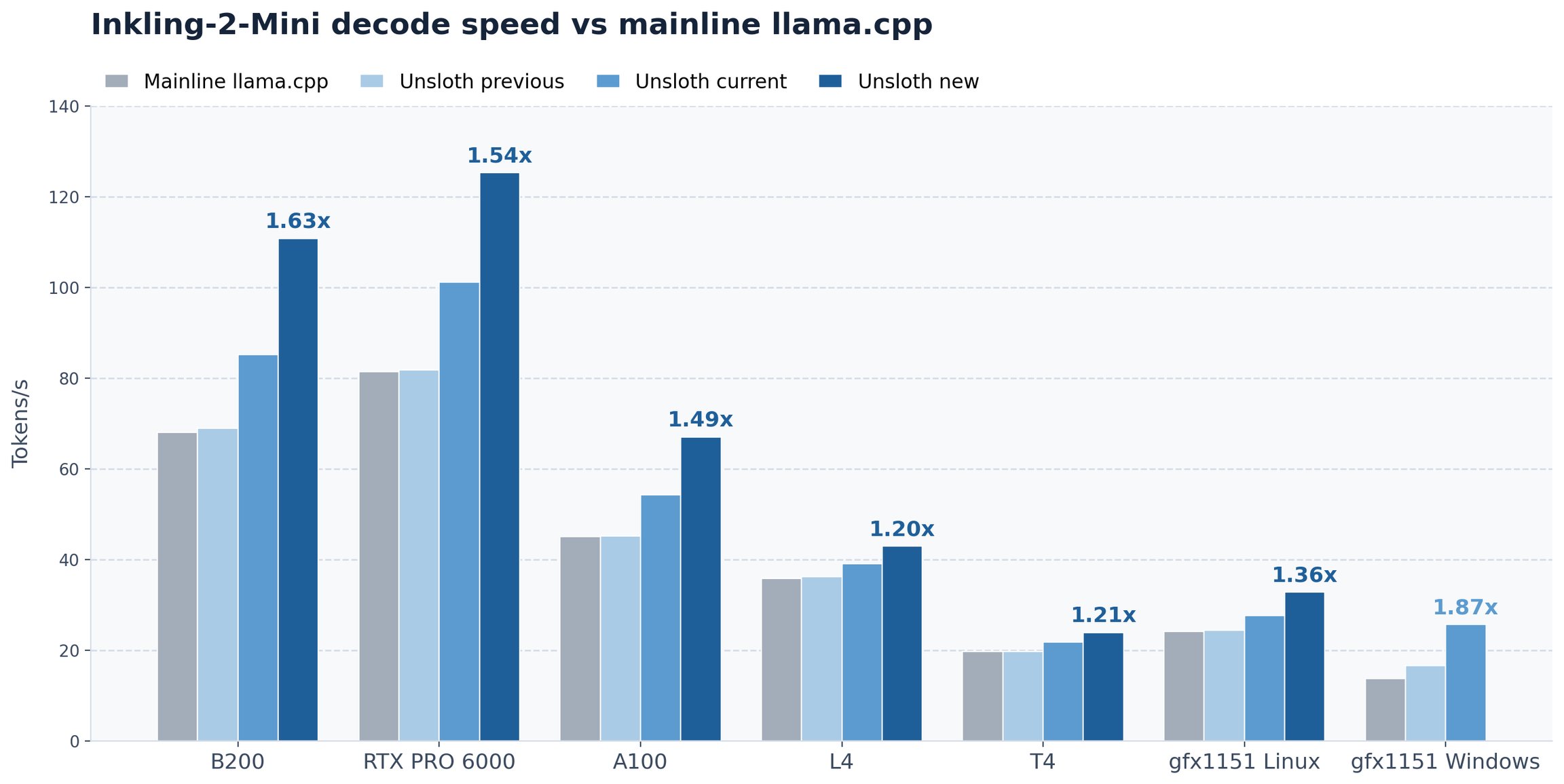
Let’s put this in context: the challenges and complexities of deploying open-weight models at scale usually mean you’re stuck with whatever engine the vendor supports. Lucebox is making the case that a targeted engine on cheaper AMD hardware can outperform a dedicated NVIDIA device. That flips the cost calculus.
Prefill and Long Context: The Rest of the Story
Decode speed is only half the battle. The engine also delivers 3,628 tok/s prefill flat to 32K, up to 5.0x llama.cpp on the same R9700, and holds a 12.2x throughput advantage over llama.cpp at 120K tokens.
Long context is where it gets genuinely impressive. Inkling 2 Mini’s hybrid sliding-window attention keeps a full 262K context resident on one 32 GB R9700 alongside the DSpark drafter. Continuation runs show 142.3-149.6 tok/s at 16K and 128.3 tok/s at 262K, versus DGX Spark Hyperflare’s 34.2 tok/s at 16K (4.3x slower) and 35.9 tok/s at 100K context.
The Skeptic’s Corner: “It Smells Like Overfitting”
The community response has been appropriately vicious. The Reddit thread on r/LocalLLaMA is a case study in healthy skepticism. The top comment, from someone who tried the earlier tuned Qwen 3.8 27B models that promised similar gains, called the accuracy improvement claim “extraordinary” and demanded full runs on independent benchmarks with confidence intervals.
The critique has teeth. 130 benchmark problems is a small sample. A 4% accuracy jump means roughly five questions flipped from wrong to right. And while the 0.023 nats KL divergence on held-out prose suggests the model didn’t just memorize the eval set, there’s a real question about whether this holds up on benchmarking open models on agentic tasks and practical performance.
Lucebox’s response was refreshingly direct: they haven’t run agentic harness evals on this release. They’re putting together a wider suite “for upcoming writeups”, and the Apache 2.0 GGUFs are public for anyone to beat on.
There’s also a fascinating data point from another user who tested the base model with a patched version of PolyStrata that allowed changing thinking levels from 0.1 to 0.99. Around 0.4, the model used half the reasoning tokens and got all 14 of their questions correct. Lower would loop forever. Higher would consume tokens without improving outcomes. That suggests the sweet spot is real, not just a Lucebox hallucination.
What This Actually Means
Lucebox’s release has three distinct implications that deserve attention.
First, weight tuning is a legitimate performance lever. We’re used to thinking of quantization and engine optimization as the tools for speeding up inference. Rewarding concise reasoning directly in the weights is a different mechanism entirely, and one that compounds with every other optimization. Fewer tokens means faster decode, smaller KV cache, lower cost per query. The efficiency and performance of compact open-weight models story keeps getting more interesting.
Second, the ROCm ecosystem is quietly getting real. Phoronix’s March 2026 benchmark sweep still showed ROCm 10-25% slower than CUDA on equivalent silicon at the same precision. But that’s a general-purpose comparison. A purpose-built engine on a specific model architecture doesn’t care about “equivalent silicon”, it cares about hitting the right kernels. The 155 tok/s on R9700 versus 110 tok/s on B200 with the same Unsloth prebuilt speaks to how much headroom exists when someone actually bothers to optimize for AMD.
Third, the DGX Spark premium is getting harder to justify. Inkling 2 Mini’s performance breakthrough on consumer GPUs already showed what dual 3090s can do with vLLM. This release suggests that a single AMD workstation card can beat NVIDIA’s dedicated AI box on this specific workload. The spreadsheet warriors will need to redraw their cost-per-token charts.
Running It Yourself
The model files are on Hugging Face under Apache 2.0, freely available. The setup is straightforward:
# download Inkling 2 Mini Fast + DSpark speculator
hf download Lucebox/Inkling-2-Mini-Fast-GGUF \
  Inkling-2-Mini-Fast-IQ4_NL.gguf mtp.safetensors --local-dir models/inkling2-fast

# single R9700 (32 GB VRAM, up to 262K context)
./server/build/luce_server models/inkling2-fast/Inkling-2-Mini-Fast-IQ4_NL.gguf \
  --target-device hip:0 --max-ctx 65536 --port 8080

# dual-GPU (R9700 + Strix Halo)
./server/build/luce_server models/inkling2-fast/Inkling-2-Mini-Fast-IQ4_NL.gguf \
  --target-device hip:0 --expert-device hip:1 --max-ctx auto --port 8080
Three checkpoints are available: a Full Dynamic Q8 (21.3 GB) for highest precision, the benchmarked IQ4_NL build (16.4 GB), and a full IQ4_NL variant (14.0 GB) for 16GB GPUs. All with the mtp.safetensors DSpark speculator.
The Bottom Line
This release doesn’t prove AMD is “better” than NVIDIA. It proves that the software stack matters as much as the silicon, and that a well-optimized engine can extract performance from hardware that an unoptimized stack leaves on the table.
It also proves that weight tuning deserves a place in the performance toolkit. Cutting output tokens in half while raising accuracy isn’t just an optimization, it’s a statement that the model’s default behavior was pathological, and the fix didn’t require retraining from scratch.
The honest caveat stands: 130 benchmark problems isn’t a full eval suite. The agentic tasks where open models are closing the gap on proprietary systems remain untested on the tuned weights. Run your own evals before you bet production workloads on this.
But the trajectory is clear. NVIDIA’s dominance in AI inference isn’t a law of physics. It’s a software advantage that’s being eroded one carefully-tuned kernel at a time. And this time, the model itself did half the work.