
Every system starts simple. A clean monolith, a crisp API boundary, maybe a neat little frontend that actually respects separation of concerns. Then comes the feature requests, the “temporary” integrations that somehow become load-bearing, and that clever abstraction you wrote at 2 AM that seemed brilliant at the time. Six months later, changing a button color requires modifying eighty files across twelve services, and your junior developer just asked if it’s okay to cry in the standup.
This is architectural entropy, the inevitable drift toward disorder that consumes 20 to 40 percent of your technology estate’s value according to McKinsey. Unlike physical entropy, software disorder isn’t truly inevitable. It just feels that way because most teams are fighting it with thoughts and prayers instead of physics.
The Physics of Software Decay
In thermodynamics, entropy measures the number of possible microscopic configurations of a system. In software, it measures the number of ways a developer can accidentally break production while trying to ship a trivial feature. The Reddit consensus among experienced architects is clear: complexity doesn’t arrive with a bang. It seeps in through “poorly designed structure” rather than the features themselves.
The pain point isn’t that you’re adding capabilities, it’s that you’re violating separation of concerns. One developer admitted to mixing a UI view model with backend entities, breaking half the endpoints after a “small” change. Another described working on a project where classes were shared across multiple solution files, creating a minefield where “you never knew where an issue was going to pop up.” These aren’t coding errors, they’re structural failures that turn your codebase into a Jenga tower where touching any block risks collapse.
The Financial Cost:
- Developers lose roughly 42% of working hours to technical debt (Stripe).
- Bottom quartile companies are 40% more likely to have canceled projects due to complexity (McKinsey).
- One B2B firm missed $2 billion in growth opportunities solely due to tech stack complexity.
Disposable Architecture vs. Load-Bearing Shortcuts
Not all shortcuts are sins. The distinction lies in whether you’re taking on “good debt”, calculated leverage that accelerates learning, or “bad debt” that compromises your foundation. Victor Quinn, CTO of Texture, notes that technical debt is only problematic when it impacts business value. The trick is knowing which beams are load-bearing.
Critical (Red) Debt
Foundation risks, data models, authentication systems, financial ledgers. One fintech startup found 38% of failed deployments traced back to a single outdated payment module. This is termites in your floor joists.
Managed (Yellow) Debt
High-impact but contained complexity requiring planning. Includes legacy integration points or suboptimal database schemas not yet blocking features.
Scale-Ready (Green) Debt
Intentional shortcuts in non-core components like UI frameworks or admin tools. Safe to carry if documented and contained.
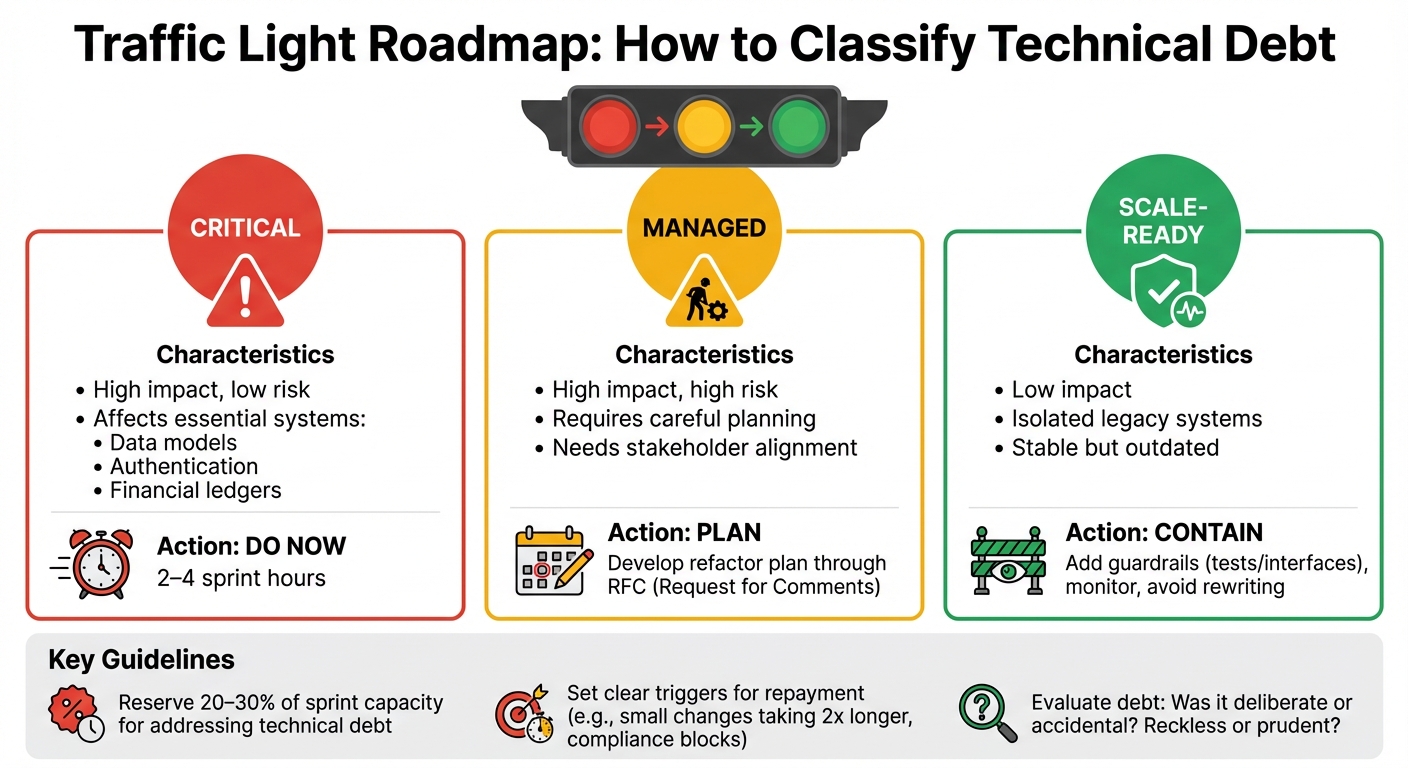
The strategy shifts by growth stage. At Validation, adopt Disposable Architecture, temporary solutions designed to be replaced once market fit is confirmed. Texture used RedwoodJS and Tailwind UI to ship fast, knowing they’d rebuild with a proper design system later. During Growth, shift to Managed Refactoring, dedicating 15-25% of sprint capacity to debt reduction. At Scale, minimize new debt entirely and focus on Strategic Modernization, modularizing monoliths and strengthening infrastructure before enterprise requirements crush you.
Structural Patterns That Resist Chaos
Entropy-resistant architectures share common traits: clear boundaries, inversion of control, and the ability to evolve without cascading failures. Several patterns dominate the conversation among architects who’ve successfully scaled without drowning in complexity.
Hexagonal Architecture (Ports and Adapters)
Creates framework-agnostic cores by isolating business logic from external concerns. Your domain code doesn’t know if it’s talking to PostgreSQL or a mocked test database. This matters because 80% of technical debt will be architectural by 2026, according to Gartner. When your business logic is entangled with your ORM or your UI framework, you can’t upgrade one without breaking the other.
Modular Monoliths
Offer a middle path between the chaos of big ball of mud and the distributed headache of premature microservices. By vertically slicing your application into sub-modules with clear interfaces, you contain complexity without the operational overhead of service meshes. Teams can share hexagonal adapters across modules while maintaining strict boundaries.
Evolutionary Architecture
Takes this further by treating adaptability as a first-class concern. This means writing your own architectural fitness functions, automated tests that verify architectural constraints like “no cycles between packages” or “database access only through repository layer.” You’re essentially creating architectural linting rules that prevent entropy at build time rather than discovering it during incident response.
The Cultural Component: Hiring for Simplicity
Technology doesn’t decay on its own, people accelerate it. One experienced architect put it bluntly: “Don’t hire engineers that like to build themselves job security. Don’t fire the engineers that KISS.”
Complexity is often a career strategy. Clever abstractions impress interviewers and make developers feel irreplaceable. Simple code that any junior can maintain does neither. You need a culture that rewards simplicity over cleverness, where “boring” code is celebrated and “impressive” code is viewed with suspicion.
This requires structural support. Quarterly Principal Council reviews should evaluate debt based on business impact and effort required. Architecture Decision Records (ADRs) must document not just what was built, but why shortcuts were taken and what triggers their repayment. For example: “Migrate to WebSockets when monthly active users exceed 7,500.” The review culture matters too. As one architect noted, you need “a culture of redesigning, refactoring and strong reviews where you sweat the small stuff.” The hard part is accepting that this slows feature delivery upfront.
The Trade-off
The payoff is vastly less maintenance work and faster feature development long term. This is a trade-off that requires executive patience and engineering discipline. You cannot eliminate architectural entropy any more than you can violate thermodynamics. But you can manage the rate of decay.
When AI Accelerates the Entropy
Here’s where the conversation gets spicy. Just as you’re learning to manage organic complexity, AI is accelerating architectural entropy by making change cheaper than commitment. Why refactor carefully when an AI can generate fifteen new microservices in the time it takes to drink a coffee? The result is a proliferation of “AI-generated debt”, code that compiles, passes tests, and fails silently in production.
The Trace3 analysis of Agentic SRE reveals the scope of the problem: modern systems are “dynamic, distributed, and constantly changing… too accelerated for traditional, alert-driven SRE models to keep up.” AI acts as a force multiplier, absorbing complexity that would otherwise overwhelm human operators, but it also generates entropy faster than ever before.
This demands architectural guardrails that prevent AI from touching load-bearing beams. You need automated constraints, database schemas that enforce referential integrity, API contracts that reject breaking changes, and data constraints that reduce technical debt by making invalid states unrepresentable.
When AI suggests minimalist solutions over enterprise bloat, listen. When it suggests adding a fifth service mesh, reach for the fire extinguisher.
Operationalizing the Defense
Prevention requires budget and metrics. McKinsey recommends allocating 15 to 20% of the IT budget to systematic debt reduction. Companies following this approach free up engineers to spend 50% more time on work that supports business goals.
Track the ratio of maintenance work to new feature development. When the former exceeds the latter, you’re in crisis mode. Startups that actively manage technical debt have a 60.6% funding success rate compared to 44.4% for those pretending their codebases are pristine.
Warning Signs
- Features taking 50-100% longer than estimates
- Small changes impacting 12+ files
- Over 30% of module updates leading to incidents
- Developers avoiding specific code sections “out of fear”
The Inevitable Conclusion
You cannot eliminate architectural entropy any more than you can violate thermodynamics. But you can manage the rate of decay. By adapting system design for the AI-centric era, enforcing strict architectural boundaries, and maintaining a cultural bias toward simplicity, you can ensure your system dies of old age rather than complexity.
The goal isn’t zero debt, that’s just code for “moving too slow.” The goal is intentional debt, contained within guardrails, with a clear repayment schedule and a team that understands the difference between temporary scaffolding and load-bearing walls. Because in the end, the only thing worse than a complex system is a simple system that stayed simple by never shipping.