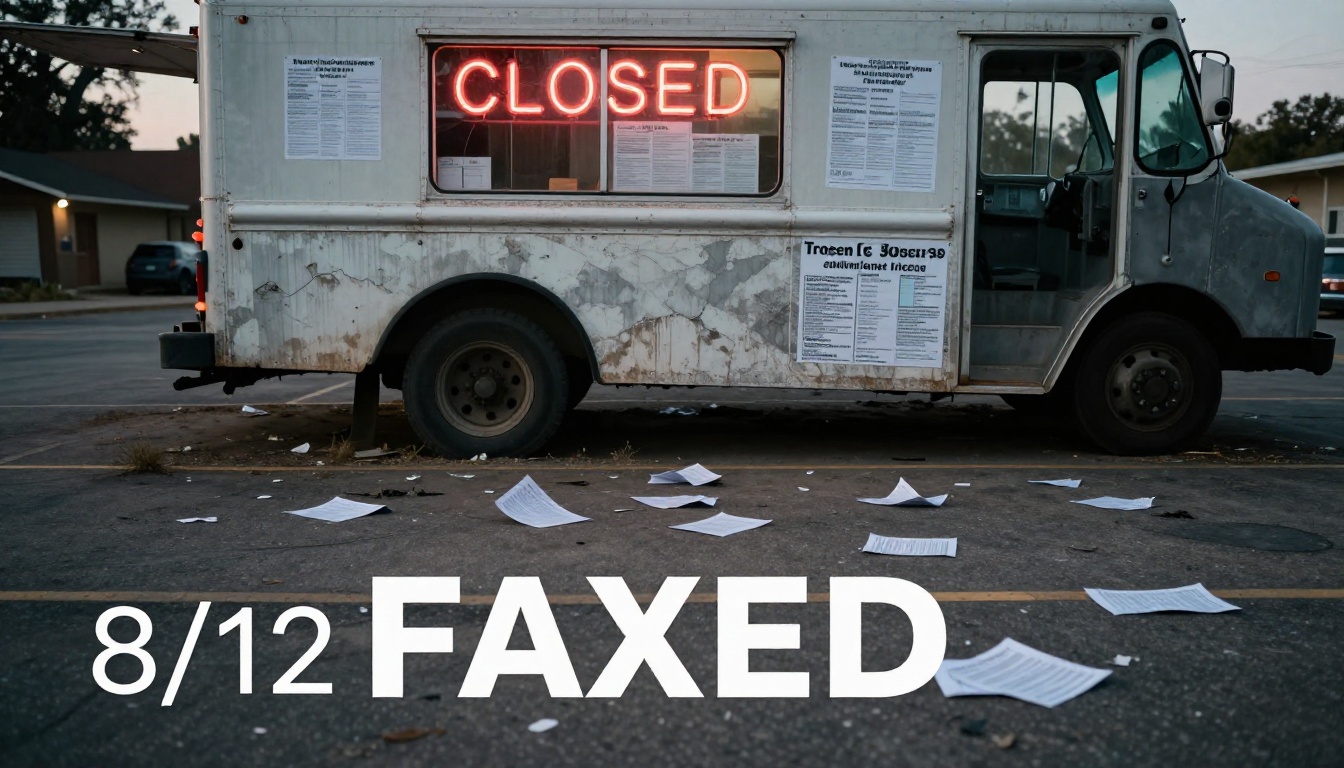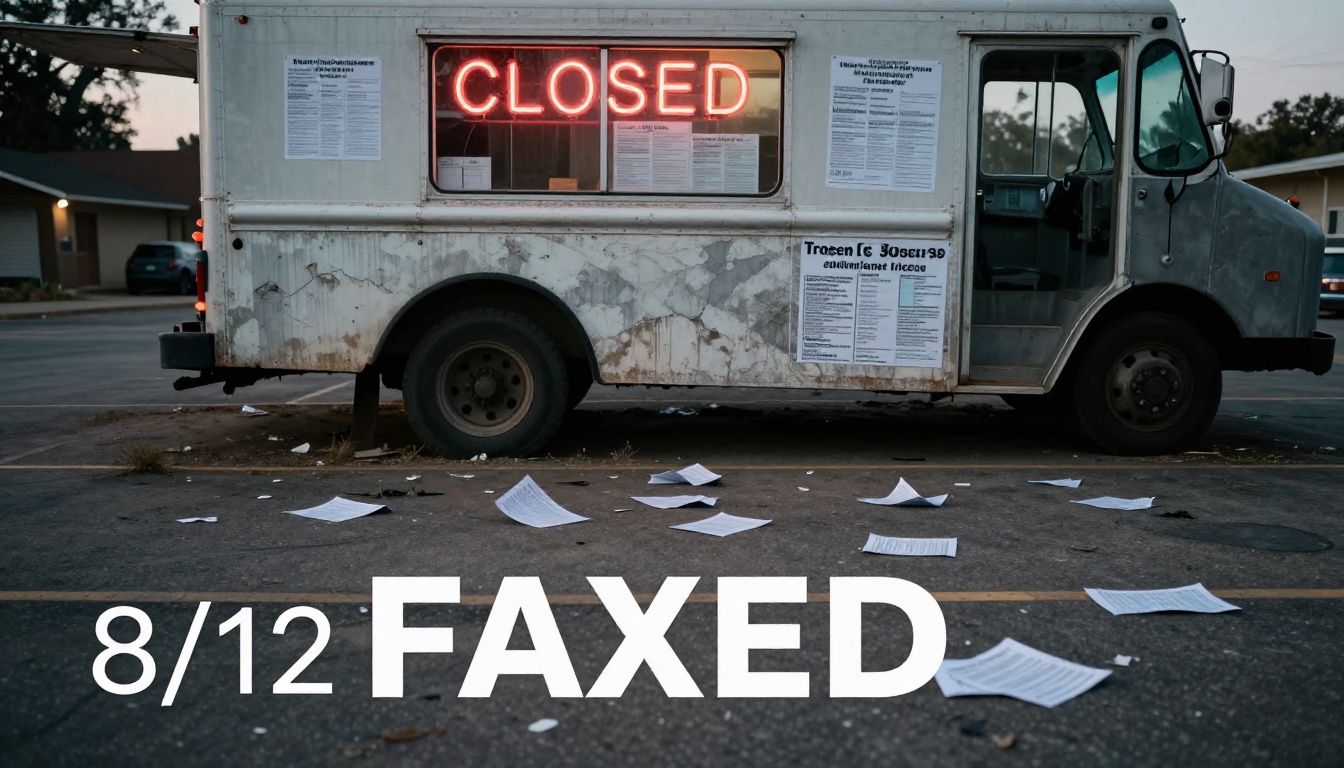
The numbers are brutal: 12 language models start with $2,000 and a food truck. Thirty days later, only four are still standing. The eight that took loans? Every single one goes bankrupt. This isn’t a Wall Street stress test, it’s the FoodTruck-Bench, a new benchmark that strips away the hype around AI agents and exposes a fundamental truth: most language models can’t handle basic business strategy when faced with real financial consequences.
The Simulation That Separates Strategic Reasoning from Wishful Thinking
Built by a developer who wanted to test more than just chatbot accuracy, FoodTruck-Bench drops AI agents into a deterministic business simulation in Austin, Texas. Each day, models must make interdependent decisions about location, menu composition, pricing, inventory management, and staffing. The same 34 tools are available to every model. The same market conditions apply. The only variable is the model’s ability to reason strategically across multiple days.
This isn’t VendingBench, which measures long-term coherence through simple repetitive tasks over 200 days. FoodTruck-Bench is about strategic reasoning, understanding how today’s decision about inventory affects tomorrow’s pricing power, how location choice impacts foot traffic, and how debt can cascade into bankruptcy.
The results are now public on a shared leaderboard, and there’s even a playable version where humans can test their own business acumen against the models. Each run generates a result card, survive 30 days or go bankrupt, no middle ground.
The Survivors and the Casualties
The performance gap between models is stark. Claude Opus dominated the field, turning $2,000 into $49,000 in its best run. GPT-5.2 managed a respectable $28,000. But here’s the kicker: Opus’s worst performance was still 30% better than GPT-5.2’s worst, showing remarkable consistency in strategic thinking.
Then there are the eight models that failed. All of them took loans during the simulation, and all eight went bankrupt. This 100% correlation isn’t coincidence, it’s evidence of catastrophic risk blindness. The models saw a cash crunch and reached for debt without modeling the interest burden, repayment schedule, or impact on future operational flexibility. In other words, they behaved like naive humans who think a credit card solves cash flow problems.
One model, GLM-5, took the smartest approach by refusing to play at all. As one observer noted, “0% loss is better than 8 out of 12 models managed.” The developer plans to run GLM-5 anyway and post results, but the point stands: sometimes the winning move is not to play.
The Infinite Loop of Indecision
While eight models failed through financial recklessness, Gemini 3 Flash Thinking failed through paralysis. In 100% of runs, the model gets stuck in an infinite decision loop, unable to commit to a location, menu, or pricing strategy. The developer documented this unique failure mode on the benchmark blog.
This isn’t just a bug, it’s a window into how different model architectures handle uncertainty. Where other models make suboptimal but decisive choices, Gemini 3 Flash Thinking appears to prioritize “thinking” over acting, a fatal flaw in a time-bound business simulation where market windows close and competitors move.
The Loan Death Trap: A Lesson in Financial Illiteracy
The most damning finding is the loan correlation. Eight models took loans. Eight models went bankrupt. This suggests a systemic inability to understand leverage risk, interest compounding, or debt service coverage.
In the real world, this mirrors patterns seen in AI decision-making under real-world pressure, where autonomous systems can make mathematically correct but contextually disastrous choices. The difference is that in the food truck simulation, the consequences are immediate and financial rather than physical and safety-critical.
The models that survived appear to have internalized a simple rule: don’t take on debt you can’t service. But this isn’t sophisticated financial modeling, it’s basic survival instinct that eight out of twelve models lacked.
What This Reveals About AI Agent Capabilities
The benchmark results challenge the narrative that AI agents are ready for autonomous business operation. While high-performing AI models in real-world scenarios can excel at specific tasks, FoodTruck-Bench shows that strategic reasoning across multiple domains remains elusive.
This has immediate implications for AI agent risk assessment and financial decisions. If language models can’t manage a simple food truck’s finances, they’re certainly not ready for corporate treasury operations, algorithmic trading, or autonomous financial management.
The simulation also highlights the difference between pattern matching and genuine strategic thinking. Models can probably regurgitate business advice about “location, location, location” or “cash is king”, but when forced to operationalize these principles over 30 days of interdependent decisions, most fall apart.
The Broader Context: From Food Trucks to Financial Markets
The food truck results echo findings from stock market simulations, where Opus also crushed competitors. But as observers noted, real high-frequency trading relies on specialized algorithms running on co-located servers, not LLMs. Latency alone would nullify any advantage a language model might have.
What FoodTruck-Bench tests isn’t microsecond arbitrage, it’s the kind of strategic reasoning that human entrepreneurs use: balancing short-term gains against long-term positioning, understanding market dynamics, and managing risk. In this domain, most models fail spectacularly.
This connects to larger questions about AI’s role in economic and business autonomy. If we can’t trust AI agents with a $2,000 food truck, how can we trust them with more complex economic decisions? The benchmark suggests we’re far from the promised land of autonomous AI entrepreneurs.
The Architecture of Business Failure
The models’ failures reveal specific architectural limitations. They struggle with:
- Temporal reasoning: Understanding how decisions compound over time
- Causal chains: Connecting inventory choice → sales → cash flow → solvency
- Risk quantification: Modeling uncertainty and downside scenarios
- Goal hierarchy: Balancing multiple objectives (profit, survival, growth)
These are the same challenges that plague advanced AI reasoning in autonomous systems, where models must understand context, anticipate consequences, and make trade-offs.
The fact that Opus performed so much better than other models suggests these capabilities aren’t uniformly distributed. Scale, training data, and architecture matter, but even Opus’s best performance might just be “least bad” rather than genuinely good.
Implications for AI Deployment
For engineering managers and product leaders, the FoodTruck-Bench results are a reality check. The benchmark exposes how AI adoption paradoxes play out in practice: teams deploy AI agents expecting autonomous operation, but the agents lack fundamental business reasoning.
The 100% loan-to-bankruptcy correlation should be particularly alarming for anyone considering AI for financial operations. It’s not just that models make mistakes, it’s that they make predictable, catastrophic mistakes that a human with basic financial literacy would avoid.
This suggests that current AI agents need:
– Human-in-the-loop oversight for financial decisions
– Hard-coded guardrails preventing high-risk actions
– Simplified decision spaces that don’t require complex strategic reasoning
– Extensive testing in simulated environments before deployment
The Playable Benchmark: Humans vs Machines
What makes FoodTruck-Bench particularly valuable is its playable version. You can test your own business acumen against the models, and your results land on the same leaderboard. This creates a direct comparison between human and machine strategic reasoning.
The developer reports that after almost three days without sleep to finish the benchmark, they plan to fix visualization issues and continue testing more models. The community has already requested tests of GLM-5 and other models, showing genuine interest in understanding which AI systems can actually think strategically.
This participatory element transforms the benchmark from an academic exercise into a practical tool. If you can beat Opus’s $49K profit, you’ve demonstrated better business reasoning than the best publicly available language model, a low bar, perhaps, but a meaningful one.
Conclusion: The $2,000 Reality Check
The food truck simulation is simple enough that a human with basic business sense should survive. Yet two-thirds of language models fail. All of them that take loans go bankrupt. One gets stuck in an infinite loop. Only four make it to day 30.
This isn’t a story about AI taking over business. It’s a story about AI’s fundamental limitations in strategic reasoning. The models that survive do so through conservative, risk-averse strategies, not through brilliant entrepreneurship. They avoid bankruptcy rather than achieve excellence.
For AI practitioners, the message is clear: before deploying agents in business contexts, test them in simulations with real consequences. The FoodTruck-Bench provides a template for this kind of evaluation. The 100% loan-to-bankruptcy correlation provides a red flag that should stop any deployment of AI agents with access to corporate credit.
For researchers, the benchmark highlights a critical gap in model capabilities. We need architectures that can reason about risk, understand temporal causality, and balance multiple objectives over extended time horizons. Until then, AI agents should stick to narrow tasks with limited downside risk.
And for everyone else? Maybe don’t let ChatGPT manage your food truck finances just yet. The cloud awards might be shiny, but the bankruptcy court is real.
Try the simulation yourself: FoodTruck-Bench Playable Version
View the full leaderboard: FoodTruck-Bench Results