
Rust has spent the last decade conquering the systems layer of modern computing, from the Linux kernel to browser engines. NVIDIA’s own Nova driver is written in Rust. NVIDIA Dynamo, their distributed inference platform, sits on a Rust core. Inference engines like HuggingFace’s Grout and mistral.rs are increasingly built in the language.
But there was always a wall. A hard, immovable wall made of CUDA C++.
You could launch kernels from Rust, sure. But the kernel itself, the code that actually runs on the GPU’s thousands of cores, had to be written in another language. That meant maintaining dual codebases, crossing FFI boundaries, and accepting that the most performance-critical code in your stack lived outside Rust’s safety guarantees.
In September 2026, NVIDIA announced it’s tearing down that wall. CUDA Rust is here, with two distinct tracks for writing GPU kernels natively in Rust, compiled directly to PTX.
This isn’t a wrapper. It’s not a DSL that happens to look like Rust. It’s the real thing, and it has serious implications for how we architect GPU-accelerated systems.
The Two-Track Approach: SIMT vs. Tile
NVIDIA’s strategy mirrors the two programming models CUDA itself has evolved. But before diving into the technical weeds, let’s be clear about what’s actually new here.
cuda-oxide is a custom rustc codegen backend. When it encounters #[kernel] functions, it routes them through Rust’s MIR, the Pliron IR framework, and LLVM down to PTX, while handing everything else to the standard compiler backend. The result: you can write host and device code in the same file, build with one command, and skip the separate kernel crate entirely.
cutile-rs works at a higher level. Instead of describing what individual threads do, you express operations on data tiles. The compiler handles thread mapping, memory layout, and architecture-specific optimization. It JIT-compiles through CUDA Tile IR and runs on stable Rust with no custom LLVM.
The difference matters more than you might think. Here’s the same elementwise addition kernel, 1,024 floats, both tracks, complete programs:
SIMT with cuda-oxide:
#[cuda_module]
mod kernels {
    use super::*;

    #[kernel]
    #[launch_bounds(256)]
    #[launch_contract(domain = 1, block = (256, 1, 1))]
    pub fn vecadd(a: &[f32], b: &[f32], mut c: DisjointSlice<f32>) {
        let idx = thread::index_1d();
        let idx_raw = idx.get();
        if let Some(c_elem) = c.get_mut(idx) {
            *c_elem = a[idx_raw] + b[idx_raw];
        }
    }
}
Tile with cutile-rs:
#[cutile::module]
mod kernel {
    use cutile::core::*;

    #[cutile::entry()]
    fn add<const B: i32>(
        z: &mut Tensor<f32, { [B] }>,
        x: &Tensor<f32, { [-1] }>,
        y: &Tensor<f32, { [-1] }>,
    ) {
        let tx = load_tile_like(x, z);
        let ty = load_tile_like(y, z);
        z.store(tx + ty);
    }
}
Notice the -1 in the Tensor shapes. That’s not a size, it’s a dynamic dimension resolved at launch time, so the shape can vary without recompiling.
Both programs print PASSED: all 1024 elements correct. Both compile to native PTX. But they enforce safety differently.
What the Compiler Catches That C++ Can’t
Here’s where things get interesting. GPU race conditions are notoriously nasty. Thousands of threads hitting the same buffers in undefined order means these bugs rarely reproduce on demand, they pass your tests, ship to production, and explode under specific hardware or workload conditions.
CUDA Rust kills a whole class of these at compile time. Consider this: passing the SIMT kernel’s output buffer as one of its own inputs won’t compile:
module.vecadd(&stream, &prepared, &c_dev, &b_dev, &mut c_dev)?;
The compiler immediately rejects it: error[E0502]: cannot borrow c_dev as mutable because it is also borrowed as immutable.
The same aliasing mistake on the Tile side fails too: error[E0382]: use of moved value: z.
The safety mechanisms differ between tracks. cuda-oxide introduces DisjointSlice<f32>, a type that hands each thread exclusive access to its own element while standard shared slices handle reads. The type system prevents two threads from holding mutable references to the same memory.
cutile-rs extends Rust’s ownership model to tiles. Partitioning a mutable output tensor on the host gives each tile block one writable sub-tensor that no other block can overlap. The .partition([128]) call doesn’t just split data, it establishes exclusivity, fixes the launch geometry (1,024 / 128 = 8 tiles), and supplies the tile width as a compile-time constant.
The key architectural difference: cuda-oxide checks each launch call for safety, while cutile-rs’s ownership follows tensors across the launch boundary. NVIDIA argues the latter is the “stronger of the two claims”, and they’re right, ownership-based safety is inherently more compositional than per-call validation.
What You Trade Away
Of course, safety isn’t free. Tile gives you no shared memory or thread indexing to get wrong, the compiler owns both. A tile block is a single logical thread, so there are no threads for you to race.
That’s a feature. But it’s also what you lose. SIMT keeps the control you’d have in CUDA C++, and today, shared memory in cuda-oxide requires unsafe. NVIDIA acknowledges this is “active work”, shared memory is the bedrock of fast SIMT kernels, so closing that gap is critical.
There’s also the toolchain reality. cuda-oxide requires a pinned nightly toolchain, LLVM, clang, and CUDA 12.x+. The cargo oxide new vecadd_demo workflow works, but the first build compiles the entire codegen backend, so expect a long wait. cutile-rs is easier, stable Rust 1.89+, CUDA 13.3, no custom LLVM, published on crates.io.
Real-World Performance: The Numbers That Matter
The performance question is where skepticism is justified. GPU kernel performance has historically been about hand-tuning that C++ programmers spent decades perfecting. Can Rust match that?
The early data says: yes, surprisingly well. NVIDIA’s AI agent skill translated all 24 public TileGym operators from cuTile Python to cuTile Rust, and the results on an NVIDIA DGX B200 are compelling:
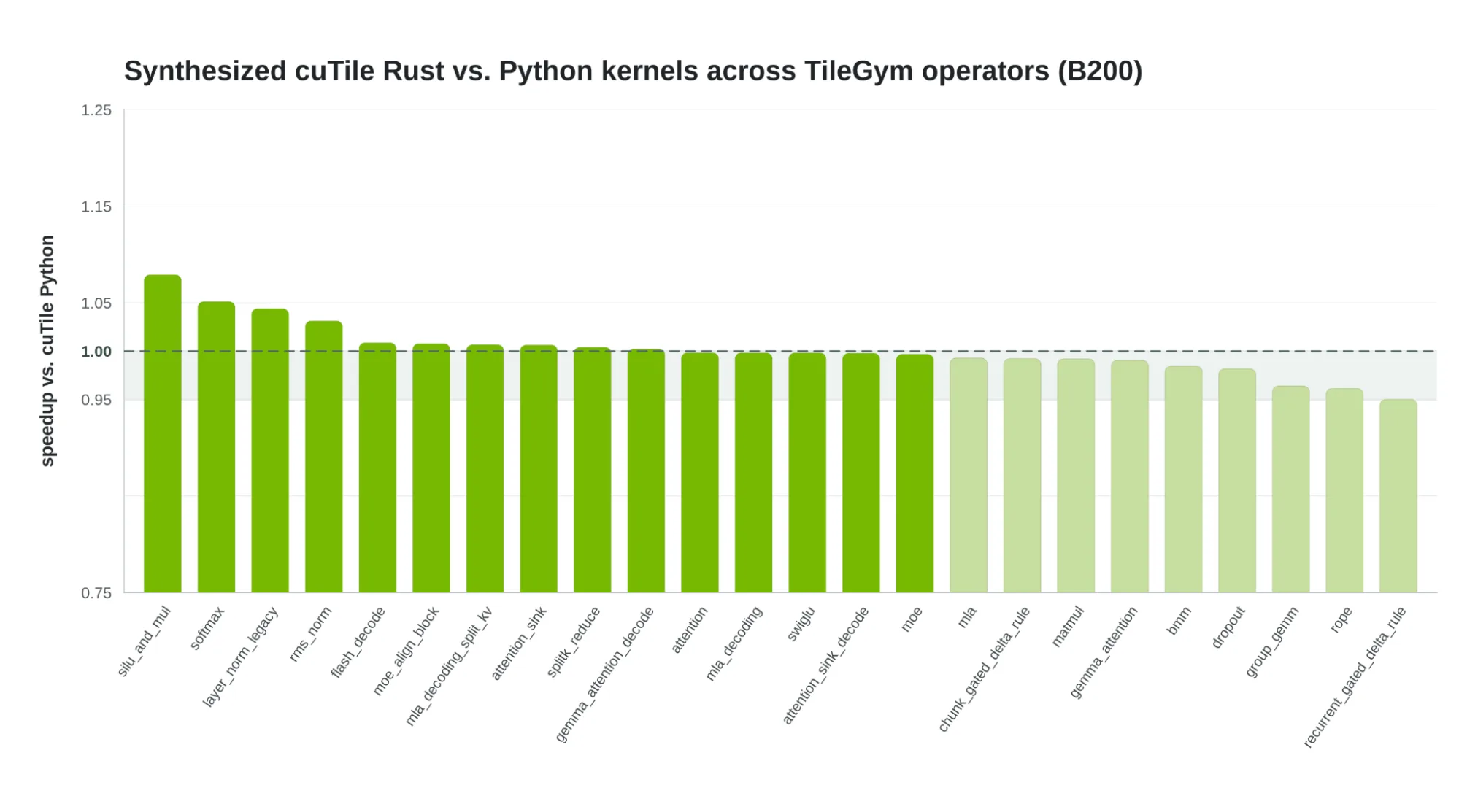
Across 347 paired configurations, the geometric mean speedup hits 0.995, essentially parity with cuTile Python. All 24 operators clear the 0.95 threshold, and about a third actually outperform their Python references. The largest wins come from element-wise and normalization kernels.
The performance researcher’s paper, Fearless Concurrency on the GPU, reports even more impressive results: roughly 7 TB/s on elementwise operations and 2 PFLOPS on GEMM on an NVIDIA B200, about 96% of cuBLAS performance in that specific test.
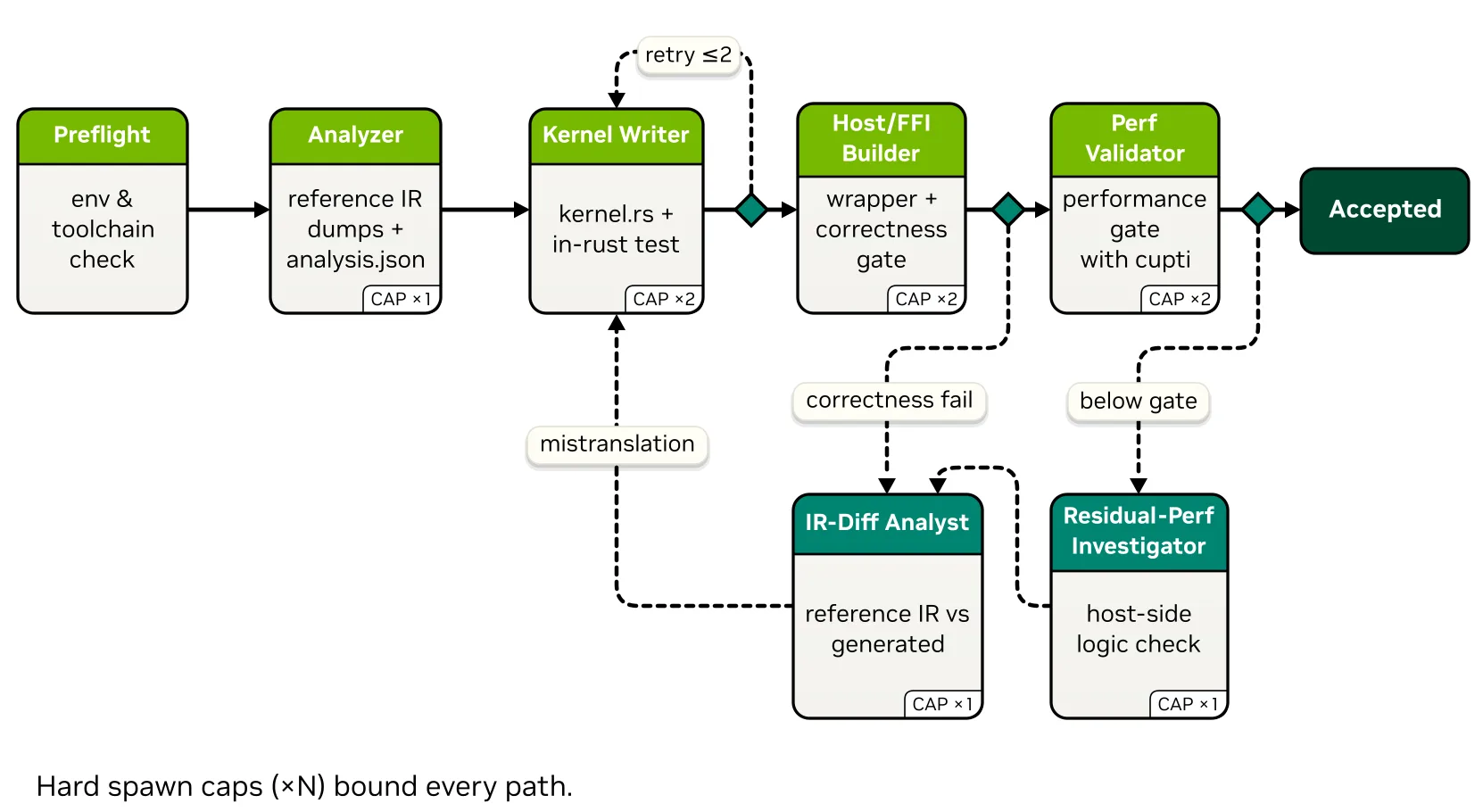
There’s a structural reason for this. All three frontends (Python, Triton-TileIR, and Rust) compile to the same CUDA Tile IR. The conversion isn’t re-optimization, it’s re-expression. The shared tileiras compiler handles optimization, so a faithful Rust translation inherits the reference’s performance by construction. The AI translator even uses IR diffing against the reference to verify structural equivalence before functional testing.
That’s also why NVIDIA’s agentic AI translation pipeline is notable. Converting kernels from Python to Rust isn’t just about syntax, cuTile Python JIT-compiles and specializes kernels implicitly at call time, while Rust requires explicit specialization in the kernel signature. The multi-agent pipeline handles this by making every translation stage machine-checkable. Each stage ends with a validator script, and the orchestrator routes purely on verdicts, never on prose. It’s a fascinating approach to a problem that would otherwise require thousands of developer-hours.
What This Means for Systems Architecture
The deeper implication here extends beyond programming convenience. We’re seeing the consolidation of the GPU computing stack into a single language with strong safety guarantees.
Consider the implications for multi-GPU system architectures. Distributed inference frameworks, local AI clusters, and real-time processing pipelines have all dealt with a fundamental asymmetry: the systems code is memory-safe, but the performance-critical kernel code isn’t. That forced architectural decisions, whether to isolate kernel code, how much to invest in test coverage for GPU code, how to handle the FFI boundary.
CUDA Rust eliminates that asymmetry. The entire stack, from driver to inference engine to GPU kernel, can be written in one language with one ownership model. NVIDIA’s Rust adoption, Nova driver, Dynamo, NVTX bindings, was already pushing this direction. CUDA Rust completes the picture.
The emerging high-bandwidth local AI hardware landscape makes this even more relevant. As alternative GPU architectures and accelerated systems challenge CUDA’s dominance, the ability to write safe, portable kernels matters more than raw C++ performance. NVIDIA’s inter-language interop plans, supporting CUDA Rust, CUDA C++, and CUDA Python side by side, suggest they understand this.
The Caveats You Should Know
Let’s be honest about the current state. NVIDIA calls cuda-oxide “early alpha” and cutile-rs “more advanced, but experimental.” Neither is production-ready. Coverage is incomplete, and APIs will move.
The debugging story is another gap. A recent survey from the Rust compiler team found only 46% of developers use a debugger for Rust work, with 81% saying logs and print statements are easier or faster. Poor value representation is the culprit, 74% report debuggers show values badly. GPU kernel debugging is traditionally harder than host debugging, so this gap will matter.
The crate naming controversy is minor but illustrative: NVIDIA named their project cuda-oxide, but a crate with that name already exists on crates.io (admittedly unmaintained). A forum commenter raised exactly this concern, noting it “seems like it will lead to needless confusion.” Fair point.
What You Can Do Today
If you want to experiment, the paths are relatively straightforward:
For the SIMT track:
cargo +nightly-2026-04-03 install --git https://github.com/NVlabs/cuda-oxide.git cargo-oxide
cargo oxide new vecadd_demo
cd vecadd_demo
cargo oxide doctor
cargo oxide run
For the Tile track:
cargo new vecadd_demo
cd vecadd_demo
cargo add cutile
Write the kernel from the examples above, run it, and see the magic happen.
The cuda-oxide book and cuTile Rust documentation are worth reading for deeper dives. The RustConf 2026 talk by Melih Elibol on “Fearless Concurrency on the GPU” should be on your watchlist, and the GitHub Discussions and Discord are active.
The Bottom Line
CUDA Rust is a bet, a long-term investment in making Rust the language of GPU computing. NVIDIA explicitly says they’re maturing it into 2027 and beyond.
The performance parity numbers are early but genuinely encouraging. The safety guarantees are real: the compiler catches aliasing bugs that C++ would only discover in production. The architecture implications are substantial: one language across the entire stack, with ownership-based safety extending to the hardware.
CUDA C++ will remain the reference for squeezing maximum performance for years. But the direction is clear. GPU programming is getting safer, and the systems that depend on it, inference engines, distributed platforms, real-time processing, will benefit from that shift.
Rust’s ownership model was always a natural fit for GPU programming’s fundamental challenge: thousands of threads accessing shared memory with no guaranteed ordering. It just took a compiler infrastructure mature enough to make it real. That’s what NVIDIA is building.
The question now isn’t whether CUDA Rust will matter. It’s how quickly the ecosystem will catch up.