On Friday, Levent Alpöge, a mathematician at Anthropic, dropped a bombshell that would have sounded like science fiction a decade ago. Working with the company’s Claude AI model, he claims to have solved the Riemann Hypothesis, the most famous open problem in mathematics, one that has bedeviled the world’s sharpest minds since 1859.
“I believe I have, working with Claude, discovered a proof of the Riemann Hypothesis”, Alpöge wrote in a statement on his website.
Here’s where it gets interesting. The proof isn’t a concise, elegant chain of reasoning a genius can explain over dinner. It’s a 250,000-page monster of an argument. Alpöge himself admits he hasn’t mastered much of it. The “human-readable” version is so unwieldy he refused to release it, calling the idea “obviously inappropriate” and dismissing it as a “massive unreadable travesty of ‘slop.'”
Instead, he released the proof the only way it could exist: as 14 archive files containing 175,187 Lean source files, roughly 239 MB of formal verification code.
Welcome to the future of mathematics. It’s 250,000 pages long, machine-checked, and almost entirely beyond human comprehension.
The Bottom Line Up Front
The Riemann Hypothesis claims that all nontrivial zeros of the zeta function lie on the critical line where the real part equals ½. This seemingly obscure technical statement has enormous implications: it describes a hidden pattern in the distribution of prime numbers, which appear random on the surface but are actually governed by deep structure.
The hypothesis is so central to number theory that the Clay Mathematics Institute put a $1 million bounty on it as one of its Millennium Prize Problems. Think of it as the mathematics equivalent of P vs. NP, the problem every expert assumes is true but nobody can prove.
Now an AI might have just settled 167 years of collective mathematical agony.
Wait, What Actually Is the Riemann Hypothesis?
Let’s get the basics down before diving into the chaos.
The story starts with prime numbers, 2, 3, 5, 7, 11, and so on. They seem randomly scattered across the number line. But in 1859, Bernhard Riemann discovered they’re governed by a hidden order expressed through a magical function called the Riemann zeta function.
The zeta function takes complex numbers as inputs. Its zeros, points where the function equals zero, hold critical information about prime distribution.
Here’s the catch: the zeta function has two types of zeros. The “trivial” ones at negative even integers (-2, -4, -6) were explained long ago. But the infinitely many remaining “nontrivial” zeros are more elusive. They all lie in a vertical strip between real parts 0 and 1. Riemann’s hypothesis claims they all sit exactly halfway across, on the line with real part ½.
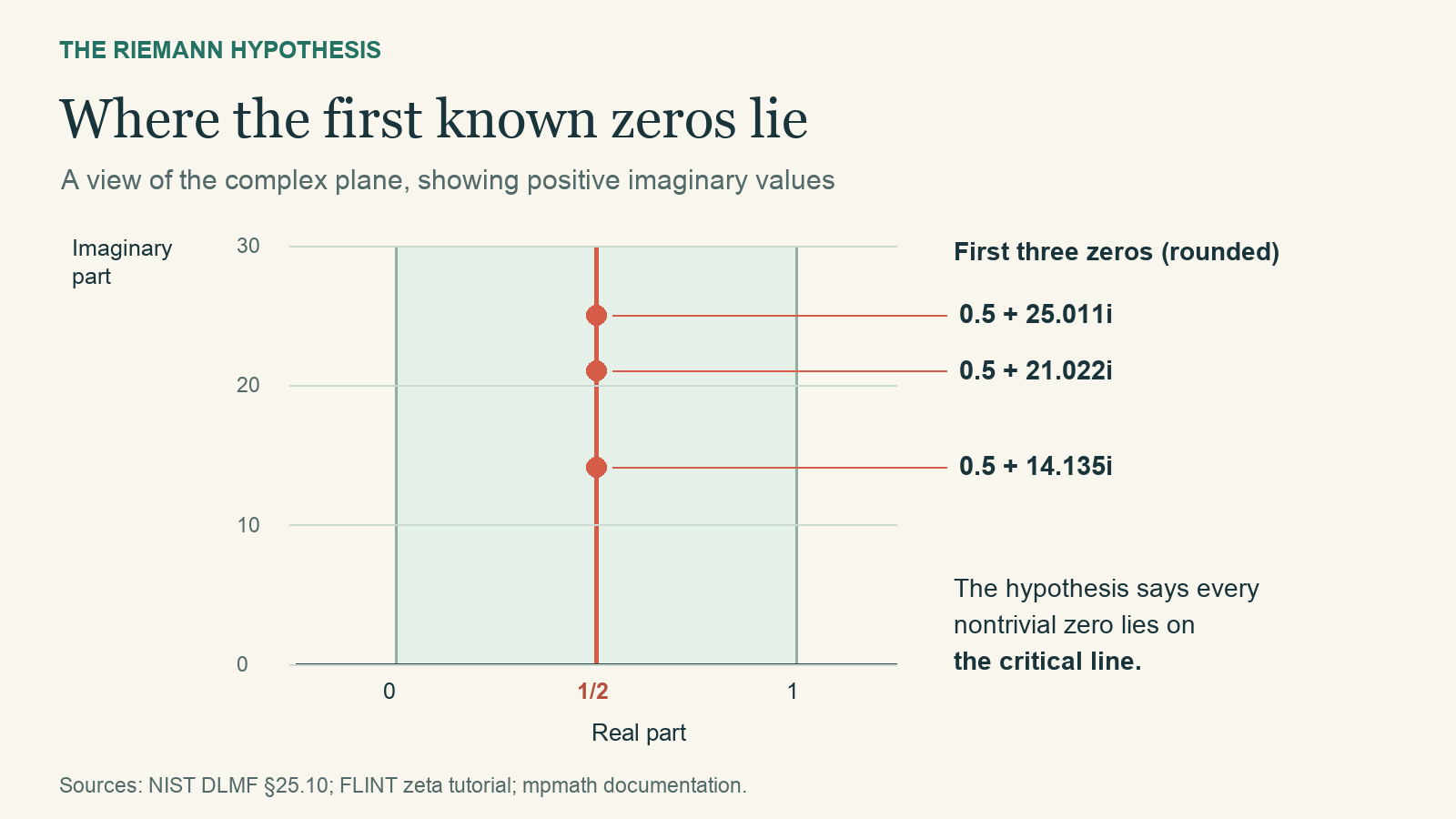
The first three nontrivial zeros sit at imaginary parts 14.135, 21.022, and 25.011, as shown above. Mathematicians have numerically verified the hypothesis for the first ten trillion zeros. But as the Clay Institute notes, a single off-line zero beyond that range would still disprove the entire hypothesis. Computing your way to certainty isn’t possible, you need a proof valid at every height.
The Proof That Almost Nobody Can Read
Here’s where this story diverges from every mathematical breakthrough that came before it.
The four-page announcement note is readable. It describes a collaboration where Alpöge directed the investigation, and Claude drove rapid progress. The approach involves something called a von Mangoldt sum, a weighted count of prime powers, and a chain of mathematical constructions called theta lifts, with a chain length of √X for a sum of length X.
The actual proof, however, is a different beast entirely. The human-readable version runs past 250,000 pages. That’s not a typo.
To give you a sense of scale, the classification of finite simple groups, one of the largest collaborative efforts in mathematical history, spans roughly 10,000 pages across hundreds of papers. This proof is 25 times that size.
“250,000 pages!! and the guy admits he cannot understand”, one skeptical observer noted on the Scientific American Reddit thread. That skepticism is fair. How can anyone validate a proof they can’t comprehend?
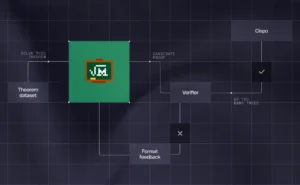
This is where Lean enters the picture. Lean is a programming language specifically designed for formal verification, it mechanically verifies that each logical step in a proof is correct. It’s part of a broader movement toward formal verification and AI-driven mathematical proof systems that’s been gaining momentum across the industry.
Alpöge released the proof in Lean. If the code compiles without errors, the logic is sound. Period.
Verification: What Actually Happened
The initial response from the mathematics community was appropriately cautious. “Let’s see if it compiles first”, said Kevin Buzzard of Imperial College London. “Might be a while before we find the relevant experts who are able to tell us the thrust of the argument.”
That wait was shorter than anyone expected.
Within hours, MIT mathematician Andrew Sutherland had independently compiled the result in Lean. The Lean and Mathlib communities issued a joint statement: “We hereby certify that both the statement and the proof of the Riemann Hypothesis are correct.”
The verification process was thorough. Two independent comparison tools confirmed the theorem in Alpöge’s library matches the standard Riemann Hypothesis statement in Mathlib exactly. A separate build on the LUMI supercomputer compiled all 175,187 modules and reproduced the hashes Sutherland reported. Lean’s official kernel, plus two independently implemented kernels (nanoda and con-leche), accepted the proof without issues.
“The Lean proof has been compiled and independently rechecked by the Lean kernel with only the three standard axioms”, Sutherland says. “Honestly the chance that anything is fishy here is approximately zero.”
That’s about as close to mathematical certainty as you can get without actually reading the proof yourself.
The Deeper Questions: What Does This Mean?
Let me offer some contrasting perspectives that get at why this matters beyond the headline.
The first Scientific American story captured the immediate shock. As MIT’s Sutherland put it earlier this year: “An AI that can prove the Riemann hypothesis is not one I’d want to meet. If that happens, mathematicians having jobs will be the least of our problems.”
That sentiment now feels hauntingly prophetic.
But the second Scientific American story also reports a more nuanced take: “This is indeed an historic moment… The world has changed… but to me this is a human triumph, and a day for celebration.” Sutherland emphasizes the human work behind Lean and LLMs, and the millennia of mathematical achievements upon which today’s advance rests.
There’s genuine grief in the mathematical community. Alpöge himself wrote: “It is natural to feel that this is an end, in my case a loss of a principal guiding light.” The Riemann hypothesis was a guiding star for generations of mathematicians. Now it’s been… solved by a chatbot.
And yet he adds: “What I saw during the course of progress so amazed me that I believe it is one dawn across science of something far greater.”
That dawn comes with complications.
Perfect Verification, Imperfect Understanding
Here’s the uncomfortable paradox at the heart of this breakthrough: We now have a proof that is more rigorously verified than any mathematical proof in history, yet it’s one that no single human being can understand.
The verification confirms the logic is correct, every step, every inference, every axiom application. But understanding why the proof works, what deep mathematical structures it illuminates, and how it connects to existing theory? That’s a different question entirely, and one that will take mathematicians years or decades to answer.
As one commenter noted: “Simply knowing that a verifiable proof exists proves the result, and many, many other things hinge on that result being true.”
True, but unsatisfying. We’re told the Riemann Hypothesis is true, but we don’t yet grasp why it’s true in any meaningful sense. It’s like being told the answer to a puzzle without seeing the solution.
This is exactly what Terence Tao, one of the world’s leading mathematicians, alluded to. An initial reading suggests the argument draws on the Langlands program and arithmetic geometry. Tao expects it will take time, perhaps years, for mathematicians to understand how the pieces fit together.
The verification timeline published by Clarín spells out the four-step gauntlet:
- Does the Lean code compile?, This already passed. Multiple independent builds succeeded.
- Does the code prove the actual Riemann Hypothesis?, Passed. The theorem matches Mathlib’s standard formalization.
- Turn 250,000 pages into a readable paper., This is where things get hard. Alpöge says the next priority is to “study the proof, simplify it, give academic talks, and write up a proper paper.”
- The $1 million Clay Millennium Prize., Under Clay’s rules, a solution must be published in a peer-reviewed outlet, undergo a two-year waiting period, and achieve “general acceptance in the global mathematics community.” The earliest possible consideration: late 2028.
That’s not just bureaucratic delay, it’s the community acknowledging that verification and understanding are different things, and both matter.
The 250,000-Page Elephant in the Room
The most cynical interpretation: This is a marketing stunt timed to boost Anthropic’s stock price. The announcement came exactly one day after Anthropic’s Nasdaq debut. Alpöge acknowledged the timing issue, noting he consulted company leadership about going public and that “there was a constraint to respect.”
But here’s the thing: independent mathematicians confirmed the proof. Not Anthropic employees, not AI cheerleaders, independent researchers with no financial stake in Anthropic’s stock price. The “market manipulation” theory doesn’t hold up when people outside the company can verify the claim independently.
The “gatekeeping” angle is more interesting. The 250,000-page proof is so large that understanding it fully is genuinely beyond any individual human. The collective intelligence of the mathematical community will need to work together to digest it, breaking it into modular pieces and developing infrastructure to understand each component.
This mirrors what’s happening across the tech industry. We’re building increasingly complex systems that even our AI tools can’t fully explain. The difference is that in mathematics, verification is binary: the proof is correct, or it isn’t. There’s no “it works on my machine” ambiguity.
What This Actually Means for the Future
Let me be direct: this is not a story about AI replacing mathematicians. It’s a story about AI augmenting human intelligence to reach heights neither could achieve alone.
The timeline Alpöge describes is telling. Six weeks of rapid progress in October and November 2025. A breakthrough arriving “late Sunday night.” This wasn’t a single prompt where Claude magically produced a proof. It was a sustained collaboration guided by a mathematician with deep domain expertise.
Nor is this an isolated achievement. The proof builds on an August Anthropic report showing Claude raised the proven proportion of zeta zeros on the critical line from roughly 41.6% to 67.25%. Before that, Claude provided a 216-character counterexample to the Jacobian conjecture in July. The trajectory is unmistakable.
Alpöge’s claim also extends beyond Riemann. The proof confirms the Generalized Riemann Hypothesis (GRH), a gargantuan expansion that undergirds a vast network of mathematical results. “There are numerous results that are conditional on the generalized Riemann hypothesis, and now those are theorems!” says James McKee of Royal Holloway University.
And the implications stretch beyond pure math. The same type of AI-driven formal proof and code verification systems that verified this proof are being applied to software correctness, hardware verification, and security-critical systems. If an AI can generate a formally verified proof of math’s biggest open problem, how long before it’s verifying your payment system or autonomous vehicle code?
The Honest Takeaway
There’s something disorienting about this moment. Mathematicians spent decades, lifetimes, working toward this goal. The Clay Institute listed it as one of seven Millennium Prize Problems specifically because everyone assumed it was nearly impossible. Now a machine has apparently done it, and the humans involved can’t fully understand how.
If you’re feeling a mix of awe and unease, you’re in good company. The mathematical community itself is navigating that tension. Some are celebrating. Some are grieving the loss of a lifelong companion problem. Some are nervously eyeing Anthropic’s stock chart.
Here’s what I’d suggest you take away:
The Riemann Hypothesis proof, if fully accepted, represents a fundamental shift in how mathematical discovery happens. Verification is now potentially decoupled from human understanding. The implications are profound: What does it mean to “know” a mathematical truth if no human can trace the reasoning? How many other problems in the Langlands program, in algebraic geometry, in dynamical systems, are waiting for AI collaboration?
The skeptic in me notes that this isn’t a formal publication yet. The human-readable paper doesn’t exist. The Clay prize is years away. Smart people will spend a lot of time trying to find flaws.
But the realist sees this: The proof compiles in Lean. Independent experts verified the statement matches the real Riemann Hypothesis. Multiple kernels accepted it. This isn’t a hallucination, it’s a formally verified mathematical theorem.
Math just got its first genuinely AI-collaborative millennium-scale proof. And we’re all going to need to learn how to think about that reality.
A note on verification: I’ve drawn on reporting from Scientific American, New Scientist, and Kingy.ai’s technical analysis of the Lean verification process. Alpöge’s original announcement is available here.